Gideon Ståhlberg
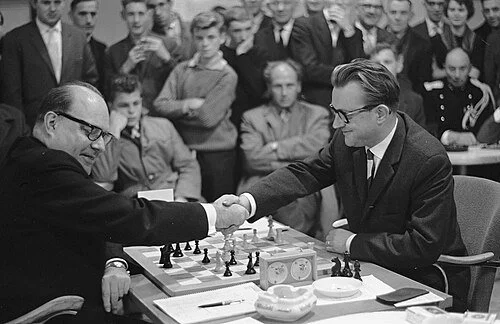
Wim van Rossem for Anefo
Introduction
Gideon Ståhlberg belongs among the most consequential non-Soviet grandmasters of the middle decades of the twentieth century. Born in Sweden in 1908, he rose from local club chess to the world elite, received one of the original FIDE grandmaster titles in 1950, qualified twice for the Candidates, and later served as arbiter in world championship matches at the height of the Soviet era. He was not a Soviet player, but his career repeatedly intersected with Soviet-centered institutions and competition, which is one reason he remains historically significant. Modern specialist scholarship on Swedish chess history goes so far as to treat him as an epoch in himself, and recent reviewers have again emphasized that he stood near the top of world chess from the mid-1930s into the mid-1950s.
For a site concerned with Soviet chess history, Ståhlberg deserves attention because he occupied a distinctive position on the edge of that story. He was a Scandinavian master who became a trusted figure in Moscow, a wartime star of South American chess, and a respected Western presence in the postwar championship system that FIDE built around Soviet dominance. That combination gave him a career unusually rich in crossings between national chess cultures.
Early Life and Chess Formation
Publicly accessible documentation on Ståhlberg's family and youth is thinner than the record of his tournaments, so recent biographical reconstruction has special value here. Peter Holmgren's research, drawing on family material and local archival work, places Ståhlberg's birth in Surte, outside Gothenburg, on 26 January 1908. Holmgren describes him as growing up in a religious household where games were not central to family life, and reports that after his father's death he learned chess from his older brother White. By 1923 he had joined the local club in Surte, and while still in school he moved into stronger Gothenburg circles, especially Majornas Schacksällskap, where his progress accelerated. The same research also shows how much of his early life remains embedded in local Swedish material rather than in the usual international chess references.
Ståhlberg was not presented by contemporaries as a child prodigy. His rise looks instead like a case of unusually rapid self-education inside a serious club culture. A Swedish retrospective by Sixten Johansson, drawing heavily on Ståhlberg's own reminiscences, shows him studying Géza Maróczy's games intensely, advancing quickly through the Swedish congress system, and sharing first in the national masters group in 1927 at only nineteen. Johansson also preserves a remark attributed to Richard Réti after a late-1920s Stockholm event: of the leading young Swedes, Ståhlberg was the one Réti thought would eventually "play best." Whatever the exact phrasing, the broader point is credible. By the end of the 1920s Ståhlberg had already moved from local promise to national leadership.
His formation also included a collective, theoretical side. Edward Winter has preserved evidence that Ståhlberg trained in a small Swedish circle with Gösta Stoltz, Stig Lundholm, and Fritz Kaijser, using thematic tournaments to deepen opening understanding. That detail helps explain why Ståhlberg, who later looked like a natural positional classicist, also became an informed opening worker and a serious chess journalist. In 1932 he took over the editorship of Tidskrift för Schack, the Swedish federation's journal, which indicates how early his authority had extended beyond tournament performance.
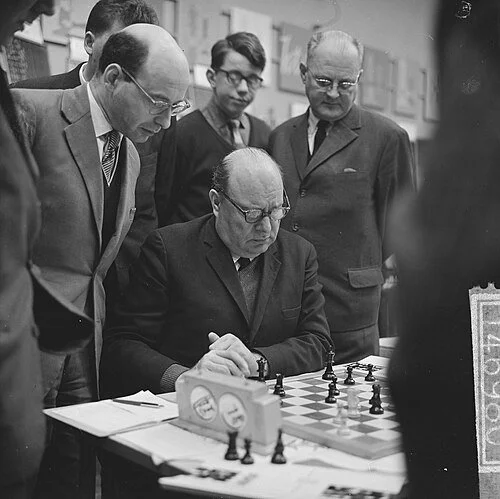
Eric Koch for Anefo
Rise in Competitive Chess
The decisive domestic breakthrough came in 1929. After earlier success in the Swedish congress system, Ståhlberg defeated Allan Nilsson in a title match and thereby became Swedish champion. In the same period he emerged as Nordic champion, establishing himself as the strongest Swedish player of his generation. He made his Olympiad debut in 1928 and, from 1930 onward, became Sweden's regular first-board leader for decades. OlimpBase records thirteen Olympiad appearances between 1928 and 1964, one of the broadest spans of any leading European master of his time.
What turned national authority into international reputation were his matches and Olympiads in the early 1930s. Sweden, led by Ståhlberg together with Gösta Stoltz and Erik Lundin, won team bronze at Folkestone in 1933 and team silver at Warsaw in 1935, results that helped make interwar Sweden a genuine chess power. In individual terms, Ståhlberg's victory over Rudolf Spielmann in Stockholm in January 1933 and his win over Aron Nimzowitsch in Gothenburg in 1934 announced that he could defeat established masters in match conditions, which was still one of the clearest tests of class in that era. By 1938 he had also drawn a match with Paul Keres, then one of the strongest players in the world.
Tournament results confirmed the point. Contemporary and reference sources agree that he was among the top finishers in strong European events such as Zurich 1934 and Dresden 1936, and by the later 1930s he had moved firmly into the circle of players invited to major international competitions. Holmgren's recent biographical work and Kingpin's review of it both place him by then within roughly the world's top dozen. That judgment is an interpretation rather than a formal ranking, but it fits the documentary record of his invitations, match results, and Olympiad leadership.
Major Career Achievements
The central turning point in Ståhlberg's life was the 1939 Buenos Aires Olympiad. Like several European masters caught abroad by the outbreak of the Second World War, he remained in Argentina instead of returning immediately to Europe. FIDE's Open Chess Museum specifically notes that Ståhlberg was among the players who stayed in South America after the Olympiad, alongside figures such as Najdorf and Eliskases. That decision reshaped his career. It placed him in one of the liveliest chess environments of the war years and made him, together with Miguel Najdorf, one of the dominant presences in South American tournament play.
The wartime and immediate postwar South American phase was one of the richest stretches of his career. Reference records confirm first place at Mar del Plata 1941 ahead of Najdorf and Eliskases, a share of first at Buenos Aires 1941, and clear first at Buenos Aires/La Plata 1947 ahead of Najdorf, Eliskases, and Max Euwe. These were not provincial successes. They were strong international events contested by players who, after the war, formed much of the non-Soviet world class. Ståhlberg's years in Argentina therefore enhanced both his practical strength and his standing as an international rather than purely Scandinavian master.
When he returned to Europe, he adapted impressively to the newly formalized FIDE championship cycle. The 1948 Saltsjöbaden Interzonal, the first interzonal in chess history, qualified him into the 1950 Candidates field. FIDE's own retrospective on Budapest 1950 records that when seeded participants withdrew, Ståhlberg was one of the players brought in from the next places at the Interzonal. He finished in the lower half of the 1950 Candidates, yet merely reaching the event already marked him as one of the serious contenders of the day. He then qualified again through the 1952 Saltsjöbaden Interzonal, where he tied for the last qualifying places, and went on to play in the famous Zurich Candidates tournament of 1953, though by then his results had clearly fallen away. In between, he still produced first-rate tournament work, including a share of third through fifth at the powerful Budapest 1952 Maróczy Memorial.
In short, Ståhlberg's greatest competitive accomplishment was not a single title but a sustained place inside the international championship structure before and after the war. He was strong enough to survive the transition from the looser tournament world of Alekhine and Capablanca to the FIDE cycle that Soviet players would increasingly dominate. That continuity is one of the clearest reasons historians still take him seriously.
Style and Reputation
Ståhlberg's playing style evolved noticeably over time. Swedish sources based on his own recollections report that in youth he was more adventurous and at times even romantic, playing openings such as the King's Gambit before stronger international opposition taught him the limits of that approach. He later reshaped his repertoire around more reliable structures, especially the Queen's Gambit as White and the French Defence as Black. That shift was not mere conservatism. It was part of a broader maturation into a player who preferred classical piece placement, patient pressure, and durable positional advantages.
Harry Golombek's well-known judgment, preserved by Edward Winter, was that no living player had more elegance of style than Ståhlberg when at his best. Modern reviewers who have gone back through his career still stress similar qualities: patience, endgame strength, dynamic defense, and a restrained but highly cultivated positional sense. Kingpin's recent review of Holmgren's biography also notes his long loyalty to the Queen's Gambit and French Defence and describes him as a classical positional player who nevertheless contributed original opening ideas. Those descriptions should not be turned into mythology, but they do point to a consensus. Ståhlberg was admired less for explosive novelty than for balance, technique, and the ability to make a position look natural even when it was difficult.
His weaknesses were those often found in players whose foundation was cultured rather than ferocious. He was highly intelligent, multilingual, socially adept, and widely read, and contemporaries clearly found him charming company. Yet the competitive record also shows that he did not convert elite status into a challenge for the world title itself. By his own later admission, 1952 was his last truly great chess year. That self-assessment, preserved in Swedish recollection, seems realistic. In Zurich 1953, against a Candidates field increasingly shaped by Soviet depth and postwar professionalism, his best years were already behind him.
Contributions Beyond Tournament Play
Ståhlberg was more than a tournament master. He became editor of Tidskrift för Schack in 1932, and later bibliographic records show him as co-editor with Erik Lundin in the late 1930s. He wrote newspaper columns over many years, annotated games, lectured, and produced books in several languages. Modern accounts of his bibliography consistently include Schack och schackmästare and its English version Chess and Chessmasters, works on the Queen's Gambit, books on Capablanca, collections on Swedish champions, and memoir-like writings such as I kamp med världseliten and Strövtåg i schackvärlden. The very range of those titles suggests a figure who helped explain high-level chess to broader publics in Sweden and Latin America.
A lesser-known episode also shows his public value as a promoter. Edward Winter records that in Buenos Aires in 1941 Ståhlberg played 400 simultaneous games over just more than 36 hours, scoring 364 wins, 14 draws, and 22 losses. Even allowing for the exhibition context, that was an extraordinary feat of endurance and publicity. It belongs among the overlooked facts that help explain why he remained so popular in Latin America after returning to Europe.
His later service as an arbiter strengthened his historical place further. Douglas Griffin's work on the 1958 Smyslov-Botvinnik match identifies Ståhlberg as arbiter, and other championship records connect him with the world title contests of the period from 1957 through 1963. This role is easy to underestimate. FIDE needed officials who were competent, internationally respected, and acceptable within a tense championship culture increasingly centered in the Soviet Union. Ståhlberg fit that profile remarkably well.
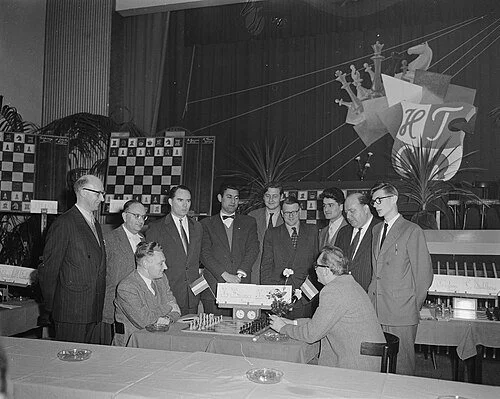
Joop van Bilsen
Historical Legacy
Ståhlberg died in Leningrad on 26 May 1967, before he could begin play in the international event for which he had traveled there. The bare fact of that ending has symbolic force. His last journey was to a Soviet tournament city, after a career deeply entangled with the international system that the Soviet Union had come to dominate. Recent Swedish scholarship and federation writing present him as one of the central architects of Sweden's strongest chess era, the age of Ståhlberg, Stoltz, and Lundin, with Ståhlberg the longest-lasting and most internationally consequential of the three.
His legacy is therefore severalfold. He was Sweden's leading male player between the interwar years and the rise of Ulf Andersson. He helped give Scandinavian chess an enduring international profile. He served as a cultural intermediary between Europe and South America during the war, and between Western and Soviet chess institutions after the war. He also left a written record that preserved, in Swedish and Spanish as well as English translation, a distinctly cultivated view of master chess. The recent revival of scholarly interest in his life, especially through Peter Holmgren's work and the reception it has received in Swedish chess circles, suggests that his reputation is presently being recalibrated upward.
Why does Gideon Ståhlberg deserve attention today? Because he embodied a form of chess greatness that modern historical memory often overlooks: not the world champion, not the system-builder on the scale of Botvinnik, and not the mythic solitary genius, but the durable international master of institutions, books, travel, and elite play. He was strong enough to be a real contender, articulate enough to interpret chess for others, and trusted enough to officiate its highest matches. Taken together, those roles make him one of the most revealing European grandmasters of his era.
Notes and Sources
This profile relies first on institutional and near-contemporary records: FIDE's historical articles on the 1950 Candidates and the Open Chess Museum's documentation of the 1935 Olympiad and Buenos Aires 1939; OlimpBase for Olympiad participation and world championship cycle results; and the Swedish Chess Federation's archive page on Tidskrift för Schack for Ståhlberg's editorial role. These sources are especially useful for titles, dates, qualification routes, and official functions.
For interpretation, the most important modern specialist source is Peter Holmgren's biographical project, represented here by the 2024 first volume, its introductory pages, and Holmgren's shorter essays. Edward Winter's Chess Notes remains indispensable for precise quotations and small but revealing factual points, including Ståhlberg's training milieu, Golombek's assessment of his style, and the 1941 simultaneous display. Tournament databases such as 365Chess and similar reference pages were used only to confirm standings and event details where more formal sources were sparse. One practical note for future researchers: non-Swedish sources often drop the diacritic and list him as "Gideon Stahlberg," so both spellings are worth checking in catalogues and databases.
