Lubomir Kavalek
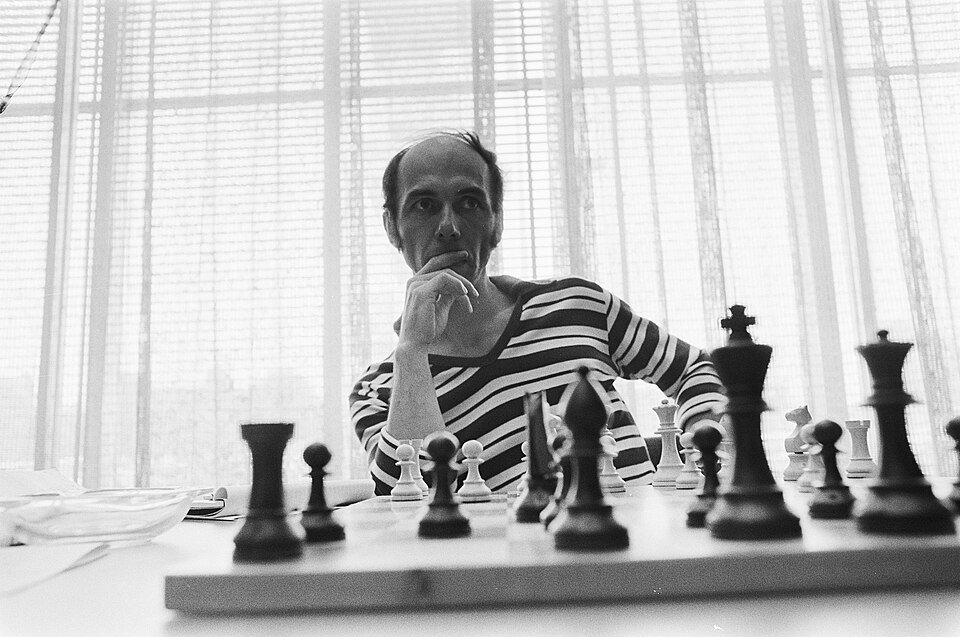
IBM-schaaktoernooi, 1977. Hans Peters for Anefo
Introduction
Lubomír Kaválek, usually rendered in English as Lubomir Kavalek and widely known among friends and readers as Luboš or Lubosh, occupies an unusual and important place in twentieth-century chess history. He was not a Soviet player. He was a Czech and later American grandmaster whose career was shaped by life in Soviet-dominated Czechoslovakia, by repeated competition against Soviet masters, by exile after the Warsaw Pact invasion of 1968, and by later service in some of the most symbolically charged East-West episodes in chess, most famously as a member of Bobby Fischer’s team in Reykjavík in 1972. That combination makes him essential to any serious account of chess culture on both sides of the Cold War divide.
The documented facts of his record are substantial enough without embellishment. Kavalek won the Czechoslovak championship twice, in 1962 and 1968, received both the IM and GM titles in 1965, rose to number ten in the world on the official May 1974 FIDE rating list at 2625, played in nine Olympiads for Czechoslovakia and the United States, helped the United States win Olympiad gold in 1976, and later entered the U.S. Chess Hall of Fame. He also became one of the most visible public intellectuals of chess in the English-speaking world through decades of editorial, journalistic, and organizational work.
Early Life and Chess Formation
Kavalek was born in Prague on 9 August 1943, in wartime Czechoslovakia. His family background combined modest social origins with the political fractures of the postwar years. Kavalek later described his father as the son of “a seamstress and a housepainter” and as a man who hated Communism. According to The Washington Post, his mother was a nurse, while his father, a radio journalist, left Czechoslovakia after the Communist takeover of 1948 and spent his career with Radio Free Europe in West Germany. Irena Kavalek later said that this made Lubomir “an enemy of the state” by association, which helps explain why politics hovered over his chess career long before his emigration.
A lesser-known but revealing part of his formation came outside Prague proper. The Czech regional memorial published after his death notes that as a boy he regularly visited his grandmother in Hronov, played for the local club in the seasons from 1956 to 1958, and remembered his training there with Dr. Rudolf Kudrnáč as decisive. His memoir sample adds another layer: the Vinohrady school team in Prague, around Michael Janata and Jaromír Kubíček, fostered a taste for gambits, unusual openings, and creative surprise weapons. That background helps explain why Kavalek’s early public image was so often tied to brilliancy prizes and tactical imagination.
His studies and early work also placed him at the intersection of chess and letters. The publisher’s biographical note for his posthumous memoir states that he studied at the transport college in Žilina and at the Faculty of Journalism of Charles University in Prague, and worked in the sports sections of Práce and Mladá fronta. Kavalek’s own memoir recalls that the liberalization of the Prague Spring finally allowed him to study journalism openly. After gaining the GM title, he wrote chess and cultural columns and became editor of the late sports editions of two Prague newspapers. This literary and journalistic training would later become central to his second career.
Breakthrough in Czechoslovakia and the Shock of 1968
Kavalek’s rise inside Czechoslovak chess was precocious. The official historical list of the national championship records him as winner in 1962 at Jablonec nad Nisou, and the Czech federation’s obituary stresses that he was only nineteen. Contemporary and later biographical notices repeatedly present that result as the breakthrough of a major new talent. By 1965 he had won at Varna and received both the IM and GM titles in the same year, a rare acceleration that signaled how rapidly he had moved from national promise to international class.
Two student-team games became especially important to his reputation. At the 1962 Student Olympiad in Mariánské Lázně, his win over Soviet master Eduard Gufeld received the brilliancy prize, and later writers continued to cite it as one of the most memorable games ever played in that event. At the 1965 Student Olympiad in Sinaia, he won another best game prize, this time against Soviet player German Khodos. Kavalek’s stature as a creative rival to Soviet opposition was therefore established early, not only by results but by the kind of games that other players remembered.
His progress through the world championship cycle was real, even if it never culminated in a Candidates berth. In his own retrospective essay, Kavalek recalled finishing third at the 1966 Hague Zonal and thus qualifying for the 1967 Interzonal at Sousse, where he was one of only three players to draw with Fischer before Fischer’s withdrawal. Kavalek also believed that the game had a lasting theoretical afterlife in the Poisoned Pawn Najdorf. One need not endorse the full theoretical claim to see the historical point: by the late 1960s, he already belonged to the circle of non-Soviet grandmasters who could test themselves against the very strongest players in the world.
The decisive rupture came in 1968. Kavalek first won the IBM tournament in Amsterdam, defeating a field that included David Bronstein and Alexander Kotov, and then returned toward Central Europe just as the crisis of the Prague Spring was reaching its endgame. During the Akiba Rubinstein Memorial in Polanica-Zdrój he learned of the invasion, listened to events on the radio, and played under conditions of political shock. His memoir shows that the fear of returning was not abstract. Even before 1968, a federation official had told him that if his émigré father kept meeting him abroad, his travel privileges could be revoked. After the invasion, Kavalek decided against going back for good and used an Austrian visa, quick improvisation, and the now famous carload of Polish vodka to make his escape westward. The anecdote has often been retold extravagantly, but the memoir confirms its essentials while placing them in a setting of confusion, urgency, and intuition rather than romance.

IBM-schaaktoernooi 1981. Bogaerts, Rob / Anefo
American Peak and International Standing
After a period in the West, Kavalek reached the United States in 1970. On the way, he won the strong tournament at Caracas ahead of Leonid Stein, Oscar Panno, Pal Benko, Borislav Ivkov, and a young Anatoly Karpov, a result that symbolically announced his arrival as an émigré grandmaster who had lost none of his competitive force. He settled in Washington, studied Slavic literature at George Washington University, and worked for Voice of America before turning to chess full time. The American phase of his career was therefore not a simple reinvention but a rapid continuation of an already elite trajectory.
The peak came in the first half of the 1970s. Kavalek’s own biographical summary lists major tournament victories or shared victories at Caracas in 1970, Netanya in 1971, Lanzarote and Netanya in 1973, and then a series of strong results that pushed him into the world top ten. The official May 1974 FIDE list placed him tenth in the world at 2625. The Czech federation obituary, the FIDE obituary, and specialist retrospectives all converge on the judgment that, in the 1970s, he belonged to the top tier, just below the world-title contenders who regularly made the Candidates. That is the right historical level at which to place him.
His American championship record requires a small but important clarification. U.S. Chess’s official champions list credits Robert Byrne with the 1972 title after the playoff. Yet other contemporary and later sources, including the Kavalek obituary published by US Chess, count Kavalek as a three-time U.S. champion because he tied for first in the main 1972 event, then shared first in 1973 with John Grefe, and won outright in 1978. For a careful historical profile, the safest formulation is that Kavalek tied for first in 1972, shared the title in 1973, and won outright in 1978.
Kavalek also became a pillar of U.S. team chess. His own 2005 summary states that he played mostly on top board for the United States in Olympiads from 1972 through 1986 and won one gold and five bronze medals with the team, after earlier Olympiad appearances for Czechoslovakia in 1964 and 1966. In club chess, the long Solingen association was equally significant. He helped the German side to multiple Bundesliga titles and, in the European Club Cup, scored 5.5 out of 6 in the 1979 edition on top board, including two wins over Vassily Smyslov. Those facts underscore a point sometimes lost in profiles of his journalism and coaching: for roughly two decades, he was a highly reliable presence at the first-board and elite-team levels.
The limit of his competitive record is also clear, and it should be stated plainly. He qualified for Interzonals more than once and remained within striking distance of the Candidates. Yet he never crossed that final barrier. In the Manila Interzonal of 1976, for example, he finished outside the qualifying places. A reasonable historical interpretation is that Kavalek was fully world-class but not quite among the small inner circle who repeatedly converted elite tournament strength into world-title contention. That assessment matches both his rating peak and his results.
Style and Reputation
Kavalek’s reputation began with tactical imagination, and there is abundant documentary support for that. His memoir’s chapter title, “The world of gambits,” is not casual. It reflects the environment from which he emerged. The Vinohrady school circle around Kubíček and Janata prized the King’s Gambit, unusual opening ideas, and surprise systems. Kavalek’s early fame came from games such as the brilliancy prize win over Gufeld and the best-game prizes at student events. Even in later biographical sketches, those games remained the first evidence cited for his style.
Yet it would be too simple to describe him as only a tactician. OlimpBase’s memorial note captured this well when it remarked that his attacking brilliancy against Gufeld became famous, but that he was “far more than a tactician.” That judgment fits the mature Kavalek. He won strong round robins, held high boards for national and club teams, and remained effective across very different tournament settings. His celebrated 1975 game against Lajos Portisch at Wijk aan Zee, rewarded as the most spectacular game of the event, preserved the public image of a player capable of beauty and risk. His sustained top-level results, however, point to a more universal grandmaster who could combine tactical alertness with strategic discipline. That final sentence is an interpretation, but it is an interpretation well grounded in the range of his results.
Among contemporaries and later observers, Kavalek was remembered not only as strong but as notably articulate, elegant, and socially effective. The World Chess Hall of Fame memorial highlighted Karel Opočenský’s old remark that Kavalek was “nailed to the chess board,” and that image is revealing. It suggests both compulsion and vocation. The same memorial, along with Czech, Russian, and American obituaries, repeatedly stressed his ability to move between roles that many grandmasters keep separate: player, writer, organizer, analyst, public spokesman. In that sense, his reputation was not simply that of a talented émigré master. It was that of an unusually complete public grandmaster.
Contributions Beyond Tournament Play
Kavalek’s off-board influence was considerable. His best-known service role came in Fischer’s 1972 world championship campaign against Boris Spassky. Edward Winter’s archival notes preserve Kavalek’s own statement that from the adjournment of game thirteen onward he effectively took over seconding duties after Fischer sent William Lombardy away, and another Winter item records that insiders believed Fischer worked more with Kavalek from that point than with Lombardy. Whatever one makes of the internal politics of Fischer’s camp, Kavalek was unmistakably part of the machinery behind one of the most consequential matches in chess history.
His later coaching work was broader and in some ways more representative of his strengths. In his own biographical summary, he listed analytical or training work with Mark Diesen, Yasser Seirawan, Robert Hübner, Eugenio Torre, and Nigel Short, as well as service as coach and analyst for the Rest of the World team in London in 1984. Chess.com’s obituary adds Robert Byrne to that circle and cites Jan Timman on Kavalek’s work in networking with organizers through the Grandmaster Chess Association. The most historically consequential of these partnerships was with Nigel Short, whose successful path through the Interzonal and Candidates in the early 1990s owed something to Kavalek’s experience, although their collaboration ended acrimoniously during the 1993 match with Kasparov.
Kavalek also helped shape international chess institutionally. The self-authored biographical note states that he organized the prestigious 1979 Montreal tournament, served as executive director of the Grandmaster Association from 1987 to 1993, and organized the 1987-1988 World Cup Grand Prix. His Washington Post account of Prague 1990 states directly that he organized that event under the auspices of President Václav Havel as a tribute to the country’s new democracy. This aspect of his career is easy to overlook because it produced structures rather than titles, but it shows Kavalek as a broker between players, sponsors, publics, and political settings.
As a writer and editor, he had lasting reach. Kavalek’s own 2005 summary states that he had been The Washington Post’s chess columnist since 1986, edited chess publishing for RHM Press from 1973 to 1989, wrote in eight languages, and authored or edited books such as Wijk aan Zee Grandmaster Chess Tournament 1975 and World Cup Chess. The Chess Journalists of America inducted him into its Gallery of Distinguished Chess Journalists in 2006, and contemporary notices credited his Washington Post column with award-winning status before its later migration to HuffPost. In an era when serious chess writing struggled for space in mainstream media, Kavalek remained one of the few grandmasters who could write for both specialists and the educated general reader.
Historical Legacy
Kavalek’s legacy now rests on several interconnected achievements. As a player, he stands among the strongest Czechoslovak-born grandmasters of his generation and among the leading U.S.-based tournament players of the 1970s. As an émigré, he embodies a wider history of Central European chess talent displaced or redirected by Communist power. As a public figure, he helped translate elite chess into newspaper prose, festival commentary, books, and institutional work. That is why his memorialization has come from both sides of the Atlantic. He entered the U.S. Chess Hall of Fame in 2001, and the Czech federation inducted him into the Czech Chess Hall of Fame in 2018.
There are also quieter, easily overlooked aspects of the legacy. He retained deep Czech attachments, returned often to Prague, wrote in Czech as well as English, and remained a visible presence in Czech commemorative and festival culture even after decades in the United States. His posthumous memoir, completed from drafts and notes with major help from Irena Kavalek and Jan Novák, reinforces this bilingual, bicultural afterlife. The book’s English foreword explains that the Czech version would appear as Rozehraný život, while the publisher’s author page explicitly presents him as a Prague-born writer, journalist, émigré, and longtime member of the world chess elite.
Why does Kavalek deserve attention today? Because he shows that chess history is not made only by world champions. It is also made by the players just below that summit who connect different cultures, carry institutions, annotate other people’s masterpieces, help prepare epochal matches, and leave a written record of the game’s social world. Kavalek was one of those figures. He was a brilliant Czechoslovak talent, a political exile, a first-rank American tournament professional, and an unusually gifted mediator between chess life and public life. That combination gives him a durable place in serious chess history.
Notes and Sources
This profile has favored primary or near-primary materials whenever possible: Kavalek’s own retrospective essays and memoir excerpts, official federation notices, hall-of-fame memorials, archival notes by Edward Winter, official U.S. and Czech championship records, and rating or team references from FIDE, U.S. Chess, Chess Journalists of America, and OlimpBase. The memoir sample, although posthumously edited and translated, is especially useful because it preserves Kavalek’s own voice on family background, political pressure, formative influences, the Prague Spring, and the mechanics of his departure from Czechoslovakia.
Two points deserve explicit caution. First, name forms vary by language and context: Lubomír Kaválek in Czech, Lubomir Kavalek in English, with Luboš or Lubosh as familiar forms. Second, the phrase “three-time U.S. champion” is common in memorial literature, but the U.S. Chess champions list credits Robert Byrne with the 1972 championship after a playoff formally. For that reason, the main text described 1972 as a tie for first in the main event and noted the ambiguity rather than silently adopting one convention. That is the most accurate way to reconcile the major sources.
