Introduction
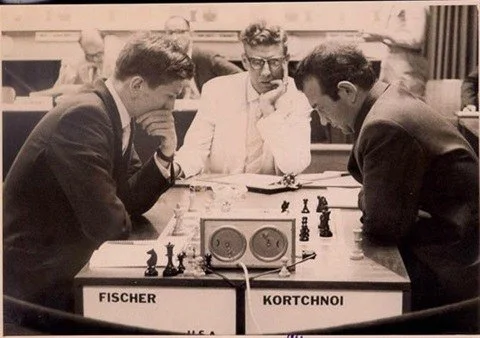
The Sousse Interzonal of 1967 is usually remembered as the tournament Bobby Fischer left while leading. That description is accurate as far as it goes, yet it compresses a month-long world championship qualifier into a single scandal. Sousse was also Bent Larsen’s emphatic victory, the first Interzonal staged in Africa, a severe test of four Soviet representatives, and an early demonstration of the administrative strain that could arise when FIDE’s universal rules met individually negotiated schedules.
Competitive play began with specially advanced games on 15 October. The general first round followed on 16 October, and the twenty-third scheduled round was played on 15 November. Some references give 16 November as the closing date; the reason for the one-day discrepancy is not established. The games and the players’ accommodation were at the Sousse Palace Hotel, a recently opened seafront property near the old city. The Tunisian Chess Federation organized the event within the FIDE world championship cycle. Ridha Belkadi, president of the federation, headed the organizing committee; Ahmed Hentati was tournament director. Romanian arbiter Paul Diaconescu served as chief referee through 31 October, after which Czechoslovakia’s Jaroslav Šajtar took over. [1][2][16]
The venue gave the event a setting unlike those of the preceding Interzonals. Tunisia had been independent for only eleven years, and Sousse was developing rapidly as both a regional center and a Mediterranean resort. Hosting an elite FIDE qualifier in a new hotel on Avenue Habib Bourguiba fitted the country’s growing investment in coastal tourism and international visibility, although no located organizing document states that tourism promotion was an explicit purpose. Participant Petar Trifunović listed President Habib Bourguiba among the event’s patrons, while Soviet eyewitness Evgeny Vasiukov noted that the players lived and competed in the same hotel, about 200 metres from the sea. [2][3][16]
Historical Setting
Sousse formed the central qualifying stage of the 1967–69 world championship cycle. The leading finishers would join Boris Spassky and Mikhail Tal, seeded from the previous Candidates competition, in eight-player Candidates matches to determine Tigran Petrosian’s next challenger. Six places were available. This gave every half-point immediate institutional consequence: the event did not award a ceremonial title alone, but access to the small group still eligible to play for the world championship. [4]
The field was assembled chiefly through FIDE’s zonal system. Larsen entered as a seed from the preceding Candidates cycle, and seventeen-year-old Slim Bouaziz received the host place. The United States sent Fischer, Samuel Reshevsky, and Robert Byrne from its championship-zonal. Four Yugoslavs, three Hungarians, two Czechoslovaks, and qualifiers from Canada, Brazil, Ecuador, Mongolia, and New Zealand made the tournament unusually broad in geographic representation. The fifteen-year-old Henrique Mecking and Canada’s Duncan Suttles were especially conspicuous members of a younger generation. [5]
The Soviet route was exceptionally demanding. The 34th USSR Championship in Tbilisi doubled as the Soviet zonal. Leonid Stein won it and Efim Geller finished second, securing two places. Viktor Korchnoi, Aivars Gipslis, and Mark Taimanov then contested a playoff for the two remaining berths. All three scored 2/4 in Tallinn. The Berger coefficients inherited from the main championship selected Gipslis (119.25) and Korchnoi (115.00) ahead of Taimanov (112.50). The international country limit that had frustrated Stein in earlier cycles no longer barred him. Sousse therefore received the reigning Soviet champion plus three seasoned grandmasters, a delegation expected to secure several of the six Candidates places. [6][7]
Fischer’s presence gave the event additional weight. He had not entered the 1964 Interzonal after his public break with the Candidates system following Curaçao 1962. By 1967 he had returned to major international play and won at Monte Carlo and Skopje. Sousse offered his first direct route back toward the world title in five years. Larsen arrived during his own exceptional season, having already won the Capablanca Memorial in Havana and shared first at Winnipeg. Gligorić, Portisch, Reshevsky, Hort, Korchnoi, Geller, and Stein made the field much deeper than a simple Fischer-Larsen contest. [8][11]
Organization, Format, and Qualification
The intended competition was a 24-player single round robin over 23 rounds. FIDE required compatriots to meet sufficiently early that late-round national cooperation could not determine qualification, which made the draw difficult with four Soviet and four Yugoslav entrants, and three players each from Hungary and the United States. The published rhythm normally reserved Monday and Friday as rest or adjournment days, with five playing days each week. Saturday games for Fischer and Reshevsky, both observing a Friday-evening-to-Saturday-evening Sabbath, were scheduled to begin at 7 p.m. instead of 4 p.m. [1][2]
The projected field never became complete. Argentina’s Julio Bolbochán did not arrive, leaving 23 starters. Dimitrije Bjelica reported that Bolbochán reached Rome but could not obtain a Tunisian visa; later accounts give conflicting explanations. His absence left a bye in what remained a 23-round schedule. [1][8]
Fischer subsequently completed ten games before his exclusion. Because this was fewer than half of his scheduled games, all ten results were annulled. The official final crosstable consequently contains 22 players, each with 21 counted games, for 231 official games. Including Fischer’s erased games, 241 games were actually played at the boards. This distinction explains why contemporary reports can describe a 23-player tournament while databases display a 22-player final table. [1][5]
The first six were to advance. When three players ultimately tied for sixth, a separate playoff was held instead of immediately applying the Sousse tie-break. The event’s sporting outcome therefore remained unsettled for more than three months after Larsen had secured first place. [5][14]
Main Course of the Tournament
Fischer and Larsen established the early pace. Fischer scored seven wins and three draws in his ten completed games, defeating Stein, Reshevsky, Byrne, László Barczay, Miguel Cuéllar, Lhamsuren Myagmarsuren, and Ortvin Sarapu, while drawing Portisch, Lubomír Kaválek, and Korchnoi. His 8½/10 was never an official final score, since every result was later erased, but it accurately describes what occurred at the board. He had not yet faced Larsen, Geller, Gligorić, Hort, or several other leading finishers, so retrospective claims that victory was certain go beyond the evidence. [1][9]
Larsen’s official campaign was more irregular and more durable. He began with two wins, lost to Portisch in the fourth round, and then resumed scoring heavily. A ninth-round victory over Stein was followed by a loss to Korchnoi and a draw with Geller. From that point he won his next six completed counted games, against Gipslis, Reshevsky, Byrne, Hort, Mecking, and Bouaziz. The sequence created the margin that the late stages never erased. [9]
The official race tightened when Suttles defeated Larsen in round 20. Larsen then drew with the undefeated Gligorić, leaving his pursuers a theoretical chance. His penultimate-round victory over Ivkov took him to 15 points and mathematically secured first place before the closing round. A final draw with Aleksandar Matanović produced 15½/21, with thirteen wins, five draws, and three losses. Larsen did not dominate every direct rival. He lost to Korchnoi and Portisch and drew Geller and Gligorić. His decisive advantage came from converting opportunities throughout the field, including victories over all three players who later tied for sixth. [5][9]
The contest behind him remained open until the end. Korchnoi recovered from three official losses with five consecutive wins in rounds 18 through 22. His round-20 victory over Portisch was central to that surge. Geller proceeded more steadily, losing only to Reshevsky. Gligorić, who said that qualification rather than first place had governed his strategy, was the only undefeated player in the official table. A final-round win over Bouaziz brought him level with Geller and Korchnoi. The three shared second on 14 points, half a point ahead of Portisch, who claimed the fifth direct qualifying place with 13½. [1][3]
Hort, Reshevsky, and Stein entered the last round level on 12½. A draw would preserve a place in the playoff, while a win would secure the sixth Candidates berth outright. Stein, playing Black against Kaválek, chose the Sicilian but encountered an unfamiliar variation; after 15.Rf2 he concluded that Black was no better and offered a draw. Reshevsky then drew Portisch, and Matulović-Hort also ended level, producing the three-way playoff. [3]
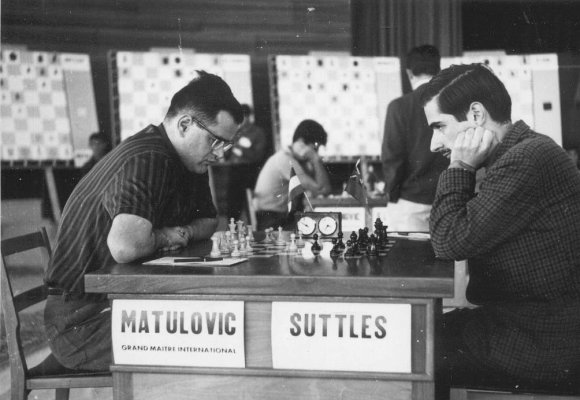
The remaining scores show the event’s depth. Milan Matulović finished on 12½, Aleksandar Matanović on 12, Ivkov and Mecking on 11, and Gipslis and Kaválek on 10. Suttles’s 9½ supplied the required international master result; FIDE’s Canadian title record dates his title to 1967. Bouaziz finished last with 3½, yet his presence as a seventeen-year-old host representative gave Tunisia direct participation in the first Interzonal staged in Africa. [5][10]
The Fischer Affair
The surviving documents do not support a simple account in which Fischer either refused one pairing or was arbitrarily expelled. They show an initial religious accommodation, a later dispute over the density of his revised schedule, two withdrawals, several attempts at reconciliation, contested forfeits, and a final exclusion. They also preserve material disagreements between the Tunisian organizers and the US Chess Federation. Chess Review printed both versions together and warned that they did not agree. [2]
The organizers’ report stated that the special Saturday-evening arrangement for Fischer and Reshevsky had been accepted unanimously before the draw. Later in October, Fischer’s game with Korchnoi was postponed for a religious observance. His following game with Geller was also moved, producing what Fischer and the USCF described as a run of six consecutive playing days. The organizing committee calculated only four consecutive games and emphasized the rest days he had already received. Fischer proposed playing Geller on the evening of 26 October, when his observance ended. The committee rejected the request without offering an alternative. [1][2]
Fischer submitted a written withdrawal on 27 October. His clock was nevertheless started against Gipslis the next evening, and the game was recorded as a forfeit. Belkadi travelled to Tunis and persuaded him to return. Fischer reached the hall within the final minutes before the one-hour default deadline against Reshevsky on 29 October and won. He drew Korchnoi the next day and beat Byrne on 31 October. When Šajtar took charge on 1 November, the Gipslis forfeit was treated as irrevocable. Fischer withdrew again; his clock was started against Hort on 2 November, producing a second forfeit. [1][2]
An attempted re-entry on 4 November ended the episode. The committee required Fischer to acknowledge both forfeits in writing and promise to complete the tournament. Fischer, then in Tunis, signaled that he would continue under terms that preserved his right to contest their legality. His scheduled game with Larsen had begun in Sousse, and his request for a later start was refused. When he could not appear within the deadline, the committee recorded a third forfeit, excluded him, and annulled his ten played results. The USCF publicly challenged the rulings and said Fischer was preparing a submission to FIDE, arguing that the forfeits and the conditions for re-entry were invalid. The organizers maintained that they had enforced an official event’s rules after repeated withdrawals. No located public record shows a later FIDE judgment reversing the tournament decision. [1][2]
Both sides had an institutional interest. Edmondson wrote as the executive director of the USCF and openly advocated Fischer’s case. The Tunisian report defended the organizers’ authority. Radojčić, who acknowledged that he was Fischer’s friend, criticized Fischer’s conduct and the committee’s lack of flexibility. Vasiukov’s Central Chess Club account condemned Fischer’s conduct. The most careful conclusion is limited: Fischer’s playing strength at Sousse was unmistakable, while his conduct and the organizers’ disputed administrative response combined to remove him from the cycle. Claims that the Soviet delegation forced this result appear in accounts not corroborated by the located institutional documents and should not be treated as established fact. [1][2][3]
Winner and Key Contenders
Larsen’s 15½ was a commanding official result: 1½ points ahead of three world-class grandmasters and built on thirteen decisive wins. It also formed part of one of the strongest tournament seasons of his career. His victories at Havana, Sousse, and Palma de Mallorca, together with his shared first at Winnipeg, helped make him the first recipient of the Chess Oscar awarded by the international chess press. Sousse confirmed that the leading non-Soviet challenge to Petrosian’s generation did not rest on Fischer alone. Larsen subsequently defeated Portisch in the 1968 Candidates quarterfinal before losing to Spassky in the semifinal. [11]
The Soviet outcome was mixed. Geller shared second on 14, and Korchnoi’s closing sprint carried him to the same score. Korchnoi later reached the Candidates final, where Spassky defeated him. Stein’s 13 points kept him alive, but Soviet commentators treated the result as disappointing for the reigning national champion. Gipslis began promisingly but faded after an extended break in his schedule and finished on 10, well outside the qualifying places. Two of the four Soviet entrants advanced directly, while two already seeded Soviet players, Spassky and Tal, meant that half of the eventual Candidates field still came from the USSR. [3][5]
Soviet eyewitness accounts add an important human qualification. Vasiukov, who spent the event in Sousse as Korchnoi’s trainer, described Stein as shaken first by his subsequently annulled loss to Fischer and then by a defeat against Hort from a favorable adjourned position. He reported insomnia, inadequate opening preparation, and a rupture between Stein and his trainer Yuri Chikovani, after which the wider Soviet delegation assisted him. These are retrospective observations from inside the team, not medical findings, but they explain why Soviet writers treated Stein’s late recovery as an escape from a deeper collapse. [3]
Critical Games and Turning Points
Only a few individual games are necessary to explain Sousse. Fischer’s win over Stein established the force of his early run and became one of the event’s most remembered games, even though it vanished from the official standings. Larsen’s wins over Stein, Reshevsky, and Hort directly damaged all three players who later shared sixth. Suttles’s defeat of Larsen briefly revived the pursuit and contributed to the Canadian’s title result. Korchnoi’s victory over Portisch separated two direct qualifiers during the final surge. Larsen’s win over Ivkov then secured first place with a round remaining. The competitive significance lies in those outcomes, not in their opening variations or tactical detail. [3][9]
One additional game entered chess history for a different reason. During Matulović-Bilek, Bilek alleged that Matulović retracted a move and only afterward claimed to have said j’adoube. Bilek stopped the clock and protested; the arbiter, who had not witnessed the disputed action, ordered play to continue. The game was drawn. Bob Wade’s near-contemporary tournament book used the cautious word “alleged,” a restraint often lost in later retellings. Edward Winter’s source audit shows that later versions have misstated the year, venue, result, and even the move number. The incident belongs in the history of Sousse as an evidentiary problem for the arbiter, not as a proven account of an unseen act. [12]
Contemporary Reception and Soviet Institutional Response
International press attention was intense. The French Larousse Journal de l’année called Sousse the great chess event of the year and described Fischer’s decisive forfeit with the deliberately cautious phrase à tort ou à raison. Chess Review devoted a multi-page dossier to the competing official, American, and player accounts. In East Germany, Neues Deutschland called the Interzonal the most important chess competition of 1967 and later published a full assessment of the five direct qualifiers. Its headline “Fischer, the Callas of chess” illustrates how quickly personality displaced tournament analysis in the press narrative. [4][13]
Evidence for large local crowds is weaker. Radojčić described the playing room as vast and, during at least one lighting dispute, almost empty. He documented the lighting dispute, while the Central Chess Club bulletin also reported complaints about noise and photographers. Fischer and Cuéllar at one point moved their own table toward better light. The world press followed Sousse closely, but no reliable attendance total has been located. [1][3][8]
The Soviet response was unusually extensive. The Central Chess Club issued a twelve-part special bulletin on the Interzonal between November 1967 and February 1968. It combined games and reports with an argument about Soviet competitive practice. A Pravda article by Alexander Kotov prompted a special meeting of the USSR Chess Federation presidium, which endorsed a broader review of recent results and instructed its commissions, Shakhmaty v SSSR, and the Central Chess Club to propose reforms. The bulletin reported hundreds of letters concerning selection, preparation, title standards, and the relationship between the USSR Championship and the zonal system. Sousse did not alone cause this discussion, but it supplied its most immediate evidence. [3]
The debate was not monolithic. Mikhail Beilin judged Geller steady, praised Korchnoi’s recovery, criticized Gipslis’s selection, and argued for a separate Soviet zonal. Vladimir Simagin defended the overall strength of the Soviet school while criticizing excessive draws, congested schedules, and a qualification system that rewarded arithmetic caution. Mikhail Tal identified Stein’s result as the principal surprise and Korchnoi’s late victory over Portisch as decisive. These were named Soviet interpretations, not a single official verdict, and they show that the Interzonal was read in Moscow as a test of selection and competitive will as well as an encounter with Fischer and Larsen. [3]
The Sixth Place Playoff
Reshevsky, Hort, and Stein met at the Herman Steiner Chess Club in Los Angeles from 18 February into early March 1968. Each played four games against each rival, for twelve games in all. All three finished on 4/8: Reshevsky drew every game, while Stein and Hort exchanged victories and drew their other meetings. The pre-established fallback was the Sonneborn-Berger coefficient from Sousse, on which Reshevsky led. [3][14][15]
With two games remaining, Stein led on 4/7, half a point ahead of Reshevsky and 1½ ahead of Hort. In the penultimate game he faced Hort. A win would qualify him outright; a draw would leave Reshevsky able to catch him by beating Hort in the final game, with the Sousse coefficient then favoring Reshevsky. Stein declined Hort’s move-15 draw offer and lost. Reshevsky, needing only a draw in the final game, then held Hort; all three finished on 4/8 and Reshevsky advanced. The Candidates draw held earlier at the Sousse governor’s residence assigned the playoff winner to Korchnoi. [3][14]
Legacy and Historical Assessment
Sousse deserves a wider legacy than “the Interzonal Fischer abandoned.” It demonstrated Tunisia’s capacity to bring the world championship cycle to Africa, eighteen years before the continent’s next Interzonal in Tunis. It produced the clearest qualifying victory of Larsen’s career and sent Geller, Gligorić, Korchnoi, Portisch, and eventually Reshevsky into the Candidates. It also exposed weaknesses in FIDE-era tournament governance: negotiated exemptions were difficult to integrate into a long round robin, the chief arbitral office changed during a live dispute, and the surviving official and federation accounts could not agree on the legal status of key decisions. [2][16]
The Fischer episode affected the result without invalidating Larsen’s achievement. Annulment erased the losses from the records of players Fischer had beaten, including Stein and Reshevsky, while subtracting half-points from Portisch, Kaválek, and Korchnoi for their voided draws. Larsen and Fischer had not met, so no responsible history can reconstruct their unplayed game or convert Fischer’s early lead into a certain final score. What can be said is that Fischer had been the strongest starter and Larsen the strongest finisher whose results survived every round and every ruling. [1][2][9]
The tournament also left two lasting cautionary cases. Matulović-Bilek showed the limits of adjudication when an arbiter had not witnessed the disputed act. The Fischer affair showed that correct procedure, clear communication, and workable accommodations are part of competitive integrity. Sousse remains historically valuable because its chess, institutional ambition, and administrative failures can still be separated from the legends that grew around them.
Its central achievement remains straightforward. In a field drawn from the world’s zonal system, amid a controversy that seriously disrupted the competition, Bent Larsen won by 1½ points through exceptional breadth of scoring. The qualifiers shaped the 1968 Candidates matches, the Soviet result provoked serious internal examination, and Tunisia established a rare African place in the history of the classical world championship cycle. That combination gives the Sousse Interzonal of 1967 enduring importance.
Notes and Sources
1. E. B. Edmondson, “USCF Protests to FIDE on Fischer’s Behalf,” Miro Radojčić, “The Fischer Affair,” and Dimitrije Bjelica’s tournament report, in Chess Life, February 1968, pp. 42–50. Edmondson’s chronology contains valuable correspondence but was published as a USCF protest. Radojčić explicitly acknowledged his friendship with Fischer.
2. The Tunisian directors’ report to FIDE, an American counter-account, and Petar Trifunović’s participant essay are printed together in Chess Review, February 1968, pp. 40–45. This dossier is the best accessible evidence for the conflicting institutional narratives, the Sousse Palace venue, and the officials. The standard near-contemporary tournament book is R. G. Wade and the Tunisian Chess Federation, Interzonal Chess Tournament, Sousse 1967 (Nottingham: The Chess Player, 1968), catalogued by WorldCat.
3.Межзональный шахматный турнир в Тунисе, a twelve-issue special Bulletin of the Central Chess Club of the USSR, 1967–68. Especially relevant are Mikhail Beilin in no. 1; Alexander Kotov’s Pravda article and the federation response in no. 1; Vladimir Simagin in no. 2; Evgeny Vasiukov’s eyewitness series in nos. 3–7; Mikhail Tal’s interview in no. 8; and the final-round report in no. 11. It is a rich near-contemporary institutional source whose judgments about Fischer and Soviet players require attribution.
4. Contemporary results and qualification notice in Chess Life, December 1967, p. 362; French contemporary assessment in Larousse Journal de l’année 1968, “Échecs”.
5. Mark Weeks, “1967 Sousse Interzonal”, for the crosstable and playoff summary, and “1966–1969 Zonal Cycle Qualifiers”, for the route into the field. Scores and games are cross-checked against the 365Chess event record.
6. Aivars Gipslis and B. Ozolins, “XXXIV чемпионат СССР,” Шахматы (Riga), no. 7 (175), 1967, pp. 6–15, a contemporary account of the Soviet zonal and the need for a playoff among Korchnoi, Gipslis, and Taimanov.
7.OlimpBase, 34th Soviet Chess Championship, Tbilisi 1966–67, used to confirm standings and Berger coefficients, together with its separate record of the Tallinn selection playoff.
8. André Schulz, “Fischer setzt sich selber matt: Sousse 1967,” ChessBase Deutschland, 25 October 2017. This is a useful German specialist reconstruction, although its interpretation and some incidental details require checking against contemporary documents.
9.PGN Mentor, Interzonal 1967 complete games, used only to confirm pairings, round numbers, and results. Fischer’s ten games appear separately from the 231 official games.
10. The Chess Federation of Canada’s official FIDE title list records Suttles as an international master from 1967; the contemporary Sousse report in note 1 connects the title result to the Interzonal.
11.“Chess legend Bent Larsen turns 75,” ChessBase, 4 March 2010, for Larsen’s Interzonal record, first Chess Oscar, and later Candidates results. Contemporary context for his Sousse victory also appears in Chess Review, February 1968, cited in note 2.
12. Edward Winter, “J’adoube”, a source audit centered on Wade’s near-contemporary account of Matulović-Bilek. Winter documents how later retellings changed essential details.
13.Neues Deutschland, 16 November 1967, 17 November 1967, and Heinz Stern’s assessment on 19 November 1967, for contemporary German-language framing, the final result, and the importance assigned to the Interzonal.
14.Chess Life, April 1968, pp. 115–17, gives the near-contemporary narrative, scores before the last two games, draw offer, 4/8 tie, and pre-existing Sousse tie-break rule. Its February advance notice, p. 47, scheduled the last round for 2 March, while the April report gives 8 March and a different final two-game order. OlimpBase confirms the format and final scores but follows the 2 March date and a conflicting round order. The precise closing date is therefore left unresolved.
15. Vlastimil Hort, “Hort stories: Leonid Stein,” ChessBase, 30 May 2019, a later first-person summary of the Sousse tie and Los Angeles playoff result.
16. FIDE, “The Growth of Chess in Africa”, identifies Sousse 1967 and Tunis 1985 as Africa’s two Interzonals. The hotel’s location and institutional history are described by the official Sousse Palace site. Maurice Wolkowitsch’s contemporary academic study “Le Tourisme en Tunisie,” Méditerranée 2, no. 1 (1961), pp. 3–22, documents the post-independence state’s promotion of foreign tourism and public investment in hotels. For the urban setting, see UNESCO’s French-language Medina of Sousse dossier; the medina’s World Heritage inscription dates from 1988 and is not projected backward onto the 1967 event.
