The 1986 Dubai Chess Olympiad
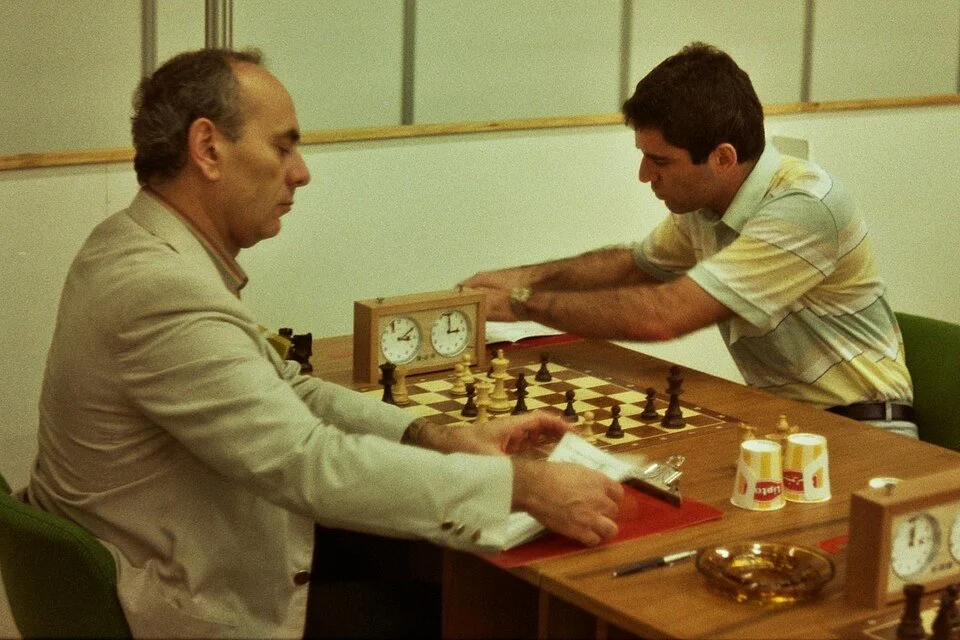
Lajos Portisch - Garry Kasparov, Chess Olympiad 1986 in Dubai, Photographer, Gerard Hund
The 27th Chess Olympiad featured exceptional playing strength, ambitious Emirati organization, a final-round reversal, and a serious dispute over equal access to international chess. The Soviet Union won both team events. It was an open victory by half a point after the United States entered the last round in front, and England completed one of the strongest Olympiad campaigns in its history.
Introduction
The 27th Chess Olympiad took place in Dubai, United Arab Emirates, from 14 November to 2 December 1986. Play was held in the Dubai Trade Centre, the contemporary name used in the tournament record for the venue in what is now the Dubai World Trade Centre complex. The opening and closing dates framed fourteen rounds played between 15 November and 1 December. FIDE supervised the event; Sheikh Buti Al Maktoum headed the local organizing committee, and Mohamad Obaid Ghobash directed its executive management. International arbiters Emad El-Din Ghalayini of Palestine and Miroslav Filip of Czechoslovakia served as chief arbiters.
Dubai 1986 deserves close attention for several distinct reasons. The open section reached 108 teams, the first three-digit field in Olympiad history. The concurrent women's event drew 49 teams. Dubai spent heavily on travel support, accommodation, transport, publicity, and ceremonial display. The playing conditions received substantial praise from participants. The host's refusal to admit Israel also made the Olympiad a test of FIDE's commitment to equal participation. Four European federations stayed away in protest, several leading grandmasters declined to play, and the FIDE Congress adopted a stricter rule for future exclusions.
The competition itself resisted the expectation of an easy Soviet success. The USSR brought Garry Kasparov, Anatoly Karpov, Andrei Sokolov, Artur Yusupov, Rafael Vaganian, and Vitaly Tseshkovsky. It still lost a match to the United States, drew three consecutive matches, fell to fifth place in the official round-eight table, and recovered only in the closing rounds. A 4-0 final-round victory over Poland took the Soviet total to 40 points from 56 games. England finished on 39.5 and the United States on 38.5. In the women's event, the Soviet side won much more comfortably with 33.5 points from 42.
Historical Setting
Dubai followed an unusually concentrated period at the summit of Soviet chess. Kasparov and Karpov had completed their 1986 world championship rematch on 8 October, little more than five weeks before the Olympiad opened. Kasparov retained the title after another exhausting contest with his predecessor. Their joint appearance therefore carried immediate significance. They had both missed the 1984 Olympiad in Thessaloniki because their first championship match was in progress. The Soviet team won there without them, while England took silver and the United States bronze. In Dubai, all three countries returned as principal contenders, now with the two strongest Soviet figures restored to the lineup.
The Soviet selection contained extraordinary depth. Kasparov played first board, Karpov second, Sokolov third, and Yusupov fourth, with Vaganian and Tseshkovsky as reserves. Sokolov and Yusupov had recently met in the Candidates cycle; Sokolov defeated Yusupov and remained on the path toward a challenge. The first four boards therefore combined the reigning champion, the recent champion, and two leading Candidates figures. Contemporary U.S. grandmaster and reporter Lubomir Kavalek described those four as the strongest players on the official rating list. The fixed board order placed Yusupov behind Sokolov despite Yusupov's higher published rating. This was a registered team order, not a day-to-day ranking.
England fielded Tony Miles, John Nunn, Nigel Short, Murray Chandler, Jonathan Speelman, and Glenn Flear. The United States brought Yasser Seirawan, Larry Christiansen, Kavalek, John Fedorowicz, Nick de Firmian, and Maxim Dlugy. Hungary, led by Lajos Portisch, Zoltán Ribli, and Gyula Sax, was another established medal candidate. The concentration of elite players extended far beyond these teams, although the field was weakened by politically motivated absences discussed below.
Dubai also represented an institutional step for chess in the Gulf. The UAE Chess Federation had been founded in 1976. Saeed Ahmed Saeed's victory in the 1981 world under-14 championship had already given local chess a visible success. The Olympiad allowed Dubai to present itself as an international sports host while connecting the event to the long history of chess in Arab culture. The opening ceremony at the Central Military Command Stadium used a parade, fireworks, a giant chessboard, and a pearl-diving boat. Contemporary and later local accounts describe chess pieces placed around hotels and public buildings, extensive television and radio publicity, a commemorative one-dirham coin, and a promotional film titled Back in Dubai. This symbolism formed part of the host's cultural program and helps explain the event's unusually strong local staging.
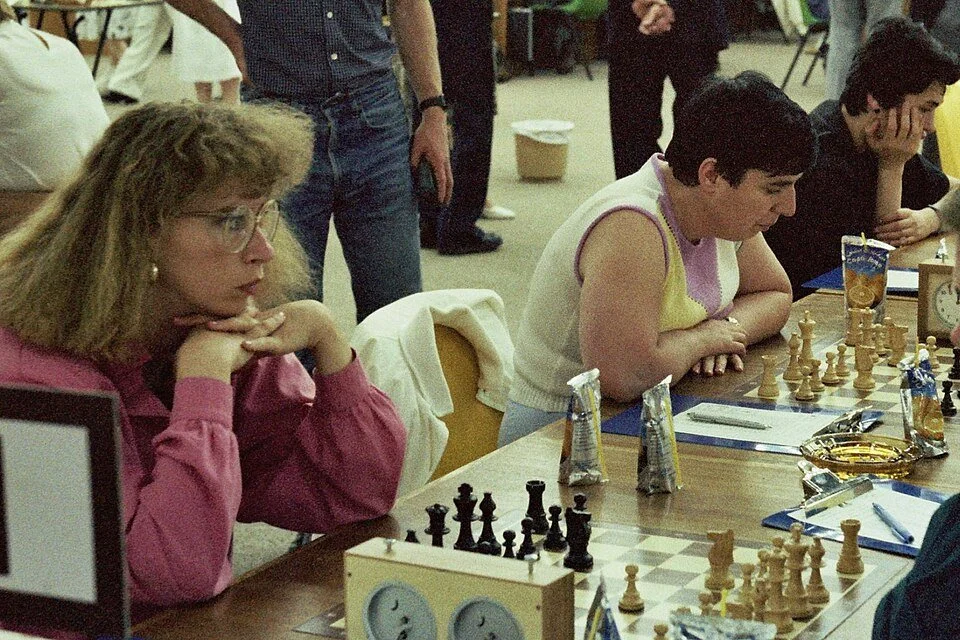
Elena Akhmilovskaya, Nona Gaprindashvili, and Nana Alexandria at the Chess Olympiad 1986 in Dubai, Photographer Gerhard Hund.
Organization, Format, and Field
The open event used a fourteen-round Swiss system. Each match was played over four boards, and a national squad could register two reserves. The women's competition also ran for fourteen rounds, with three boards and one reserve. The time control was 40 moves in two hours, followed by one hour for each further 20 moves. There was no international qualification tournament. FIDE member federations entered national teams and chose their own players. No accessible federation record documents a formal Soviet selection trial. The host entered a second team in the open section, so the total of 108 teams represented 107 federations or countries.
Standings were determined first by the sum of individual game points. A win counted one point, a draw one half, and a loss zero. Buchholz was the first tie-break, followed by match points. This detail is essential to understanding the outcome. England won twelve matches, drew one, and lost one, which produced 25 match points under the two-points-for-a-match-win calculation used as the third ordering criterion. The USSR recorded ten match wins, three draws, and one loss, equivalent to 23 match points. The Soviet team won because its 40 board points exceeded England's 39.5 under the primary rule in force. A modern match-points-first reading produces a different order, but that is a counterfactual, not the 1986 result.
The scale was formidable. The open section listed 641 players, including 59 grandmasters and 90 international masters. Its record contains 3,024 board results, at least four of them forfeits. The women's field listed 193 players and 1,008 board results. The official English-language bulletin appeared daily with pairings, standings, games, and feature articles. Fourteen issues survive as an archival record.
The host helped teams reach Dubai. Kavalek reported soon after the event that airfare was paid for some delegations, and OlimpBase's tournament reconstruction gives the travel offer a value of about $1 million. Kavalek estimated the combined Olympiad and FIDE Congress cost at close to $12 million. These figures were contemporary estimates, not audited accounts. Their scale is consistent with the documented provision of high-quality accommodation, transport, an equipped press center, public decoration, and an extensive ceremonial program.
The late growth of the field also produced a revealing logistical episode. According to the tournament reconstruction based on Bob Wade's The Game of the Round, the pairing computer had been tested for no more than 100 teams. Faced with 108, it returned an overload message, and the opening draw had to be made manually. The problem did not derail the tournament, but it captures the practical consequence of Dubai's unexpected participation record.
Participation, Exclusion, and FIDE Authority
Israel's absence was the principal institutional failure of the Olympiad. The UAE host federation did not invite the Israeli team, and the state refused entry permits. A contemporary Jewish Telegraphic Agency report recorded the UAE explanation that the two states were in a condition of conflict. Israel had not failed to qualify. It was excluded from an event open in principle to FIDE member federations.
The decision had been visible well before play began. According to FIDE delegate Horst Metzing's account in the 1987 German tournament book, the 1982 Lucerne Congress had allowed the General Assembly to grant exceptions to the usual visa guarantee, particularly in cases of war or serious violence. After Venezuela relinquished the 1986 event, the Dubai offer proceeded through that framework. Negotiations over Israeli participation did not produce admission. By 1985, Israeli representatives were pressing for a rule that would prevent a repetition at future FIDE competitions.
The Netherlands, Norway, Denmark, and Sweden are securely documented as having withheld their teams in solidarity. Sources disagree about whether another absent federation should be counted as a formal boycotter, so a larger total should be treated cautiously. Viktor Korchnoi, Robert Hübner, and Eric Lobron were prominent individual absentees. Lobron publicly linked his decision to the exclusion. A strong tournament held in Jerusalem at the same time gave the protest a further chess expression.
The United States Chess Federation chose to compete after a substantial internal debate. Contemporary U.S. federation reporting records a compromise adopted by its delegates: the federation condemned Israel's exclusion, sent its teams, and instructed its delegation to withdraw if the proposed FIDE amendment on future access was not adopted. Forty members of the U.S. Congress had urged a boycott. At the Dubai Congress, FIDE adopted a provision under which a future exception would require a three-quarters General Assembly majority. The amendment did not repair Israel's exclusion from Dubai. It established a higher barrier for repeating it.
This history explains the divided reception of the event. Praise for the physical organization was sincere and well documented. Criticism of discriminatory access was equally grounded in fact. A historically responsible account has to retain each part of that record without using the quality of the hospitality to soften the exclusion.
Main Course of the Open Olympiad
The USSR began with the score expected of the top seed. Kasparov and Karpov rested in the first round while their teammates defeated Lebanon 4-0. The next three matches brought victories over Peru by 3.5-0.5, Czechoslovakia by the same score, and Hungary by 2.5-1.5. Karpov's win over Ribli supplied the only decisive game against Hungary.
The fifth round changed the rhythm. Yugoslavia held the Soviet team 2-2 after Ljubomir Ljubojević defeated Karpov and Sokolov defeated Petar Popović. The loss was Karpov's first in an Olympiad since 1972. England then met the USSR in one of the event's most concentrated matches. All four games were decisive and every White player won. Kasparov beat Miles and Yusupov beat Short; Nunn defeated Sokolov and Chandler defeated Vaganian. The 2-2 result was followed by another 2-2 draw with Iceland. At the halfway point, Hungary and the United States had 20 board points, while England and the USSR had 19.5.
The eighth round, played on 23 November, created the deepest Soviet deficit. The United States defeated the USSR 2.5-1.5. Seirawan beat Kasparov, and the other three games were drawn. It was Kasparov's only loss in Dubai. England simultaneously defeated Iceland 4-0 and opened a substantial lead. Kasparov later recalled that the USSR fell to sixth place, 2.5 points behind England.
The Soviet recovery began with a 3.5-0.5 victory over France. Kasparov drew Boris Spassky, playing first board for France, while Karpov, Sokolov, and Yusupov won. A 2.5-1.5 victory over Romania followed. England then suffered the largest reversal among the leaders, losing 3.5-0.5 to Spain in round ten. The United States moved to 28 points, with England and the USSR on 27.
The England-Spain match generated an allegation that must be stated with precision. Members of the English team suspected that Soviet grandmaster Tamaz Georgadze, who was serving as Spain's trainer and captain, had improperly discussed play with a Spanish player. The accessible OlimpBase narrative attributes the accusation to Reuters. A later UAE retrospective reported that organizers regarded it as unsubstantiated, and no accessible record shows a formal finding of outside assistance. OlimpBase also reports that the top tables were roped off after the rest day to restrict circulation. Spain's 3.5-0.5 victory remains the official sporting result; the allegation remains unproved.
The United States kept the lead through victories over Spain and Iceland. The USSR stayed close with wins over Bulgaria and Spain, then defeated Italy 3-1 in round thirteen. England beat Poland and Czechoslovakia. With one round left, the United States stood on 36.5, the USSR on 36, and England on 35.5. Each could still win.
The pairings favored a close finish. The United States faced Bulgaria, while the USSR met Poland and England met Brazil. Bulgaria held the Americans 2-2. England produced a 4-0 score. The Soviet team also won 4-0 through Kasparov, Karpov, Yusupov, and Vaganian. Kasparov's game against Włodzimierz Schmidt was the last game among the contenders to finish. By then, his teammates had already won, England had completed its sweep, and the U.S. match had ended. A draw would apparently have left the USSR and England level on 39.5 with the Soviet team ahead on the published Buchholz figures. Kasparov's win made the championship outright on board points.
Winner and Key Contenders
The Soviet result depended heavily on its depth. Kasparov scored 8.5 from 11, with seven wins, three draws, and one loss. Yusupov produced the team's strongest percentage, an unbeaten 10 from 12. Karpov and Sokolov each scored 6 from 9, Vaganian 7 from 10, and Tseshkovsky 2.5 from 5. Kasparov received the first-board gold and the leading published performance figure in the open event. Yusupov won the fourth-board gold and ranked immediately behind Kasparov by performance.
Later recollections reveal how the Soviet players understood their narrow escape. Kasparov described the Olympiad as a severe test because his first appearance on board one coincided with late-night activity at the FIDE Congress. He credited coach Efim Geller in his annotations and identified Alexander Nikitin as his analyst before the final-round game. Karpov recalled in 2010 that he and Kasparov assumed practical control of lineup decisions when the team's position deteriorated. That claim survives as retrospective testimony; no team order corroborating it is available. Yusupov later remembered persistent tension around the Karpov and Kasparov camps, while also describing Geller's advice as valuable. Read together, these accounts show a highly institutionalized team that relied on individual initiative during a difficult event.
England's silver was earned by sustained team scoring. Short made 10 from 13 and won the third-board gold. Chandler scored 9 from 11, Speelman 7 from 9, and the team won twelve of its fourteen matches. Its single match loss, the heavy defeat by Spain, cost three and a half board points at the most damaging moment. England finished only half a point from gold, its closest challenge to the Soviet team in this period.
The U.S. bronze also understates the drama of its campaign. The fifth-seeded team led into the final round, defeated the USSR directly, and lost only three individual games across the recorded board results. Fedorowicz scored 8 from 10, de Firmian 6.5 from 9, and Dlugy 5.5 from 7. A 2-2 final-round draw with Bulgaria left the Americans on 38.5, one and a half points behind the USSR. For several rounds, their combination of resilience and balanced scoring had placed a first U.S. Olympiad victory since 1976 within reach.
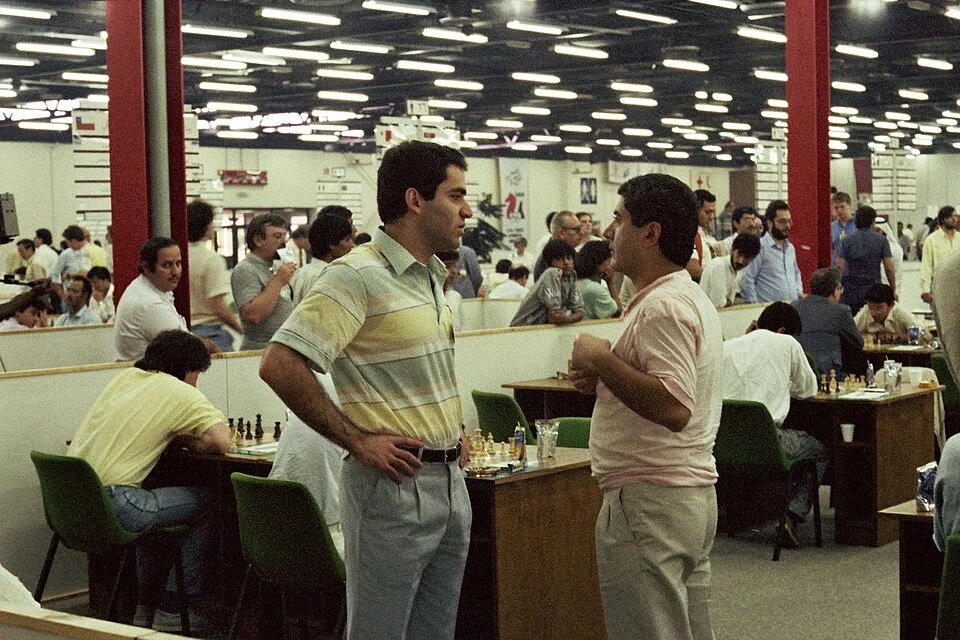
Chess Olympiad 1986 (Garry Kasparov, Rafael Vaganian, debating in the tournament hall), Photographer Gerard Hund
Critical Games and Turning Points
Four games carry most of the result's historical weight. Ljubojević's fifth-round win over Karpov interrupted the Soviet opening surge and helped Yugoslavia secure a 2-2 match. Its significance lies in the change of competitive direction and in Karpov's long prior unbeaten Olympiad record.
Seirawan's victory over Kasparov in round eight decided the U.S. match win. It was the world champion's only loss of the event and gave the American challenge unmistakable credibility. Kavalek's contemporary account presents the result as the moment when U.S. hopes of gold became concrete.
England's defeat by Spain was collective. José Luis Fernández García beat Miles, Miguel Illescas defeated Nunn, and Juan Manuel Ochoa de Echagüen overcame Chandler. The 3.5-0.5 score damaged England's lead and generated the unresolved allegation described above.
Schmidt-Kasparov in the final round supplied the closing image. Kasparov played for a win with Black. When his game finished, the other three Soviet victories had already been secured, and his point placed the USSR alone on 40. His memoir recalls a crowd of several thousand around the final game and prolonged applause after Schmidt resigned. The crowd estimate, finishing sequence, and atmosphere belong to participant recollection; the score and championship consequence are confirmed by the results record.
The Women's Olympiad
The concurrent women's event deserves more than a passing reference. The Soviet team consisted of Maia Chiburdanidze, Elena Akhmilovskaya, Nona Gaprindashvili, and Nana Alexandria. Three were Georgian greats; Akhmilovskaya had challenged Chiburdanidze for the world title earlier in 1986. Chiburdanidze was the reigning champion, and Gaprindashvili was a former champion. The lineup reflected the depth of Soviet women's chess and Georgia's central place within it.
The USSR scored 33.5 points from 42, with 13 match wins and one draw. Hungary finished second on 29. Romania and China each scored 28, with Romania taking bronze on Buchholz. The margin of four and a half points gave the Soviet women's victory a very different character from the open team's final-round escape.
Gaprindashvili's 10 wins from 10 games on third board was the outstanding individual score of the entire Olympiad. The official FIDE archival description gives her a published performance rating of 2877, more than 100 points above the leading male performance figure. Historical rating performances across sections and eras should be read within the calculation method of the time, yet the perfect score itself requires no qualification. Chiburdanidze scored 8 from 10, Akhmilovskaya 8.5 from 12, and Alexandria 7 from 10.
Dubai also produced a notable home result. Farida Al Karim, whose name appears as “Fraidah A. Karim” in the database record, scored 7 from 8 and received the second-board individual gold. UAE federation officials later identified it as the country's first Olympiad gold medal. In an event remembered internationally for the leading teams and the visa dispute, her result is an important part of its local chess history.
Contemporary Reception
Reception depended on which aspect observers emphasized. Participant reports praised accommodation, transport, the hall, and the attention given to delegations. Nigel Short later remembered the hotels, food, and playing conditions with particular approval. The official bulletin functioned as a daily newspaper for the Olympiad. Local organizers used broadcast publicity and citywide symbols to give elite chess a broad public presence in Dubai.
The contemporary English-language reports cited here focused on the late three-team race, Seirawan's victory over Kasparov, England's collapse against Spain, and the political dispute over Israel. A United Press International report published immediately after the final round presented the outcome as a Soviet comeback and emphasized that the United States had led before drawing with Bulgaria. Kavalek's longer Washington Post account, written as a participant, combined match detail with an openly personal portrait of the Soviet pressure. It is valuable eyewitness evidence, although its sharper judgments about personalities should not be mistaken for neutral reporting.
The February and March 1987 issues of Shakhmaty v SSSR emphasized the narrowness of the victory. Nikolai Krogius, head of the USSR State Sports Committee's Chess Administration, described the open event as difficult and dramatic in the February issue. He also raised a selection problem: Kasparov, Karpov, Sokolov, and Yusupov had arrived after exhausting match play, so recent physical condition and team role required closer attention alongside longer-term results. In the same issue, captain Efim Geller analyzed the early 2-2 match with England under the title “The Struggle Was Difficult.” His follow-up in March, “The Olympiad Raises Questions,” called for a sustained national-team program, clearer preparation, and more systematic coaching support. This unusually direct institutional critique appeared after a gold-medal result.
Kasparov's later memoir and Karpov's interview preserve different recollections of how leadership worked when the team faltered. Their common point is the severity of the competitive situation. The contemporary Soviet reports and the later testimony support an account of a hard recovery.
The FIDE Congress added another institutional layer. Florencio Campomanes was returned to the presidency after his challenger, Lincoln Lucena, withdrew. Kasparov campaigned against Campomanes while playing first board and began organizing what became the Grandmasters Association, formally established in early 1987. Dubai therefore linked a contest over the Olympiad title with a contest over representation and authority inside international chess. That connection belongs to the event's history, although a full account of the later FIDE conflict lies beyond its scope.
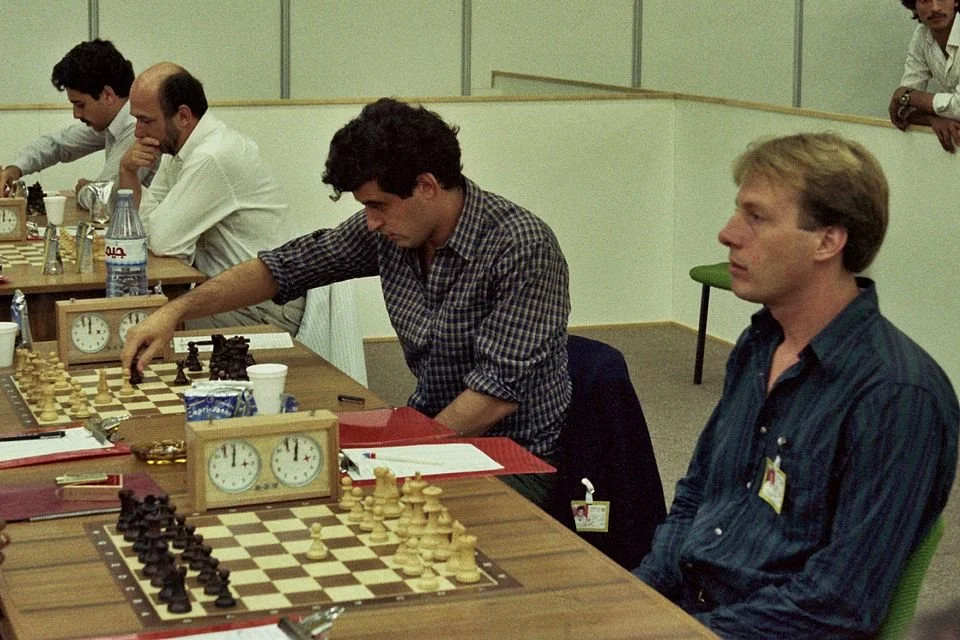
Team USA in Dubai. Photographer Gerard Hund
Legacy and Historical Assessment
Dubai established that an Olympiad of unprecedented size could be staged in the Gulf with strong material support and an elaborate public program. Later Emirati accounts credit the event with accelerating club development and broadening local interest. The long-term claim is retrospective and difficult to measure precisely, but the federation's promotional effort, the public symbolism, and Farida Al Karim's individual gold provide concrete evidence of local significance.
Its institutional legacy is less comfortable. The exclusion of Israel exposed a gap between FIDE's universal language and the exceptions allowed to a host. The boycotts and the U.S. federation's conditional participation kept the issue before the Congress. The three-quarters rule adopted for future exceptions represented a procedural response. It did not provide equal access in Dubai. The access dispute therefore forms an enduring part of the event's record.
For Soviet chess, the double gold displayed two forms of strength. The women's team dominated with three leading Georgian players alongside Akhmilovskaya. The open team survived serious pressure through elite scoring, deep reserves, coaching support, and a forceful final round. The result extended the USSR's record of winning every Olympiad it had contested since its 1952 debut except for Hungary's victory in 1978. The half-point margin also showed how close England and the United States had come to ending that control.
The scoring system remains part of the event's later discussion. England accumulated more match points than the USSR and won more matches. The official competition ranked teams by board points, so the Soviet victory was fully valid under the stated rules. Applying a later scoring preference can illuminate the different strengths of the two campaigns. It cannot revise the historical standings.
The OlimpBase narrative repeats an unsubstantiated suspicion that the Polish team faced political pressure, but adduces no evidence. No documentary record or formal finding establishing such pressure has been located. The completed games and the score alone cannot prove collusion. The responsible historical conclusion is limited to the verified record: Poland lost all four games, and the Soviet sweep completed a comeback from half a point behind the United States.
Notes and Sources
The FIDE Open Chess Museum, “Bulletin of the 27th Chess Olympiad” confirms the official dates, the 108-team open field, the 49-team women's field, the Soviet double victory, the daily bulletin's function, and Gaprindashvili's 10/10 score. The full fourteen-issue bulletin sequence is cataloged by WorldCat.
OlimpBase provides the event data and narrative, open final standings, and round fourteen results. These pages support the format, organizers, team and player totals, scoring order, match sequence, final scores, and individual medals. Its tournament narrative draws on Bob Wade's The Game of the Round. Its comment about the Poland match is not used as evidence of political pressure.
Team pages give the individual records for the Soviet Union, England, and United States. The round pages document the decisive sequence, especially round five, round six, round eight, round ten, and round thirteen.
The women's event record and individual medals, final standings, and Soviet team page support the field size, format, scores, team order, and individual results.
Lubomir Kavalek, “The Matchup at Dubai,” The Washington Post, 22 December 1986, is a contemporary participant account of the U.S. challenge, the Soviet roster, Seirawan-Kasparov, event expenditure estimates, paid travel, and FIDE politics. Its personality judgments are treated as the author's perspective.
United Press International, “Soviets Win Chess Olympiad,” Los Angeles Times, 1 December 1986, is a contemporary report on the final-round reversal and medal order.
The Jewish Telegraphic Agency's contemporary reports, “Israel Banned from Chess Olympiad,” 3 September 1985 and “40 Lawmakers Urge the U.S. to Boycott Chess Olympics in Dubai,” 12 August 1986, document the visa refusal, the UAE explanation, Israel's FIDE position, and the U.S. congressional appeal.
Contemporary U.S. federation debate is recorded in the Illinois Chess Bulletin, March-April 1986, page 6, and September-October 1986, page 9. The latter reports the delegates' 64-34 compromise on participation and future FIDE rules.
John Dennehy, “Giant chess pieces, Cold War intrigue and an Emirati gold,” The National, 17 December 2018, draws on local archival material and interviews for the opening ceremony, publicity, commemorative coin, Farida Al Karim, and later UAE assessment. It is a retrospective source and is used accordingly.
Garry Kasparov's first-person account appears in the chapter “Vpervye na pervoi” (“First Time on First Board”), in Moi shakhmatnyi put, 1985-1993, volume 2. The authorized English edition is Garry Kasparov on Garry Kasparov, Part II: 1985-1993 (Everyman Chess, 2013). The memoir supports his recollections of first-board pressure, FIDE campaigning, the score sequence, Geller and Nikitin, and the final game. His political explanations are identified as interpretations.
Anatoly Karpov, interview with Karen Agamirov, Radio Free Europe/Radio Liberty, 21 September 2010, recalls the practical leadership he and Kasparov exercised during the crisis. Artur Yusupov's ChessPro interview discusses Geller's advice, Yusupov's frequent use of Black, the final-round necessity, and tension within the Soviet side. Each is retrospective testimony.
The Soviet periodical Shakhmaty v SSSR carried Nikolai Krogius, “Shakhmatnyi forum v Dubae” (“The Chess Forum in Dubai”), no. 2 (1987), pp. 2-3, and Efim Geller, “Borba byla trudnoi” (“The Struggle Was Difficult”), pp. 4-5, in this direct scan of number 2. Geller's “Olimpiada stavit voprosy” (“The Olympiad Raises Questions”), no. 3 (1987), pp. 2-3, appears in the scan of number 3.
Casto Abundo, “Campo's Legacy to World Chess,” ChessBase, offers a participant-administrator's later account of the negotiations over Dubai and Campomanes's role. Its private conversations are treated as recollection.
Hans-Joachim Hecht, Sergiu Samarian, Klaus Klundt, and Theo Schuster, Schacholympiade Dubai 1986 (Verlag Deutsche Schachblätter/Schach-Report, 1987), ISBN 3-88805-071-5, is a near-contemporary tournament book. Publication details are confirmed by the ISBN record. Horst Metzing's essay “Warum wurde Israel ausgeschlossen?” on page 4 supplies the account of the earlier FIDE rule and host-selection background. Bob Wade and Andrew Martin were the principal authors of The Game of the Round: Dubai 1986, the 27th Chess Olympiad (Chequers Chess Publications, 1986 or 1987), ISBN 978-1-870207-15-7. See its bibliographic record and an Edward Winter Chess Notes article.
Yochanan Afek's “Chess in Jerusalem: A journey through time” identifies the strong 1986 Jerusalem tournament as a protest against Israel's exclusion from Dubai and names Viktor Korchnoi and Genna Sosonko among its participants.
Concluding Assessment
The 1986 Dubai Olympiad merits attention because its central facts resist a simple triumphal account. It joined unprecedented global participation, first-rate organization, discriminatory exclusion, an exceptionally close open contest, and a commanding Soviet women's victory. The USSR's final-round recovery demonstrated the depth and discipline of its chess system. England and the United States showed that the margin of Soviet supremacy had narrowed to a single board result. Dubai's lasting historical value lies in that convergence of competition, institutions, and host ambition within one tightly fought Olympiad.
