Maia Chiburdanidze
Introduction
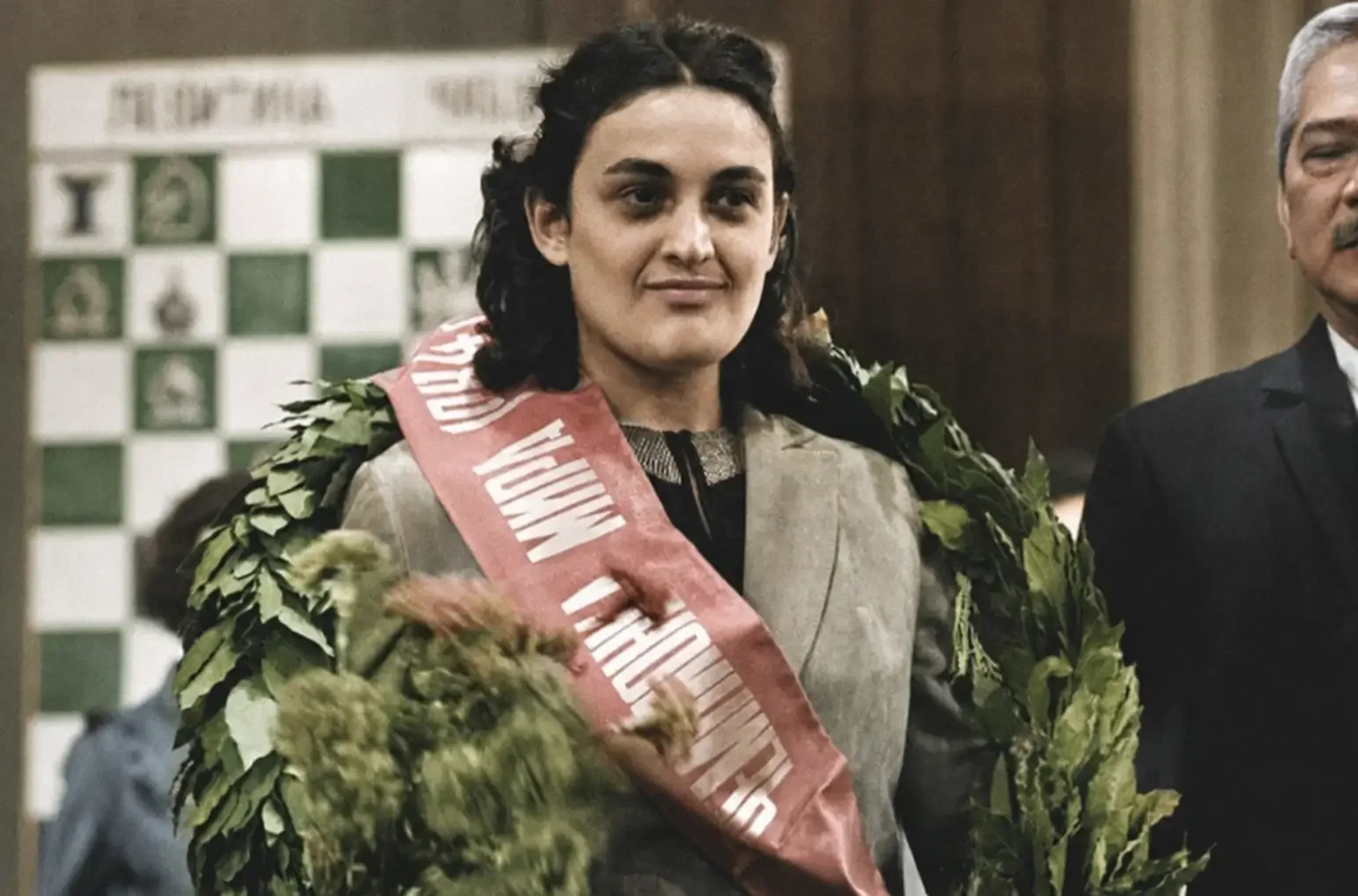
Maia Chiburdanidze (Georgian: მაია ჩიბურდანიძე; Russian: Майя Григорьевна Чибурданидзе; also rendered Maya in English) occupies a distinctive place in modern chess history. Born in Kutaisi on 17 January 1961, she became the sixth Women’s World Champion in 1978, at seventeen, and held the title until 1991. She remained the youngest holder of the title until Hou Yifan surpassed her age record in 2010. In 1984 Chiburdanidze became the second woman, after Nona Gaprindashvili, to receive FIDE’s unrestricted grandmaster title. At her January 1988 peak of 2560, she appeared among the first fifty names on the overall FIDE rating list. [1, 9, 12]
Those facts establish her eminence. A fuller explanation begins with a thirteen-year championship reign through four defenses, credible results in strong mixed competition, and one of the great records in Women’s Chess Olympiad history. Her career also connected two sporting systems. She was formed by Soviet Georgian institutions and became a leading representative of the USSR; after independence, she repeatedly led Georgia to team gold. Her historical position is therefore best understood in terms of championship strength, open-event credibility, and continuity across the Soviet and post-Soviet periods.
Early Life and Chess Formation
Chiburdanidze was the fourth child of Grigory Feofanovich Chiburdanidze, an agronomist, and Nelli Pavlovna Khurtsidze, a teacher of Russian language and literature. Chess was already present in the household. Her older brother Revaz, ten years her senior, taught her the moves when she was eight. Contemporary biographical writing describes a family that quickly recognized unusual ability. Some oft-repeated prodigy stories about her reading and arithmetic rest on family testimony and lack independent school records. Her brother’s early death interrupted the family’s chess routine and remained important in Chiburdanidze’s later recollections. [2, 3, 5]
Her first formal instruction took place at the Kutaisi Palace of Pioneers, where David Chiradze and Giorgi Kantaria were among her early teachers. By ten she had won the Georgian schoolgirls’ championship and was already competing successfully against adults. In 1972, Nelli Pavlovna moved with her daughter to Tbilisi so that Maia could receive more intensive instruction. That decision placed her within the Georgian capital’s unusually rich chess culture. She worked first with Yuri Chikovani and then with Mikhail Shishov. [3]
Shishov’s contemporary assessment is especially useful because it records strengths and limitations before later success obscured the developmental process. He praised her exceptional concentration, combinational vision, and rapid, accurate calculation. He also identified weaknesses in positional evaluation, technical conversion, and opening knowledge. Those gaps belong to her adolescence and should not be projected onto the mature champion. The next decisive influence was grandmaster Eduard Gufeld, who worked intensively with her in 1976 and 1977. In an interview conducted immediately after the 1978 championship match, Chiburdanidze credited Gufeld and her mother above all others. She said that Gufeld made her work, taught her strategy, and led her beyond the direct mating attacks she later called “children’s chess.” [3, 6]
Her education continued beside an increasingly demanding playing schedule. She entered the Tbilisi Medical Institute in 1978 and eventually graduated, although institutional references disagree on the year. Chiburdanidze later said that continuous tournament play prevented her from entering medical practice. [4, 8]
Rise in Competitive Chess
The speed of Chiburdanidze’s ascent was remarkable even by the standards of the Soviet chess system. In the 1973 USSR–Yugoslavia match, at twelve, she scored 4–0 against the adult Yugoslav champion Vlasta Kalchbrenner. Observers noted maneuvering, endgame technique, tactical attack, and combination across the four games. The contemporary account is celebratory; the score itself shows that she had already outgrown ordinary junior opposition. [3]
At 13, she won her first international tournament in Brașov in 1974, finishing three points ahead and earning the Woman International Master title. She won the USSR girls’ championship in 1976 and the senior USSR women’s championship in Lviv in 1977, completing the latter event undefeated. FIDE awarded her the Woman Grandmaster title that year. These were distinct achievements, a point worth stressing because some later anniversary notices mistakenly identify her as the 1976 USSR women’s champion. [8, 9]
Her entry into the world championship cycle came at the 1976 Tbilisi Interzonal, where the fifteen-year-old shared second place and qualified for the Candidates matches. She then defeated Nana Alexandria, Elena Akhmilovskaya, and the experienced former challenger Alla Kushnir. Each match was close. The sequence demonstrated sustained preparation, recovery within a match, and practical decision-making under pressure. [8, 10]
The resulting 1978 championship match paired her with Nona Gaprindashvili at Pitsunda in the Georgian SSR. Gaprindashvili had held the title for sixteen years and had provided the model for Georgia’s emergence as the center of Soviet women’s chess. Chiburdanidze admired her and later described Gaprindashvili’s bold play and conduct as exemplary. Their sporting succession should not be recast as personal hostility. [3]
After three opening draws, Chiburdanidze won the fourth and fifth games and retained the lead through the fifteenth. Her final score was 8½–6½, with four wins, two losses, and nine draws. Deputy chief arbiter Lev Abramov’s contemporary account emphasized her maturity, rational judgment, prepared ideas, and capacity to calculate quickly without entering needless complications. He also noted that her conversion technique still left opponents more resistance than necessary in some favorable positions. The match established both her strength and the remaining scope for development. [6, 9]
World Champion and International Grandmaster
Chiburdanidze’s championship reign lasted from 1978 to 1991. She retained the title in an 8–8 match with Nana Alexandria in 1981, then defeated Irina Levitina 8½–5½ in 1984, Elena Akhmilovskaya 8½–5½ in 1986, and Nana Ioseliani 8½–7½ in 1988. The last date is often misprinted as 1989 in Russian reference works. Describing her as a “five-time world champion,” common in Georgian and Russian commemorative writing, counts the original victory and four defenses. The clearer formulation is that she was world champion for thirteen years and successfully defended the title four times. [8, 9]
The drawn 1981 match was an early warning about the demands of incumbency. Chiburdanidze later recalled that her preparation had been inadequate and that opening work sometimes continued between games. She survived a sixteen-game struggle in which each player won four times. The more decisive victories over Levitina and Akhmilovskaya showed a champion with a broader strategic and technical range. Her final successful defense against Ioseliani was much closer and required steadiness over sixteen games. [4, 9]
FIDE awarded Chiburdanidze the unrestricted grandmaster title in 1984, a title earned in the common competitive field. Her mixed-event record explains its historical weight. She shared first place in Barcelona in 1979, won in New Delhi in 1984 and in Banja Luka in 1985, drew an eight-game match with Yugoslav grandmaster Petar Popović in 1986, shared third and fourth in Bilbao in 1987, and finished second in Brussels that year. At Bilbao she scored 5½ points in a field headed by Anatoly Karpov and Ulf Andersson, sharing her place with Ljubomir Ljubojević. Taken together, these results establish that the reigning Women’s World Champion could compete successfully with strong grandmasters in the same mixed field. [8, 12]
The January 1988 FIDE list placed her rating at 2560 and within the first fifty names overall. Exact ordinal claims vary because several players shared the same rating, so “world number 48” requires a tie-handling qualification. The broader fact is secure: she had reached a level then attained by very few women and had done so through a substantial body of mixed competition. [12]
In Manila in 1991, Chiburdanidze lost the title to Xie Jun by 6½–8½. The match marked a genuine change in international women’s chess, with China entering the championship succession. Chiburdanidze’s elite career continued. She tied Zsuzsa Polgar for first in the 1994 Candidates tournament at Tilburg, lost their 1995 playoff, and reached the semifinals of the knockout Women’s World Championship in both 2001 and 2004. Those later results attest to her continued relevance after the end of her reign. [9, 10]
Olympiad Leadership and the Soviet–Georgian Transition
Chiburdanidze’s Olympiad record is central to her historical profile. In seven appearances for the USSR from 1978 through 1990, she scored 58 points from 76 games, with 41 wins, 34 draws, and a single loss. The Soviet team won five consecutive gold medals from 1978 through 1986, followed by two silvers. Her consistency on the leading boards made her a foundation of a team that contained several current or future world-title challengers. [11]
The dissolution of the Soviet Union changed the flag beside her name, revealing the continuity of the Georgian school. At the 1992 Olympiad, she led newly independent Georgia on board one, remained undefeated, won 10 of 13 games, and received both team and individual gold; FIDE calculates a performance rating of 2692. Georgia won again in 1994 and 1996. At Dresden in 2008, when Chiburdanidze was forty-seven, she scored 7½/9 with a 2715 performance, won board-one gold, and helped Georgia regain the team title after twelve years. In a contemporary interview, she placed the collective result ahead of her own score. Gaprindashvili observed that the confidence of Chiburdanidze’s play spread through the team. [11, 16]
Across fifteen Olympiads from 1978 to 2008, Chiburdanidze scored 125½ points in 167 games, with 89 wins, 73 draws, and five losses. Her teams won nine gold medals, five with the USSR and four with Georgia. Nona Gaprindashvili won more team golds, so claims that Chiburdanidze’s total is unique are incorrect. Her record remains exceptional for its span, low loss rate, and successful leadership under two national systems. It makes her a particularly clear link between Soviet Georgian training and the international identity of independent Georgia. [11]
Style, Strengths, and Limitations
Chiburdanidze’s mature style is best described as intuitive, universal, and practical. In a long Georgian interview, she explained that she often sensed the correct plan before calculating and ordering its details. That self-description fits the contemporary evidence. Shishov first saw tactical vision, concentration, and speed of calculation. Gufeld broadened those gifts through strategy and technical work. Abramov’s 1978 match report emphasized rational choice and tactical foresight. FIDE’s museum profile preserves later assessments of her positional sense, endgame skill, patience, and combinational sight. [1, 3, 4, 6]
Her reputation as a calm player needs qualification. Chiburdanidze later said that she felt nervous strain intensely and learned to keep it from becoming visible. She treated chess as a psychological encounter and watched an opponent’s face, habits, and emotional response to the position. This helps explain her preference for human opponents. She used software for analysis, while continuing to value the human contest and the search for original ideas. [4, 5]
Her early limitations were clear: positional judgment, opening knowledge, and conversion technique lagged behind her calculation. Much of that gap closed during the work with Gufeld. A more complex limitation emerged during the championship years. Chiburdanidze later judged her own development severely, describing the thirteen-year reign as “lost time” in one specific sense. Strong match assistants and episodic coaches included Tamaz Giorgadze, Adrian Mikhalchishin, Gennady Kuzmin, and others. Her criticism concerned the absence of a stable day-to-day trainer whom she considered necessary for further progress against the strongest open-field players. After losing the title, regular work with Khvicha Supatashvili helped modernize her repertoire and renew her creative confidence. Her remarks are best read as a severe retrospective judgment on development during the reign. [4, 7]
Her mature repertoire was broad. She valued activity and the creation of winning chances, retained sharp combinational sight, simplified when appropriate, defended patiently, and won through small technical advantages. “Universal” is an interpretive summary grounded in several contemporary and retrospective descriptions.
Place in Soviet and International Chess Culture
Chiburdanidze benefited from a serious training structure: Pioneer Palaces, Georgian coaches, Soviet qualifying events, national-team preparation, and access to a dense competitive calendar. Rimma Bilunova, later head coach of the Soviet women’s team, also recalled having to press officials for places for Chiburdanidze in strong mixed tournaments because such competition was necessary for further growth. Bilunova remembered her as especially purposeful and hardworking among the emerging Georgian players. Her testimony places Chiburdanidze inside a strong system whose officials sometimes limited access to the competition needed for further development. [13]
Chiburdanidze continued the practical challenge that Gaprindashvili had posed to dismissive assumptions about women’s play. Her strongest argument was a competitive record: an unrestricted GM title, victories in mixed events, an overall top-fifty rating, and decades of results on first board. She also stated the principle directly in later interviews, rejecting the idea that chess talent or intelligence should be divided by sex. Women’s championships and team events occupied much of her calendar. Performances in mixed fields strongly shaped her wider standing. [1, 4, 13]
Within Georgia she became a national sporting figure as well as a Soviet champion. The relationship among Gaprindashvili, Chiburdanidze, Nana Alexandria, and Nana Ioseliani combined rivalry, team cooperation, and shared public symbolism. Tatia Skhirtladze’s documentary Glory to the Queen uses their careers to examine how Soviet media celebrated female achievement while presenting the players through approved images of youth, education, and femininity. That is the filmmaker’s historical interpretation. The underlying public prominence is well documented: these players helped make elite women’s chess a recognizable part of Georgian cultural life. [18]
Contributions Beyond Tournament Play
Chiburdanidze’s documented contributions beyond competition include two coauthored books, teaching at the academy, and an experimental approach to chess preparation.
With Eduard Gufeld and Arsen Yeremyan, she was credited as a coauthor of Майя Чибурданидзе: Играю против мужчин (Maia Chiburdanidze: I Play Against Men), published in Tbilisi in 1984. With Gennady Kuzmin she later coauthored Олимпиада-90: Избранные партии (Olympiad 90: Selected Games), published in 1991. These books preserve annotated play and aspects of her competitive outlook, giving her a documented place in the analytical literature of her period. [14]
By the late 2010s she had returned to more visible educational work. The Maia Chiburdanidze Chess Academy, also known as the “Chess Queen” Academy, opened in Tbilisi in September 2019, offering instruction based on her program and introductory outreach for children. FIDE’s Trainers’ Commission listed the academy among its endorsed institutions in 2023, and FIDE records Chiburdanidze as a Senior Trainer from 2020. The available record documents a selective training role focused on children and promising pupils. [1, 15]
Her most original pedagogical proposal has sometimes been called “Maia’s Chess.” Players begin from a fixed, preselected position reached several moves beyond the normal starting array. Chiburdanidze presented the format as a way to reduce rote computer preparation, restore independent decision-making, and give coaches more scope to teach a range of structures. She also associated it with lower pregame stress and proposed broader trials. The experiment reveals a coherent late-career concern: preserving human creativity in a computer-saturated chess culture. [4, 15]
Later Life and Historical Legacy
Chiburdanidze gradually reduced regular tournament activity, and FIDE now lists her standard rating as inactive. In later interviews she has discussed education, computer preparation, the psychology of competition, and the renewal of Georgian chess. Her medical education and broad intellectual interests remained part of her private life; she has said that the demands of tournament play kept her from medical practice. [1, 4, 5]
FIDE and national institutions have formally recognized her career. She was inducted into the World Chess Hall of Fame in 2014, in the same class as Paul Keres. The 2020 documentary Glory to the Queen situated her within the collective memory of Georgian women’s chess. Her academy and FIDE Senior Trainer title added an educational dimension to that legacy. [1, 15, 17, 18]
Chiburdanidze should be assessed in light of the competitive opportunities and institutional conditions of her own career. She held the world title for thirteen years, survived four different challengers, entered the overall top fifty, and produced elite Olympiad performances three decades apart. Few careers combine championship duration, mixed-event validation, and team leadership so convincingly.
Historical Assessment
Maia Chiburdanidze deserves sustained attention as a long-reigning champion, an unrestricted grandmaster with credible mixed-event results, and the first-board leader of independent Georgia’s finest Olympiad teams. Her later teaching and fixed-position experiments extended a career formed by Soviet Georgian institutions into a distinct educational legacy. Her record offers a precise case study in talent, institutional opportunity, uneven support, competitive longevity, and the passage from Soviet representation to Georgian national sporting identity.
Notes and Sources
FIDE, “Maia Chiburdanidze,” Commission for Women’s Chess; FIDE Open Chess Museum, “Maia Chiburdanidze”; FIDE, official rating and title profile. These are the principal official sources for title dates, FIDE titles, Olympiad totals, and current trainer designation.
Eduard Gufeld and Arsen Yeremyan, Семнадцать вёсен Майи (Moscow: Fizkultura i sport, 1980), St. Petersburg State Library for the Blind catalogue record, with a digitized contents listing. A near-contemporary biographical source, useful for family background and early development; its celebratory tone requires care.
Viktor L. Vasiliev, Нетерпение доброты, chapter “Главное – человек, шахматы потом” (Moscow: Fizkultura i sport, 1980), Russian transcription. This documentary account contains early coaching information, Shishov’s assessment, and Chiburdanidze’s interview immediately after the 1978 match.
Ia Antadze, “თუ საკუთარ თავში არ ჩაიკეტე, ახალს ვერაფერს შექმნი”, Georgian Public Broadcaster / 1TV. A long first-person retrospective on family support, education, intuition, preparation, coaching continuity, medicine, and her educational ideas.
Rati Shelegia, 2019 interview with Maia Chiburdanidze, Kviris Palitra, 23 August 2019; Ambebi family interview, 17 January 2021. These Georgian-language interviews support her own accounts of style, psychology, her brother, the lack of a permanent trainer, and the academy. Personal religious recollections are explicitly treated as testimony; no independent verification is claimed.
Lev Abramov, “Чемпионке – 17 лет,” Шахматы в СССР, 1978, no. 12, pp. 9–10, available through the digitized magazine archive. A contemporary assessment by the deputy chief arbiter of the 1978 match.
Mark Livshits, interview with Adrian Mikhalchishin, ChessPro, 2009, and a later Mikhalchishin interview, ChessPro, 2012. These recollections help identify Chiburdanidze’s changing network of coaches and seconds, including Tamaz Giorgadze and Gennady Kuzmin.
Vladimir Linder, “Чибурданидзе Майя Григорьевна”, Большая российская энциклопедия, 19 December 2024; Russian State Research Institute of Physical Culture and Sport, biographical entry; National Parliamentary Library of Georgia, Biographical Dictionary entry. These institutional references provide useful data and contain isolated inconsistencies. In particular, the Russian and Georgian encyclopedias disagree on her graduation year, and some Russian entries misdate the Ioseliani defense. The article therefore omits a medical graduation year and relies on FIDE for match chronology.
FIDE, Women’s World Champions. Used with the FIDE sources in note 1 for the 1978 match, four defenses, the 1991 loss, and later championship appearances.
OlimpBase, 1976 Tbilisi Interzonal, 1994 Candidates tournament, and 1995 Candidates playoff. These crosstables confirm qualification and later championship-cycle results.
OlimpBase, Chiburdanidze’s complete Women’s Olympiad record; FIDE, Commission for Women’s Chess profile; FIDE, “Remarkable Performances at Chess Olympiads”. These support the aggregate statistics and the 1992 and 2008 performances.
OlimpBase, January 1988 FIDE rating list; Bilbao 1987 crosstable; Banja Luka 1985 event record. Exact placement at 2560 depends on the treatment of tied ratings, hence the article’s “within the first fifty names” formulation.
Vladimir Barsky, interview with Rimma Bilunova, ChessPro, 2010. Bilunova’s firsthand recollections cover Chiburdanidze’s work ethic, Soviet team culture, and the effort required to secure strong mixed events for leading women.
Maia Chiburdanidze, Eduard Gufeld, and Arsen Yeremyan, Майя Чибурданидзе: Играю против мужчин (Tbilisi: Ganatleba, 1984), State Public Scientific and Technical Library of Russia bibliography; Maia Chiburdanidze and Gennady Kuzmin, Олимпиада-90: Избранные партии (Togliatti, 1991), National Library of Tatarstan catalogue.
Georgian Public Broadcaster, academy announcement, 7 May 2019, and 2024 retrospective; FIDE Trainers’ Commission, list of endorsed academies. These support the academy, her teaching program, and the fixed-position experiment.
ChessPro, interview after Georgia’s 2008 Olympiad victory; FIDE, 2008 performance retrospective.
World Chess Hall of Fame, Maya Chiburdanidze; US Chess Federation, 2014 induction announcement.
Austrian Films, interview with director Tatia Skhirtladze about Glory to the Queen; FIDE, “A Film to Watch: Glory to the Queen”. These sources support the discussion of Georgian cultural memory and the filmmaker’s interpretation of Soviet media imagery.
