J.H. Donner
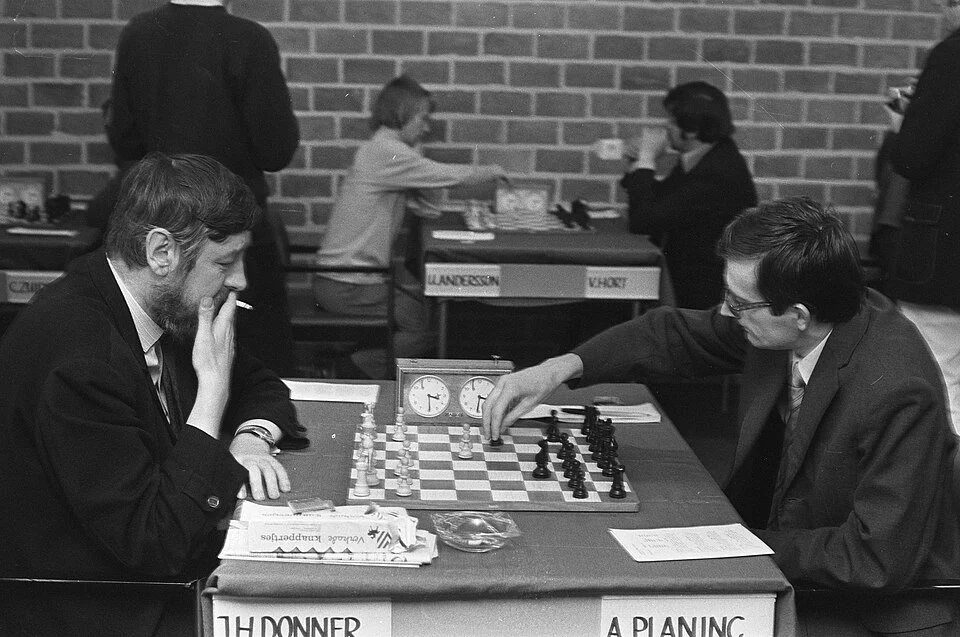
Albin Planinc vs. Jan Hein Donner at Wijk aan Zee. W. Punt for Anefo
Introduction
Johannes Hendrikus Donner, usually cited in chess literature as J.H. Donner and also found in sources as Hein Donner, Jan Hein Donner, or Jan-Hein Donner, was born in The Hague on July 6, 1927 and died in Amsterdam on November 27, 1988. Edward Winter has noted the unusually wide range of name variants in circulation, and Dutch literary reference works identify him as both a leading chess master and a public writer. For a Soviet chess history readership, his interest lies in his place among the strongest non-Soviet Europeans of the postwar decades, his repeated encounters with Soviet opposition, and his unusually powerful voice as a Western observer of master chess culture.
Donner belonged to Dutch chess rather than Soviet chess, yet he was never provincial. His career ran through elite international tournaments, Olympiads, zonals, and the major invitational events where Soviet champions and contenders set the standard. He won Hoogovens in 1950 and 1963, shared first there in 1958, won the IBM tournament in Amsterdam in 1965, won Venice in 1967 ahead of Tigran Petrosian, and represented the Netherlands eleven times at the Chess Olympiad. Those facts alone explain why Soviet and post-Soviet reference works continued to treat him as a significant rival from outside the Soviet system.
What gives Donner his lasting fascination, though, is not only the tournament record. He was also a self-conscious professional in a country where that identity was still unusual, a polemical journalist, an influential literary personality, and one of the rare chess writers whose prose survived the occasion that produced it. Jan Timman, writing soon after Donner’s death, treated him as a double talent, first a player and then increasingly a writer. That judgment remains a sound starting point for historical assessment.
Early Life and Chess Formation
Donner grew up in a conspicuously establishment Dutch family. His father, Mr. Dr. Jan Donner, had been Minister of Justice from 1926 to 1933, later a judge, and after the war president of the Dutch Supreme Court. The family was deeply rooted in the Reformed and Anti-Revolutionary political tradition, and later writers repeatedly described the household as severely Calvinist. Jeroen Vullings, drawing on Harry Mulisch’s formulation, summarized the milieu as a “steep Calvinist family with ministers and judges.” That background does not mechanically explain Donner’s later personality, yet it helps clarify the absolutist moral tone that runs through both his chess journalism and his literary criticism.
At the Christelijk Gymnasium Sorghvliet in The Hague, Donner later recalled that chess seized him at fourteen with destructive force. In Vullings’s account, quoting Donner, he set out to learn “the whole theory,” with the result that he repeated a year, skipped a class, and repeated another. The episode is useful because it captures the central feature of his formation: the sources emphasize obsession, self-direction, and willpower far more than organized coaching or systematic institutional training. After passing the gymnasium examination, he moved to Amsterdam for university study after the war.
In Amsterdam he enrolled in law at the Vrije Universiteit, also studying psychology for some years and medicine briefly, before abandoning formal academic completion in order to devote himself to chess. Multiple Dutch biographical sources agree on the pattern: he belonged by birth and education to the Dutch legal-intellectual elite, yet chose an occupation that remained precarious, improvisational, and culturally eccentric. That tension between patrician background and bohemian vocation remained one of the defining facts of his life.
Rise in Competitive Chess
Donner’s breakthrough came suddenly. In 1950, still only twenty-two, he won the Hoogovens tournament at Beverwijk. Tata Steel’s historical roll of champions records him as the winner of the 1950 edition, and Timman emphasized that he finished a full point ahead of Max Euwe and Nicolas Rossolimo. Donner himself later cultivated the image of a professional pioneer, and Timman wrote that he was the first person in the Netherlands to pride himself on being a professional chess player. The combination of an early major tournament victory and a self-conscious professional identity explains why Donner appeared, almost at once, as a successor figure to Euwe rather than only another talented national master.
The decisive domestic breakthrough came four years later. In the 1954 Dutch Championship, Donner finished first with 8/11, ahead of Nicolaas Cortlever and Euwe, thereby ending Euwe’s national hegemony after thirty-three years. He lost the 1955-56 return match with Euwe by 7-3, which showed the gap that still separated him from the older champion in match conditions, yet he recovered to win the Dutch title again in 1957 and 1958. In other words, his rise was genuine but uneven: he displaced Euwe in tournament play before he could equal Euwe’s stability.
Internationally, Donner moved close to the Candidates path several times. OlimpBase records him as tying for second-third in the Munich 1954 zonal, qualifying to the 1955 Gothenburg Interzonal, where he finished in the 19th-21st bracket. It also records further strong zonal showings in Wageningen in 1957 and Madrid in 1960, the latter producing a first-fourth tie before a failed playoff. Standard chess reference sources date his grandmaster title to 1959, by which point he had become the second Dutch grandmaster after Euwe. These results show a player who was too strong to be described as merely national, yet whose path repeatedly stopped short of the Candidates class.
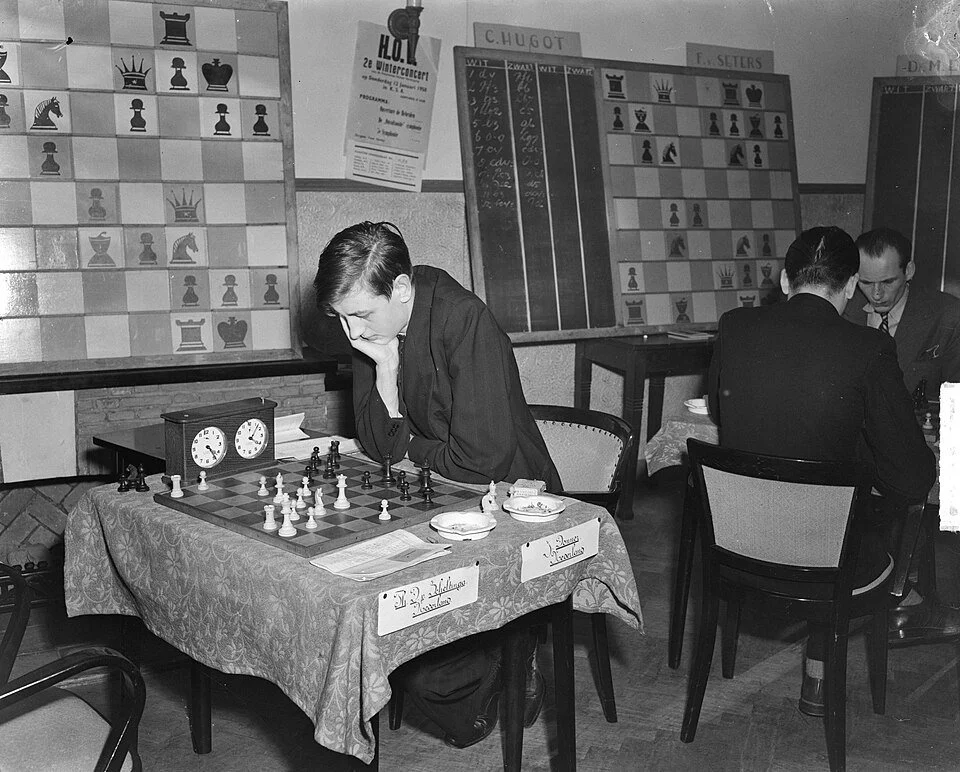
Hoogovenschaaktoernooi 1950
Major Career Achievements
Donner’s best period came in the 1960s. His clearest tournament triumph was Hoogovens 1963, where Tata Steel’s historical record lists him as sole winner, and OlimpBase’s cross-record shows him taking first place with 12/17. Timman later wrote that Donner himself always regarded this as his greatest result. Two years later he won the 1965 IBM tournament in Amsterdam, and contemporaries treated that same period as the moment when he genuinely connected with the world elite. Timman pointed to his board one performance at the 1965 European Team Championship in Hamburg and the invitation to the 1966 Piatigorsky Cup as evidence of that standing, while OlimpBase’s event review called his 5½/10 for the Netherlands in Hamburg “the only consolation” on a struggling team, which underscores how much rested on him individually.
His most famous non-Dutch tournament success came at Venice in 1967. Both the Max Euwe Centrum and Timman record that he won the event ahead of the reigning world champion Tigran Petrosian. This was the kind of result that Soviet and Eastern European reference works never ignored, because it placed a Dutch player ahead of the supreme representative of high Soviet positional chess. It did not turn Donner into a perennial world title contender, yet it fixed his international reputation more firmly than any domestic success could have done.
A lesser-known achievement, though one that says much about the respect he commanded, was his result in the 1970 four-player event at Oegstgeest. The Max Euwe Centrum summarizes it as a second place behind Boris Spassky, ahead of Mikhail Botvinnik and Bent Larsen, and Timman judged it Donner’s finest performance overall because he held his own against the absolute top level across twelve games. Even if one does not fully accept Timman’s ranking of Donner’s best event, the point is solid: this was not a fluke miniature or one heroic upset, but a sustained showing against first-rank opposition.
His Olympiad record was also substantial. OlimpBase gives him eleven Olympiad appearances for the Netherlands between 1950 and 1978, with 92 points from 153 games, and shows how he moved from reserve status to the first board by 1968 and 1972. In 1976, at Haifa, the Dutch team finished second, and Donner’s individual line there was 6/9 on board three. For a player from a country outside the Soviet bloc and outside the United States, that was a significant team achievement. It placed Donner within the strongest Dutch national team performance of his era and confirmed his value as a match player in team competition even after his individual peak had passed.
One game from his late career does deserve mention because of its broad historical resonance. At the 1978 Buenos Aires Olympiad, Liu Wenzhe’s short win over Donner became internationally famous. FIDE later called it the moment when “the whole world took notice” of Chinese chess, and OlimpBase treated it as one of the emblematic curiosities of the tournament. The game now belongs as much to Chinese chess history as to Donner’s, yet its place in his profile is justified because it marks his presence at another hinge point in international chess history.
Style and Reputation
Timman’s description of Donner’s chess remains the most precise compact assessment by a major successor. He saw affinities with Euwe: trust in the bishop pair, preference for a strong center, a serious feel for initiative, and especially fine endgame technique. He also identified Donner’s weakest area with unusual clarity, opening theory. According to Timman, Donner could control systems he truly understood, yet often had to fight his way out of inferior middlegames created by poor preparation. This accords well with Donner’s public reputation as an instinctive competitor rather than a laboratory theoretician.
Timman’s account also catches the psychological texture of Donner’s play. He described him laboring through bad positions, cigarette after cigarette, reaching difficult endgames a pawn down and then saving them by stubborn technique and will. He added that Donner neglected both opening preparation and physical condition, yet still qualified as a genuine professional through fighting spirit and sheer force of personality. When Donner lost to much weaker players, Timman attributed it to low motivation and underestimation rather than lack of class. As interpretation, this suggests a competitor of very high practical strength whose ceiling was real and whose consistency was self-limited.
His relationships with other players helped shape his reputation. Euwe was the unavoidable benchmark, first as the national patriarch whom Donner dethroned in 1954, later as the older player whose style Timman still saw echoed in Donner’s best games. Lodewijk Prins occupied the opposite role, less a model than a permanent target. The Max Euwe Centrum calls Donner’s verbal attacks on Prins notorious, and the literary lexicon describes his chess essays as polemical, exuberantly abusive, and determined to expose mediocrity. These disputes were not incidental ornaments to his image. They were part of how Donner presented himself as a man for whom chess remained inseparable from rank, intelligence, vanity, and combat.
Contributions Beyond Tournament Play
Donner’s second major career was in print. Dutch reference works agree that he began as a chess journalist for De Tijd in 1955, wrote simultaneously for Elseviers Weekblad, later contributed to Schaakbulletin, moved to De Volkskrant in 1975, and from 1985 wrote for NRC Handelsblad. The sheer spread of publications is important. Donner did not write only for specialist chess readers. He crossed repeatedly into the general Dutch public sphere, carrying chess with him into journalism, literary culture, and political and cultural polemic.
Critics of his prose described it in ways that still feel accurate. The Kritisch lexicon credits him with introducing “muscular reportage” into Dutch chess writing and stresses that his essays are inherently polemical. It also emphasizes a central point for chess historians: Donner refused to treat chess as a detached logical exercise. For him it was a struggle of character, instinct, and destruction. That conception helps explain why his tournament reports remain readable after the tournament facts themselves fade. He did not merely record results; he dramatized the human pressure inside them.
His life in letters extended far beyond chess journalism. Vullings records a long and unusually intense friendship with Harry Mulisch beginning in 1958, a friendship that produced three books by Donner on Mulisch, a great many articles and letters, and, after Donner’s death, a literary afterlife in Mulisch’s fiction. In De ontdekking van de hemel, the character Onno Quist was explicitly modeled in part on Donner. The literary lexicon’s judgment is careful and useful: Donner’s Mulisch criticism could be overblown and factually loose, yet later Mulisch scholarship would have been difficult to imagine without the groundwork he laid. This is an overlooked contribution because it places Donner inside postwar Dutch intellectual history, not merely chess history.
He also used public gestures to fuse chess, politics, and self-dramatization. Timman recounts that after Venice he declared on television that he would give the prize to the Vietcong, a gesture that cost him his relationship with Elsevier. Whether one reads the episode as conviction, theatricality, or both, it shows how far Donner stood from the restrained public style associated with Euwe. Even his non-chess literary interventions could be consequential. Dutch literary scholarship notes that in 1967 he wrote the essay that helped present Marten Toonder’s Bommel stories as literature, which is a small but telling sign of his range in Dutch letters.
The final phase of this writing career came after catastrophe. Donner suffered a cerebral hemorrhage on August 24, 1983. After rehabilitation he resumed column-writing, largely from care institutions, and in 1987 received the Henriëtte Roland Holst Prize for Na mijn dood geschreven. The jury report is especially valuable because it shows how his contemporaries understood the late work: not as a charitable tribute to an invalid, but as prose of unusual compression, originality, and force. Timman adds the concrete image that has become inseparable from the late Donner, typing with one finger in a wheelchair while following the chess world closely.
Historical Legacy
Donner’s final years changed the tone of his legacy. Vullings records that he spent his last five years in care institutions and died in Amsterdam’s Vreugdehof nursing home in 1988. Timman remembered that although he was paralyzed and had difficulty speaking, his mind remained intact. The late columns therefore acquired a double authority. They were written by a former elite player who had lost most of his body’s freedom and had gained a sharper sense of contingency, bitterness, and limit. That deepened his prose and broadened his audience beyond the chess world.
Within Dutch chess history, Donner occupies the central space between Euwe and Timman. Reference works identify him as the second Dutch grandmaster; FIDE’s obituary for Timman, in turn, described Timman as only the third Dutch player to reach that title, after Euwe and Donner. That chronology supports a larger interpretation: Donner carried Dutch ambitions through the decades when the Soviet Union set the world standard and before Timman restored Dutch presence at the Candidates level. He did so less by institutional school-building than by personal example, international competitiveness, and a public style that made chess culturally visible.
He deserves attention today because he joined three histories that are too often separated. He belongs to the history of postwar non-Soviet elite competition, to the history of Dutch public intellectual life, and to the history of chess writing as literature. Many stronger players have vanished from memory because their games alone were expected to carry them. Donner’s games were strong enough to place him among the serious Western rivals of the Soviet era, and his prose ensured that he would remain legible after the crosstables ceased to be fresh. That combination is rare. It is the best reason to keep reading him now.
Notes and Sources
This profile relies first on Dutch biographical and literary reference works hosted by DBNL, especially the biographical entry by G.J. van Bork and the substantial Kritisch lexicon essay by Jeroen Vullings. For tournament and match results, Olympiad records, zonals, and round-robin placements, the principal reference has been OlimpBase, supplemented where useful by the Tata Steel archive and the Max Euwe Centrum’s historical pages. For contemporary interpretation and retrospective assessment, Jan Timman’s 1989 memoir of Donner is especially important because it combines firsthand knowledge with analytical judgment.
Two small factual cautions deserve explicit notice. First, sources vary on how Donner’s forenames are presented. Winter has shown that the record includes Hein, Jan Hein, Jan-Hein, J.H., and other variants. Second, Dutch literary reference works sometimes place the grandmaster title in 1958, whereas standard chess reference sources and later federation summaries usually date the formal award to 1959. Since both datings appear in reputable sources, it is best to treat 1958 as the year by which the title had effectively been secured and 1959 as the conventional formal date.
For Donner’s literary afterlife and non-chess significance, the Vullings essay on Donner in Mulisch’s work and the Henriëtte Roland Holst Prize jury report are especially revealing. They show how contemporaries outside narrowly chess circles understood him: as more than a grandmaster who could write, and as a writer whose authority remained inseparable from the competitive severity of the chessboard.
