Nona Gaprindashvili

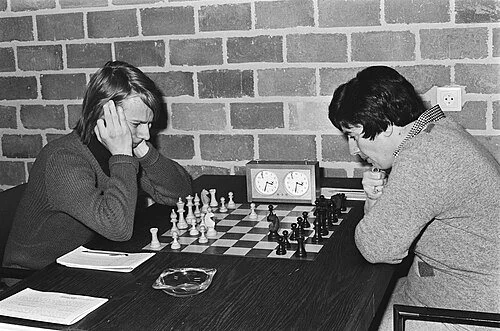
Gaprindashvili, Hoogovens 1963. Harry Pot / Anefo
Introduction
Nona Gaprindashvili occupies a rare position in chess history. She was the fifth Women's World Champion, held the title continuously from 1962 to 1978, and became the first woman awarded FIDE's open Grandmaster title in 1978. Her historical profile brings together sustained command of the women's world championship, credible success in strong open competition, and lasting institutional leadership in Georgian and international sport.
Born in Soviet Georgia, trained within its youth chess system, and active well into the post-Soviet era, Gaprindashvili belongs to several histories at once. She was a Soviet champion who retained a pronounced Georgian identity, a beneficiary of organized coaching who became a mentor and administrator, and a player whose appetite for initiative challenged the restrictive language then used to describe women's chess. Her record grows clearest when placed within its full setting: a sporting family, unusually perceptive coaching, an exacting tournament culture, state institutions, and her own unusually durable competitive temperament.[1][2]
Her standard English name is Nona Gaprindashvili. Russian sources give Нона Терентьевна Гаприндашвили, sometimes romanized with the patronymic Terentievna, while Georgian sources use ნონა გაფრინდაშვილი. The form used here follows current FIDE and Georgian practice.[2][3]
Early Life and Chess Formation
Gaprindashvili was born on 3 May 1941 in Zugdidi, in the Georgian Soviet Socialist Republic. Her father, Terenty Severyanovich, directed an agricultural school and taught at a technical college. Her mother, Vera Tadeevna, and her grandmother Kionia carried much of the daily responsibility for a large household. Nona was the fifth of six children and the only daughter. Her five brothers were Emzar, Tamaz, Jemal, Murad, and the younger Nugzar. The order is worth recording because many later profiles incorrectly call her the youngest child.[1]
The household was intensely sporting. Football, volleyball, basketball, table tennis, billiards, gymnastics, and chess all formed part of family and neighborhood life. Gaprindashvili learned the moves by watching her brothers, especially Emzar, and later recalled that they gave her no concessions because she was a girl. She understood that environment as an education in competition. Its importance was broader than early chess technique: it made playing boys and men feel ordinary long before mixed events became a public test of her status.[1]
Her decisive entrance into organized chess came in 1953. The Zugdidi House of Pioneers needed a girl for the Georgian school team championship in Batumi and selected the twelve-year-old whom local officials knew through her brothers. She scored 3.5 points from seven games. More consequentially, Vakhtang Karseladze, head of the chess section at the Tbilisi Palace of Pioneers and an early architect of the Georgian women's chess school, noticed her. With family support, she moved to Tbilisi in 1954 and lived with an aunt and uncle while studying under him.[1][4]
Karseladze's influence was formative. Gaprindashvili later associated him with the romantic element in her chess: combinations, imagination, independent judgment, and confidence in unfamiliar positions. He discouraged passive memorization and invited pupils to challenge a coach's analysis. The method suited a child already drawn to initiative. Her progress was rapid. She placed second in the 1955 Tbilisi women's championship, then won the 1956 Georgian women's championship with 15.5 points from 16, including fifteen victories.[1]
Mikhail Shishov became her principal coach at the start of 1957 and broadened Karseladze's foundation. He introduced a regular training schedule, classical strategic models, systematic opening study, defensive technique, and endgames. Gaprindashvili's own account presents this period as a demanding adjustment. She had been inclined to force events even when a position called for restraint. By the 1958 USSR Women's Championship in Kharkov, where she finished third and earned the USSR Master of Sport title in the women's category, her tactical gift had begun to operate inside a more stable positional framework. The complementary work of Karseladze and Shishov offers the most convincing explanation for the universality of her mature play.[1][2]
Chess did not displace formal education. Gaprindashvili studied English at the Tbilisi State Pedagogical Institute of Foreign Languages and graduated in 1971. In her 1977 memoir she wrote that she was working as an assistant in the institute's Department of Language and Literature Methodology. She married in 1969 and became a mother during the championship reign. Her memoir discusses the practical pressure of combining elite competition with family and household responsibilities.[2][5][11]

Gaprindashvili at Hoogovens 1969. Eric Koch / Anefo
Rise in Competitive Chess
The progress from promising junior to world-title challenger was swift without being smooth. Gaprindashvili scored 9.5 from 10 for Georgia at the 1959 Spartakiad of the Peoples of the USSR, then produced a less commanding result in that year's national women's championship. The experience reinforced Shishov's effort to temper impatience with strategic control. In 1960 she finished fourth in the USSR championship and qualified for the next Women's Candidates Tournament.[1]
At Vrnjačka Banja in 1961, in her first major individual event abroad, she scored 13 from 16 without a loss and finished two points ahead of Valentina Borisenko. A contemporary report in the Tbilisi newspaper Zarya Vostoka described a mid-tournament score of six points from seven games and printed Shishov's cautious assessment while the result was still being formed. The finished event confirmed more than tactical brilliance. Across sixteen rounds she sustained concentration, absorbed defensive pressure, and converted her initiative often enough to dominate a field of experienced internationals.[6][7]
Preparation for the 1962 world championship match against Elisaveta Bykova drew on a wider Georgian and Soviet network. Shishov remained the main trainer. David Bronstein and Bukhuti Gurgenidze consulted, with Bronstein paying particular attention to the endgame, the phase in which the experienced champion was expected to hold an advantage. Gaprindashvili also sought practice against male opposition in Georgia. The available specialists, training camps, and increasingly demanding competition gave structure to her preparation, while her choice of positions and opponents directly tested the perceived gaps in her game.[1][8]
Gaprindashvili defeated Bykova in Moscow by 9-2, with seven wins, four draws, and no losses. At twenty-one, she had become world champion through a decisive title-match victory. The reaction in Georgia was immediate. A contemporary Zarya Vostoka report described the reception at Tbilisi railway station, where she publicly thanked Shishov and others who had supported her. Photographs and reports placed her among institute colleagues, young players, and civic representatives. The welcome reflected personal fame and a broader sense that a Georgian sporting institution had produced a world champion.[9]
Major Career Achievements
Gaprindashvili's championship reign lasted sixteen years. She defended the title three times against Alla Kushnir, winning 8.5-4.5 in 1965, 8.5-4.5 in 1969, and 8.5-7.5 in 1972. The repeated pairing created the central rivalry of her reign. The first two matches confirmed her superiority over a formidable challenger; the third demanded recovery and endurance as Kushnir brought the contest to its narrowest margin. In 1975, Gaprindashvili defeated Nana Alexandria 8.5-3.5. Alexandria, like Gaprindashvili, had been trained by Karseladze, so the match also demonstrated the growing depth of the Georgian school.[10]
The reign ended in 1978 when seventeen-year-old Maia Chiburdanidze won their match 8.5-6.5, marking a transfer within an exceptionally strong Georgian succession. Gaprindashvili remained an elite contender for many years, winning the Bad Kissingen Interzonal in 1982, the Kuala Lumpur Interzonal in 1990, and sharing first at the 1991 Subotica Interzonal. Her peak official rating of 2495 in 1987 and her continued success in qualification events show that the post-1978 phase was a substantial second career.[3][11]
Her national record supplies another measure of longevity. Gaprindashvili won the USSR Women's Championship five times: 1964, 1973/74, 1981, 1983, and 1985, sharing the 1981 title with Nana Ioseliani. Three of those victories came after she had lost the world crown. She also won the individual European Cup for national women's champions in 1969 and 1972. In 1982 she became the first woman to receive the Chess Oscar. These results resist any simple division between a dominant championship period and a ceremonial later phase.[2][3]
Team play amplified that consistency. Gaprindashvili represented the USSR in eleven Women's Olympiads from 1963 through 1990. The team won gold in her first ten appearances and silver in 1990. She then helped independent Georgia win gold in 1992. Across twelve Olympiads, OlimpBase records eleven team gold medals, one team silver, and thirteen individual medals, including nine golds. Her total score was 107 from 128 games. The precise medal accounting can be confusing in later summaries, yet the central point is clear: her Olympiad record joined individual excellence to more than three decades of dependable team performance.[12]
Open competition was essential to Gaprindashvili's historical reputation. At Hastings in 1963/64 she shared first in the Challengers section, an important result that is sometimes inflated into victory in the Premier event. Her defining open tournament was Lone Pine in California in 1977. She scored 6.5 from nine and shared first with Yuri Balashov, Oscar Panno, and Dragutin Šahović in a forty-eight-player international field. The result produced a Grandmaster norm. In 1978 FIDE awarded her the open GM title after that norm and her wider record in open competition, making her the first woman to receive it. The title was distinct from the Woman Grandmaster title she had received in 1976.[3][13][14]
Gaprindashvili also won mixed international events, notably Reggio Emilia in 1982/83, where she finished unbeaten with 8 from 11. She sustained rated competition far beyond the normal span of an elite career and won eight Women's World Senior titles, in 1995, 2009, 2014, 2015, 2016, 2018, 2019, and 2022. The championship later divided into age categories, so the formats are not identical across the full series. Her eighth title came at Assisi in 2022, where, aged eighty-one, she scored seven points and had the best tie-break among the women competing in the Open 65+ section.[2][11][15]
Gaprindashvili in 1979 at the Hoogovens-schaacktoernooi. Fernando Pereira
Style and Reputation
Gaprindashvili's most durable stylistic quality was her pursuit of the initiative. As a young player she willingly accepted material or structural risk to obtain active pieces, tactical pressure, and difficult decisions for the opponent. In 2010 she said that her chess temperament most resembled Mikhail Tal's and identified tactics as the strongest component of her chess. Her intuition often led her toward resources that a more conventional calculation process might never consider.[5][16]
Contemporaries frequently called this a "male" or "masculine" style. Alexander Konstantinopolsky, writing after the 1961 Candidates Tournament, used the language while identifying concrete features: persistent aggression, willingness to play for a win when a draw would serve the tournament situation, and an instinct for forcing opponents into practical error. The gendered label belongs to the assumptions of the period. The useful chess content lies in the qualities underneath it. Gaprindashvili was initiative-seeking, concrete, tactically inventive, and psychologically comfortable in double-edged positions.[16]
Her early game also had identifiable developmental limits. Konstantinopolsky noted that ambitious play could leave positional weaknesses, while Gaprindashvili herself recalled a youthful tendency to force complications and less enthusiasm for technical strategic study. Shishov's training in maneuvering, defense, and endings made those risks more selective. Aivars Gipslis, who became her long-term coach during the championship years, added deep opening erudition and a calm analytical presence. Their work helped turn a natural attacker into a broad practical player who could win through pressure, positional control, defense, or direct combination.[1][16]
Gaprindashvili was unusually candid about opening preparation. In a 2010 interview she said that it had not been her strongest area during much of her reign. The provocative headline claiming that she became champion without really knowing openings should not be read literally, since her memoir documents serious work with Shishov and Gipslis. Her point concerned temperament and method: she preferred understanding ideas and finding something original at the board to reproducing long files from memory. After 1978, work with Elizbar Ubilava and especially Georgy Borisenko made her preparation more systematic. She credited Borisenko with teaching her how to develop personal ideas inside a stable repertoire.[5]
One game deserves brief mention because it shows the mature balance of her style. Against Dragoljub Velimirović in 1984, Gaprindashvili met a dangerous sacrificial attack with active tactical defense and counter-sacrifices. The game ended in a draw. In 2010 she recalled that the USSR Chess Federation awarded it a best-game prize, although a later interview associated the recognition with Chess Informant. It was the only draw she selected for her 2001 collection of best games. Its significance lies less in any single variation than in the transformation it records: the young player who once needed the initiative had become a defender capable of creating counterplay under extreme pressure.[5][8]
Her reputation among other players consequently extended beyond spectacular attacks. It included competitive nerve, resistance, and the ability to impose practical problems across a long match or tournament. Ludmila Belavenets praised her psychological stability, while Tatiana Zatulovskaya emphasized her influence on other leading women entering open events. Her own open results supplied direct evidence against the assumption that the women's champion belonged only in a separate competitive sphere.[13][17]
Contributions Beyond Tournament Play
Gaprindashvili's contribution outside tournament play was concentrated in mentoring, writing, and sports administration. Her autobiographical writing first appeared in Georgian as არსი ჩემი ცხოვრებისა (The Essence of My Life), recorded with the writer Viktor Vasiliev and published in Tbilisi in 1976. The Russian volume Predpochitayu risk (I Prefer Risk) followed in Moscow in 1977. These books offer an unusually rich first-person account of family life, training methods, championship preparation, gender, and the ethics of risk. Because the text is a literary collaboration and the accessible Russian copy contains occasional scanning errors, its factual details require comparison with contemporary records. Its reflections on coaches and style remain indispensable. A Georgian collection of her selected games followed in 2001, organized into short games, games against women, and games against men.[1][2][5]
She also became a chess-school director and mentor. Vasiliev's later history of the Georgian school records her direction of a Tbilisi municipal chess school whose groups extended to several Georgian cities. Gaprindashvili has identified Woman Grandmaster Ana Matnadze as a former student, and her later advice to younger players repeated Karseladze's central lesson: computer preparation should accompany independent analysis and the search for one's own ideas. This continuity of method is one of her quieter contributions.[4][5][18]
Her administrative career was substantial. She led FIDE's Commission for Women's Chess during the early 1980s through 1986, although official Georgian and Russian sources differ over whether the chairmanship began in 1978 or 1980. She captained the Georgian women's team to Olympiad bronze in 1998 and served as president of the Georgian Chess Federation from 2000 to 2002. She also served in the Georgian SSR Supreme Council. These positions enlarged her influence beyond the authority of a celebrated former champion.[2][3]
Her most consequential administrative role lay in the Olympic movement. Gaprindashvili became the first president of the Georgian National Olympic Committee when it was founded in 1989. She led it through the dissolution of the Soviet Union, conditional recognition by the International Olympic Committee in 1992, full recognition in 1993, and Georgia's early years of independent Olympic participation. Her term ended in 1996, after which she became honorary president. This was practical institution-building during a difficult political transition, with responsibilities far removed from ceremonial patronage.[19]
The relationships that shaped her career remained visible in this later work. Karseladze gave her the intellectual confidence of an independent analyst. Shishov supplied structure. Bronstein and Gurgenidze contributed specialist help before the first title match. Alexei Suetin and Gipslis assisted before the first Kushnir match, and Gipslis became the central coach of the mature championship period. Ubilava and Borisenko supported her reinvention after 1978. Gaprindashvili's career is therefore a useful corrective to the solitary-genius model: individual originality flourished through a succession of distinct, carefully chosen collaborations.[1][5][8]
Historical Legacy
Gaprindashvili's rise helped make women's chess a major element of Georgian cultural life. Her 1962 victory was catalytic, while the later dominance of Georgian players had several causes: Karseladze's coaching tradition, strong youth institutions, frequent competition, public attention, and an overlap of generations. Gaprindashvili, Alexandria, Chiburdanidze, Ioseliani, and their successors competed with and learned from one another over decades. Assigning the entire phenomenon to one champion would obscure the system that formed her. Omitting her example would be equally misleading.[4][17]
FIDE created the Nona Gaprindashvili Trophy in 1997 for the federation with the best combined result across the open and women's sections of the Chess Olympiad. The choice reflects a career that linked those two competitive arenas. Gaprindashvili had also played on independent Georgia's 1992 Olympiad gold-medal team.[2][12][20]
Her name has acquired a permanent public presence. The Tbilisi Chess Palace was named for her in 2001, and a commemorative star was unveiled outside it in 2016. She entered the World Chess Hall of Fame in 2013. In June 2026, during celebrations of her eighty-fifth birthday, Georgia presented her with its highest national award for sporting achievement. These honors recognize competitive accomplishment, public service, and exceptional longevity.[2][21][22]
The defense of her historical record also became part of her later public life. In 2021 she sued Netflix over a line in The Queen's Gambit stating that she had never faced men. That assertion contradicted a central, documented part of her career. In January 2022 a federal court dismissed her false-light theory but allowed the defamation claim to proceed and denied Netflix's motion to strike it. The parties reached a confidential settlement that September, and the case ended without a trial judgment on the merits. The episode is relevant because the disputed wording erased the very open competition on which her pioneering status rested. Legal accuracy requires an equally clear limitation: the settlement terms were undisclosed, and the case did not yield a final judicial finding on every contested factual claim.[23]
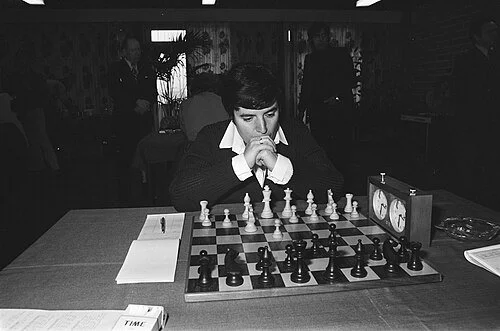
Hoogovens-schaacktoernooi 1979. Fernando Pereira
Historical Assessment
Nona Gaprindashvili deserves attention today because she combined championship authority with a broader competitive and institutional record. She ruled the women's championship for sixteen years, established credibility in strong open tournaments, became the first woman to receive the open Grandmaster title, and remained a serious contender after losing the crown. She then used her stature in mentoring, chess administration, and the creation of independent Georgian sports institutions.
Her career also rewards careful historical reading. Gaprindashvili joined the traditions of the women's world championship to ambitious open competition, then carried the authority earned at the board into mentoring and sports administration. Her influence grew within the Georgian school and later helped shape Georgia's independent Olympic institutions. Across those roles, she widened the competitive horizon available to women through documented results and connected Soviet chess culture to the international game of the twenty-first century.
Notes and Sources
Nona Gaprindashvili, Predpochitayu risk (Moscow: Molodaya Gvardiya, 1977), literary recording by Viktor Vasiliev. Linked Russian chapters: "Правила игры", "Романтика. Здравый смысл. Эрудиция", and "Хорошо быть темной лошадкой". The web transcription contains occasional OCR errors, so numerical claims have been checked against official or contemporary records. The earlier Georgian-language autobiography is listed separately in Note 2; no claim is made here that the Russian book is a direct translation.
Georgian National Academy of Sciences, "ნონა გაფრინდაშვილი", Georgian Encyclopedia. This is the principal Georgian reference for birth, education, championship years, Olympiad medals, senior titles, offices, publications, and honors. Its bibliography records არსი ჩემი ცხოვრებისა (The Essence of My Life), literary recording by Viktor Vasiliev (Tbilisi, 1976), and რჩეული პარტიები (Selected Games, Tbilisi, 2001). See also the National Parliamentary Library of Georgia, Biographical Dictionary entry.
FIDE, official rating and title profile, confirming WIM 1961, IM 1962, WGM 1976, and GM 1978; Russian Chess Federation, "Nona Gaprindashvili at 75", for championship and administrative data.
Viktor Vasiliev, Neterpenie dobroty (Moscow: Fizkultura i sport, 1980), online chapter "Грузинский феномен", on Karseladze, the Georgian coaching system, and Gaprindashvili's municipal chess-school work; Russian Chess Federation, profile of Vakhtang Karseladze.
Maria Fominykh, "Нона Гаприндашвили: Я стала чемпионкой, особо не зная дебютов", ChessPro, 2010. This first-person interview is central for her assessment of tactics, intuition, opening preparation, Ubilava, Rashkovsky, Borisenko, and the 1984 Velimirović game. See also Gaprindashvili, "Не для слабых духом", on chess, work, and family obligations.
Zarya Vostoka, no. 260 (1961), digital facsimile, National Parliamentary Library of Georgia, for contemporary coverage of the Vrnjačka Banja Candidates Tournament and Shishov's comments.
FIDE, history of the Women's World Championship, for the undefeated 1961 Candidates result; Gaprindashvili, "Партия жизни", for her recollection of the event.
Gaprindashvili, memoir chapter on her coaches; Sagar Shah, "Gaprindashvili: I am very thankful that chess was my sport of choice", ChessBase, 2018. Statements about informal Soviet restrictions on male grandmasters assisting women come from Gaprindashvili's later recollection and are not treated here as independently established policy.
Zarya Vostoka, no. 249 (1962), digital facsimile, National Parliamentary Library of Georgia, for her Tbilisi reception and acknowledgment of Shishov; see also no. 244 (1962), contemporary match report.
FIDE Open Chess Museum, Nona Gaprindashvili champion profile, for the match records against Bykova, Kushnir, Alexandria, and Chiburdanidze. The played match scores are used here in preference to several later profiles that reproduce scheduled match lengths as final scores.
Tibor Károlyi, Nona Gaprindashvili: Legendary Chess Careers (Chess Evolution, 2016), a specialist career study based partly on interviews, p. 82 for the 1969 marriage date; OlimpBase, July 1987 FIDE rating list; 365Chess, Kuala Lumpur 1990 and Subotica 1991; Classic Chess, Reggio Emilia 1982/83 crosstable.
OlimpBase, Gaprindashvili's USSR team record and all-time Women's Olympiad statistics, for appearances, scores, and team and individual medal accounting.
FIDE Commission for Women's Chess, Nona Gaprindashvili biography, for Lone Pine and the 1978 GM title; Lone Pine 1977 crosstable, confirming the four-way tie on 6.5 points.
Károlyi, Nona Gaprindashvili: Legendary Chess Careers, a specialist synthesis; Edward Winter, "Chess and Women", for contemporary reaction to the significance of her Lone Pine result.
FIDE, 2022 World Senior Championship report and FIDE Commission for Women's Chess, report on her eighth senior title.
Gaprindashvili, "Предпочитаю риск", and "Хорошо быть темной лошадкой", for her description of risk and the contemporary assessment by Alexander Konstantinopolsky.
Interviews with Soviet contemporaries collected by ChessPro: Ludmila Belavenets, "Золотая пешка", and Tatiana Zatulovskaya, interview on the rise of Georgian women's chess.
Shah, 2018 ChessBase interview, for Gaprindashvili's identification of Ana Matnadze as a former student; Fominykh, 2010 ChessPro interview, for her later training advice.
Georgian National Olympic Committee, official institutional history, for Gaprindashvili's election as first president, IOC recognition, and the dates of her term.
FIDE Open Chess Museum, Nona Gaprindashvili Trophy, for the trophy's origin and combined open and women's Olympiad basis.
World Chess Hall of Fame, Nona Gaprindashvili, for her 2013 induction.
FIDE, "Georgia honours Nona Gaprindashvili with highest national sports award", 28 June 2026.
U.S. District Court for the Central District of California, order dismissing the false-light claim while allowing the defamation claim to proceed and denying the motion to strike, 27 January 2022; case docket reproduced by Justia, including the 6 September 2022 stipulated dismissal; TASS, Russian-language report on the confidential settlement, 6 September 2022. A docket records allegations and procedure, not findings of liability.
