Albert Kapengut
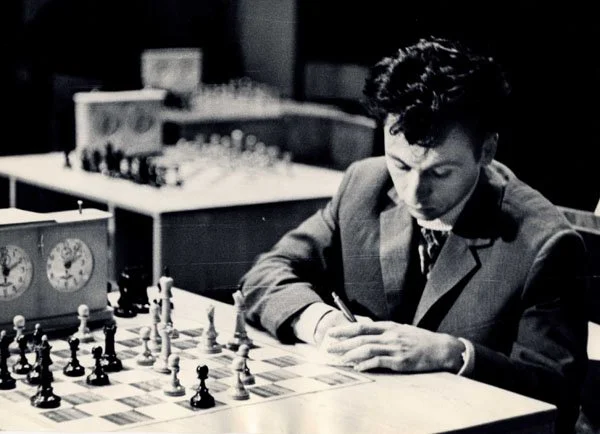
Kapengut seals his 41st move in the game v. Balashov at the 39th USSR Championship. Douglas Griffin Chess
Introduction
Albert Zinovievich Kapengut (Russian: Альберт Зиновьевич Капенгут; Belarusian: Альберт Зіноўевіч Капенгут), born 4 July 1944, belongs to a distinctive category in Soviet chess: the player whose international title understates both his competitive strength and his historical reach. He earned the Soviet Master of Sport standard at seventeen, won the 1964 USSR junior championship, helped the Soviet Union win four World Student Team Championships, reached two USSR Championship finals, and won or shared first in seven championships of the Belorussian Soviet Socialist Republic. FIDE formally awarded him the International Master title only in 1991. His larger influence came through analysis, writing, and coaching, especially his long work with Boris Gelfand and his shorter assignments with Mikhail Tal and Anatoly Karpov. Russian Chess Federation; FIDE rating profile
Kapengut’s career also illuminates a recurring problem in Soviet chess biography. Tournament results, titles, and official appointments are reasonably verifiable. Explanations involving travel permission and administrative obstruction often survive only through testimony because relevant state or federation files remain unavailable. His life therefore requires two levels of narration: a secure competitive record, and a more cautiously framed account of the circumstances that may have limited it.
Early Life and Chess Formation
Kapengut was born in Kazan while his father, Zinoviy, was recovering there from a severe wartime wound. His parents had lived in Minsk before the German invasion and returned to the devastated city in 1946. His father was trained as a historian; his mother, Anna, came from a family of doctors in Riga and was a conservatory-trained musician. These details do not establish a direct cause of his chess ability, though they help explain the intellectually broad household recalled in later biographical accounts. Douglas Griffin, “Stein v. Kapengut”
At ten he entered the chess section of the Minsk Palace of Pioneers, where Abo Shagalovich trained much of the postwar Belarusian generation. Around age fourteen or fifteen, Kapengut began working with Isaac Boleslavsky, the Minsk-based grandmaster and one of the leading opening analysts of his era. That relationship supplied more than variations. Kapengut later recalled that when he brought Boleslavsky a question, the teacher first asked what he had already read. Preparation became the price of instruction. After leaving the army in 1966, Kapengut checked recommendations and corrected material for the first volume of a Boleslavsky opening manuscript intended for East Germany. This editorial apprenticeship sharpened the habits that later defined his own theory and coaching. Kapengut on Boleslavsky
His formal education initially followed architecture and construction. After secondary school, he attended an architectural and construction technical college and worked at the Belgosproekt design institute before military service. A transfer to Riga in 1964, arranged after trainer Alexander Koblencs encountered him at a regional event, placed him close to Mikhail Tal. Kapengut recalled sharing first with Tal in a blitz tournament and winning the ensuing playoff match. The playoff story rests on his recollection; their friendship and later professional collaboration are independently well attested. Kapengut interview, 2025
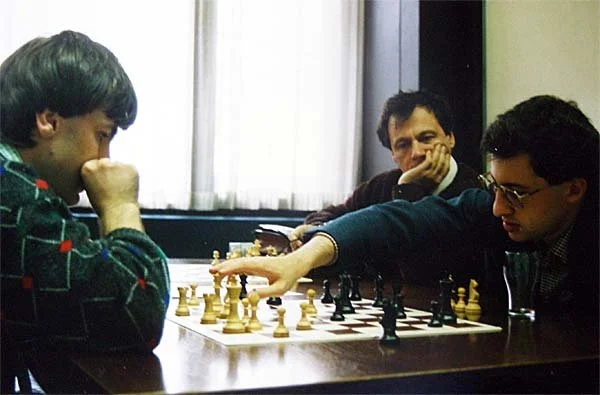
At the Tilburg super-tournament in late 1990, Kapengut looks on as Vasily Ivanchuk analyses with Boris Gelfand.
Rise in Competitive Chess
Kapengut’s ascent was unusually rapid. He became Minsk champion in 1961 and earned the Soviet Master of Sport standard the following year, at seventeen. In 1964 he won the USSR junior championship ahead of a generation that included Vladimir Tukmakov, Vitaly Tseshkovsky, Roman Dzindzichashvili, and Alvis Vitolins.
That same year he began an exceptional run in the World Student Team Championship. Across the 1964, 1965, 1966, and 1968 events he scored 20½ points from 27 games. The Soviet team won gold on all four occasions, while Kapengut earned individual board golds in 1966 and 1968. His 1966 result, 7½ from 8, was the statistical peak of the sequence. OlimpBase student record; Belarus Chess Center historical record
He also played in the BSSR team that took bronze at the 1963 Spartakiad of the Peoples of the USSR and in the Burevestnik side that won the 1968 USSR championship of the voluntary sports societies. Within Belarus, he became one of the dominant championship players of his generation. The most supportable count is seven first-place finishes or shares: 1962, 1968, 1969, 1970, and 1976 through 1978. In 1970 he tied for first with two others, while Viktor Zhelyandinov received the formal championship designation on tiebreak. This detail explains why title totals and year lists differ among reference works. “Seven-time champion” is the conventional description, though “seven-time winner or co-winner” is more exact. Kapengut, Theorist, Player, Coach
The 1970 rating list published by Arpad Elo in CHESS placed Kapengut at 2490, equal 78th in the world. Early lists were incomplete and cannot be compared mechanically with modern ratings, yet the figure locates him within the top hundred names on the published list. His lack of an international title at that date is therefore a poor measure of playing strength. FIDE rating list, 1970
Major Career Achievements
Qualification for a USSR Championship final was a severe test because strong masters first had to survive republican, society, or semifinal stages. Kapengut reached the final twice. In Leningrad in 1971, on his debut, he scored 10½ from 21 and finished equal tenth to eleventh, listed tenth on tiebreak. The field included Vasily Smyslov, Mikhail Tal, David Bronstein, Lev Polugaevsky, Efim Geller, Leonid Stein, and the young Anatoly Karpov.
Kapengut defeated Stein, a three-time Soviet champion, in the game most often cited as evidence of his capacity to compete with the elite. Its historical value lies in the result and in Kapengut’s confident handling of a complex, prepared struggle. Griffin, with Kapengut’s contemporary annotations
His second final, Baku 1972, produced 9½ from 21 and a share of thirteenth through sixteenth. Taken together, the finals support a restrained assessment. Kapengut was an upper-level Soviet master capable of beating leading grandmasters and holding his place in exceptional company. His results did not establish sustained Soviet title-challenger strength. That distinction is important because later admirers have sometimes converted a plausible claim about lost opportunities into an unprovable grandmaster counterfactual. Baku 1972 crosstable
The lost-opportunity question nevertheless has a factual core. Kapengut has said that he brought a copy of Boris Pasternak’s prohibited novel Doctor Zhivago home from Sweden in 1966 and lent it to friends. According to his account, officials initially refused him permission for the 1968 student championship in Austria, relented for that single trip after intervention by a senior sports official, and then withheld Western travel.
He subsequently played in Kecskemét in 1971 and Lublin in 1973, both in socialist countries, and achieved International Master norms. Kapengut says the Soviet federation failed to submit the necessary papers to FIDE. In a 2025 interview, he explicitly stated that he could only guess whether the initiative came from the security apparatus or Central Chess Club director Viktor Baturinsky. No published archival file cited in the present research settles that question. The secure facts are the reported norm performances, the long delay, and FIDE’s eventual award of the title in 1991 after a tournament in Debrecen. Kapengut interview; FIDE profile
By the late 1970s, Kapengut had regained the BSSR title three years running. He later recalled that in 1978 he qualified for the USSR First League after finishing only half a point behind the teenage Garry Kasparov in a preliminary event, then performed poorly in the league while ill. Tal’s invitation to serve as a second offered a different route. Kapengut described that moment as the turning point in his career, when he shifted the center of his focus from competition to training. The turn was gradual, since he continued to play domestic events, but historically decisive. Kapengut interview
Style and Reputation
The evidence suggests a research-driven, dynamic player. Kapengut’s association with the Modern Benoni was central, since that opening requires comfort with structural risk, uneven space, active counterplay, and positions whose strategic logic often depends on concrete calculation. Boleslavsky’s influence encouraged him to integrate opening research with the characteristic middlegames that followed.
His strongest qualities were analytical persistence, theoretical imagination, and a readiness to test sharp ideas in serious competition. The win over Stein in 1971 is representative. So is Tal’s willingness to use Kapengut’s work during the 1979 Riga Interzonal. Kapengut later claimed that Tal employed four of his prepared novelties there; Tal’s published closing remarks thanked him for help with opening preparation and positional analysis. The contemporary acknowledgment supports the broad claim even if the precise authorship of each novelty remains difficult to reconstruct. Kapengut on Tal
The practical record also reveals limits. His first USSR final contained six wins and six losses, evidence of ambition and volatility; his second brought fewer decisive successes. His all-Union results were less consistent than his record in Belarus and student team events. On Kapengut’s account, restricted international travel reduced the number of norm opportunities and strong round robins available to him, while a growing commitment to coaching divided his attention. The surviving evidence cannot assign exact weight to competitive inconsistency, institutional restriction, and professional choice. A careful assessment recognizes all three.
Kapengut’s later teaching also argues against reducing him to a narrow opening specialist. Gelfand recalled that his trainer demanded questions before agreeing to a lesson, required extensive homework, and taught him to organize magazines, bulletins, and Chess Informants with unusual rigor. Kapengut also urged him to become a universal player and study every major school. In Gelfand’s concise formulation, Kapengut “forced me to ask questions.” The comment captures a reputation built on disciplined independence and active learning. Gelfand on Kapengut; ChessPro interview with Gelfand
Contributions Beyond Tournament Play
Kapengut entered institutional coaching early. From 1969 he served as head trainer of the Belarusian trade-union youth chess school, taking a vacancy left by Alexey Sokolsky and helping maintain Minsk as a serious training center. He also participated in the Sokolsky memorials as player and organizer.
Around 1972 he took charge of the republic’s qualification commission and expanded its card index from Spartak candidate masters to rated players across Belarus. This little-noticed recordkeeping work supported the infrastructure through which advancement and tournament eligibility were administered. In this setting, coaching, tournament administration, editorial work, and theoretical research formed a single professional culture. Russian Chess Federation profile; Kapengut, Theorist, Player, Coach
His elite assignments demonstrate the value placed on his analysis. Before the 1978 Karpov-Korchnoi match, Semyon Furman commissioned him to continue a broad opening study begun by Boleslavsky. In 1979 Kapengut worked directly with Tal before and during the Riga Interzonal, which Tal won by a wide margin. In 1984 and 1985 he joined Karpov’s preparation for the first match with Kasparov, concentrating especially on Modern Benoni structures.
Russian Chess Federation accounts also associate him with the training staff of Elena Akhmilovskaya and with analytical assistance to several other Soviet grandmasters. These roles varied in duration and form, so “trainer,” “second,” and “analyst” should not be treated as interchangeable in every instance. Kapengut on his work with Karpov; Russian Chess Federation profile
His defining coaching relationship began in autumn 1980, when Eduard Zelkind emigrated and asked Kapengut to take over the most promising member of his Minsk group, Boris Gelfand. Kapengut recalled that the young player initially came to his apartment four times a week for sessions lasting three or four hours. Their intensive collaboration accompanied Gelfand from exceptional junior to world-class grandmaster.
Kapengut traveled with him when he first shared the 1990 Manila Interzonal and throughout the subsequent Candidates matches with Predrag Nikolic and Nigel Short. As Gelfand entered the elite, the relationship became more collaborative, but its original method remained visible: independent questioning, exhaustive analysis of one’s own games, broad chess culture, and disciplined information management.
Kapengut also trained Ilya Smirin for four years and worked with Yury Shulman, both of whom became grandmasters. The USSR Chess Federation awarded him the Mikhail Chigorin medal for coaching in 1988, the same year he received the designation Honored Trainer of the BSSR. In 2013, the FIDE Trainers’ Commission elected him to its Trainers’ Hall of Fame. This should be identified precisely as a trainers’ award, not confused with the general World Chess Hall of Fame. FIDE Trainer Awards 2013
As a theoretician, Kapengut published his first opening article in the Riga magazine Shakhmaty in 1965 and became a regular contributor to Shakhmatny Byulleten. His 1984 book Indiiskaia zashchita (Indian Defense) was a substantial Modern Benoni monograph and appeared in a reported print run of 50,000. From 1979 he served on the editorial board and handled theory for the Minsk periodical Shakhmaty, shashki v BSSR, recruiting contributors as well as publishing his own work.
His international output continued for decades: the New In Chess Yearbook archive lists twenty-two surveys under his name between 1990 and 2013. The Half-Sämisch treatment of the Modern Benoni is frequently called the Kapengut Variation, a durable sign that his analysis entered the opening’s working vocabulary. New In Chess archive; Kapengut, Theorist, Player, Coach
Later Life and Historical Legacy
During the first post-Soviet decade, Kapengut remained part of Belarusian national chess culture and served as team captain at the 1994, 1996, and 1998 Olympiads. He moved to the United States in 2000 and settled in New Jersey. He continued to play and teach. Kapengut recalled finishing second in the 2008 U.S. Senior Championship after a long break from major competition. That year, in his sixties, he completed a university degree with a specialization in art history, an interest he had carried since youth. FIDE records his transfer from Belarus to the United States on 28 April 2008. Kapengut, Theorist, Player, Coach; Kapengut interview; FIDE profile
His 2024 Russian-language memoir and games collection, Teoretik, igrok, trener (Theorist, Player, Coach), consolidates the three parts of his career in a 496-page volume containing seventy annotated games. Like all memoirs, it is both evidence and interpretation. Its chief historical value lies in the detail it supplies about Belarusian chess institutions, analytical labor behind elite players, and the informal networks through which Soviet chess knowledge passed from one generation to another.
Kapengut’s deepest legacy is this transmission of method. Shagalovich gave him a place in the postwar Minsk school; Boleslavsky trained him to research before asking and to connect openings with middlegames; Kapengut converted those habits into a more explicit pedagogy for Gelfand, Smirin, Shulman, and others. Gelfand’s later career gives that lineage unusual visibility, though Kapengut’s own tournament record, writing, and organizational work remain substantial achievements in their own right.
Notes and Sources
Primary and near-primary testimony. Albert Kapengut’s 2025 interview with BetNews is the clearest first-person source for his military service, the Doctor Zhivago episode, travel restriction, unsubmitted title papers, work with Tal and Karpov, coaching of Gelfand and Smirin, emigration, and later education. His essay on Isaac Boleslavsky records their working method and his editorial assistance. His memoir, Теоретик, игрок, тренер (Moscow: Russian Chess Federation, 2024), is the fullest autobiographical source. Claims about motive or responsibility drawn from these works are identified above as recollection.
Official and statistical records. The FIDE player profile confirms the International Master title and later U.S. affiliation. The 1970 FIDE list preserved by OlimpBase gives the 2490 rating, while OlimpBase’s student championship file supplies game and medal totals. The Belarus Chess Center confirms major BSSR team and student results. The FIDE Trainers’ Commission results document the 2013 Hall of Fame election.
Biographical and tournament synthesis. Douglas Griffin’s study of Stein-Kapengut, Leningrad 1971 combines Kapengut’s annotations with a carefully sourced English-language biography. The Russian Chess Federation profile is useful for early life and coaching appointments, though its claim of eight Belarusian championships conflicts with Kapengut’s own book and the commonly accepted total of seven. The present article uses the event-by-event count and flags the 1970 tiebreak.
Coaching and theory. Boris Gelfand’s 2015 recollections are the strongest independent testimony about Kapengut’s pedagogy. A separate ChessPro interview confirms the emphasis on universality. The New In Chess Yearbook archive documents the breadth and longevity of Kapengut’s theoretical publications.
Names and transliteration. The standard English and FIDE spelling is Albert Kapengut. Russian sources use Альберт Зиновьевич Капенгут, and Belarusian sources use Альберт Зіноўевіч Капенгут. Some catalogs influenced by Belarusian transliteration render the surname Kapenhut; searches of archival databases should include both forms.
Historical Assessment
Albert Kapengut deserves attention today because his career restores several forms of chess labor that title lists tend to obscure. He was a player of genuine all-Union strength, a theorist whose ideas remained in international circulation for decades, and a coach who carried the analytical culture of Boleslavsky into the careers of later grandmasters. His delayed title and restricted opportunities require cautious documentation; counterfactual certainty cannot be supported. The documented record is already significant: Kapengut helped shape Belarusian chess as competitor, teacher, editor, analyst, and custodian of a demanding intellectual tradition.
