Karpov Korchnoi: Baguio 1978
In the Philippines, the reigning champion and the most formidable exile in Soviet chess fought a 32-game match whose sporting logic survived an extraordinary burden of politics, protest, and rumor.
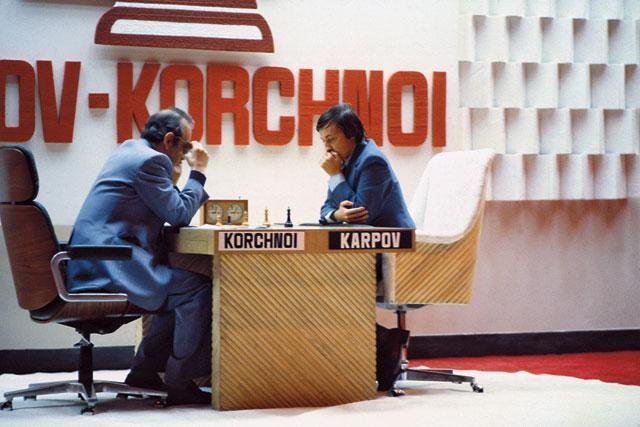
Introduction
On 18 October 1978, Korchnoi's chief second, Raymond Keene, informed the arbiters that the challenger would not resume the adjourned thirty-second game of his World Championship match against Anatoly Karpov. Board play had ended the previous evening with Korchnoi's position beyond practical repair. His resignation gave Karpov the sixth victory required by the regulations and ended a contest that had begun in Baguio City on 18 July. The official match score was Karpov 6, Korchnoi 5, with 21 draws. In ordinary points, counting each draw as one half, the result was 16½-15½.1
Both ways of expressing the result are necessary. Six wins to five records the rule that decided the championship. Sixteen and a half points to fifteen and a half records how little separated the players across 32 games. Karpov led 5-2 after Game 27 and appeared one victory from an emphatic defense. Korchnoi then won Games 28, 29, and 31, with a draw in Game 30, to reach 5-5. Karpov's victory in Game 32 therefore settled a contest that had moved from apparent decision to complete uncertainty in less than three weeks.
The match was also an event for which the documentary record demands unusual discipline. Its yogurt delivery, reflective spectacles, disputed chairs, psychologist in the audience, religious visitors, police arrangements, and formal protests are documented. Claims that food carried codes, that a spectator exercised hypnotic power, or that unseen forces altered games are allegations, interpretations, or rumors. The Soviet state's refusal to let Korchnoi's family emigrate is documented in internal records. The challenger's description of his family as "hostages" was his political characterization of that policy. Later memoirs illuminate the atmosphere, but their authors were participants defending reputations and settling old arguments. A sound history of Baguio must keep those categories separate.
The resulting picture is more compelling than the mythology. Karpov was a 27-year-old champion of exceptional competitive range, playing his first World Championship match after receiving the title by default in 1975. Korchnoi, aged 47, was a five-time Candidate who had left the Soviet Union in 1976 and then survived the strongest match circuit in chess. Their conflict carried the asymmetries of the Cold War. The chess of each player deserves analysis beyond political status. Baguio was consequential because two great competitors, under radically different personal pressures, drove an unstable match format to its narrowest possible conclusion.
From Moscow to Baguio
Baguio followed an unresolved championship crisis. Bobby Fischer had won the title from Boris Spassky in 1972 and then did not play a rated competitive game before his scheduled defense. FIDE accepted most of Fischer's proposed match structure for 1975, including an unlimited contest decided by a fixed number of wins, but rejected his demand that a 9-9 tie leave the champion in possession of the title. Fischer did not accept the approved conditions by the deadline. FIDE president Max Euwe declared Karpov world champion on 3 April 1975.2
Karpov had earned the right to challenge Fischer through the 1974 Candidates matches, defeating Polugaevsky, Spassky, and Korchnoi. His accession was lawful under FIDE's process, but it was inevitably incomplete as a public sporting narrative: no championship game had been played. Over the next three years Karpov answered much of the resulting skepticism through sustained tournament success. By January 1978 he led the FIDE rating list at 2725. Korchnoi, rated 2665 and listed without a national federation, stood second among active players. Baguio was consequently a meeting of the two highest-rated active competitors as well as champion and challenger.3
The choice of Baguio was contested, but it was not an arbitrary exile imposed on two Europe-based players. FIDE regulations called for sealed bids after the Candidates final and gave the president the final choice after considering the players' preferences. Seven bids were recorded, six from Europe and one from the Philippines. The strongest European offers were around or above one million Swiss francs; Baguio offered CHF1,054,350. The surviving accounts disagree over the exact ordering of Karpov's preferences and over the timing of a late Hamburg-Graz joint proposal. They agree on the central fact: both players included Baguio among their acceptable choices, and Euwe selected the Philippine bid.4
The organizer was Florencio Campomanes, the Philippine Chess Federation's leading international representative and then FIDE Deputy President for Asia. Campomanes had helped turn the Philippines into a major Asian chess center and had already pursued the unrealized 1975 Fischer-Karpov match. In 1978 he coordinated national and local authorities, FIDE officials, the two delegations, security services, transportation, accommodation, broadcasting, and a purpose-prepared venue. His role was institutional and intensely personal: when disputes threatened play, he wrote warnings, convened meetings, and negotiated directly with the camps.
Karpov as World Champion
Karpov entered Baguio carrying two reputations. To the Soviet chess establishment he was the legitimate culmination of a development system that had produced a succession of champions. To critics abroad, especially those still preoccupied with Fischer, he remained a champion who had never won the title across a board. The second view could ignore the strength of his 1974 Candidates victory and his results after 1975, but it was politically potent. Baguio offered the one answer that tournament prizes could not supply: a successful defense in a World Championship match.
His play was often described too narrowly as quiet positional accumulation. Karpov did excel at limiting counterplay, improving pieces without loosening his own position, and converting small structural advantages. He also calculated quickly, managed the clock well, defended resourcefully, and could launch a direct attack when preparation produced the opportunity. His Game 8 victory in Baguio, built around a pawn sacrifice against Korchnoi's Open Ruy Lopez, was forceful rather than incremental. Game 14 turned on an exchange sacrifice and a passed-pawn ending. The range displayed in those games was already familiar to elite opponents.5
Karpov's preparation was collective but not mechanical. His analytical team tested the Open Ruy Lopez repeatedly, explored Korchnoi's favored structures, and worked through adjourned positions after the five-hour sessions. Karpov's own practical judgment remained central. He moved rapidly in positions he understood, pressed opponents while their clocks ran down, and was unusually willing to defend slightly worse endings for hours. That combination of preparation, speed, and technical patience was especially valuable in an unlimited match with frequent adjournments.
The pressure on him was real. A defeat would have intensified the argument that his championship depended on Fischer's absence. It would also have embarrassed the Soviet sports system in a contest against a recent defector. Yet Karpov did not play as a passive emblem of that system. He was an ambitious individual competitor at his peak, intent on settling a personal rivalry and a question about his title.
Korchnoi's Road to the Match
Korchnoi reached Baguio by the hardest available route. As the losing finalist in the 1974 Candidates cycle, he was seeded into the 1977 matches. At Il Ciocco in Italy, he defeated former world champion Tigran Petrosian 6½-5½. At Évian-les-Bains, he overwhelmed Lev Polugaevsky 8½-4½. In Belgrade, in a final extended by adjournments, postponements, and its own offstage disputes, he defeated Boris Spassky 10½-7½. Across the three matches he scored fourteen wins, six losses, and 23 draws.6
That achievement was inseparable from his changed life. In July 1976, after playing in the IBM tournament at Amsterdam, Korchnoi declined to return to the Soviet Union and sought asylum in the Netherlands. He later settled in Switzerland. During the Baguio match, he had no sponsoring national chess federation, although he formally retained Soviet citizenship until a decree of 28 December 1978 removed it. Protocol therefore presented a genuine problem: he was a Soviet citizen opposed by the Soviet federation and a Swiss resident who was not yet entitled to represent Switzerland.7
His wife, Bella, and son, Igor, remained in Leningrad and had applied to leave the USSR. Internal Soviet documents remove any doubt about the political nature of the refusal. A KGB memorandum of 12 June 1978 recommended that they be denied exit because established practice barred the families of people classified as non-returnees or traitors. It argued that granting permission would create a precedent and give foreign governments and the media leverage. A later memorandum recorded Bella Korchnoi's approaches to foreign correspondents and President Jimmy Carter and again recommended refusal. The documents do not use Korchnoi's language of hostages. They do show a deliberate state policy connecting the denial of the family's exit applications to his departure.8
Korchnoi carried that pressure into a match already likely to test endurance. His chess had never been confined to one mode. He was famous for resistance in inferior positions, severe calculation, counterattack, and an appetite for unbalanced structures. He could also win long technical endings, as his late victories in Games 29 and 31 demonstrated. His liabilities were linked to the same intensity. He spent a prodigious amount of time checking variations, entered clock trouble, and could allow a dispute to occupy the attention needed for the board. In 1978, his age was considered a likely disadvantage. His Candidates campaign and the final weeks in Baguio made that judgment look superficial.
Korchnoi's circumstances offered freedom and isolation in the same measure. He could speak openly to Western reporters and define his own political position. He lacked a national federation, diplomatic apparatus, and state-funded support network comparable to Karpov's. His seconds and friends gave him a highly capable team, but every question about flags, visas, security, and public statements passed through an improvised delegation. The contrast influenced the match without predetermining its chess.
Organization, Format, and Delegations
The championship was an unlimited first-to-six-wins contest. Draws counted in the conventional point total but did not advance either player toward the required six victories. The regulations also restored a defeated champion's right to a return match within eighteen months. That clause would have benefited Karpov alone if Korchnoi had won; it was never activated because Karpov retained the title. The 1981 meeting between the same players occurred during a new Candidates cycle, not under this provision.9
Games normally began at 5 p.m. on Tuesdays, Thursdays, and Saturdays. Each player received two and a half hours for the first 40 moves. After five hours, unfinished games were adjourned, and a move was sealed for later resumption. Fifteen of the 32 games required at least one adjournment. The arrangement made each delegation's overnight analysis important and helped turn a nominal playing day into a cycle of preparation, competition, sealed-move work, and recovery. Players could also request limited postponements under the regulations, another source of negotiation during the long match.10
West German grandmaster Lothar Schmid served as chief arbiter, assisted by Czechoslovak grandmaster Miroslav Filip and Philippine official Manuel F. Lara. Filip assumed the chief role for the closing phase after Schmid's planned, abbreviated stay. Appeals went to a seven-person Match Jury chaired by Lim Kok Ann of Singapore. Its neutral members were Lim, American chess administrator E. B. Edmondson, who served as secretary, and Bulgarian lawyer and arbiter Andrei Malchev. The jury also included Campomanes, an arbiter, and representatives of the two delegations. Its membership encouraged negotiated settlements, but it also placed interested parties inside a body described by the regulations as impartial.11
Viktor Baturinsky, vice-president of the Soviet Chess Federation and director of Moscow's Central Chess Club, led Karpov's delegation. Petra Leeuwerik led Korchnoi's. The players were officially allowed three organizer-funded seconds, an increase from the two specified in the base regulations. Karpov's seconds were Yuri Balashov, Igor Zaitsev, and Mikhail Tal. Tal also reported for the Soviet weekly 64, a dual role that must be kept in mind when using his vivid contemporary annotations. Korchnoi worked with Raymond Keene, Michael Stean, and Yakov (Yasha) Murey. Keene, Stean, and Murey had already assisted him in the 1977 Candidates matches.12
The formal symmetry concealed a large difference in resources. Karpov's official group of five sat within a Soviet party of roughly fourteen, including a physician, a physical trainer, a cook, interpreters, the press officer Alexander Roshal, and the psychological consultant Vladimir Zukhar, with embassy support in Manila. It would be inaccurate to describe every member as a chess analyst. Their collective work provided health care, food, logistics, communications, physical preparation, media handling, security, and analytical support. Korchnoi's smaller, multinational group concentrated several functions in the same people. Leeuwerik and Keene handled protests and negotiations while the seconds also prepared openings and analyzed adjournments.12
The advertised purse was approximately US$550,000, divided into approximately $350,000 for the winner and $200,000 for the loser, though contemporary reports gave differing converted figures for the eventual payments. The large bid and unlimited format imposed costs that could not be predicted in advance. A match ending after fifteen games and one lasting 32 required very different commitments from the host.9
The Philippine Setting
Baguio was selected as more than a neutral point on a map. The mountain city offered a cooler climate than Manila, an established resort infrastructure, and a Philippine government eager to stage a global event. President Ferdinand Marcos's martial-law government used international sport and culture to project competence and prestige. Marcos opened the match, and the Baguio Convention Center, and members of his family participated in the ceremonies. A 1974 presidential decree had already commissioned a convention center on the site as part of a national conference and tourism policy, so the building was state-enabled but not originally decreed for this match. The event had clear official sponsorship, although later claims that assign every financial or organizational decision directly to Marcos are less well documented.13
The newly opened Convention Center was prepared as the venue for the event. Contemporary estimates of its capacity ranged from about 1,000 to 2,000, a reminder that even simple venue statistics were reported inconsistently. Thick carpeting reduced movement noise, and the hall was darkened around a brightly lit stage. The mountain climate created other difficulties. Heavy rain sounded on the roof, dampness became a recurrent theme in correspondence, and a blackout briefly interrupted Game 5. Karpov's group stayed at the Terraces Plaza Hotel, while Korchnoi's was based at the Pines Hotel. Practice facilities and official transport connected the hotels, the Convention Center, the Baguio Country Club, and Camp John Hay.14
Philippine interest was broad but uneven. Games were carried on national television with Eugene Torre providing commentary, giving an audience far larger than the hall could hold. International correspondents made chess a conspicuous presence in the city, and local officials treated the match as a landmark. In-hall attendance did not remain uniformly high. One contemporary eyewitness reported that expensive opening ticket prices were reduced and that the auditorium was no more than half full during his visit. The best description is therefore strong public and media attention combined with variable paid attendance during a contest that lasted three months.14
Campomanes and the Philippine organizers faced burdens beyond promotion. They had to mediate political symbolism, inspect equipment, control access to the auditorium, respond to security warnings, and decide when a private complaint had become a threat to the event. Their interventions were sometimes improvised and sometimes contested. The record also shows repeated efforts to keep play going, often through written compromises rather than categorical rulings.
Opening Phase of the Match
The first seven games were drawn. Caution was understandable. Karpov was testing an opponent he knew from the Soviet circuit and the 1974 Candidates final; Korchnoi was measuring the champion's preparation while learning how a new delegation functioned under championship conditions. The draws were not uniformly bloodless. Game 5 lasted 124 moves, required two adjournments, and ended in stalemate. Korchnoi had held the more promising position and missed a concrete winning continuation, while Karpov's defense demonstrated how difficult he was to finish.15
The first break came in Game 8 on 3 August. Karpov, playing White, met Korchnoi's Open Ruy Lopez with a prepared pawn sacrifice and a direct kingside attack. The 28-move victory gave the champion a 1-0 lead and displayed the tactical side of his play. The game also acquired an offstage afterlife because Karpov did not offer the agreed customary handshake before play. Korchnoi responded at the board in Game 11 on 10 August. Beginning with 1.g3, he built a closed strategic struggle, exploited Karpov's passivity, and leveled the score at 1-1.16
At that stage the match still resembled a prolonged test between near equals. The very abundance of draws increased the weight of each decisive game. Because there was no fixed finishing line in total points, one victory altered the scoreboard without bringing the end predictably closer. The structure rewarded resilience, but it also allowed a player behind by several wins to remain theoretically alive for months.
Karpov Builds His Lead
Games 13 and 14 transformed the contest. Game 13 began on 17 August with Korchnoi pressing as White, but the adjourned struggle turned after he mishandled the position and again consumed too much time. Karpov won with Black. In Game 14, begun on 19 August, Karpov used an exchange sacrifice to convert a position that had appeared close to balanced. Both results were completed on 20 August, giving him a 3-1 lead within a single day. Korchnoi had gone from equality to a two-win deficit, and Karpov had broken through the Open Ruy Lopez that had formed a central part of the challenger's match preparation.17
Game 17 on 26 August deepened the crisis. Korchnoi obtained a substantial positional advantage. Karpov later acknowledged that he had lost the strategic opening battle, but he found active defensive chances as Korchnoi's clock became critical. The challenger's final error permitted a forced mating attack, and Karpov led 4-1. It is often retold as a simple squandered win. The fuller record shows a difficult advantage, purposeful resistance, and a collapse under time pressure. That sequence captures both players' strengths and Korchnoi's recurrent risk.18
Korchnoi won Game 21, played on 12 and 13 September, to reduce the deficit to 4-2. His success came in a long technical ending rather than a reckless attack. Five draws followed. In Game 27, begun on 28 September, Korchnoi's opening preparation again gave him useful prospects, but heavy time expenditure allowed Karpov to seize the initiative. Korchnoi resigned the adjourned game the next day. At 5-2, Karpov required one more win and Korchnoi required four. No previous phase had suggested that the challenger could close that distance.5
Controversies Away from the Board
Protocol, representation, and the physical stage
The opening ceremony exposed the political ambiguity around Korchnoi. He requested Swiss identification, although he was a resident rather than a Swiss citizen or federation representative. The Soviet delegation objected. The Match Jury adopted Edmondson's compromise: neither player would display a table flag, while the venue retained the flags of the Philippines, the USSR, and FIDE. At the ceremony, the band played the Internationale rather than the Soviet state anthem; Karpov and Baturinsky stood, while Korchnoi remained seated. Beethoven's "Ode to Joy" was used for the challenger. These were documented protocol disputes, not evidence that either competitor received a chess advantage.19
The chairs produced another real but inflated disagreement. Korchnoi brought a dark green Giroflex chair. The Soviet side requested inspection, and the chair was dismantled and X-rayed before being cleared. Later complaints concerned its height, Karpov's swiveling, and movement near the board. Arbiter meetings attempted to limit conduct that could distract a player on move. Seating disputes also concerned where delegation members and spectators could sit in the darkened hall. None of the inspections found evidence of tampering with a chair.19
The handshake dispute was similarly concrete in occurrence and elusive in meaning. A pre-match agreement called for the players to shake hands before each game. Karpov declined before Game 8, and the camps argued over courtesy, notice to the arbiter, and the political statements Korchnoi had made about his family. Contemporary observers recorded that the two soon ceased speaking. It was a visible measure of estrangement. Claims that the absent handshake itself caused a particular result belong to participant psychology, not verifiable fact.19
Yogurt and the problem of communication
During Game 2, a container of yogurt was delivered to Karpov. Korchnoi's delegation filed a formal protest, arguing that the timing, color, flavor, or type of food could theoretically transmit coded instructions from a delegation to a player. The delivery occurred; the supposed code was hypothetical. No evidence showed that the yogurt conveyed chess information.20
The complaint had a procedural core beneath its comic possibilities. Any unscheduled object or refreshment passed to a player created an uncontrolled communication channel. The jury responded by clarifying how food and drink could be delivered and by giving the arbiter authority over exceptional requests. That was a sensible administrative answer. Later retellings often preserve the menu and discard the ruling, turning an issue of control over communications into pure farce.20
Zukhar, reflective glasses, and claims of influence
Vladimir Zukhar was a psycho-neurologist and psychological consultant in Karpov's extended party. He sat in the audience where Korchnoi could see him. Korchnoi alleged that Zukhar was attempting hypnosis or harmful psychological influence. The Soviet delegation denied the accusation and described his role as support for Karpov. Match officials repeatedly altered seating arrangements, eventually placing Zukhar farther back in the hall.21
Three distinct facts are often collapsed here. Zukhar was present, and his seat was formally disputed. Korchnoi repeatedly complained that the man's stare affected him. No reliable evidence demonstrates that Zukhar hypnotized him or exercised a remote influence on his play. The officials did not need to accept the paranormal claim to recognize a distraction: once a competitor had fixed on a conspicuous spectator, moving that spectator was a practical way to reduce friction.21
Korchnoi's reflective spectacles formed the counterpart. His camp presented the mirrored or strongly reflective lenses as protection from eye contact and stage glare. The Soviet delegation complained that reflections disturbed Karpov. On 5 August, Schmid, Filip, and Lara tested the glasses under the actual lighting and unanimously found them unusual but not disturbing. A negotiated arrangement at the end of August linked Korchnoi's abandonment of the glasses and his request for a mirror partition with agreed seating for Zukhar in the Soviet section. Again, the objects and complaints are documented. Assertions about an optical tactic or occult defense exceed the evidence.21
Ananda Marga and security
During a break in Manila, Korchnoi met members of Ananda Marga, a spiritual and political movement founded in India. Two members, Stephen Michael Dwyer and Victoria Shepherd, returned to Baguio and taught him meditation. They had been convicted in a Philippine court of "frustrated murder" in connection with a knife attack on an Indian diplomatic official. Their appeal was pending, and they were free on bail. That legal status made their presence a security question independent of any belief in meditation.22
The record contains formal organizational action. Campomanes warned on 13 September that the match could be recessed or terminated if the security dispute was not resolved. On 14 September Keene wrote that Dwyer and Shepherd would leave the Pines Hotel and stop using official transport unless accompanied by recognized principals. The organizers accepted that assurance and play continued. Before the final game, further police and organizational pressure secured their departure from Baguio. Reports that their meditation improved Korchnoi's results reflect Korchnoi's belief, his assistants' observations, or journalistic interpretation. The record offers no proof of causation.22
Security, surveillance, and political pressure
The event operated under visible security. Karpov had guards and Soviet embassy support. Philippine police controlled access, investigated threats, and intervened in the Ananda Marga dispute. Korchnoi and his delegation alleged surveillance and a KGB operation. Contemporary journalists could confirm the presence of Soviet officials and the presence of intensive security, but they could not substantiate every identity or task assigned in Baguio. During Game 8, one of Korchnoi's aides reported an apparent Geiger-counter spike. Philippine authorities called it a false alarm and summoned atomic-energy specialists. The complaint and investigation are documented; a radiation attack is not.23
Later accounts, based on Vasili Mitrokhin's copies of KGB archive notes, describe a sizable Soviet security operation surrounding the match. That source lineage gives the claim more weight than contemporary rumor, while leaving important limits. The underlying operational files have not been published in full, and the account does not establish that surveillance changed any game or validate allegations of hypnosis and electronic interference.23
The strongest documented political pressure concerned Korchnoi's family. The June KGB memorandum was written before the first move and recommended continued refusal of exit visas partly because foreign publicity could pressure the Soviet government. Korchnoi's appeals in Baguio therefore addressed a real policy, even when his language was polemical. This state action, the unequal delegational resources, and the symbolic value assigned to Karpov's victory created a political asymmetry. They do not supply a shortcut for explaining 32 games of elite chess.8
The volume of complaints also affected the championship's administration. Letters were copied, translated, answered, referred to the jury, revised into compromises, and sometimes leaked to reporters. Some concerned legitimate playing conditions; some enlarged minor irritations; some framed untestable suspicions. The surviving paperwork shows psychological warfare in the ordinary sense of attempts to unsettle, pressure, and control the environment. It does not establish coded yogurt, hypnotic control, a radiation attack, or any other extraordinary mechanism.11
Korchnoi's Remarkable Recovery
Game 28 began on 30 September, the day after Karpov reached 5-2. With Black in another Open Ruy Lopez, Korchnoi generated queenside play and won a rook ending with connected passed pawns. Karpov's camp later suggested that the champion relaxed after coming within one victory of the title. That is a plausible participant interpretation, not an established diagnosis. The board record shows that Korchnoi created and converted a technical advantage.24
Game 29 was delayed by a transformer failure and played on 7 and 8 October. Several later databases date it 2 and 3 October, but contemporary reports and the calendar establish the later dates. Korchnoi, playing White, accumulated pressure and outplayed Karpov in a long minor-piece ending. The score was now 5-4. A draw in Game 30 left Karpov one win from the title and Korchnoi one win from equality.25
In Game 31, on 12 and 13 October, Korchnoi deliberately entered another technical struggle. Karpov adopted a passive defensive plan, and the game continued after adjournment. Korchnoi missed stronger continuations, bringing a draw close, before Karpov's late error allowed the challenger to finish the conversion. The decisive score was 5-5. Korchnoi had won three of four games, two of them through sustained endgame play. The comeback revised his image from survivor to active equal at the point of maximum pressure.25
The psychology of this phase is easy to dramatize and hard to know. Karpov had watched a commanding lead disappear. Korchnoi had reversed weeks of failure but still needed another victory against an opponent who had already beaten him five times. Tal reported that Karpov used a postponement after Game 31 and attended the USSR-Yugoslavia basketball final before returning to preparation. The outing is a contemporary detail; claims that it restored him are camp interpretation. What can be said securely is that Karpov and his analysts had several days to choose a clear response for the next White game.
Game 32 and the Final Result
Game 32 began on 17 October. Korchnoi chose a Pirc setup that soon acquired a Benoni structure, avoiding another direct test of his Open Ruy Lopez. The surprise did not dislodge Karpov. He established central space, restricted Black's counterplay, and delayed the central break until his position was ready. Under severe time pressure, Korchnoi could not generate activity. Karpov sealed 41.b6, and the game was adjourned in a position where his protected queenside pawn and more active pieces made the outcome clear.26
The next day, Keene informed Chief Arbiter Filip that Korchnoi had resigned. The formal ending date is therefore 18 October, although 17 October was the final day on which moves were played. Karpov had won six games, Korchnoi five, and 21 had been drawn. The decisive-game score was 6-5; the total-points score was 16½-15½.1
The final game was historically apt. Karpov did not win through administrative intervention or a speculative attack. He absorbed an opening surprise, controlled the position, and converted mounting advantages under match-ending pressure. Korchnoi's choice was rational: at 5-5 he sought a fresh structure in which Black could fight. The risk was that unfamiliarity would deprive him of the counterplay his position required. Karpov's preparation and judgment made that risk decisive.
Contemporary Soviet and International Reception
Soviet coverage operated on more than one level. TASS presented the victory ideologically, treating it as a triumph for communist sport and a fulfillment of Karpov's duty to Soviet supporters. The official vocabulary linked an individual's result to the state's prestige. Brezhnev's congratulatory message, reproduced in 64, praised the victory's "Soviet character." Such language confirms the political value attached to the title.27
The specialist chess press was more textured than the broad political framing. 64 published Tal's annotations from Baguio across issues 31 through 43 and gave its readers detailed accounts of openings, errors, adjournments, and critical positions. It often adopted the Karpov camp's interpretations, as might be expected from a correspondent who was also one of his seconds. It did not erase Korchnoi's name from its match coverage, contrary to some sweeping later claims about Soviet treatment of defectors. The coexistence of serious analysis and state celebration is more accurate than a picture of uniform propaganda.
Philippine coverage treated the contest as a national event while debating its likely sporting course. Ding Marcelo of Manila's Bulletin Today, for example, argued early that a long contest would favor the younger Karpov; Edmondson preserved the report in his near-contemporary account. National television carried the games with Eugene Torre commentating, according to Kavalek's on-site report. Later Philippine archival accounts emphasize the new venue, Campomanes's negotiations, and the country's growing position in international chess. They also recall that interest and paid attendance became uneven as the match extended across three months.1314
Western coverage frequently treated Baguio as a sequel to Reykjavík 1972. American and British reports stressed the defector-versus-state narrative, the purse, the guards, the family campaign, and the psychology of the hall. Time framed the event as political theater before the first game and as an extraordinary spectacle afterward. The Washington Post sent Jay Mathews to Baguio for a long report rich in direct observation, yet written openly in the language of a "chess circus." BBC television broadcast Kings of the Castle during the match. British and European chess writers, including William Hartston and Korchnoi's own second Raymond Keene, produced rapid books for an audience that wanted games and backstage conflict. A Times retrospective called the event "high tragedy and low comedy" and judged that Korchnoi deserved to win, an influential Western interpretation rather than a consensus verdict.28
That appetite imposed costs on accuracy. A December 1978 interview in the French weekly L'Express promoted Korchnoi's uncorroborated allegation that a spy in his entourage had helped cause his defeat, without naming the supposed agent. Later memoirs offered further stories about secret proposals, hypnosis, betrayal, and political direction. Their proximity gives them evidentiary value; their personal stakes require corroboration. The best contemporary sources were also interested sources: Tal belonged to Karpov's team, Keene to Korchnoi's, Edmondson to the match administration, and Campomanes to the organization. Agreement among them is strong evidence. Solitary dramatic claims remain claims.29
Within the wider chess world, opinion divided between admiration for the competitive finish and impatience with the quality of some games or the volume of protest. Thirty-two games inevitably included short draws, errors, and exhausted play. It also produced Game 8's attack, Karpov's defense and reversal in Game 17, Korchnoi's late technical wins, and a final game worthy of the pressure. Contemporary judgments that dismissed the chess because the conduct was undignified missed the extent to which endurance was part of the sporting test.
Consequences for Karpov and Korchnoi
For Karpov, Baguio supplied direct championship legitimacy. He had been FIDE's lawful champion since 1975, and his tournament record had already established elite supremacy. Victory over the highest-rated active challenger answered the narrower objection that he had never defended the crown at the board. The collapse from 5-2 to 5-5 prevented the result from looking easy, but winning Game 32 strengthened its competitive force. Karpov had endured both the challenger and the possibility of becoming the champion who lost after a three-win lead.
The match also revealed vulnerabilities. Karpov could become passive when protecting an advantage, and fatigue reduced the precision his style depended on. His team learned that superior resources did not prevent environmental disputes from consuming attention. In 1981, when Korchnoi again won the Candidates cycle, Karpov defended the title at Merano by six wins to two with ten draws. The shorter, more controlled rematch suggested that Baguio's near collapse had been instructive.30
Korchnoi left Baguio without the title and with his reputation enlarged. At 47, without a national federation and with his family still unable to join him, he came within one decisive game of defeating the world champion. His run from 2-5 to 5-5 became one of the great recoveries in title-match history. It demonstrated physical stamina, technical range, and a capacity to continue after blows that would have ended a fixed-length match.1
His political conflict also continued. The Soviet state removed his citizenship in December 1978. His son was later imprisoned after avoiding military service. Bella, Igor, and Korchnoi's stepmother were eventually permitted to leave in 1982. These later events should not be retroactively folded into every decision at Baguio. They confirm that the family crisis was genuine and remained unresolved when the match ended.31
Legacy and Historical Assessment
FIDE formally closed the institutional dispute in stages. Its November 1978 General Assembly recognized Karpov as the winner and referred the outstanding complaints to the Bureau. In February 1979, the Bureau reviewed the arbiter's report, Swiss and Soviet submissions, and jury minutes. It accepted that Zukhar's forward seating in Game 32 could have been experienced as a disturbance by Korchnoi, but unanimously confirmed the 6-5 result and concluded that the arbiters had enforced the rules. It also severely admonished Korchnoi for conduct it regarded as harmful to FIDE. This was the governing body's final judgment, not independent proof of every factual assertion made by either delegation.32
Baguio demonstrated the dramatic power of first-to-six-wins play alongside its administrative weakness. Draws did not move the competitors toward a predetermined end, so Korchnoi could recover from 2-5 and force a genuine sudden-death finish. The same rule left organizers unable to know how long the venue, hotels, broadcast arrangements, security, or delegations would be required. Adjournments created legitimate analytical work but also made control of contact, food delivery, spectators, and sealed information a continuous concern.910
The match did not immediately transform FIDE's championship system. The same six-win principle was used for Karpov-Korchnoi in 1981 and for the much longer Karpov-Kasparov match of 1984-85. Baguio nevertheless became an early warning about open-ended duration, unequal delegational power, loosely specified environmental rules, and appeals bodies that combined neutral and partisan members. Its paperwork reads like a catalogue of questions that later organizers would address more explicitly: permitted equipment, refreshments, audience seating, delegation access, security authority, postponements, and the boundary between a complaint and disruption.
Its cultural legacy is equally durable. Baguio reinforced the modern World Championship as an event in which architecture, cameras, delegation behavior, and political biography could compete with the games for public attention. Books, broadcasts, films, and later retellings repeatedly returned to the image of two Soviet grandmasters, divided by the Cold War, standing in a darkened hall. That image is powerful but incomplete. Karpov's game was more varied than the stereotype of a state-trained positional machine. Korchnoi's achievement was more than dissent expressed through chess. The political story deepened the contest because it acted on two fully realized competitors.
The 1978 Karpov-Korchnoi match remains one of the most consequential and closely scrutinized World Championships because its essential facts already contain enough drama. A champion who had inherited the title without a match faced a former compatriot who had defeated three elite Soviet opponents after leaving the country. Karpov built a 5-2 lead; Korchnoi recovered to 5-5; Karpov won the deciding game. Around them, FIDE procedure, Philippine ambition, Soviet state power, family coercion, security fears, and media appetite produced a record dense with both documents and contested testimony. Its historical significance lies in holding all of those elements together without allowing rumor to substitute for evidence or politics to erase the chess.
Notes and Sources
FIDE Open Chess Museum, "Medal of the 1978 World Championship Match"; Chess Life & Review, December 1978, p. 649, US Chess Federation scan. The latter records that Game 32 began on 17 October and that Korchnoi resigned at noon on 18 October.
FIDE, "Chess Champions: Anatoly Karpov"; Associated Press, "Karpov Named Chess Champion," 3 April 1975, reprinted in the Daily Illini, 4 April 1975. Contemporary and later sources vary between 2 and 3 April because FIDE's deadline and public declaration crossed dates and time zones; 3 April is the date of the public announcement.
FIDE rating list, January 1978, reproduced by OlimpBase, "Men's Rating List". Karpov is listed at 2725 and Korchnoi at 2665; Korchnoi's federation field is blank.
E. B. Edmondson, Chess Scandals: The 1978 World Chess Championship, with annotations by Mikhail Tal (Oxford: Pergamon Press, 1981), pp. 7-9, bibliographic record at WorldCat; Max Euwe interview with Pal Benko, Chess Life & Review, August 1978, p. 412, USCF scan. Edmondson, Match Jury secretary, reproduces the selection procedure and bid figures. Euwe discussed the rejected late Hamburg-Graz proposal.
Mikhail Tal's contemporary annotations, originally published in 64, nos. 31-43 (1978), collected and translated by Douglas Griffin, "Karpov-Korchnoi, Baguio City 1978", including the reports on Game 21 and Game 27. Tal was a Soviet delegation member and the magazine's correspondent, so his variations are close evidence while his psychological judgments remain interested testimony.
Candidate match results checked against the game collections for Korchnoi-Petrosian, Il Ciocco 1977, Korchnoi-Polugaevsky, Évian 1977, and Korchnoi-Spassky, Belgrade 1977-78. The respective scores were 6½-5½, 8½-4½, and 10½-7½.
Edmondson, Chess Scandals, pp. 2-3; Leonard Barden, "Viktor Korchnoi obituary", The Guardian, 6 June 2016; Presidium of the Supreme Soviet of the USSR, decree depriving Korchnoi of Soviet citizenship, 28 December 1978, archival description and scan at Leaders of Soviet Russia in Documents. "Stateless" is accurate as FIDE protocol shorthand in Baguio, but it should not be confused with the date of formal Soviet denaturalization.
KGB memorandum no. 1167-A, 12 June 1978, and CPSU Secretariat decision, 16 June 1978, scan in the Bukovsky Archive; Russian transcription, "Документы ЦК КПСС по сыну Корчного". The same page transcribes Yuri Andropov's memorandum of 30 October 1978 concerning Bella and Igor Korchnoi.
Chess Life & Review, September 1978, p. 468, USCF scan; Raymond Keene, Karpov-Korchnoi 1978: The Inside Story of the Match (London: Batsford, 1978), pp. 14-15. Keene was Korchnoi's chief second. The rematch clause was asymmetrical and did not cause the 1981 match.
Chess Life & Review, September 1978, p. 468; Jay Mathews, "The Moves Behind Those Moves", Washington Post, 12 September 1978. For the number of adjourned games, see the result record in Edmondson, Chess Scandals, pp. 229-30.
Edmondson, Chess Scandals, pp. 4-7, 224-26. Edmondson reproduces the jury's composition and regulatory language. Lubomir Kavalek, on-site report, Chess Life & Review, October 1978, pp. 536-38, USCF scan. On Schmid's abbreviated stay, see André Schulz, "Lothar Schmid (1928-2013)", ChessBase, 20 May 2013.
Edmondson, Chess Scandals, pp. 4-7. Edmondson lists Campomanes, Baturinsky, Leeuwerik, the arbiters, jury members, three seconds for each side, and Karpov's extended party. Kavalek's contemporary report initially described Balashov and Zaitsev as Karpov's formal seconds and Tal as 64 correspondent; the fuller match record confirms Tal's analytical role.
Ferdinand E. Marcos, Presidential Decree No. 396, 27 February 1974; Kavalek, Chess Life & Review, October 1978, pp. 536-38; Time, "Pawns and Politics in Baguio City", 17 July 1978; Ambeth R. Ocampo, "Queen's Gambit in Baguio, 1978", Philippine Daily Inquirer, 2 December 2020. Ocampo's retrospective account draws on Philippine and Associated Press reporting; its colorful details are treated here as reported recollections, not official minutes.
Kavalek, Chess Life & Review, October 1978, pp. 536-37; Edmondson, Chess Scandals, pp. 33-34, reproducing Ding Marcelo's contemporary report for Manila's Bulletin Today; Philippine News Agency, "Baguio starts bidding to restore 1978 world chess tilt venue", 30 November 2017. The capacity estimates differ between contemporary reports, which is why the text gives a range.
Yuri Averbakh's contemporary analysis of Game 5, translated by Douglas Griffin, "Korchnoi-Karpov, 5th Match Game"; complete event score file, PGN Mentor, World Championship 1978.
Tal, annotations to Games 8 and 11 in 64, linked from Griffin's match collection; Edmondson, Chess Scandals, pp. 62-94, especially the reproduced correspondence in "Shaking Hands."
Tal, annotations to Games 13 and 14, 64, reproduced in Griffin's match collection; complete scores and dates at Chessgames, Karpov-Korchnoi 1978. Both adjourned wins were formally completed on 20 August.
Anatoly Karpov's retrospective annotations to Game 17, translated by Douglas Griffin, "Korchnoi-Karpov, Game 17". His admission about the opening and his psychological conclusions are memoir evidence; the move score independently confirms the time-pressure reversal.
Chess Life & Review, September 1978, p. 468; Edmondson, Chess Scandals, pp. 9-15, 67-82, and the Match Jury material. For contemporary observations on flags, chairs, glasses, and the cessation of conversation, see Mathews, "The Moves Behind Those Moves".
Joseph McLellan, "Yogurt Gambit? Food for Thought", Washington Post, 20 July 1978; Edmondson, Chess Scandals, pp. 27-31 and the reproduced jury clarification. The quoted contemporary protest proposed possible codes; it did not supply evidence that one had been used.
Edmondson, Chess Scandals, pp. 54-61, 76-82, 113-40; Mathews, "The Moves Behind Those Moves." Edmondson identifies Zukhar as a psycho-neurologist and psychological consultant. "Hypnotist" was Korchnoi's allegation and a press label, not an established professional function.
Edmondson, Chess Scandals, pp. 140-61. The book reproduces Campomanes's letter of 13 September and Keene's reply of 14 September. Mathews, "The Moves Behind Those Moves," provides contemporary on-site observation. The trial status of Dwyer and Shepherd is stated as it stood during the match; later legal outcomes should not be projected backward.
"Radiation Scare at Chess Match," The Times, 29 August 1978, contemporary text archive; Christopher Andrew and Vasili Mitrokhin, The Sword and the Shield: The Mitrokhin Archive and the Secret History of the KGB (New York: Basic Books, 1999), bibliographic preview at Google Books; The Mitrokhin Archive, Churchill Archives Centre. The published KGB account is archive-derived but does not establish the claimed effects on play.
Tal, annotations to Game 28 in 64, reproduced in Griffin's match collection. Tal's explanation that Karpov relaxed is retained only as an attributed camp judgment.
Tal, annotations to Games 29 and 31; Joseph McLellan, "Now, It's Sudden Death in Baguio", Washington Post, 13 October 1978. A 4 October United Press International report in the Daily Iowan archive records the transformer explosion that postponed Game 29; Tal's contemporary heading and the Washington Post report place play on Saturday and Sunday, 7-8 October.
Tal, annotations to Game 32 in 64, reproduced in Griffin's match collection; Karpov's later annotations, "Karpov-Korchnoi, Game 32"; Chess Life & Review, December 1978, p. 649.
64: Shakhmatnoe obozrenie, no. 42 (19-25 October 1978), front-page victory coverage and Game 32 report; 64, no. 43, congratulatory telegrams. Contemporary issue archive at Publ.lib.ru. "Tass: 'Communist Triumph'", Washington Post, 18 October 1978, reproduces the agency framing.
Time, "Checkmate in Baguio City", 30 October 1978; Mathews, "The Moves Behind Those Moves"; "Chess: High Tragedy and Low Comedy," The Times, 21 October 1978, contemporary text archive; Edward Winter, "Victor Korchnoi (1931-2016)", which identifies the BBC-2 broadcast Kings of the Castle on 22 July 1978 and traces contemporary European publications and interviews.
Winter, "Victor Korchnoi," citing L'Express, 23 December 1978; Edmondson, Chess Scandals, preface and documentary appendices. Edmondson's post as Match Jury secretary gave him access to correspondence and minutes. His claim to complete neutrality is an author's self-assessment and is not assumed here.
Complete 1981 match score, Chessgames, Karpov-Korchnoi, Merano 1981. Karpov won 6-2 with ten draws in 18 games after Korchnoi qualified through the next Candidates cycle.
Supreme Soviet decree, 28 December 1978, cited in note 7; United Press International, "The wife, son and step-mother of defected Russian chess...", 4 July 1982. The latter records the family's departure from the Soviet Union.
Edmondson, Chess Scandals, pp. 217-26, reproducing the post-match FIDE proceedings and February 1979 Bureau decision. The Bureau's decision confirmed the result after considering the arbiter's report, delegation submissions, and Match Jury record.
Source note
This article gives priority to contemporary match records, FIDE materials, official correspondence reproduced by Match Jury secretary E. B. Edmondson, Soviet internal documents, contemporary 64 annotations, on-site reports in Chess Life & Review and the international press, and verified game scores. Participant memoirs and later interviews are used when identified as such. Spellings vary across sources, especially Korchnoi, Korchnoy, and Kortchnoi, and Zukhar, Zoukhar, and Suchar. Modern English spellings are used in the text, with original titles preserved in citations.
