Konstantin Lerner
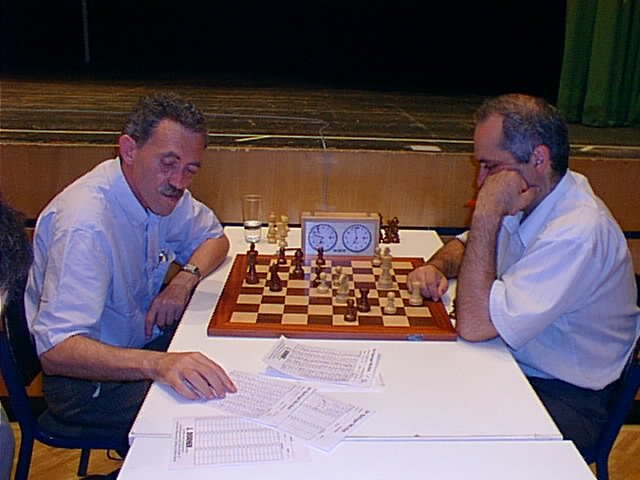
Konstantin Lerner and Giorgi Bagaturov (right) analyzing their game, Recklinghausen 1999. Photo by GHund
Introduction
Konstantin Zaivelevich Lerner, also found in sources as Konstantin Z. Lerner and Константин Зайвелевич Лернер, was born in Odesa on 28 February 1950 and died in Herzliya, Israel, on 24 September 2011. He was a leading Ukrainian grandmaster of the late Soviet and early post Soviet decades, twice champion of the Ukrainian SSR, a silver medalist in the 1984 USSR Championship final, and a player whose strongest claims to historical notice rest on the seriousness of his domestic achievements, the precision of his technical play, and his later influence as a trainer in Israel.
Lerner never became a household name on the level of the Soviet world championship contenders, but that is part of why he deserves a careful profile. Yochanan Afek described him as one of the better Soviet players of the 1970s and 1980s, while Ukrainian federation commemorations later placed him among the notable Ukrainian players of the 1980s and 1990s. Contemporary recollections from Vladimir Tukmakov, Vyacheslav Eingorn, and Semyon Palatnik present him as an inward, modest, highly responsible chess professional whose genuine class shows most clearly in the quality of his Soviet Championship results and in the respect he commanded among peers.
Early Life and Chess Formation
The best documented facts about Lerner’s youth are almost entirely chess related. According to the Russian Chess Federation’s commemorative profile, he took his first steps at the Odesa Palace of Pioneers under the experienced youth trainer Samuil Kotlerman, and later worked with Vladimir Klubis, who became both mentor and second in competitions of varying level. The same profile places him firmly inside the rich Odesa chess milieu of the postwar decades, a setting where structured youth training and analytical seriousness were taken for granted.
Lerner’s wider formative environment also led back to Roman Pelts, one of the defining Odesa trainers of the era. The Russian Chess Federation’s profile of Pelts lists Lerner among the future grandmasters who emerged from his circle, alongside Lev Alburt, Semyon Palatnik, Vladimir Tukmakov, and Valery Beim. That association is historically useful because it situates Lerner not as an isolated talent but as part of a recognisable Odesa training tradition that prized systematic opening work and disciplined preparation.
Published sources are much thinner on Lerner’s family background and formal education than on his chess upbringing. The accessible obituaries and federation notices I found identify his wife Sara and son Andrey, and record that the family emigrated to Israel in 2001, but they offer little dependable detail about his parents or his non chess schooling. That silence is worth noting because it places limits on what can be responsibly asserted.
What is clear is that Lerner developed unusually quickly. He became a Soviet master in 1971, won the Odesa championship four times between 1972 and 1976, and, while still comparatively young, already served as senior coach of the Odesa junior team, assisting a younger generation headed by Stanislav Savchenko. His 1977 success at Starý Smokovec in Czechoslovakia earned him the international master title and opened the next phase of his career.
Rise in Competitive Chess
Lerner’s rise to top Soviet competition was not theatrical, but it was substantial. In 1979 he reached his first USSR Championship final, and during that event he defeated Garry Kasparov, then still a rising force rather than the dominant figure he would soon become. That single result did not define Lerner’s career, but it was an unmistakable sign that he belonged in the hardest Soviet company.
His breakthrough into the very front rank of Soviet tournament practice came in the mid 1980s. At Lviv in 1984 he finished second in the USSR Championship final behind Andrei Sokolov and ahead of a field that included Alexander Beliavsky, Vladimir Tukmakov, Vyacheslav Eingorn, Adrian Mikhalchishin, Leonid Psakhis, Iossif Dorfman, Valery Salov, Yuri Balashov, and Alexey Vyzmanavin. Two years later, in the 1986 USSR Championship in Kyiv, he again finished near the top, sharing second through seventh places behind Vitaly Tseshkovsky. Contemporary recollection from Eingorn, preserved by the Russian Chess Federation, is especially telling here: for players of their generation, the USSR Championship remained the real proving ground, and Lerner’s 1984 and 1986 results established him as a player of very serious level.
At the same time Lerner began converting Soviet strength into visible international credentials. The Russian Chess Federation states that his results in the Rubinstein Memorials of 1985 and 1986, together with his victory in the 1986 Kotov Memorial in Moscow, brought him both Soviet and international grandmaster recognition. Polbase’s record of the 1986 Rubinstein Memorial confirms that Lerner shared first place there with Péter Lukács on 8.5 out of 12, both undefeated. Afek’s later retrospective likewise treated the mid 1980s as Lerner’s flowering, listing Polanica Zdrój, Tallinn, and Moscow among the events that marked that peak.
Major Career Achievements
Lerner’s most enduring headline achievements were clear and substantial: Ukrainian champion in 1978 and 1982, silver medalist in the 1984 USSR Championship final, equal second in the 1986 USSR Championship, and grandmaster from 1986. The Ukrainian Chess Federation later described him as one of the leading Ukrainian players of the 1980s and 1990s, a judgment that aligns well with both his Soviet record and his later rating history.
His later career shows a different kind of strength, less tied to a single dramatic peak than to long professional durability. Afek’s survey of tournament results records wins or shared wins at Genoa 1989, Copenhagen 1990, Gausdal 1992, the Mykolaiv zonal in 1995, Berlin and Graz in 1997, Recklinghausen in 1999, Bad Wörishofen in 2000, Tel Aviv in 2001 and 2002, Rishon LeZion in 2004, and two Israeli events in 2005. The Russian Chess Federation profile adds that 1995 brought his career high Elo of 2605. In other words, Lerner did not fade after the Soviet system collapsed. He remained a formidable open and Swiss tournament grandmaster deep into the 1990s.
The Mykolaiv zonal of 1995 had additional significance because it took him into the new FIDE world championship structure. The Russian Chess Federation notes that he won the zonal, and later FIDE knockout documentation and the Russian Chess Federation’s page on Eduardas Rozentalis show that Lerner played in Groningen in 1997, where Rozentalis eliminated him in the first round. That does not place Lerner near the summit of world championship history, but it shows that he remained internationally relevant during the first turbulent years of the knockout era.
A useful historical caution comes from the recollections of contemporaries. Eingorn argued that Lerner’s open tournament successes in the 1990s, though numerous and real, should not be weighed more heavily than his 1984 and 1986 USSR finals, because the Soviet finals were simply stronger events. That judgment seems persuasive. Lerner’s career was broad, but his deepest claim on chess history still rests on the years when he proved himself inside the Soviet domestic elite.
Style and Reputation
The available evidence points to a player defined by technique, strategic patience, and endgame control rather than by public flamboyance. Afek wrote that Lerner produced exemplary positional games and showed a masterful ability to exploit small advantages. The same article stressed that several of his endings against other grandmasters entered standard endgame textbooks, which is a significant kind of legacy for a player whose historical stature depended on quality more than on celebrity.
The best known example is Lerner’s rook ending against Iossif Dorfman from the 1980 USSR Championship. Afek described it as a classic that appears in numerous textbooks, and a later ChessBase review of Karsten Müller’s rook ending training material again used the Lerner, Dorfman ending as a didactic example, explicitly noting that there is only one winning move and presenting the position as a serious test of practical technique. That repeated reuse in instructional literature helps explain why Lerner is remembered so fondly by technically minded players and trainers.
Contemporary testimony sharpens the picture. Tukmakov remembered Lerner as quiet and laconic in everyday life but transformed at the board into an uncompromising fighter. Palatnik, in a brief obituary remark, likened him in bearing and depth of conception to fellow Odesa great Efim Geller. Eingorn recalled him as a bookish man who read serious poetry and intellectual prose, and who combined that inward temperament with rigorous post mortem analysis and a high sense of professional responsibility. These are not empty memorial compliments. They match the chess evidence: Lerner appears, in both games and recollections, as a cultivated and deeply serious practitioner.
If one wants a limitation rather than a praise point, it is probably not a stylistic weakness so much as a historical one. Lerner’s rise to the grandmaster title came late, at age thirty six. Afek explicitly connected that delay to the difficulty Soviet players faced in obtaining invitations to the small number of foreign events available at the time. In other words, his modest public profile and relatively late formal recognition should not be mistaken for a lack of strength. They reflect the structure of Soviet opportunity as much as the player himself.
Contributions Beyond Tournament Play
Lerner’s contribution outside his own tournament crosstables is easy to underrate, but the record is meaningful. The Russian Chess Federation states that, even while still an active young player, he became senior coach of the Odesa youth team and helped the next generation of local talent. After emigrating to Israel in 2001, he played for the Kfar Saba club and also trained junior players there. Afek wrote that quite a few of those pupils went on to national team and individual successes, while an interview on e3e5 later listed Lerner among the notably strong Israeli coaching corps.
There is also a small but revealing trace of Lerner the analyst. In Douglas Griffin’s translation of Garry Kasparov’s notes to Kasparov, Timman from the 1984 USSR versus Rest of the World match, Kasparov explicitly credited the sharp long castling idea 11.0-0-0!? as “an idea of the Odessa master K. Lerner.” That single acknowledgment is valuable evidence. It shows that Lerner’s analytical work circulated upward into elite Soviet preparation and that his reputation inside the chess community included theoretical originality, even if he did not leave behind a major published authorial corpus.
His later Israeli years extended this bridging role between traditions. TWIC’s obituary, drawing on Afek, records that he immigrated with his family from Ukraine in 2001 and continued to play for Kfar Saba. The Maccabiah record shows that in 2001 he shared first in the main competition with Evgeny Alekseev, and TWIC’s 2005 report places him third in the super tournament at the 17th Maccabiah behind Evgeny Najer and Ilia Smirin. These were not merely farewell appearances by an aging émigré. They show a grandmaster who remained competitive and institutionally important within Israeli chess.
Historical Legacy
Lerner’s legacy has two interlocking parts. The first is competitive. He belongs to that important class of Soviet masters whose standing is measured less by world title cycles than by how they performed in the hardest domestic championships on earth. Ukrainian federation commemorations, Afek’s retrospective, and the testimony of contemporaries all converge on the same point: Lerner was not a peripheral figure. He was a genuine top class Soviet and Ukrainian professional, especially in the mid 1980s, and he sustained that level of seriousness for decades.
The second part of his legacy is pedagogical and cultural. Odesa formed him, and in turn he helped transmit that technical, analytical tradition to younger players in Odesa and later in Israel. The endurance of his endgames in training literature, the survival of his name in Kasparov’s analytical credits, the junior coaching work attached to his Kfar Saba years, and the fact that FIDE records a Konstantin Lerner Memorial Tournament in Kfar Saba in 2021 all indicate that his influence outlasted his own tournament career.
Why does Lerner deserve attention today. Because chess history becomes distorted when it remembers only champions and public stars. Lerner represents something equally important: the high professional standard of the Soviet and Ukrainian grandmaster class, the Odesa school’s combination of technique and preparation, and the way strong émigré masters carried that inheritance into new chess cultures. His career shows that historical significance can reside in silver at Lviv, in a textbook rook ending, in a preparation idea borrowed by Kasparov, and in the quiet labor of coaching after migration. That is more than enough to justify close remembrance.
Notes and Sources
The principal name forms in the material consulted are Konstantin Zaivelevich Lerner, Konstantin Z. Lerner, and Константин Зайвелевич Лернер. The core biographical and evaluative sources used here were the Russian Chess Federation’s commemorative pages on Lerner and Roman Pelts, the Ukrainian Chess Federation’s anniversary notice, Yochanan Afek’s 2012 Israeli retrospective on Lerner’s endgames, Mark Crowther’s TWIC obituary preserving Afek’s family details, Douglas Griffin’s translation of Kasparov’s 1984 annotations, Polbase’s record of the 1986 Rubinstein Memorial, TWIC tournament reports for Lerner’s Israeli results, and FIDE’s record of the 2021 Konstantin Lerner Memorial in Kfar Saba.
A source caution is appropriate on two details. First, retrospective summaries differ on how many USSR Championship finals Lerner played. The Russian Chess Federation profile refers in one passage to his first of five finals, while the Ukrainian Chess Federation’s later commemorative note calls him a participant in seven finals. Because the accessible online record is not uniform, the main text refers to multiple finals rather than fixing a definitive number. Second, some winner lists for the 1986 Rubinstein Memorial name Péter Lukács alone, whereas Polbase’s event record shows Lukács and Lerner as co winners on 8.5 out of 12. The profile above follows the more detailed tournament crosstable and therefore treats 1986 as a shared first.
