Semyon Alapin
Introduction
Semyon Zinovyevich Alapin (Russian: Семён Зиновьевич Алапин) was one of the strongest Russian masters of the generation formed before Mikhail Chigorin established himself as the country’s leading player. English sources also use Semen or Semion; contemporary German sources usually call him Simon Alapin.
Alapin’s customary dates are 7 November 1856 Old Style, or 19 November New Style, to 15 July 1923. Recent archival work makes Vilna, now Vilnius, his securely documented birthplace. The year is less certain: a biographical notice published during his lifetime gives 1856, while a Vilna metrical entry is dated 1857 and an 1858 revision list records him as one year old. This article retains the conventional 1856 date while noting the conflict. [1]
Alapin’s historical identity requires similar care. His career took shape entirely in the Russian Empire. He left Russia in 1913, four years before the Revolution, and spent his final decade in Heidelberg. His connection with Soviet chess is an intellectual afterlife. Soviet analysts preserved several of his opening ideas, and Evgeny Sveshnikov’s work from the 1970s gave new force to the Sicilian system that bears Alapin’s name.
At the board, Alapin never achieved Chigorin’s international stature. He did establish a long career at master level, reached the fringes of the world’s top ten in one modern statistical reconstruction, and defeated or held his own against leading contemporaries. His larger contribution came through analysis, publication, teaching, and a persistent search for playable alternatives to accepted opening doctrine.
Early Life and Chess Formation
Vilna records identify the future master as Shimel Zimel, also rendered Shimon Zimel, the son of Zundel Nokhim-Yankelevich Alapin and Ginda Yudelevna Epstein. He grew up in a Jewish mercantile family.
His mother, later known as Elena, belonged to the Epstein-Vengerov circle. The memoirist Pauline Wengeroff was his maternal aunt, while the literary historian Semyon Vengerov and pianist Isabelle Vengerova were his first cousins. These relationships placed Alapin within an educated, multilingual family network extending from Vilna and St Petersburg into Germany. [1] [2]
The family moved to St Petersburg when Alapin was about ten. A letter to Vengerov from July 1874 says that he intended to complete a private real-school course, sit the qualifying examination, and enter the Institute of Engineers of Ways of Communication.
Alapin entered the institute in 1875 and was restored to the student rolls twice, most recently in 1879. A biographical sketch in the book of the Fourth All-Russian Tournament states that his father’s sudden serious illness forced him to leave. It then records employment on the Libau-Romny Railway, first on the line and later as a substitute member of its board, followed by timber business and registration as a St Petersburg first-guild merchant.
The evidence does not establish that Alapin graduated. It also provides no support for the often-repeated claim that he studied at Heidelberg University, which appears to have arisen from confusion with relatives who did study there. [1]
The surviving record says little about a chess teacher or decisive early mentor. A letter from 1874 casually reports that a game with a man named Nikolai interrupted Alapin’s correspondence, confirming that chess already formed part of his life at seventeen. His rapid emergence soon afterward suggests intensive play in St Petersburg’s private and club circles, although naming a specific formative influence would exceed the evidence. [2]
Rise in Competitive Chess
Alapin’s first major result came in the strong St Petersburg tournament of 1878-79, often treated as an early all-Russian event. He tied for first with Chigorin and lost the deciding playoff.
Their 1880 match clarified the immediate hierarchy. Chigorin won 7-3, with no draws. Even so, Alapin, Chigorin, and Emanuel Schiffers formed the leading group in Russian chess during the period. Alapin’s engineering studies and commercial obligations then limited the continuity of his tournament career. [3]
His first large Western European master tournament was Frankfurt 1887. Results at Breslau 1889 and Dresden 1892 were modest, while Manchester 1890, Berlin 1897, and Vienna 1898 showed that he could compete successfully below the highest international tier.
The 1923 British Chess Magazine obituary, valuable as contemporary evidence despite its erroneous St Petersburg birthplace, records this uneven progression and concludes that his analytical powers outlasted his peak playing strength. [4]
Match play often suited him better than crowded international round robins. He defeated Curt von Bardeleben 3.5-1.5 in 1893 and drew a six-game match with Carl Schlechter in 1899.
A modern retrospective system developed by chess statistician Jeff Sonas places Alapin at an estimated 2688 and tenth in the world in February 1898. These are reconstructed figures, not contemporary ratings. They offer a reasonable scale for his best period: a strong master of international standard who could trouble elite opposition, without a sustained record as a challenger for chess supremacy. [5]
Major Career Achievements
Vienna 1898 had more theoretical than competitive significance. There Alapin repeatedly used 2.c3 against the Sicilian against first-class opponents, drawing with Géza Maróczy and defeating Schiffers.
Alapin did not invent the move. Earlier examples are known. His repeated use against leading masters made it a serious system and fixed his name to it. [6] [7]
At Monte Carlo 1901 he finished fifth under an unusual rule that required drawn games to be replayed. Across original games and replays, his record was six wins, one loss, and fourteen draws in twenty-one games.
The result displayed his defensive resilience and the caution for which the press sometimes called him the “draw king.” The label was incomplete, since his tournament included a victory over the eventual winner, Dawid Janowski. [3]
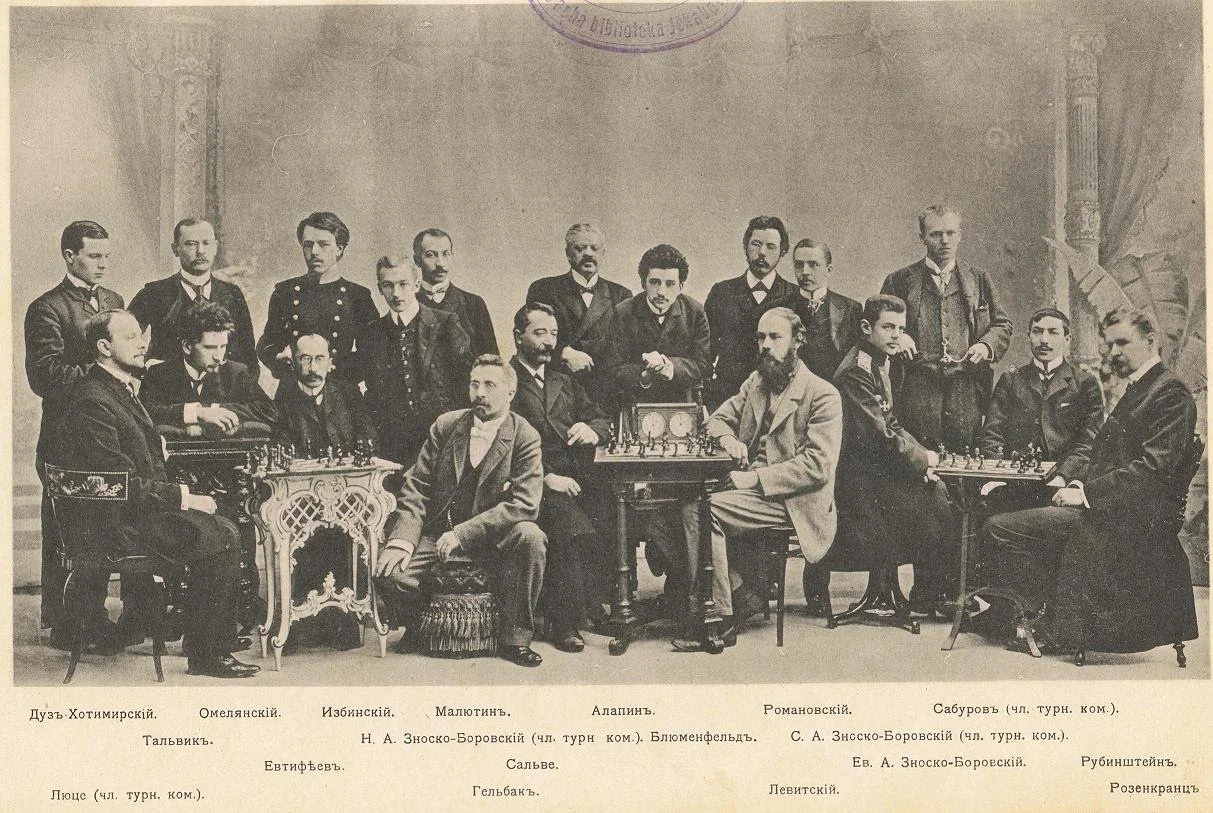
Alapin returned to sustained Russian competition from 1905. He finished fifth in the Fourth All-Russian Tournament in St Petersburg in 1905-06 and defeated Chigorin in their individual game.
In a small St Petersburg match-tournament later in 1906, organized to mark his return, Alapin finished first ahead of his old rival. He then won five games without a loss in a 1907 match with Stepan Levitsky.
His strongest late championship result was second place behind Akiba Rubinstein at the Fifth All-Russian Tournament in Lodz, played across 1907-08. The finish was marred by a dispute after Alapin accused Fyodor Duz-Khotimirsky of assisting another competitor’s analysis.
Rubinstein and two colleagues protested and forfeited games. The tournament committee did not uphold their demand to expel Alapin. The episode belongs in his record because it affected how fellow masters viewed him, though the surviving accounts do not justify a verdict on the underlying accusation. [3]
His final years in major events were less successful. A 1911 match loss to Rudolf Spielmann and poor results in several large tournaments revealed declining consistency. Alapin nevertheless remained active in analysis and occasional competition.
At the Fourth Upper Rhine Chess Congress in Pforzheim in 1922, he won the master event while playing outside the formal prize classification. This appears to have been his last public competitive success. [3]
Style and Reputation
Alapin’s chess was grounded in calculation, technical persistence, and a preference for positions whose strategic logic he believed he had clarified in advance. Many of his opening projects sought a sound central structure or a precise defensive resource.
His Sicilian 2.c3 work is the clearest example. White prepares a broad center and reduces the amount of forcing theory. His analyses of the Evans Gambit and Falkbeer Countergambit reveal a sharper side, concerned with testing sacrifices and locating exact defensive answers.
A 1905 victory over Frank Marshall in the Falkbeer Countergambit became notable because Alapin successfully applied his published analysis against one of the era’s most dangerous attackers. The game is significant as evidence of his method, without requiring a detailed tactical examination. [6]
Contemporary and later accounts credit Alapin with endgame resourcefulness, especially in rook and minor-piece endings. His high drawing rate reflected defensive skill, a willingness to simplify, and occasional excessive caution.
His record in the largest events remained inconsistent. Commercial demands, long gaps in top-level competition, and age probably contributed, though temperament also played a role. He could be confident to the point of rigidity, and he sometimes carried analytical disagreements into public conflict.
His relationship with Chigorin illustrates the mixture of rivalry, respect, and estrangement in Russian chess culture. In memoirs published in 1937, former St Petersburg club secretary G. A. Gelbak associated the club split of 1890 with an attempt to add a rule concerning people of non-Christian faith.
Alapin, who was Jewish, left the club. Schiffers and several others reportedly followed in solidarity. Since Gelbak’s account was written decades later, it should be used as retrospective testimony. [3]
The next year, Alapin published defensive analysis of the Evans Gambit and sent it to Wilhelm Steinitz before Steinitz’s 1892 title match with Chigorin. Members of Chigorin’s circle treated this as disloyal.
Steinitz did not adopt Alapin’s specific recommendation, so its direct effect on the match should not be exaggerated. The controversy nevertheless worsened relations between the two Russians. Chigorin’s participation in Alapin’s 1906 return event shows that the breach did not end professional contact.
Contributions Beyond Tournament Play
Alapin’s theoretical work was unusually broad and unusually dispersed. German and Russian periodicals carried much of it as freestanding analysis. He corrected published lines, explained older maneuvers, and sometimes presented instructional material through invented players and humorous fictional games. The approach joined research with popular exposition. [6]
His name remains most familiar through the Sicilian 2.c3 system. Specialist opening literature stresses two points that popular summaries often blur. Alapin was not its inventor, while his repeated use against strong competition made him its first important high-level advocate.
Soviet grandmaster Evgeny Sveshnikov revived and greatly expanded the system from the 1970s. Its modern theoretical content owes far more to Sveshnikov and later analysts, while its historical name accurately recalls Alapin’s pioneering practical campaign. [7]
Other ideas carried Alapin’s name in the Spanish Game, the French Defence, open games, and early forms of the Slav Defence. Some proved durable. Others became historical curiosities or were later reassigned after earlier examples came to light.
His 1896 pamphlet Toward the Theory of the Spanish Game: A Chess-Analytical Study demonstrates that opening research was already a distinct part of his public identity. His successful use of analysis against Marshall in 1905 further shows that his theory could withstand practical testing.
From 1898 to 1901 Alapin published the Berlin periodical Der Schachfreund. In 1913 he reused the title for a beginner’s handbook issued in Heidelberg. The periodical allowed him to circulate original analysis outside the editorial priorities of established magazines.
Edward Winter’s archival dossier reproduces material from its first volume and helps document its bibliographical history. [8]
Alapin also lectured, gave simultaneous exhibitions, supported events financially, and played consultation games. In Berlin in 1897, he scored seventeen wins, two losses, and one draw in a twenty-board simultaneous exhibition. In 1892 he supplied the fifty-mark prize for a short Bardeleben-Caro match.
A postcard preserved in the Pushkin House archive reports that in 1910 Alapin addressed more than three hundred people at a Munich workers’ chess club. These records identify genuine teaching and patronage activity. No evidence has emerged of a permanent coaching post, a stable school of pupils, or service as a formal second in the modern sense. [2] [3]
A lesser-known essay, “On the Protection of the Intellectual Property of Chess Researchers,” discussed whether games and analysis could receive copyright or comparable legal protection. It appeared in the 1908-09 period and reveals an early concern with the status of analytical labor.
Alapin also wrote philosophical pieces. In a 1907 letter to philosopher Ernst Radlov, he explained that chess supplied the reputation and audience through which he could sometimes publish more abstract reflections. The letter is valuable evidence of how deliberately he understood his public identity as an analyst and writer. [1] [2]
Place in Russian and Soviet Chess History
Alapin occupied an international chess culture linking St Petersburg with Berlin, Vienna, Paris, Munich, and Heidelberg. His commercial independence enabled travel, publication, patronage, and periodic returns to serious play. It also kept him outside a single national or institutional career path.
The Berlin Chess Society and St Petersburg clubs were important professional environments, while his multilingual publication record allowed ideas developed in one chess culture to circulate through another.
For a history of Soviet chess, chronology is decisive. Alapin’s mature career belonged to the Russian Empire, and his permanent move to Heidelberg preceded the Revolution. He took no documented role in the emerging Soviet chess institutions before his death in 1923.
His presence in Soviet culture came through reception. Soviet reference books and opening manuals retained his name and analyses, and Sveshnikov’s later work transformed the Alapin Sicilian into a substantial modern system.
Alapin therefore belongs to the prehistory inherited by Soviet chess, especially its respect for systematic opening investigation. [6] [7]
Later Life and Historical Legacy
Alapin settled in Heidelberg in 1913, where his mother and maternal relatives had lived. A postcard from that year states that he had never married.
He continued to write, correspond, and publish, although the First World War reduced his income and restricted his circumstances. He died in Heidelberg on 15 July 1923. His grave has not been located. [1] [3]
His reputation has been narrowed by the fame of a single opening name. A fuller assessment recognizes three achievements.
Alapin belonged to the small first generation of Russian players who could sustain master-level competition across Europe. He treated opening analysis as research that could be published, defended, revised, and taught. He also helped connect Russian chess with German-language chess journalism before specialized national institutions assumed that work.
One familiar attribution deserves caution. The standard “Fahrni-Alapin” pawn ending is usually presented as if its complete origin were known. Edward Winter has shown that the early printed source identifies only a position from a Fahrni-Alapin game. The event and full game score remain uncertain. It is best described as a traditional attribution, not a securely reconstructed episode. [9]
Notes and Sources
1. Mikhail Zaytsev, “Alapin: A New Biography”, based on Vilna revision lists and metrical records, Heidelberg address books, the 1907 tournament biography, and other archival materials. Especially important for the birthplace, date discrepancy, education, family, and final residence.
2. Alexander Kentler, “Surprises of the Pushkin House, Part Two: Alapin”. The article publishes letters and postcards from the S. A. Vengerov collection in the Manuscript Department of the Institute of Russian Literature, including Alapin’s 1874 educational plans, 1910 Munich lecture, and 1907 letter to Ernst Radlov.
3. Mikhail Zaytsev, “Alapin’s Chess Legacy: Biographical Section”. This study assembles contemporary press notices, memoir evidence, tournament disputes, simultaneous exhibitions, patronage, and the 1922 Pforzheim result. Its interpretive comments have been separated here from the documents it cites.
4. “S. Alapin,” British Chess Magazine 43, no. 10 (October 1923), p. 374, available in the Internet Archive volume. The obituary is useful for contemporary tournament assessment but gives the now-discredited birthplace of St Petersburg.
5. Jeff Sonas, Chessmetrics profile and retrospective rating summary. The figures are historical estimates, not official ratings.
6. Mikhail Zaytsev, “Alapin’s Chess Legacy: Theoretical Section”. This specialist study traces Alapin’s periodical analysis and separates genuine advocacy from later or inaccurate eponymic claims.
7. Alexander Khalifman and Sergei Soloviov, Squeezing the Sicilian: The Alapin Variation (Chess Stars, 2020), introduction. Useful for distinguishing Alapin’s historical advocacy from Sveshnikov’s modern development of the system.
8. Edward Winter, “Simon Alapin”, Chess Notes. Includes bibliographical evidence and images from Der Schachfreund and discusses the correction of Alapin’s birthplace.
9. Edward Winter, “The So-called Fahrni-Alapin Pawn Ending”, Chess Notes. A source-critical examination of an attribution whose full game context is unknown.
10. Evgeny A. Znosko-Borovsky, ed., IV Vserossiiskii shakhmatnyi turnir [Fourth All-Russian Chess Tournament] (St Petersburg, 1907), pp. 195-196. The biographical sketch, evidently based on information supplied by Alapin, is a primary source for his move to St Petersburg, education, railway service, and business career.
11. David Hooper and Kenneth Whyld, The Oxford Companion to Chess, 2nd ed. (Oxford University Press, 1992), entry “Alapin.” Useful as a standard reference, with its biographical claims checked against the newer archival findings above.
12. G. A. Gelbak, memoirs, Shakhmaty v SSSR, no. 3 (1937), cited and reproduced in part by Zaytsev. This is the retrospective source for the 1890 St Petersburg club dispute and should be read with the normal cautions attached to memoir testimony.
Historical Assessment
Semyon Alapin deserves attention today because his career reveals how serious chess research operated before federations, professional coaching staffs, and formal title systems gave it institutional support.
He was a strong, uneven, intellectually independent master whose best ideas traveled farther than his tournament fame. His surviving work, his role in the first generation of internationally active Russian masters, and the later Soviet development of the system bearing his name place him securely in the intellectual genealogy of modern chess.
