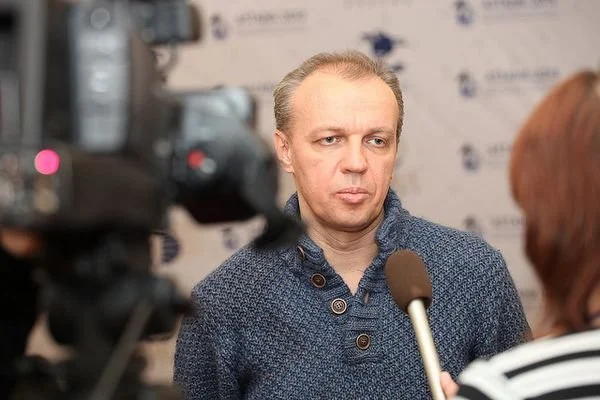
In August 1988, Sergey Shipov sat down with the black pieces against East German international master Gernot Gauglitz. The men’s title at Moscow State University’s international chess tournament was still open. Shipov won their Nimzo-Indian Defense in 46 moves and finished undefeated with 7½ points from nine games. The Riga magazine Shakhmaty identified the winner as a fourth-year physics student. He was 22 and still held the Soviet rank of candidate master. [1]
Ten years later, Shipov shared the top score in the Russian Chess Championship. He became a blitz sparring partner for Garry Kasparov, wrote The Complete Hedgehog, and taught young players including Ian Nepomniachtchi and Daniil Dubov. On his website Crestbook, Russian-speaking spectators could follow a tournament game as it unfolded and ask him about the moves. [2, 3, 5, 7, 8]
A chess education in Kirzhach and Moscow
Sergey Yuryevich Shipov (Сергей Юрьевич Шипов) was born on April 17, 1966, in Murom. A year later, his family moved to Krasny Oktyabr in the Kirzhach district of Vladimir Region. His father gave him Vasily Panov’s First Book of the Chess Player when he was four. During a long stay in the hospital as a boy, Shipov played children in other wards. Those who could walk carried the moves between beds. [2, 4]
Back in Kirzhach, his first coach was Yuri Golub. In 1979, Shipov’s father wrote to the Soviet chess federation asking it to send a trainer to the town. The reply invited him to bring his son to Moscow. Admissions at the city’s sports boarding school had already closed, but two masters agreed to test the boy. He solved enough positions to earn a place. Among his classmates were Evgeny Bareev and Yuri Dokhoian, both future grandmasters. [2, 3]
From the physics faculty to the Russian Championship
Shipov chose to study physics at Moscow State University and continued to play for its chess club. The Soviet magazine 64 counted 114 players in the men’s event he won in 1988. After university, he worked at the Institute of Chemical Physics in Chernogolovka. In his memoir, he recalled taking leave to play an open tournament in Poland and coming home with the equivalent of a year’s salary at the institute. He resigned the following year, taught children, and began earning his living on the tournament circuit. [1, 2, 3]
FIDE awarded Shipov the international master title in 1992 and the grandmaster title in 1996. At the 1998 Russian Championship in St. Petersburg, he beat Oleg Korneev and Andrei Shchekachev, then drew Peter Svidler in the final round. Shipov, Svidler, Konstantin Sakaev, and Alexander Morozevich each scored 7½/11. Morozevich won the championship on tiebreak. [4, 5]
Shipov reached 2662 on the January 1999 FIDE rating list, which placed him 24th in the world. His St. Petersburg result had also qualified him for the FIDE World Championship in Las Vegas. There he eliminated Iceland’s Hannes Stefánsson in the second round, 2½–1½, before losing both games to Vassily Ivanchuk in the third. [2, 4, 6]
Kasparov and The Complete Hedgehog
In the late 1990s, Kasparov was looking for someone to play him at short time controls. Shipov got the call at home in Chernogolovka. One subject they repeatedly tested in blitz was the Hedgehog. Black typically arranges pawns on a6, b6, d6, and e6, leaving White more room to maneuver. The difficulty for Black is judging when to break out with ...b5 or ...d5. Move too soon and the pawns can become targets. Wait too long and White can prevent the break altogether. [2, 7]
Kasparov supplied an example from his own career in the foreword to Shipov’s book. Against Robert Hübner at Tilburg in 1981, he played both pawn breaks on successive moves and won. Shipov devoted a book in Russian, Ёж (The Hedgehog), to positions of this kind. The first volume of the expanded English edition, The Complete Hedgehog (Mongoose Press, 2009), treats the English Opening. The second, published in 2011, follows the Hedgehog into positions arising from 1.e4 and 1.d4. [2, 7]
Beating Magnus Carlsen in Tromsø
In the seventh round of the 2006 Midnight Sun Chess Challenge, Shipov and 15-year-old Magnus Carlsen met on 5/6. Carlsen had White against the French Defense. On move 34 he played his queen to f3, and Shipov pushed his d-pawn forward with 34...d3! The pawn looked available to the queen. Shipov later explained that after 35.Qxd3 Rfd8, moving the queen out of the rook’s path would allow a knight fork on d4. [8]
Carlsen chose 35.Re1. Shipov captured on c2, won the exchange, and converted an ending with rook against knight and three pawns apiece. He finished clear first with 7½/9, half a point ahead of Carlsen. When Shipov later picked four combinations to illustrate his career, the position after Carlsen’s 34.Qf3 was one of them. [2, 8]
Yakov Damski, Crestbook, and Ian Nepomniachtchi
Shipov’s first regular commentary work came at KasparovChess. For the 2000 world championship match between Kasparov and Vladimir Kramnik, he collaborated with veteran Soviet broadcaster Yakov Damski on the Russian match book Последняя интрига века (The Last Intrigue of the Century). Shipov remembered how Damski could slip out of a pressroom analysis session and begin a radio report without a page of notes. Years later, he credited Damski with helping him find his own way into chess publishing. [2, 9]
After writing for ChessPro, Shipov founded Crestbook in 2006, taking its name from his online handle, Crest. In a 2016 tribute, grandmaster Dmitry Kryakvin recalled the pleasure of finding an analyst of Shipov’s strength who would take a reader’s question and answer it himself. [3, 8]
From 2004 to 2007, Shipov worked with the young Ian Nepomniachtchi, helping him prepare the Grünfeld and French defenses and accompanying him to tournaments as a second. In April 2023, when Nepomniachtchi faced Ding Liren for the world championship in Astana, Shipov called the tiebreak for Crestbook. The first three rapid games were drawn. When Ding won the fourth and took the title, Russian-speaking viewers had followed the deciding moves with the grandmaster who had helped build the challenger’s repertoire nearly twenty years earlier. [3, 10]
Notes and Sources
Moscow State University tournament, 1988. B. Gelman’s report includes Shipov’s final-round win over Gernot Gauglitz and his unbeaten score of 7½/9. A second Soviet report records the field of 114 players. Шахматы (Riga), no. 23 (1988) and 64. Шахматное обозрение, no. 22 (1988).
Shipov’s autobiography. Sergey Shipov recalls learning chess in Kirzhach, entering the Moscow sports boarding school, studying physics, and earning his living on the tournament circuit. He closes with four combinations from his own games. Сергей Шипов, «Мои полвека», Crestbook, April 2016.
Coaching Ian Nepomniachtchi. The Chess Federation of Russia dates their work together to 2004–2007 and identifies the Grünfeld and French defenses among Shipov’s contributions to his pupil’s repertoire. «Сайт ФШР продолжает цикл публикаций про тренеров Яна Непомнящего», April 19, 2023.
Titles and world ranking. FIDE records Shipov’s international master title in 1992 and grandmaster title in 1996. The January 1999 rating list places him 24th in the world at 2662. FIDE player record and Shipov’s historical FIDE ratings at OlimpBase.
1998 Russian Championship. Shipov, Alexander Morozevich, Peter Svidler, and Konstantin Sakaev scored 7½/11 in St. Petersburg. Morozevich won the title on tiebreak. Mark Crowther’s contemporary report, The Week in Chess, August 10, 1998 and OlimpBase tournament crosstable.
1999 FIDE World Championship. The official knockout results record Shipov’s second-round victory over Hannes Stefánsson and his third-round loss to Vassily Ivanchuk. FIDE, Las Vegas 1999 tournament record.
Kasparov and the Hedgehog. In his foreword, Garry Kasparov recalls testing the opening against Shipov in blitz and describes playing both thematic pawn breaks against Robert Hübner at Tilburg in 1981. Kasparov’s foreword and Shipov’s introduction, publisher’s PDF. Mongoose Press also gives the contents and publication dates for The Complete Hedgehog, volume one and volume two.
Shipov against Magnus Carlsen, Tromsø 2006. Dmitry Kryakvin’s profile reproduces Shipov’s explanation of 34...d3! Contemporary coverage records the endgame and the final standings. Кряквин, «Мистер Фёст информационной эпохи», Chess Federation of Russia, ChessBase tournament report, and Norsk Sjakkblad, no. 5 (2006), standings on page 6.
Yakov Damski and the London match book. Damski and Shipov collaborated on Последняя интрига века. Каспаров-Крамник. Лондон 2000 (Moscow, Eleks-KM, 2000). Shipov later recalled watching Damski deliver radio reports without notes and credited him with helping him enter chess publishing. Yakov Damski profile and bibliography, Soviet Chess History and Shipov’s recollection in Советский спорт, July 2009.
2023 World Championship commentary. Shipov called the Nepomniachtchi–Ding Liren tiebreak for Crestbook on April 30, 2023. The federation’s match record gives the results of all four rapid games. Watch Shipov’s original Russian-language broadcast and read the Chess Federation of Russia’s match record.
