Soviet Chess Culture
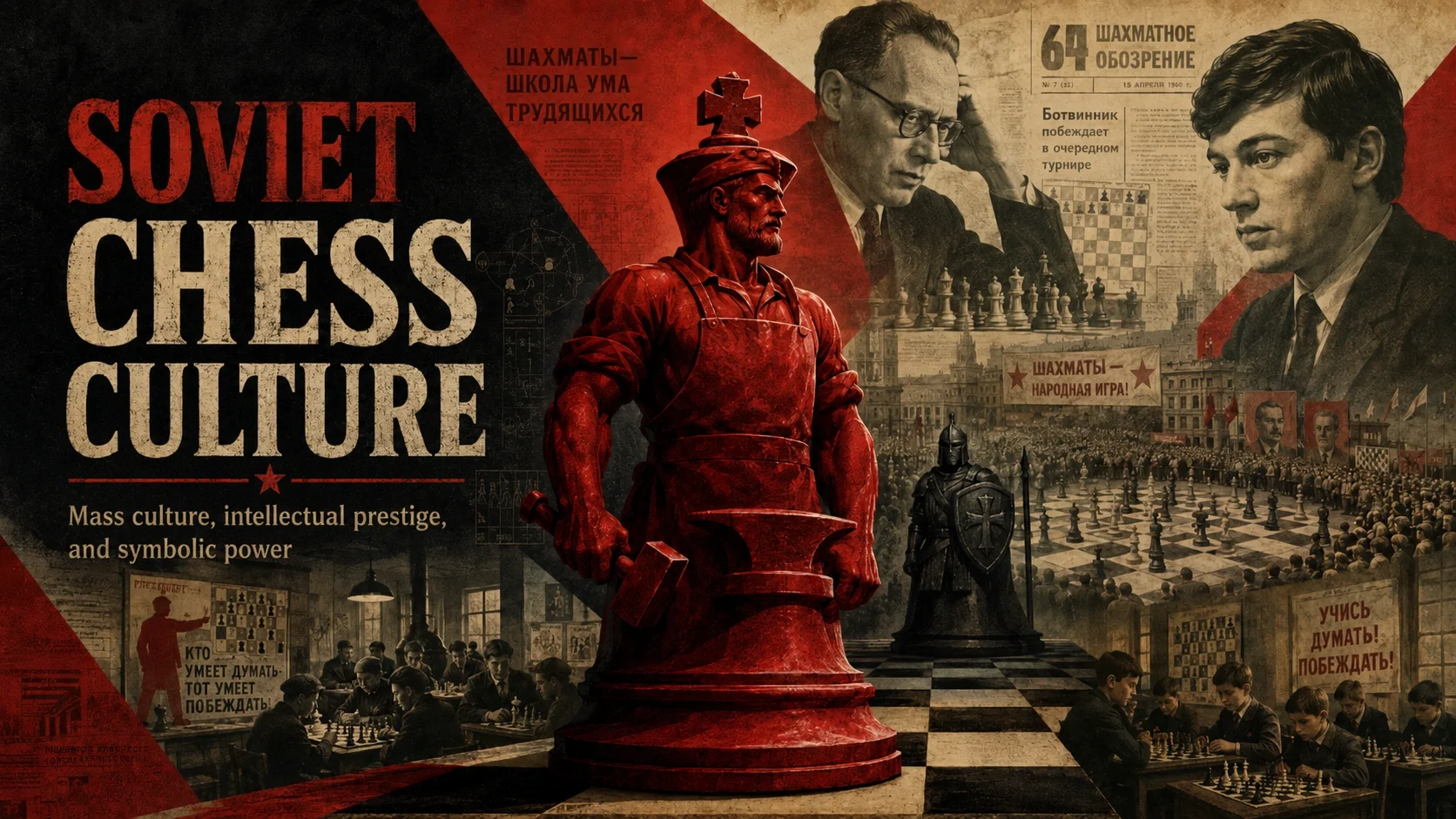
From the mid‑1920s, chess shifted from club pastime to mass activity. The state’s flagship periodical changed its masthead over time to “64. Шахматы и шашки в рабочем клубе” and later “64. Шахматы и шашки в массы” (“Chess and Draughts to the Masses”), signaling policy intent and distribution into workers’ clubs and youth venues.
Public spectacle reinforced the message. On 20 July 1924, Leningrad’s Palace Square hosted a “human chess” exhibition directed by masters Ilya Rabinovich and Pyotr Romanovsky. Red Fleet sailors played the “white” pieces in parade dress, Red Army soldiers the “black”; mounted knights and gun crews as rooks dramatized the moves for thousands of spectators. Contemporary Russian reporting and later retrospectives fix details like cavalry knights, rooks as gun teams, tickets priced 10–50 kopecks, and an hours‑long draw.
The mass infrastructure scaled beyond spectacles. Palaces of Young Pioneers and school‑adjacent clubs provided free sections for chess alongside other activities, giving a durable pipeline from casual play to competitive training.
The celebrated Moscow 1925 international tournament—and the film “Chess Fever” released the same year—projected a city in “chess fever,” mixing reportage footage and comedy to present chess as modern culture. This was popular culture doubling as policy communication.
Soviet periodicals like Shakhmaty v SSSR (1931–1991) became official forums linking results, pedagogy, and ideology, while figures such as Nikolai Krylenko organized high‑profile events and argued for chess as education.
Victories by champions from across the Union were framed as evidence of a successful educational model. Honors illustrate the public role: Mikhail Botvinnik received, among other awards, the Order of Lenin and the Order of the Red Banner of Labour for his achievements and contributions to the chess school.
Women’s chess was integral, not peripheral: Georgia’s Nona Gaprindashvili held the women’s world title from 1962 to 1978 and became the first woman awarded the GM title (1978); Maia Chiburdanidze succeeded her in 1978 and kept the title through 1991. These careers emerged from the same system of clubs and coaching and mattered to audiences from Tbilisi to Moscow.
The 1972 Spassky–Fischer match condensed geopolitical narratives into a sports broadcast. Even neutral accounts note the match’s symbolism and the shock of a non‑Soviet champion after decades of Soviet dominance, prompting internal reviews of preparation methods. For facts and framing, see Russian‑language and international reporting.
If films and newspapers told the story at scale, porcelain told it on the tabletop. The State Porcelain Factory in Petrograd/Leningrad—formerly the Imperial Porcelain Factory, nationalized in 1918 and named for Lomonosov in 1925—produced propaganda wares that visualized the new order. Among them, the “Reds vs Whites” chess set designed after 1922 by sculptor Natalia Danko (with painting attributed in some sets to her sister Elena) is a compact visual manifesto.
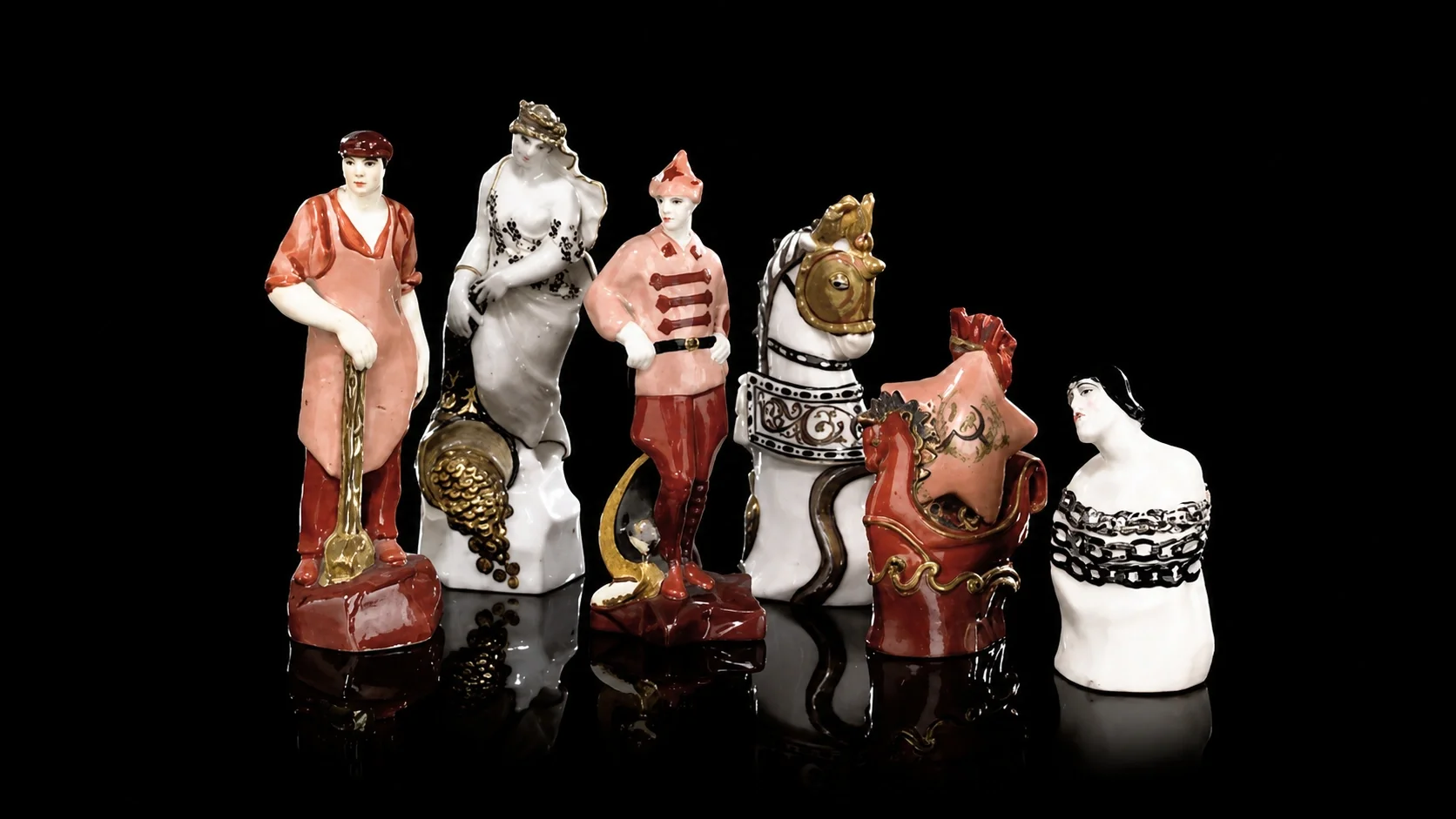
Two ideologies, two iconographies.
Auction and museum records agree on the allegory: the Red king is a muscular blacksmith in apron with hammer; the White/Capitalist king is Death in armor with an ermine‑lined mantle. Queens oppose a peasant woman with wheat to Fortuna scattering coins. Red bishops are Red Army soldiers; White bishops are officers of the old regime. Pawns bear sickles and sheaves on the Red side; on the White side they are shackled. Rooks are stylized ships; on Red, they carry stars and socialist emblems; on White, double‑headed eagles appear on finials and tack. The set exists in several production runs, c. 1920s–1930s.
Material rhetoric.
Porcelain’s sheen and gilding serve meaning, not luxury: polished Reds suggest virtuous labor; glossy, black‑and‑gold Whites suggest decadence and mortality. The Death‑king’s smile literalizes the narrative of a dying order; chained pawns compress a class argument into one gesture. This is propaganda by design language rather than slogan.
Factory context.
The same workshop created other “agit‑porcelain” pieces, linking avant‑garde graphics and state themes. The factory’s renaming history (Imperial → State → Lomonosov) maps cleanly to this ideological turn and helps date marks on bases in surviving sets.
Reading with care.
The set is polemic, not reportage. It tells us how a young state wished chess to look and feel in domestic space. It also coexisted with a plural chess culture that produced champions from many republics and styles—from Petrosian’s prophylaxis to Tal’s combinational storms—so the iconography should be placed alongside living practice, not taken as its total meaning.
Behind the images stood a method. Botvinnik’s coaching ethos—laboratory‑like preparation and post‑game analysis—was institutionalized after 1963 in a school that developed or influenced future world champions Karpov, Kasparov, and Kramnik. The emphasis was less on a single “Soviet style” than on systematic training.
Sources and further reading
Mass movement & media: 64 magazine history and mastheads; Russian Chess Federation library facsimiles.
Human chess, 1924: Kommersant explainer; archival notices reproduced in local media.
Moscow 1925 & “Chess Fever”: Film references and synopses.
Porcelain set iconography and dating: Sotheby’s, Christie’s, Bonhams entries; Metropolitan Museum overview of “Capitalism” vs “Communism” pieces.
Factory context: Renaming and propaganda wares.
Soviet chess school & coaching: Botvinnik biographies and summaries.
Cold War proxy: Russian‑language overview and AP obituary context on 1972’s significance.
Women’s champions: Gaprindashvili and Chiburdanidze biographies.
Notes on balance
This piece uses Russian‑language and neutral institutional sources so the frame is not Western‑centric. It recognizes contributions from republics across the former USSR and keeps the focus on documented policy, media, and design, avoiding judgment of any state or people.
