Viktor Korchnoi wins Hoogovens 1968
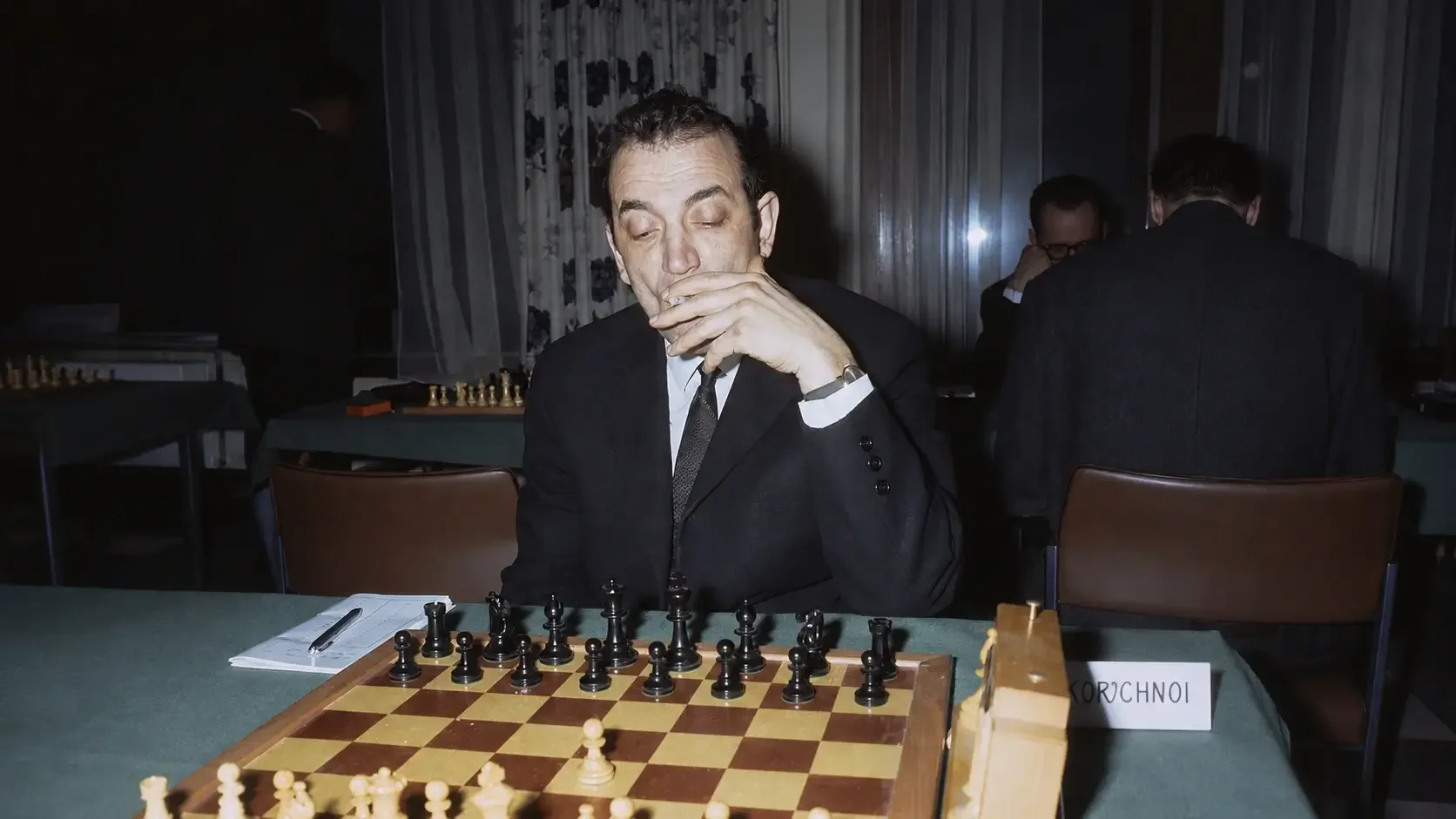
Eric Koch for Anefo, CC0, via Wikimedia Commons
Viktor Korchnoi’s victory at the 1968 Hoogovens Chess Tournament stands among the most dominant tournament performances of his long career. Playing in the Netherlands against a 16-player international field, the Soviet grandmaster scored 12 points from 15 games and finished three full points ahead of Mikhail Tal, Vlastimil Hort, and Lajos Portisch, who shared second place on 9/15.
For Korchnoi, this was more than a tournament win. It was an announcement. In a field that included a former World Champion, elite grandmasters, experienced international competitors, and strong Dutch representatives, Korchnoi turned Hoogovens 1968 into a display of force. He scored 10 wins, 4 draws, and only 1 loss. His victims included Mikhail Tal, one of the most feared attacking players in chess history.
The image of Korchnoi from the Dutch National Archives captures the mood perfectly: a cigarette in hand, a chessboard in front of him, and the nameplate “Korchnoi” at the side of the table. The archival caption identifies the event as Hoogovenschaaktoernooi te Beverwijk and dates the photograph to January 5, 1968. Historically, 1968 was also the first year the main Hoogovens tournament was played at Wijk aan Zee, the seaside village that later became inseparable from the tournament’s identity.
Hoogovens and the Rise of a Chess Tradition
The Hoogovens tournament began in 1938 and gradually became one of the most important recurring events in international chess. Today it is known as Tata Steel Chess, but its earlier identity as Hoogovens remains central to its history. The tournament became famous for combining elite chess with a distinctive Dutch atmosphere: seaside weather, crowded playing rooms, and a mix of established grandmasters and ambitious challengers.
By the 1960s, the tournament had grown far beyond its local origins. Soviet players began to play an increasingly visible role, and the event became a regular stage for measuring Soviet chess strength against leading players from Western Europe, Yugoslavia, the Netherlands, and beyond. Korchnoi’s 1968 win came at a time when Soviet chess still dominated the world championship cycle, but individual events in Western Europe gave players a different kind of test. A Soviet grandmaster had to win outside the Soviet system, under foreign conditions, against a field that knew exactly whom it was facing.
Korchnoi passed that test with room to spare.
The 1968 Field
The 1968 Hoogovens field included several major names. Mikhail Tal brought the aura of a former World Champion and one of chess history’s most creative attacking minds. Lajos Portisch represented the best of Hungarian chess and was already a serious figure in world championship qualification. Vlastimil Hort, Florin Gheorghiu, Borislav Ivkov, Aleksandar Matanovic, Hans Ree, Jan Hein Donner, Nicolas Rossolimo, and others gave the tournament real international depth.
Korchnoi did not win by edging ahead in the final round. He separated himself from the field. His final score of 12/15 gave him an 80 percent result in a round-robin event in which every player faced the same opposition. That margin is the lasting mark of the tournament. Tal, Hort, and Portisch finished three points behind him, a huge gap at this level.
The crosstable shows the shape of Korchnoi’s performance. He defeated Tal, Hans Ree, Nicolas Rossolimo, Dirk van Geet, Dragoljub Ciric, Borislav Ivkov, Milko Bobotsov, Nikola Karaklajic, Aleksandar Matanovic, and Nikola Padevsky. He drew with Jan Hein Donner, Florin Gheorghiu, Vlastimil Hort, and Kick Langeweg. His only loss came against Portisch.
That balance tells the story: Korchnoi beat almost everyone he had to beat, held firm against dangerous rivals, and absorbed one setback without losing control of the tournament.
Korchnoi’s Style in Full View
Korchnoi’s chess was never soft. He was a player of tension, resistance, calculation, and willpower. His best games often feel less like smooth demonstrations and more like tests of endurance. He invited complexity, defended stubbornly, and punished any opponent who expected him to crack.
At Hoogovens in 1968, that character came through in the result. Korchnoi was not simply collecting safe draws against the leaders and wins against the lower half of the table. He beat Tal, one of the tournament’s main attractions, and kept scoring at a pace no one else could match. His chess could be tactical, positional, defensive, or provocative, depending on the position. That flexibility made him especially dangerous in a long event.
The photograph from the tournament adds a human layer to the record. Korchnoi appears focused, tired, and completely absorbed in the game. The room is dim, the chessboard is crowded, and the tournament hall has the unmistakable atmosphere of late-1960s European chess. It is a world of wooden boards, analog clocks, score sheets, cigarettes, and long concentration. In that setting, Korchnoi looks exactly like the player his opponents feared: alert, combative, and difficult to move.
A Landmark Year for Korchnoi
Korchnoi’s 1968 did not end with Hoogovens. The same year, he advanced deep into the World Championship Candidates cycle. He defeated Samuel Reshevsky in Amsterdam, then defeated Mikhail Tal in Moscow, before losing the Candidates final to Boris Spassky in Kiev. That run placed him close to a match for the World Championship.
Seen in that context, Hoogovens 1968 was part of a larger surge. Korchnoi was entering one of the strongest periods of his career. He was already a multiple Soviet Champion and an established world-class grandmaster, but 1968 sharpened his reputation. He was no longer simply one of many powerful Soviet players. He was a genuine contender for the highest title in chess.
His performance in the Netherlands also foreshadowed his long connection with the Wijk aan Zee tournament. Korchnoi later won the event again in 1971, 1984, and 1987. Few players have maintained that kind of presence across so many eras. In 1968, he was still officially representing the USSR. By the 1980s, after his break with the Soviet system, he returned to the same tournament as one of the most famous defectors in chess history.
That later biography gives the 1968 photograph a deeper resonance. It shows Korchnoi before the political rupture, before his World Championship matches with Anatoly Karpov, and before his name became inseparable from Cold War chess drama. Yet the essential Korchnoi is already there.
Why Hoogovens 1968 Still Stands Out
Many great players won Hoogovens, but few won it the way Korchnoi did in 1968. A three-point margin in a 16-player round robin is rare. Doing it ahead of Tal, Hort, and Portisch makes the result even more striking.
For Soviet chess history, the tournament shows Korchnoi at the height of his competitive powers. It also shows how deeply Soviet chess had entered the international tournament circuit by the late 1960s. The USSR was not only producing World Champions. It was sending players abroad who could dominate elite events with brutal efficiency.
Hoogovens 1968 belongs in any serious account of Viktor Korchnoi’s career. It captures his strength before the famous defection, before the Karpov matches, and before his later reputation as chess’s great dissident fighter. In January 1968, in the Netherlands, Korchnoi was simply overwhelming.
Notes
Tata Steel Chess Tournament, “Hoogovenstoernooi 1968: Standings,” All-time Tournaments.
Tata Steel Chess Tournament, “Hoogovenstoernooi 1968: Crosstable,” All-time Tournaments.
ChessBase, “Ten Trivia about the Tata Steel Tournament Series, the Wimbledon of Chess,” January 13, 2023.
Douglas Griffin, “The Korchnoi-Tal Candidates’ Semi-final (Moscow, 1968), with annotations by Petrosian, Koblencs & Kirillov,” August 21, 2020.
Nationaal Archief, Fotocollectie Anefo, Eric Koch, “Hoogovenschaaktoernooi te Beverwijk; Kortsnoj, USSR,” January 5, 1968, Bestanddeelnummer 254-7968.
