Viktor Kupreichik
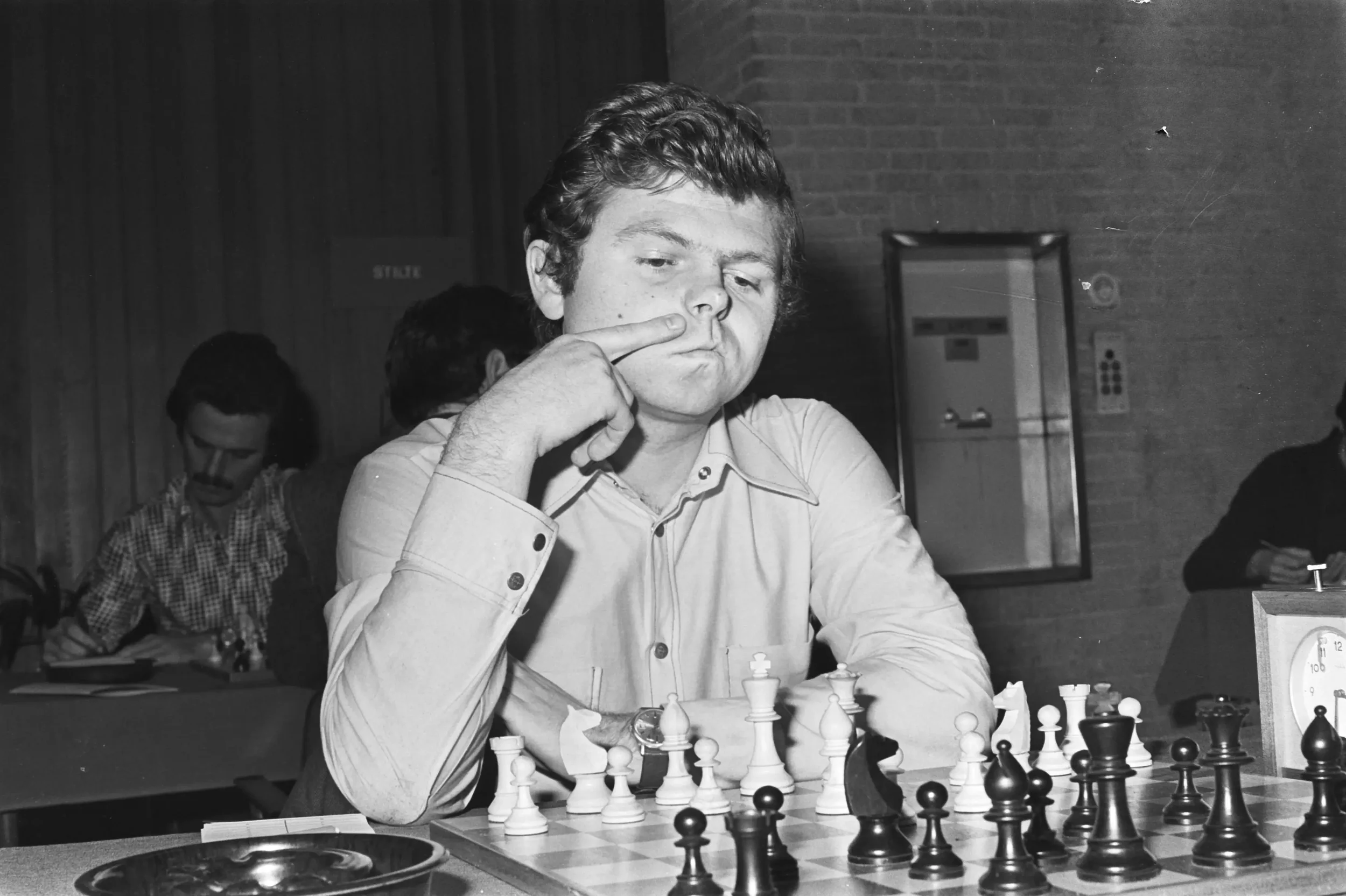
Hans Peters for Anefo, CC0
Introduction
Viktor Davydovich Kupreichik, born in Minsk on July 3, 1949 and died there on May 22, 2017, occupies a distinctive place in Soviet and Belarusian chess history. He was the first Belarusian grandmaster, a player of striking originality, and at his peak one of the strongest players in the world by rating, reaching 2580 and a world ranking of number 22 in July 1981. Those bare markers, however, only begin to explain his historical profile. Kupreichik was prized less for institutional status than for the rare intensity of his chess. Contemporary and retrospective sources agree on the central point: he was a creative attacker whose games radiated imagination, risk, and refusal of routine.
He is also an unusually good example of a player whose reputation was larger than his formal place in the world championship hierarchy. Within Soviet chess culture, professionals respected him because his best form could destabilize almost anyone, while Belarusian spectators embraced him as a local hero whose success did much to popularize chess in the republic. Later memorial sources, including those issued by FIDE-affiliated and Belarusian organizers, consistently describe him not only as the first Belarusian grandmaster but as a symbolic founder of modern Belarusian chess identity.
Early Life and Chess Formation
Kupreichik grew up on the Minsk outskirts in the district known as Selykhozposelok, a plain postwar environment far removed from any idealized image of the cultivated Soviet chess prodigy. Russian and Belarusian reminiscences agree that his father, David Mikhailovich, a veteran of the Second World War who helped liberate Minsk and later worked as an economist at the Kommunarka factory, together with an uncle, first introduced him to chess. Kupreichik himself remembered a childhood dominated by street games, football, and rough neighborhood life. Chess emerged almost accidentally: he went to enroll in football, found no places available, and turned instead to the Palace of Pioneers chess circle, where his talent quickly became unmistakable.
That early formation is historically significant because it shaped both his social image and his style. Soviet chess was full of highly educated, technically schooled players, but Kupreichik was repeatedly remembered as someone who brought a more instinctive, street-fighter energy to the board. Even in later official memorial language, he was portrayed as a child who dreamed first of becoming a footballer, only later giving himself to chess. By school age he had already progressed far enough to fulfill the Soviet master norm, and he later enrolled in the journalism faculty of Belarusian State University. In a later interview, he explained the choice of journalism in characteristically understated terms, saying that essays had always gone well for him.
His rise was visible early enough that future world champion Anatoly Karpov remembered meeting him at the USSR Junior Championship in 1963. Karpov’s recollection of a joint trip to Czechoslovakia in late 1966 or early 1967 is revealing. Kupreichik appears there as a first-year Minsk University student already trusted to represent Soviet chess abroad, and already recognized by peers as an exciting, combative player. This is a useful corrective to any tendency to treat him merely as a later attacking specialist. From the beginning, he was regarded as a player of promise at the all-Union level.

Rise in Competitive Chess
Kupreichik’s first major phase came through student and young master competition, a traditional Soviet proving ground for future elite players. At nineteen he entered the Soviet student national team and participated in a run of team successes that helped establish his name. The Russian Chess Federation obituary records that he won the World Student Team Championship three times, in 1968, 1969, and 1974. OlimpBase confirms the standout quality of his 1968 performance at Ybbs, where he took the best individual result in Group A as second reserve with 5.5 points from 7 games. These results show that his rise was not a matter of local Belarusian prominence alone. He was already functioning in one of the USSR’s most competitive developmental channels.
The next step was consolidation among the strongest non-elite Soviet professionals. The same obituary notes his victories in the All-Union Young Masters tournaments of 1970 and 1974, evidence that he was more than a gifted junior. Just as important, the Russian Chess Federation states that at the beginning of the 1970s he started working with Viktor Korchnoi as one of his seconds. That detail is easy to overlook, but it is historically valuable. To be brought into Korchnoi’s analytical orbit meant that Kupreichik was already respected for serious chess labor, not merely for sacrificial flair. The obituary adds that this cooperation helped him refine and harmonize his style without changing its essential basis, which is a plausible and careful way to describe the maturation of a naturally aggressive player into a strong grandmaster candidate.
Another important professional relationship came with Yuri Balashov. In a later interview, Kupreichik said that he had worked with Balashov from 1977 onward, adding that they helped one another in zonal and interzonal events and in USSR Championships. This is an illuminating detail because it places him inside serious collaborative networks of Soviet top-level preparation. He was not an isolated romantic attacker. He belonged to the analytical culture of Soviet chess while retaining a pronounced personal style of play.
By the second half of the 1970s he had clearly entered the higher Soviet tier. He won the Masters group at Wijk aan Zee in 1977 and shared first at Kirovakan in 1978, then received the grandmaster title in 1980. The rating record helps show the velocity of that rise. OlimpBase’s FIDE history places him at 2530 in January 1978, 2540 in January 1979, 2535 in January 1980, 2575 in January 1981, and 2580 in July 1981. That pattern is not the profile of a cult favorite alone. It is the profile of a genuinely world-class player at his best.
Major Career Achievements
Kupreichik’s strongest run came from the late 1970s into the early 1980s. He won or shared first in a notable string of international events: Wijk aan Zee 1977, Kirovakan 1978, Reykjavik 1980, Plovdiv 1980, Medina del Campo 1980, and Hastings 1981 to 1982. Those victories explain why, in rating terms, he broke into the top quarter of the global list in 1981. They also explain why some contemporaries remembered him as a player who could look nearly unstoppable when conditions favored dynamic, fighting chess.
Within the USSR Championships, the record is especially revealing. OlimpBase credits him with eight final appearances, in 1969, 1974, 1976, 1979, 1980, 1981, 1985, and 1987. His best result was shared fifth through seventh in 1979, and his championship career never translated fully into a run through the world championship cycle. Yet two facts define his place in Soviet tournament folklore. First, he was strong enough to remain a recurring finalist in the deepest national championship in the world. Second, he twice opened a USSR Championship with five straight wins, a feat repeatedly cited in later memorial sources. That combination, sustained access to the very top Soviet field and bursts of destructive momentum inside it, captures both his strength and his volatility.
Post-Soviet Belarus did not reduce him to a ceremonial veteran. He remained a competitive and symbolic leader. The Russian Chess Federation described him as the leader of the Belarusian national team in various team competitions, and OlimpBase places him on board one for Belarus at the 1994 Moscow Olympiad. He also won the Belarusian championship in both 1972 and 2003, a striking span that shows how long he remained relevant to national chess. Later in life he added successes such as winning Group B of the first Aeroflot Open in 2002 and the European Seniors’ Rapid Championship in 2010. Those later results did not redefine his historical place, but they do show that his competitive energy was not confined to the Soviet decades.
Style and Reputation
Among the many labels attached to Kupreichik, the most durable are the most concrete. Alexey Suetin characterized him as a player of bright combinational style, distinguished by rich imagination, absence of stereotypes, and constant readiness to risk. That description is unusually serviceable because it comes close to matching every serious recollection from very different witnesses. In the foreword to the Russian edition of the modern Kupreichik book, Genna Sosonko likewise stressed his independence in the already crowded world of Soviet chess, while Anastasia Sorokina emphasized the brilliance and fearlessness that made spectators queue to watch him.
The comparison with Mikhail Tal is not superficial. Tal was explicitly identified as Kupreichik’s idol, and memorial sources report that Tal once called him the “d’Artagnan of chess.” That image is colorful, but it is not empty rhetoric. It evokes exactly what observers meant by Kupreichik’s style: initiative before safety, imagination before orthodoxy, and a readiness to draw the sword at any moment. Sosonko’s foreword goes further by saying that Kupreichik repeatedly placed pieces en prise on the same key attacking squares Tal loved and that, when he was in form, professionals knew they had to be wary because few could withstand the pressure of his ideas.
If one game must be named to explain his fame, it is the 1970 win over Tal at the Grandmasters versus Young Masters event in Sochi. That game became a touchstone not because of some later engine-certified perfection, but because it represented Kupreichik’s style in concentrated form. Sosonko’s foreword identifies it as a defining fireworks display beginning with a knight sacrifice on d5, and Alex Yermolinsky later recalled the game as one that “shook” his understanding of chess, highlighting the energy of the young master beating Tal with an all-in attack and three sacrificed pieces. For a historical profile, the significance of that game lies not in the variations themselves but in what it did to Kupreichik’s image. It fixed him in chess memory as a player who could attack Tal in Tal’s own territory and win.
There was, however, a cost to such uncompromising play. This is best stated as interpretation rather than hard fact. His long-event record suggests that the same refusal of stereotype which made him electrifying also made him uneven. He could begin Soviet championships with astonishing force, yet finish outside the very top prizes. That does not diminish him. On the contrary, it clarifies why his reputation has endured. Kupreichik was one of those players for whom spectators and colleagues remembered the quality of struggle, not only the arithmetic of placings.

Contributions Beyond Tournament Play
Kupreichik’s contribution to chess extended beyond his own results. The documentary record is thinner here than for his tournament successes, so caution is necessary. What is clearly documented is that he served as an analytical helper and second for stronger title contenders. The Russian Chess Federation explicitly notes his work for Korchnoi in the early 1970s. Later sources also connect him with Vasily Smyslov’s team in the 1984 Candidates final against Kasparov, and Adrian Mikhalchishin later recalled that Kupreichik’s “wild ideas” helped enliven Smyslov’s play. Even where the documentation is partly retrospective, the broad conclusion is secure: elite players valued his analytical inventiveness enough to bring him into serious preparatory work.
His later interview record also suggests that contemporaries saw him as a strong trainer. The ChessPro interview introducing him in 2014 explicitly notes that it gradually became clear he was not only a fierce tournament fighter but also an excellent trainer. It is wiser not to overstate this into a full biography of a coach, because the surviving public record is scattered, but the point itself is important. Kupreichik’s creativity was transferable. Peers believed that his original thinking could help others, not just produce his own attacking games.
He also belonged to Belarusian chess culture as a public figure, not just as a player. Sorokina’s foreword says that in the 1980s he was recognized in the street and that, largely thanks to him, a chess boom began in the republic. Karpov’s memoir in the same volume provides a concrete institutional echo of that popularity, recalling the enormous spectator interest around the 1979 USSR Championship in Minsk and the subsequent push for a dedicated chess club or palace in the city. One should not simplify this into the claim that Kupreichik alone built Belarusian chess institutions, but it is fair to say that his popularity gave Belarusian chess an unusually vivid public face.
One smaller but telling sign of legacy lies in opening nomenclature. A Sicilian line beginning with an early ...Bd7 is still commonly marketed and discussed as the Kupreichik Sicilian. This does not mean that Kupreichik was primarily an opening theoretician in the usual published sense. It does show that his practical experimentation left a durable mark on chess language. His name survived not only in memorial tournaments, but inside the living vocabulary of practical play.
Historical Legacy
Kupreichik’s later years combined ongoing competitive activity with increasing symbolic stature in Belarusian chess. He continued to play into the 2010s, and according to contemporaneous Belarusian reporting, his final tournament came in Minsk only two weeks before his death, where he finished second in a large field and was preparing for the European Championship in Minsk later that year. This is an important final image because it confirms that he did not withdraw into honorary status. He remained oriented toward play almost to the end.
After his death, commemoration came quickly and in forms that reflect both local affection and institutional recognition. Memorial rapid tournaments in his honor began in Minsk in 2018, and subsequent FIDE and Russian Chess Federation notices continued to present him as the first Belarusian grandmaster and as a lasting inspiration to younger players. Sorokina’s foreword also records that the Chess Academy in Minsk bears his name. Together these memorial forms suggest that, in Belarus at least, Kupreichik’s legacy is not antiquarian. He remains a reference point for what ambitious, creative chess from Belarus can look like.
Why does he deserve attention today. Because he represents a category of historical player who is easy to undervalue if one looks only at canonical title pathways. Kupreichik was not chiefly a world championship figure. He was something in some ways rarer: a first national grandmaster, a feared Soviet professional, an analyst trusted by major contemporaries, and a generator of games that outlived their tournament crosstables. His own summary of his chess life, “It was a good game!”, is brief, modest, and unusually fitting. A historically careful assessment would say that Viktor Kupreichik deserves continued study because he shows how chess history is made not only by champions, but also by original masters of style who shape the memory and culture of the game.
Notes and Sources
This profile is based chiefly on Russian and Belarusian sources, checked under the spellings Купрейчик and Купрэйчык as well as the English transliteration Kupreichik. The most important primary or near-primary materials used here were the Russian Chess Federation obituary, Kupreichik’s 2014 ChessPro interview, the recollections and forewords preserved in the sample pages of Kupreichik: The Maestro from Minsk, and Belarusian and Russian press features that preserve personal testimony about his childhood, education, and last years. For results, dates, rating peaks, and championship participation, I relied on OlimpBase and closely related reference records, using them only for documentary confirmation rather than for interpretive claims. Supporting secondary commentary came from Alex Yermolinsky’s ChessBase eulogy and later memorial notices issued by FIDE-related organizers.
A few claims in the historical literature are retrospective and memorial in character, especially those concerning public impact in Belarus, his effect on other players, and his work as an analyst or trainer. In those cases, I have treated the sources as evidence of contemporary and near-contemporary reputation, and I have flagged interpretation where the documentary record is not as exact as it is for dates, titles, or placings. That approach seems especially appropriate for Kupreichik, whose historical importance lies as much in remembered style and cultural presence as in official tournament arithmetic.
