Alexander Morozevich
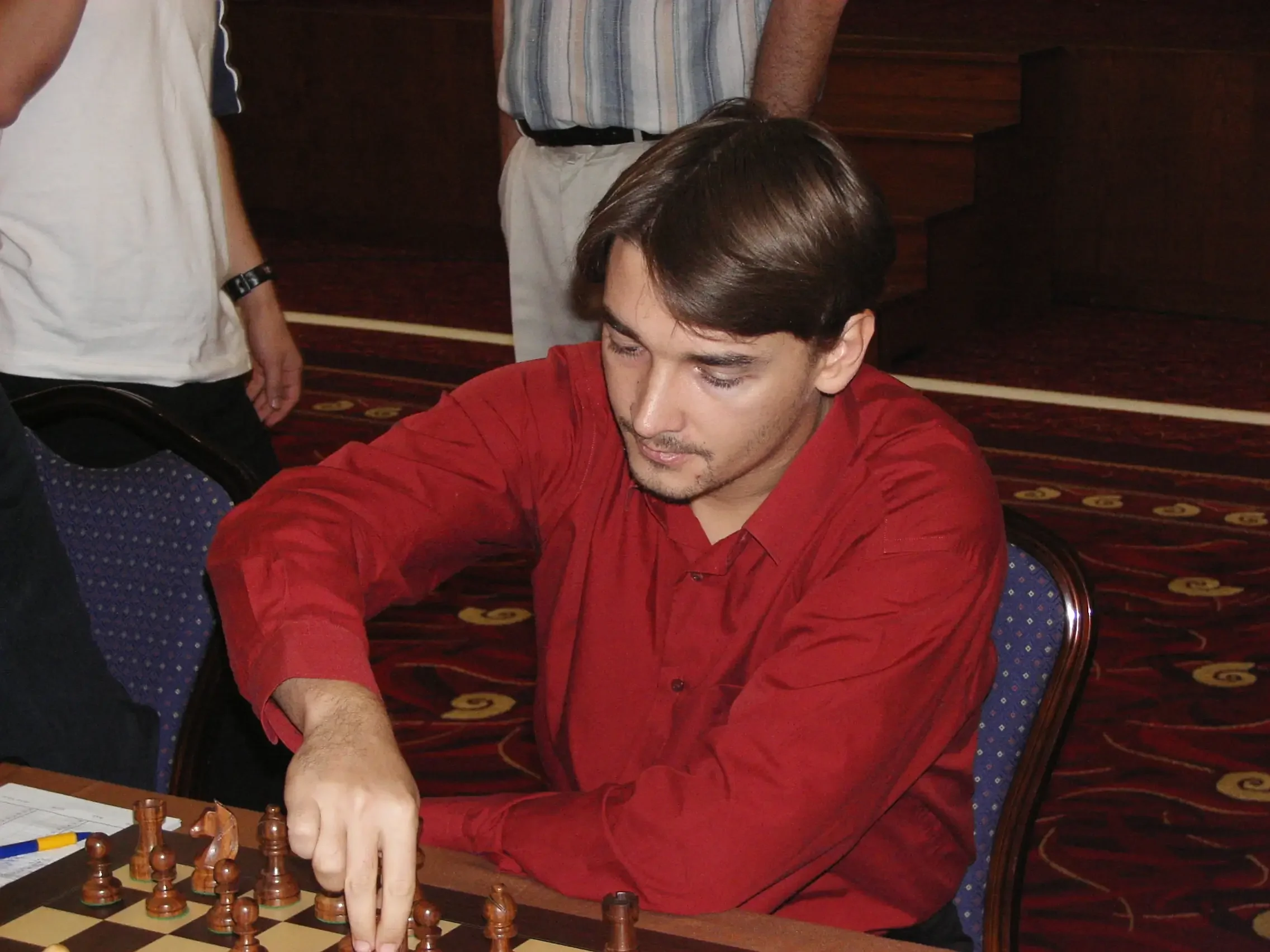
karpidis from Piraeus, Greece, CC BY 2.0
Introduction
Alexander Sergeyevich Morozevich, also written in Russian as Александр Сергеевич Морозевич, was born in Moscow on July 18, 1977 and became one of the most distinctive elite players of the late Soviet and post-Soviet generations. FIDE records him as a Russian grandmaster born in 1977, with the grandmaster title awarded in 1994. His career arc is unusual even by super-grandmaster standards: a teenage breakthrough in the early 1990s, a rise into the world top five by 2001, world number two in July 2008 with a 2788 rating, repeated spells of elite contention, and a public image built around originality rather than technical orthodoxy.
He deserves attention because he stood for a specific possibility in modern chess. Morozevich showed that a player could remain fully world class while resisting the narrowing tendencies of top level professional preparation. He was never simply a crowd-pleaser. He was a two-time Russian champion, a world championship participant in both the 2005 San Luis tournament and the 2007 Mexico City championship, a multiple winner of Biel and Melody Amber, and a major force in Russian team competition. Yet his historical profile rests on more than results. He became, in the words of a contemporary ChessBase interview, a “cult figure” among younger players, and even Vladimir Kramnik remarked after losing to him in Mexico that “when he is on song, he can beat anybody.”
Early Life and Chess Formation
Morozevich was formed in a recognizable late Soviet chess environment. Russian Chess Federation biographical material states that he was born and raised in Moscow and trained at the Stadium of Young Pioneers, first under Liudmila Belavenets and later under Vladimir Yurkov. That detail is historically significant. The Stadium of Young Pioneers was one of the institutional pipelines through which Soviet and then Russian talent was organized, coached, and socialized. Belavenets herself was later described by FIDE as the first coach of Morozevich, which reinforces how deeply his formative years were tied to established Moscow training structures.
His family background helps explain the texture of that development. In a 2007 interview, Morozevich said that both parents had graduated from the Bauman institute, that his father was an interested amateur who played at first-category strength, and that there was chess literature at home. He also explained that chess was not his only childhood sport. He first tried acrobatics and football, then stayed with chess and swimming, eventually dropping swimming because illness repeatedly interrupted his progress. Chess survived those interruptions because, as he put it, books and analysis at home could continue even when he was unwell. In the same interview he said he had reached first-category strength by age nine and candidate master by eleven, achievements he himself recognized as relatively late by current prodigy standards but still very fast in practical terms.
One should also note a small but revealing caution about biography. The most reliable federation biographies and interviews emphasize his family, coaches, and competitive development. They do not give a clear, well-documented account of a university education or a non-chess professional course of study, so it is better not to assert one. That caution is consistent with the broader shape of his public record, which foregrounds coaching lineage, tournament practice, and intellectual self-education through books and analysis rather than a formal academic curriculum.
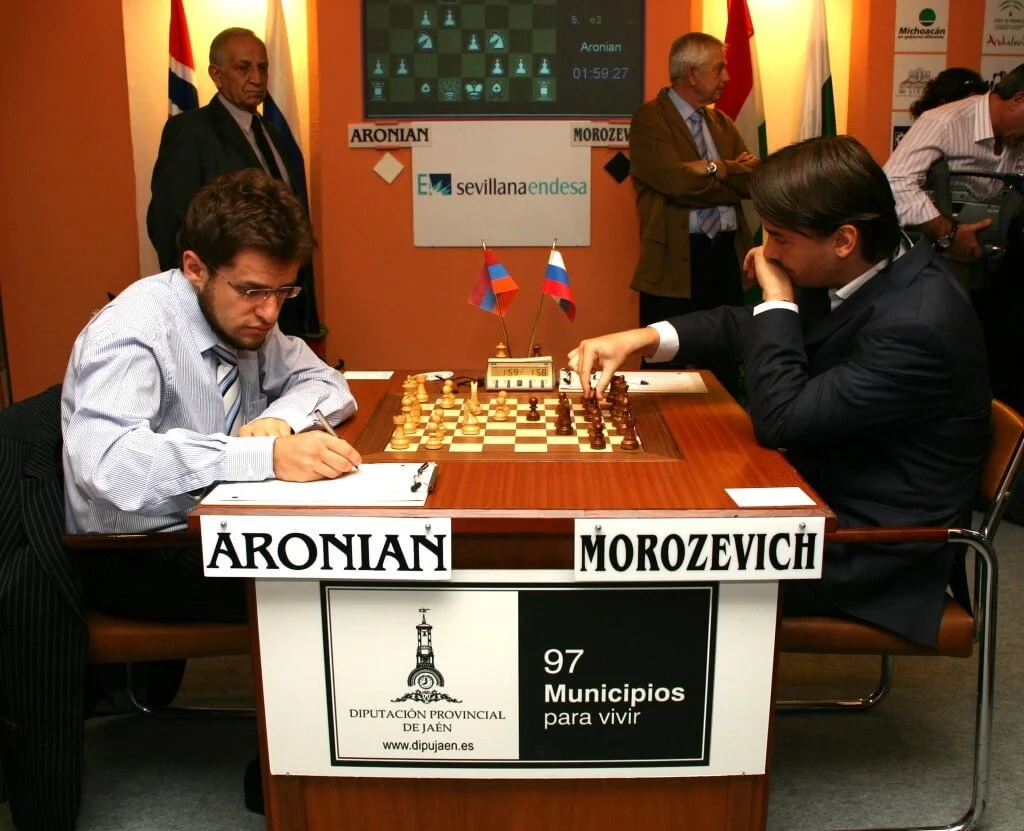
Óscar Javier García Baudet, CC BY 3.0
Rise in Competitive Chess
Morozevich’s first unmistakable breakthrough came very early. The Russian Chess Federation notes that in 1994, at age seventeen, he won the Lloyds Bank tournament in London with 9.5 out of 10, a result that immediately marked him as more than a gifted junior. The following year, according to the same official biographical account, his attacking win over Viswanathan Anand with the King’s Gambit at the Intel Grand Prix in Moscow brought him a wave of admirers in Russia and abroad. Those episodes are important because they fixed the public image that stayed with him for decades: dangerous, anti-routine, willing to choose symbolic openings, and unafraid of reputational risk.
His ascent into the elite was not linear, but by the start of 2001 FIDE’s retrospective rating analysis already placed him fifth in the world on the January 1, 2001 list, sharing the 2745 mark with Peter Leko and trailing only Kasparov, Anand, Kramnik, and Adams. That ranking is one of the clearest indicators that Morozevich was not merely an attractive outsider. He had become part of the actual governing group of world chess. His reputation for unpredictability sometimes obscures this statistical fact. At his peak, he was not adjacent to the elite. He was in it.
The early 2000s also show how closely his personal trajectory tracked the unsettled institutional life of international chess. In his Biel interview from 2003, he explained that he had grown weary of the lack of “reasonable prospects” in the chess world, explicitly citing the absence of a clear world championship system and even saying that he had effectively decided to stop dedicating himself fully and seriously to chess before Dortmund 2002. This was not mere rhetoric. It fits the broader confusion of the split-title era and helps explain why Morozevich’s career often seemed to alternate between brilliant surges and periods of detachment. In other words, part of his unevenness belonged to the player, but part belonged to the age in which he worked.
Major Career Achievements
The achievements themselves are substantial. Morozevich won the Russian Championship twice, in 1998 and 2007, and established himself as one of Russia’s central team players over more than a decade. Russian federation and media records describe him as a three-time Olympiad gold medalist, twice a world team champion, and twice a European team champion with Russia. A Russian Chess Federation historical feature on team play also credits him with exceptional board results, including first-board distinctions in several international team events and an individual gold performance at the 2000 Olympiad in Istanbul. These data place him among the crucial team competitors of post-Soviet Russian chess, not merely among its gifted individuals.
His tournament record at Biel is central to his historical profile. The Biel festival’s own archives list him as champion in 2003, 2004, and 2006. The 2003 festival interview, preserved in the official archive, described him as the “stunning winner” of the grandmaster event with a 2879 performance rating, six wins, four draws, and no losses, calling it a tournament record. That is one of the cleanest single snapshots of Morozevich at full force: high risk, high velocity, and yet undefeated. His achievements in blindfold and mixed-format events were also exceptional. ChessBase’s Amber coverage noted that he won the blindfold section on his 2002 debut and later shared or won the overall tournament several times, including 2004 and 2006, with a record 9.5 out of 11 in the 2006 blindfold section.
In world championship play, Morozevich came close enough to the summit to be historically serious, even if he never converted that promise into the title. FIDE’s historical overview of the Candidates cycle notes that the 2007 Mexico City championship included players seeded from the 2005 San Luis event, where Morozevich had finished in the group behind Topalov. ChessBase’s 2006 Amber preview likewise described his fourth place in San Luis as sufficient to secure participation in the 2007 championship. He then played in Mexico as one of only four players present in both the 2005 and 2007 world championship tournaments. That is not the record of a romantic outsider. It is the record of a genuine title-level contender in the strongest stretch of his career.
His second Russian title in 2007 offers a particularly revealing late-peak moment. ChessBase’s event coverage stressed that he won six straight games in the Superfinal, including victories over Peter Svidler and Alexander Grischuk, and called the tournament notably combative in a field where the draw rate was unusually low. That title run condensed his best qualities into one episode: form, nerve, stamina, and the ability to turn elite round robins into decisive competitions. It also anticipated his rise to world number two on the July 2008 FIDE list, where a 2788 rating put him second behind Anand and ahead of Kramnik on tiebreak by games played.
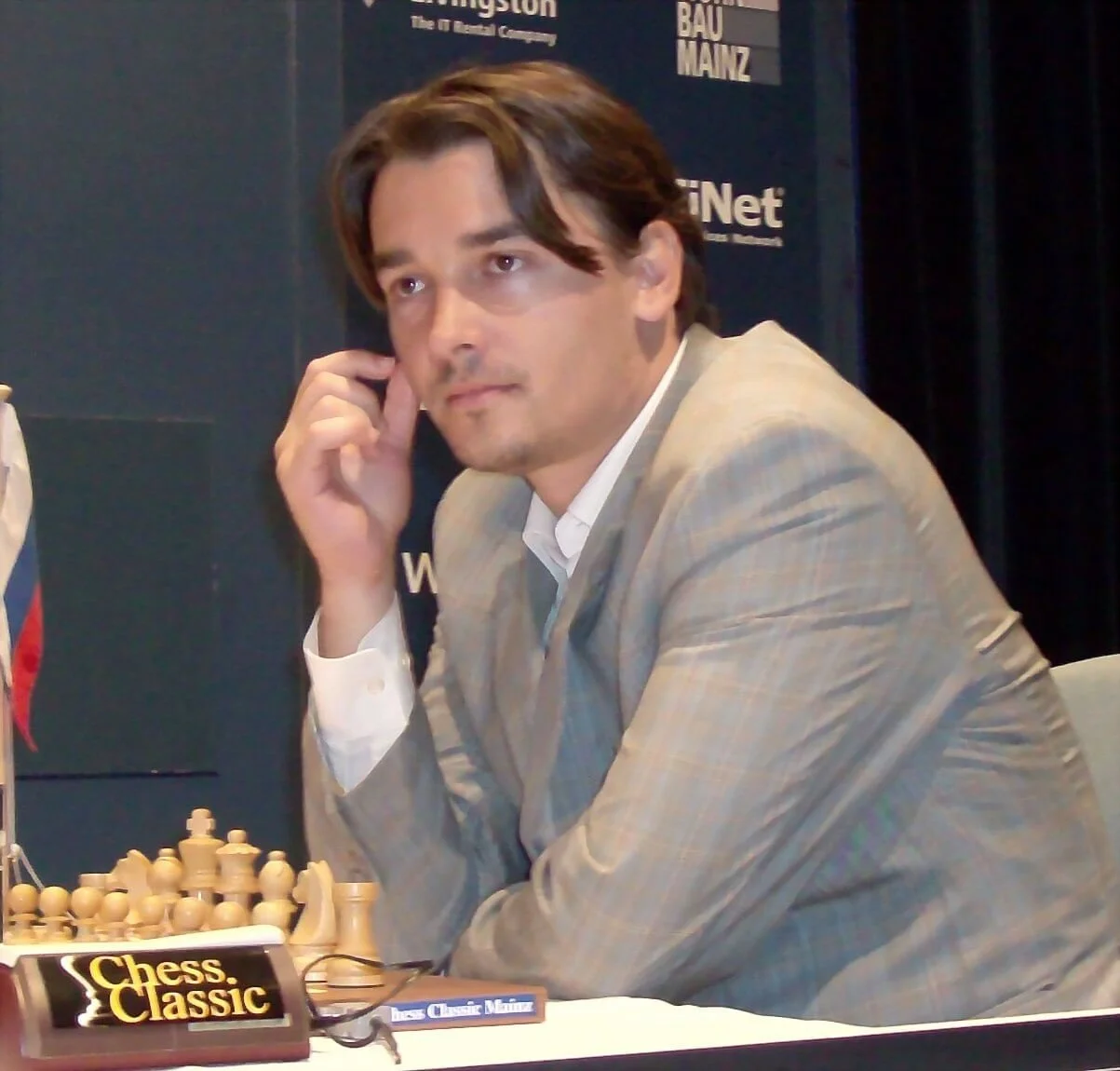
Stefan64, CC BY-SA 3.0
Style and Reputation
Morozevich’s style is best described as creative, risk-accepting, and structurally nonconformist, though he himself pushed back against shallower versions of that description. In the 2003 Biel interview he said, very plainly, “I am not scared when I am playing. I like taking risks.” In the 2007 Tomsk interview he rejected the cliché that he preferred beauty to results and insisted instead that he had “always striven to become a universal player.” He complained that journalists kept repeating an early image of him as a quirky tactician even though, by then, he considered himself one of the players helping shape opening fashion. Those two self-descriptions belong together. Morozevich was willing to assume practical risk, but he did not think of himself as a one-dimensional adventurer. He wanted to be understood as a full chess player whose originality included strategic and theoretical work.
That self-understanding is supported by how strong contemporaries wrote about him. ChessBase described him in 2007 as a “cult figure” whose uncompromising play and ventures into the unknown had given him enormous popularity, especially among younger players. The same interview preserved Kramnik’s judgment that “when he is on song, he can beat anybody.” Another ChessBase report from the 2007 Russian Championship highlighted his decisive streak and low draw percentage in a top field. The recurring theme is consistent across observers: uneven, yes, but never tame. His weakness was not lack of strength. It was the instability that often comes with a style built on tension, imbalance, and constant practical decisions.
He also carried symbolic weight in an era increasingly shaped by deep preparation and technical caution. The Russian Chess Federation’s biographical sketch says that he was never chiefly defined as an opening specialist and preferred to shift the burden of the struggle into the middlegame. Yet the same federation profile adds that he often revived old lines or found new ideas in standard structures, while Morozevich himself said that many players built parts of their opening baggage on his games. This combination helps explain why his reputation lasted. He did not reject theory from ignorance. He used theory as a launching point, then tried to break a game out of sterile routines and back into live struggle.
Contributions Beyond Tournament Play
Morozevich’s work beyond tournament play is more substantial than casual summaries usually suggest. In 2007 he and Vladimir Barsky published The Chigorin Defence According to Morozevich. Publisher and bibliographic sources confirm the book’s appearance that year, while Morozevich’s own published remarks explained that regular use of the Chigorin Defence expanded his sense of what Black could permit in the opening and led him to add other supposedly “incorrect” systems, such as the Albin Countergambit, to his repertoire. This is a real theoretical contribution. He did not merely revive offbeat openings as curiosities. He helped restore practical credibility to lines long treated as peripheral and gave them a serious explanatory text.
He also coached, advised, and collaborated. A 2011 interview recorded that he had recently finished a training spell with Qatar and especially with former women’s world champion Zhu Chen, and said that the experience taught him something about a different chess culture. Russian Chess Federation material on Alexey Kuzmin confirms that Kuzmin served for several years as Morozevich’s trainer-manager, while Morozevich himself said in a 2007 interview that Kuzmin had become both his assistant and manager. These connections show that Morozevich’s role in professional chess extended beyond being a lone artistic performer. He participated in the coaching, preparation, and managerial networks that sustain elite careers.
He also invested in chess culture and public communication. In 2007 the Russian Chess Federation reported the opening of the “School of Alexander Morozevich” in Tomsk. In interviews that same year he tied the project to his family’s historical connection to Tomsk and described a broader regional chess academy that would include school chess, advanced training, and even trainer education. Later, as a commentator for the 2018 Women’s World Championship in Khanty-Mansiysk, he said openly that he wanted to “return interest to chess” and spoke of tournaments as social and cultural spaces, not just technical competitions. That role is important for historical assessment. Morozevich was not only producing memorable games. He was also thinking about how chess should be presented, taught, and renewed.
A final, often overlooked point concerns influence on younger players. Daniil Dubov stated in Russian Chess Federation material that his long contact with Morozevich had been extremely important to his own formation and that some of Morozevich’s ideas had been ahead of the stage Dubov had reached at the time. That is a very significant testimonial from one of the most creative Russian players of the next generation. It suggests that Morozevich’s legacy is partly subterranean. Some of his ideas may have entered later Russian chess not through canonized textbooks or school doctrine but through direct intellectual contact with players who absorbed his approach.
Historical Legacy
Morozevich’s later career followed a pattern already visible in the 2000s: periods of partial retreat, followed by conspicuous returns. The Russian Chess Federation notes that he almost stepped away from practical play in 2010, then returned strongly in 2011 by winning the Russian Higher League in Taganrog, finishing second at Biel and in the Russian Superfinal, and winning the Saratov Governor’s Cup. Federation biographical material also notes that he came close to winning the 2012 Tal Memorial and later won Poikovsky in 2014. Even in his more selective years, he remained especially dangerous in rapid and blitz. The point is not simply that he aged well. It is that his chess stayed eventful whenever he chose to re-engage.
His interests outside orthodox tournament routine also became more visible. In 2017 he told RIA Novosti that chess would remain part of his life, but that he did not want to wake up at fifty-five or sixty and discover that he had done nothing except chess. The same interview discusses his serious interest in go, and official Russian Chess Federation coverage recorded his 2016 mixed chess-and-go match victory over Tiger Hillarp Persson. These episodes should not be treated as eccentric footnotes. They fit a career-long pattern. Morozevich consistently treated intellectual games as a larger field of inquiry, and he seems to have resisted the idea that a grandmaster’s identity had to be exhausted by tournament routine alone.
The concise historical assessment is therefore this. Alexander Morozevich deserves attention today because he was one of the strongest players in the world for a long period, because he reached genuine world championship contention, and because he gave post-Soviet elite chess one of its clearest demonstrations that originality could still coexist with top-level competitive seriousness. His record is strong enough to command respect on conventional terms. His style, self-definition, pedagogical activity, and influence on younger masters give him a larger historical value. He is one of the key figures for anyone trying to understand how creative, fighting chess survived inside the heavily professionalized elite culture of the late 1990s and 2000s.
Notes and Sources
This profile prioritizes federation records, official tournament archives, player interviews, and long-form chess journalism close to the events. The most important primary and near-primary sources used here are the FIDE profile and rating archives for title and ranking data; Russian Chess Federation biographical and historical materials for childhood, coaching, team records, and later career phases; the official Biel International Chess Festival archive for the 2003 interview and tournament result; the 2018 Women’s World Championship site for Morozevich’s commentary views; and Russian interviews in Argumenty i Fakty and RIA Novosti for family background, self-description, and later-life priorities.
Specialist secondary sources were used carefully where they add context or preserve contemporary testimony, especially ChessBase coverage and interviews. Those sources are particularly useful for the 2003 Biel context, the 2007 world championship period, the 2007 Russian title run, Amber results, and the Kramnik remark on Morozevich’s peak strength. For Morozevich’s work beyond tournament play, the key references are the Russian Chess Federation note on the Tomsk school, the Barsky-Morozevich Chigorin book references, the e3e5 text explaining his opening ideas in his own words, and the Dubov testimony on Morozevich’s influence.
