Via ChessPro
In December 1967, Mikhail Tal sacrificed a knight to expose Viktor Zhelyandinov’s king at the Soviet Championship in Kharkov. Zhelyandinov accepted the sacrifice and found enough counterplay to keep Tal busy defending his own position. The former world champion gave check on move 41, and the players agreed to a draw. When Tal published the encounter in his book with Yakov Damsky, he recorded a distinction that belonged to both men. Each had received a special prize for the most interesting game of the championship.[1]
Zhelyandinov would spend much of his career looking at positions with other people. In Lviv, he trained Marta Litynska during her years as a world championship contender and helped Vassily Ivanchuk develop from a schoolboy in western Ukraine into an international player. In 1985, Anatoly Karpov’s camp put his analytical ability to work in the world championship match against Garry Kasparov. Yet Zhelyandinov was already 64 when he earned the international master title. To understand how a player of his strength came so late to that distinction, his career is best followed through the institutions where he actually spent his working life, beginning with a newspaper office outside Moscow.[2][3]
A chess education in a newspaper office
Viktor Savelyevich Zhelyandinov was born on March 17, 1935, in Lyubertsy, near Moscow, in the Russian SFSR. When Germany invaded the Soviet Union, he was staying with relatives with his mother, brother, and sister. In the account he gave grandmaster Adrian Mikhalchishin in 2010, Zhelyandinov recalled that his younger brother died before the family returned to Moscow in 1943. His father, a workshop chief at the Frezer factory, remained behind when the plant was evacuated to the Urals. He subsequently went to the front and was killed.[2][3]
Zhelyandinov traced his interest in chess to half a set of pieces he acquired from a childhood friend after the war. While he was home sick, the boys tried playing with what they had. Viktor lost. He remembered being sufficiently annoyed to start studying, with Lasker’s chess manual as his first serious book. More systematic instruction came from the master Mikhail Gerchikov, whose pupils included Viktor and his friend Gennady Shkundov. Their meeting place was the editorial office of Ukhtomsky Rabochy, a local newspaper. Fyodor Podolsky, its editorial secretary and later its editor, was a chess enthusiast who gave the players somewhere to gather.[2][3]
By 1953, Zhelyandinov was representing the Russian SFSR at the Soviet youth team championship in Kharkov. The contemporary report lists him as a first-category player. Moscow and Leningrad fielded separate teams, and Leningrad had Boris Spassky. The Russian republic nevertheless won the final ahead of both cities. The report drew attention to a feature easily lost in accounts of the future grandmasters who took part. Each team fielded eight boys and two girls. Leningrad had the best aggregate on the boys’ boards, and the results on the girls’ boards helped decide the championship. Zhelyandinov remembered Rashid Nezhmetdinov and Georgy Bastrikov as coaches of the Russian team.[2][4]
A master in the Soviet armed forces
In 1954, after attending technical college in Lyubertsy, Zhelyandinov entered the army. He had already earned the right to play a qualification match against a master. Military service postponed that opportunity, then gave him regular access to strong competition. Posted to the Group of Soviet Forces in Germany, he could play in individual and team army championships and in Russian competitions. By the late 1950s, he was also helping prepare the military team for its matches. His careers as player and coach had begun to overlap while he was still a candidate master.[2][3]
The national master title came in 1962. At the Soviet Championship semifinal in Riga that year, Zhelyandinov scored 11 out of 17 and shared fifth place. His two most significant victories came against the men who finished first and second, Lev Aronin and Vladas Mikėnas. Each suffered his only loss of the tournament against Zhelyandinov. Aronin, an older master whom Viktor knew well, resigned after 23 moves. His king had been driven from the queenside across the center, and Zhelyandinov still had a check to spare.[2][5]
In 1966, Zhelyandinov won his first individual Soviet Armed Forces Championship in Vilnius. He scored 11½ out of 17, half a point ahead of Vladimir Liberzon and Igor Kalinsky. His game with Liberzon helps explain his standing among army players. Reporting for Shakhmaty v SSSR, A. Magergut described a position that appeared to favor Liberzon heavily. Zhelyandinov kept finding threats, and on the last move before the time control his opponent fell into a trap. A game Liberzon had reason to expect to win helped decide the championship in Zhelyandinov’s favor.[6]
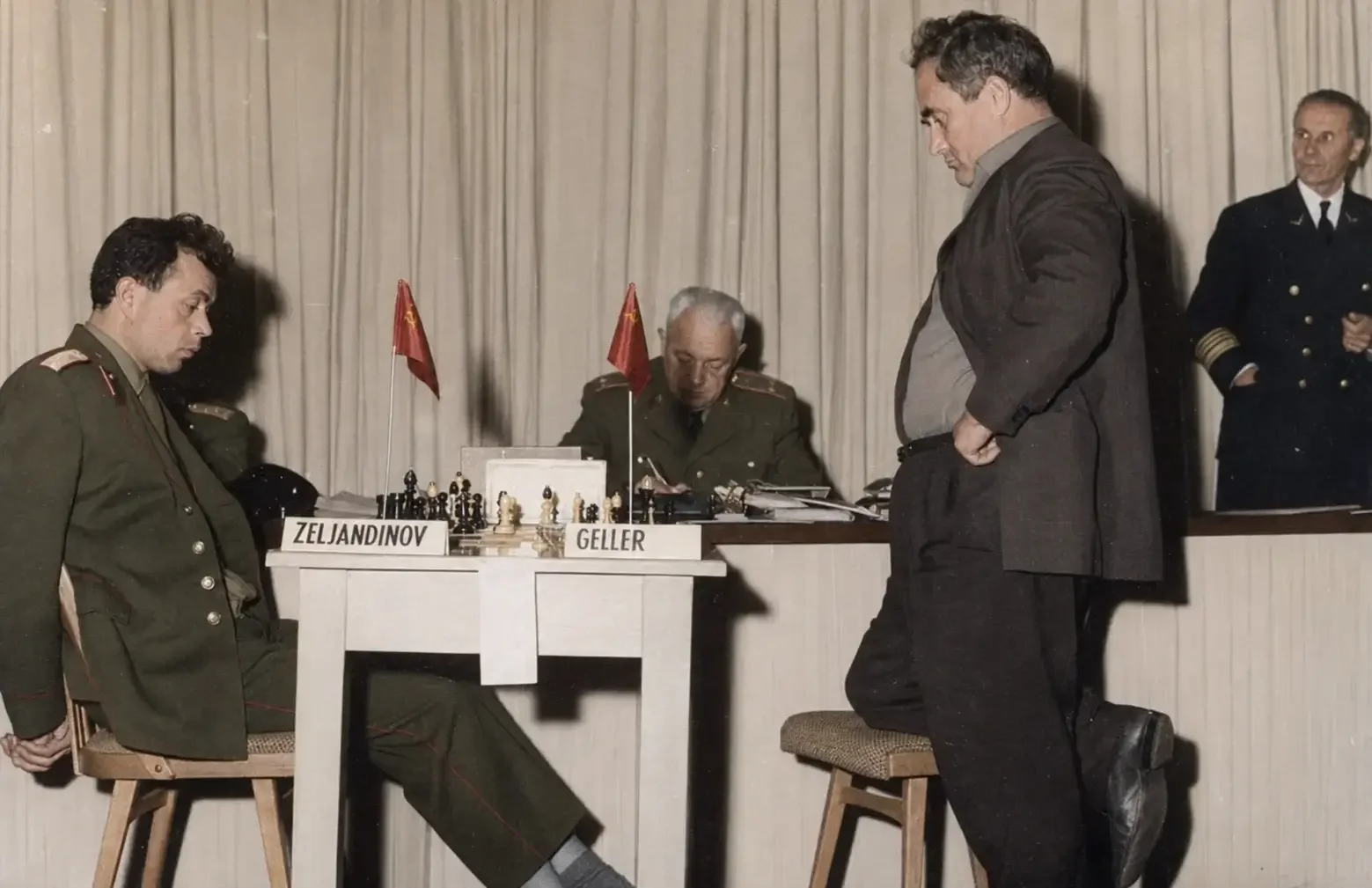
Later that year, Zhelyandinov and Efim Geller represented the Soviet Army at the third Championship of the Friendly Armies in Prague. In the penultimate round, Vlastimil Hort defeated Geller, while Zhelyandinov beat the young Czechoslovak player Josef Přibyl. The final standings gave Hort and Zhelyandinov 11 points apiece from 13 games, one point ahead of Geller. Both leaders received gold medals. The Czechoslovak newspaper Mladá fronta awarded Zhelyandinov a separate prize for his attacking victory over Hungary’s András Ozsváth. Decades later, he remembered finishing ahead of Hort as well as Geller. The contemporary account is explicit about the shared victory.[2][7]
The Kharkov championship and his reputation as a player
Zhelyandinov considered Prague his greatest competitive success, but he remembered the 1967 Soviet Championship in Kharkov as the tournament in which he played his best chess. The organizers used a thirteen-round Swiss system. He began with three straight wins and finished with six victories, five draws, and two losses. His 8½ points placed him in the group sharing eighth through seventeenth on score. He drew with both eventual champions, Tal and Lev Polugaevsky, who finished on 10 points each.[1][2]
The Tal game illustrates a quality that the army chess writer Nikolai Golovko recognized in him. In his 1970 instructional book, Golovko singled out Zhelyandinov’s resourcefulness in defense as well as his combinational ability. He chose an example from the 1967 Friendly Armies Championship in Havana to teach the use of a pin. Zhelyandinov took third in Havana, but the position had a longer life as a lesson for other players. His pupil Volodymyr Hrabinsky later recalled that Zhelyandinov liked classical openings, played the Ruy Lopez comfortably from either side, and would open with either the king’s pawn or the queen’s pawn. Hrabinsky also remembered how he sat, slightly sideways with his legs crossed, writing down his moves without taking his eyes off the board. His scoresheets could be difficult to decipher.[8][9]
After the 1967 season, Zhelyandinov spent a month in hospital following what he described as a serious poisoning. He regarded the illness as a turning point in his competitive career. A substantial result still lay ahead. His military affiliation in Germany had made him eligible for competition in the Byelorussian SSR, and in 1970 he won its championship. The Belarusian championship roll records an unusually close finish. Zhelyandinov, Abram Roizman, and Albert Kapengut each scored 8½ out of 12, and the roll lists them in that order. Zhelyandinov later dated his victory to 1967. The roll identifies Kapengut as the champion that year.[2][10]
The working life of the Lviv chess school
Zhelyandinov’s posting in Germany lasted until 1972. His wife was from Lviv, and Mikhalchishin dates his move to her city, then in the Ukrainian SSR, to 1974. Lviv already had a generation of gifted players who had studied with Viktor Kart at the Palace of Pioneers. Zhelyandinov’s particular contribution came through the Carpathian Military District and its Officers’ House. With support from Colonel General Nikolai Abashin, the district assembled a team that included Alexander Beliavsky, Iosif Dorfman, and Marta Litynska. The players met regularly to analyze, play blitz, and eat together in the officers’ dining room. In 1981, after the death of longtime club leader Iltizar Kutuev, Zhelyandinov took charge of the Officers’ House chess club.[2][11]
An adjournment at the 1977 Soviet Championship gives some idea of what a coach in Lviv could do for a player competing in Leningrad. Dorfman had an unfinished game against Oleg Romanishin. According to Zhelyandinov, Abashin sent a car for him, and they spent the night analyzing the position. Their findings were passed to Dorfman the following morning. The tournament record establishes the outcome. Dorfman beat Romanishin in the twelfth round and eventually shared the Soviet title with Boris Gulko. The account of the overnight work comes from Zhelyandinov himself.[2][12]
Of the players he coached, Zhelyandinov said he spent the most time with Marta Litynska. A pupil of Kart and Soviet women’s champion in 1972, she was already an accomplished tournament player. During her years of work with Zhelyandinov, she reached the closing stages of the women’s world championship cycle. In Odessa in 1980, she defeated Tatjana Lematschko 5½–2½ to reach the Candidates semifinal. Mikhalchishin also described the effect of Zhelyandinov’s coaching on his own play. During a period when he had lost his way competitively, he said, Zhelyandinov persuaded him to play more actively again.[2][11][13]
Their work as a group received contemporary recognition in 1983. At the Ukrainian Spartakiad in Simferopol, the Lviv region recovered from a heavy loss to Odessa and took first place with 38 board points out of 54. Its six players included Romanishin, Dorfman, Mikhalchishin, and Litynska. In naming the winning side, the Soviet magazine 64 also named the master who had prepared it, Viktor Zhelyandinov.[14]
Ivanchuk, Karpov, and the next generation
The young Vassily Ivanchuk lived in Berezhany, some distance from Lviv. Mikhalchishin recalled that the army sports club arranged for a master to travel there twice a month. A 1987 account by Soviet youth coach Anatoly Bykhovsky helps identify who actually taught him. Ivanchuk’s father had introduced him to chess. Local players helped him, and the Lviv masters Volodymyr Buturin, Viktor Zhelyandinov, and M. Nekrasov worked with him periodically. Bykhovsky added that Buturin was then spending the most time with him. Zhelyandinov’s association with Ivanchuk continued well beyond those school years. Hrabinsky remembered him accompanying the grandmaster to Linares as his second.[9][11][15]
For Karpov’s second world championship match against Kasparov in 1985, Zhelyandinov worked alongside Geller. What he remembered with particular pleasure was the chance to analyze with the grandmaster who had been his teammate in Prague nearly twenty years earlier. That same year he helped Romanishin prepare for the Mexico interzonal. In 1986 he accompanied the national team of South Yemen to the Dubai Olympiad. Later, he conducted training sessions with Slovenian and Polish players. One of the latter, grandmaster Mateusz Bartel, told an interviewer in 2012 that he had also learned his Russian from Zhelyandinov, right down to a few turns of phrase that Bartel suspected came from the army.[2][8][11][16]
Zhelyandinov continued to play for independent Ukraine. He earned the international master title in 1999. In 2004, aged 69, he won both games he played as first reserve for Lviv’s Ivan Franko University at the Ukrainian club team championship in Alushta. The university took bronze. Among his teammates was grandmaster Mykhailo Kozakov, who had once attended his lessons as a boy. Ukraine recognized Zhelyandinov as an Honored Trainer, and the FIDE Trainers’ Commission elected him to its Hall of Fame in the awards for 2015. He died on July 24, 2021, aged 86.[3][9][17]
Hrabinsky left perhaps the clearest account of what his pupils took away. Even after Vitaly Golod became Ukrainian champion, he still brought a notebook to analysis and carefully wrote down the conclusions. Teacher and pupil would argue amiably, each willing to take his side of the position against the other. Hrabinsky went on to train grandmasters himself, among them Andriy Volokitin and Yuriy Kryvoruchko. In 2005, at a European youth championship in Montenegro, he and his old teacher were there as fellow coaches. Across two generations of Lviv chess, one of Zhelyandinov’s characteristic invitations could still start an afternoon’s work. In Hrabinsky’s recollection, translated from Russian, it was simply, “Show me something fresh.”[9]
Notes and Sources
Mikhail Tal and Yakov Damsky, В огонь атаки (Moscow: Fizkultura i Sport, 1978), 90–91. Tal identifies the prize and gives the conclusion of the game. The championship record lists 130 starters, including four who did not finish, which accounts for the figure of 126 in some summaries. Tal and Damsky’s account and OlimpBase, 35th Soviet Chess Championship, Kharkov, December 1967. 1978
Viktor Zhelyandinov, “Только этого нам еще не хватало!,” as told to Adrian Mikhalchishin, ChessPro, 2010. This seventy-fifth-birthday reminiscence is the principal firsthand source for his family, education, army service, and work as an analyst. Mikhalchishin supplied the game annotations. Read Zhelyandinov’s recollections and the annotated games. chesspro.ru
Chess Federation of Russia, “Виктор Желяндинов,” Person of the Day, March 17 entry. The federation gives his full name, birthplace, dates, teacher’s name, and the year he completed his international master requirements. Its account also reproduces portions of his earlier reminiscence. Federation biography of Viktor Zhelyandinov. ruchess.ru
V. Nevsky, “Юношеское первенство страны,” Шахматы в СССР, no. 12 (December 1953), especially 359–60. The printed team roster names Zhelyandinov. His friend Shkundov appears in the later reminiscence but is absent from the published roster for the winning side. Nevsky’s contemporary report and team results. sovchess.ru
L. Ya. Abramov, comp., Советские шахматисты: Справочные данные на 1 марта 1964 года (Moscow: Central Chess Club of the USSR, 1964), master register, entries for 1962. Alexey Popovsky’s tournament reconstruction records both wins and the shared fifth-place score. Central Chess Club master register and RusBase, Riga semifinal, August 18 to September 15, 1962. Абрамов Л.Я.
A. Magergut, “Новый чемпион,” Шахматы в СССР, no. 10 (October 1966), digital scan 21. The report gives the Vilnius standings and analyzes the decisive phase of Liberzon’s game with Zhelyandinov. Read the Soviet Armed Forces Championship report. sovchess.ru
G. Arkadyev, “Спор за медали,” Шахматы в СССР, no. 12 (December 1966), 23–24. The report gives the scores, identifies both gold medalists, and records the newspaper prize for the Ozsváth game. Read the contemporary Prague tournament report. sovchess.ru
N. G. Golovko, Путь к мастерству: Советы шахматного мастера (Moscow: Voenizdat, 1970), especially 112–13. See also the International Chess Federation’s biographical entry on Zhelyandinov for the Havana placing and his role on Karpov’s 1985 team. Golovko’s assessment and tactical example and FIDE’s biographical notice, April 9, 2020. 1970
Volodymyr Hrabinsky, “Мастер Желяндинов,” Grandcoach, March 17, 2015, and his autobiographical account on the same site. Hrabinsky publishes in English as Vladimir Grabinsky. The closing quotation is translated from his Russian tribute. Hrabinsky’s recollections of his teacher and Hrabinsky’s account of his own pupils and coaching appointments. Шахматный сайт львовских гроссмейстеров: Новости
Andrei Malyush, comp., “Призеры Чемпионатов Беларуси,” Открытые шахматы, entries for 1967 and 1970. The compilation credits Sergei Evmenchik with preserving historical tournament tables. Belarusian championship medalists and scores. Открытые шахматы
Adrian Mikhalchishin, Львів: шахова столиця України (Lviv: Yevrosvit, 2016), chapter 2, especially “Наш Савельїч,” and the account of the Officers’ House club in chapter 1. Mikhalchishin writes as a fellow member of the Lviv team and as a player Zhelyandinov coached. Read Mikhalchishin’s Ukrainian-language history of Lviv chess. 2016
OlimpBase, “45th Soviet Chess Championship,” Leningrad, November–December 1977, round 12 and final standings. Dorfman’s win over Romanishin came three rounds before his final-round victory over Vasily Smyslov. Leningrad championship results by round. olimpbase.org
OlimpBase, “Candidates’ Matches, Quarterfinals,” FIDE Women’s World Chess Championship cycle, 1978–1981, Odessa match, June 1980. Litynska–Lematschko match record. olimpbase.org
P. Marusenko, report on the Ukrainian Spartakiad in Simferopol, 64: Шахматное обозрение, no. 12 (683), June 1983, digital scan 4. The report identifies Zhelyandinov as the winning team’s coach and names all six players. Read the Spartakiad report. sovchess.ru
Anatoly Bykhovsky, interview with Yu. Golubovsky, “Проявился мужской характер...,” Шахматы в СССР, no. 3 (March 1987), digital scan 28. Reporting after Ivanchuk’s European junior victory, Bykhovsky names the masters who had worked with him and describes the arrangements in Berezhany. Read Bykhovsky’s contemporary account of Ivanchuk’s training. sovchess.ru
Mateusz Bartel, interview by Eteri Kublashvili, “Матеуш Бартель: Призовые деньги хочу вложить в квартиру,” Russian Chess Federation, February 16, 2012. Bartel on training with Zhelyandinov and learning Russian. ruchess.ru
Ukrainian Chess Federation, “Ukrainian Chess Club Teams Championship,” Alushta, May 13–22, 2004, final standings. OlimpBase supplies the individual board record under the spelling Viktor Zheliandinov. FIDE Trainers’ Commission, FIDE Trainer Awards 2015: Results, 1, lists him among the three Hall of Fame winners. Ukrainian federation standings, Ivan Franko University’s individual results, and FIDE’s official award results.
