Vladimir Petrov
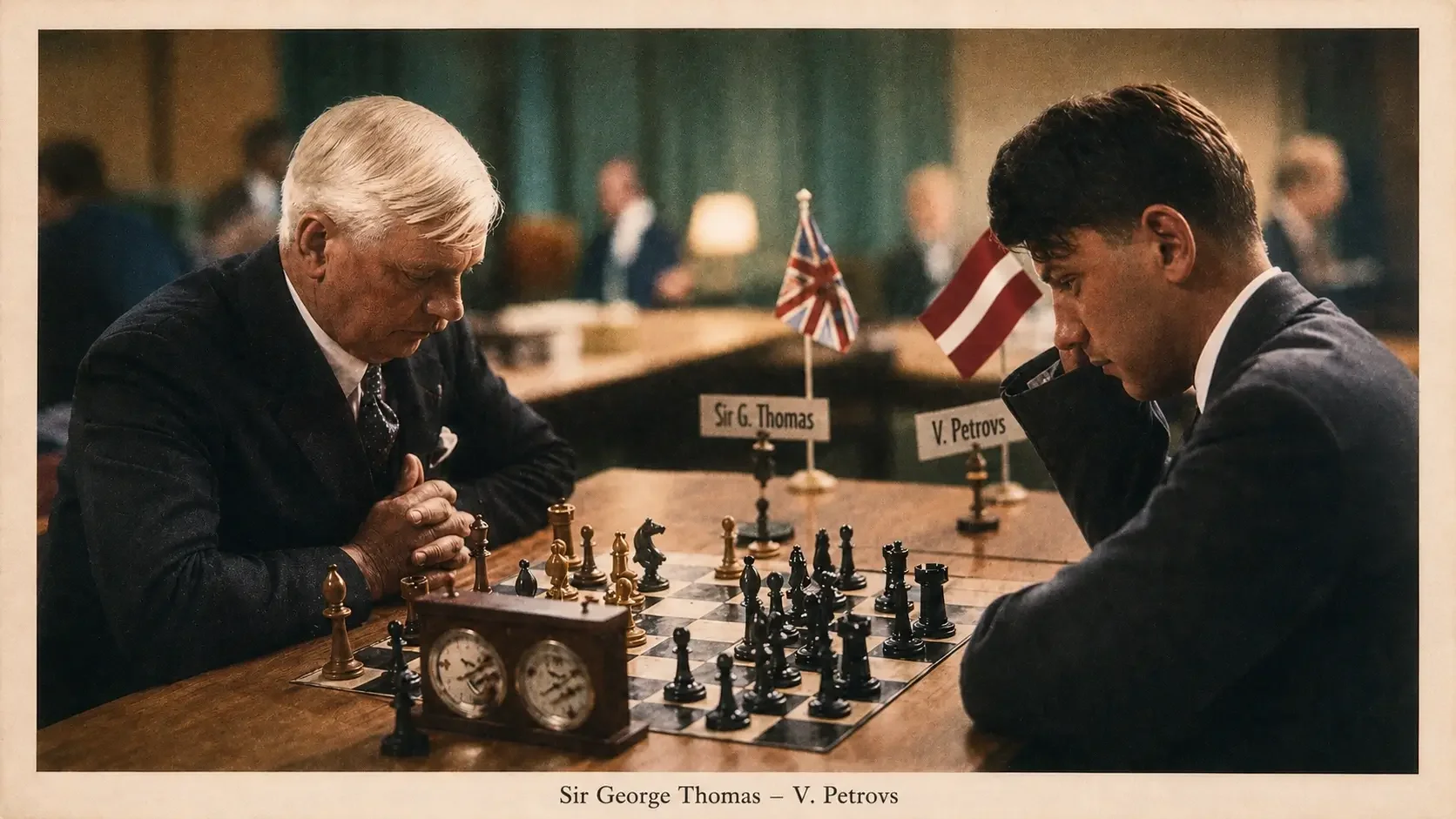
Prague, 1931 Olympiad
Early life and education
Vladimirs Mikhailovich Petrovs was born in Riga on 27 September 1908 into a Russian family; his father Mikhail Tikhonovich Petrov ran a small shoemaker’s shop while his mother Anastasia Parfenovna was a homemaker. Petrovs grew up with two elder sisters and attended the Riga city Russian secondary school (formerly the Lomonosov grammar school) between 1919 and 1925. His interests were diverse—he was a talented footballer before taking up chess seriously. In 1925, he enrolled in the law faculty of the University of Latvia and remained connected with the university for 15 years, during which he joined the Russian student corporation Ruthenia. During his student years, Petrovs’s talent for chess blossomed. By 1926, he won both the first Riga championship and the Latvian Chess Club championship, establishing himself as one of Latvia’s strongest players.
Rise to international prominence
Petrovs became a regular member of the Latvian national team. He played in seven pre‑war Chess Olympiads; at the 1931 Olympiad in Prague, he scored 11 points from 16 games on the third board, achieving the best individual result on that board. In the 1935 Olympiad in Warsaw, he led Latvia on the first board. Petrovs reached his career pinnacle at the Kemeri 1937 international tournament. Facing a field that included world champion Alexander Alekhine, future champion Paul Keres, Salo Flohr, and Samuel Reshevsky, he tied for first place with Flohr and Reshevsky. Latvian president Kārlis Ulmanis presented him with the winner’s cup, and he was widely hailed as a grandmaster. In the same year, he married Galina Zene.
Petrovs continued to collect notable results. At the Margate international tournament in 1938, he defeated world champion Alekhine and finished joint third. The 8th Chess Olympiad in Buenos Aires in 1939 was arguably his finest performance—playing first board for Latvia, he remained undefeated and drew with both Alekhine and former champion José Raúl Capablanca. His 13½/19 score contributed to Latvia’s respectable finish. After the Olympiad, he won a tournament in Rosario, Argentina. Throughout this period, he worked as a chess journalist, contributing to Latvian and Soviet publications such as 64, Shakhmaty v SSSR, and the English magazine Chess.
Soviet occupation and repression
The Soviet annexation of Latvia in 1940 ended Petrovs’s international career. He received the title of Master of Sport and was required to compete in Soviet events. In the 12th USSR championship (Moscow 1940), he finished tenth. When Germany invaded the USSR in June 1941, Petrovs was playing in the semifinals of the Soviet championship in Rostov‑on‑Don; the tournament was interrupted, and his train home was stopped near Velikiye Luki. Stranded in Soviet territory, he joined the 201st Latvian Rifle Division and later moved to Moscow. In the 1941 Moscow championship, he took second place, and he repeated this achievement in tournaments in Moscow and Sverdlovsk in 1942.
On 31 August 1942, the NKVD arrested Petrovs following a denunciation. His wife later obtained his file, which revealed that three Moscow masters had reported him for alleged anti‑Soviet remarks. On 3 February 1943, a special tribunal sentenced him to ten years in labor camps for “anti‑Soviet agitation”. Petrovs died of illness during transit near Kotlas on 26 August 1943. He was buried in an unmarked grave, and his name vanished from Soviet chess publications. His wife and daughter were among the many Latvians deported during the mass repressions, surviving the ordeal to learn his true fate decades later.
Legacy and rehabilitation
Petrovs was posthumously rehabilitated in March 1989. His widow Galina Petrova‑Matisa published the memoir A Star Prematurely Extinguished to restore his legacy. Latvian and Russian chess historians now celebrate him as one of the strongest pre‑war Latvian players. A memorial tournament in his honor has been held in Riga, and the Latvian Chess Federation regards him as the country’s first grandmaster. Petrovs’s games, particularly his bold attacking style and successes against top grandmasters, continue to inspire players and highlight the cultural richness of interwar Latvian chess.
