Yuri Razuvaev
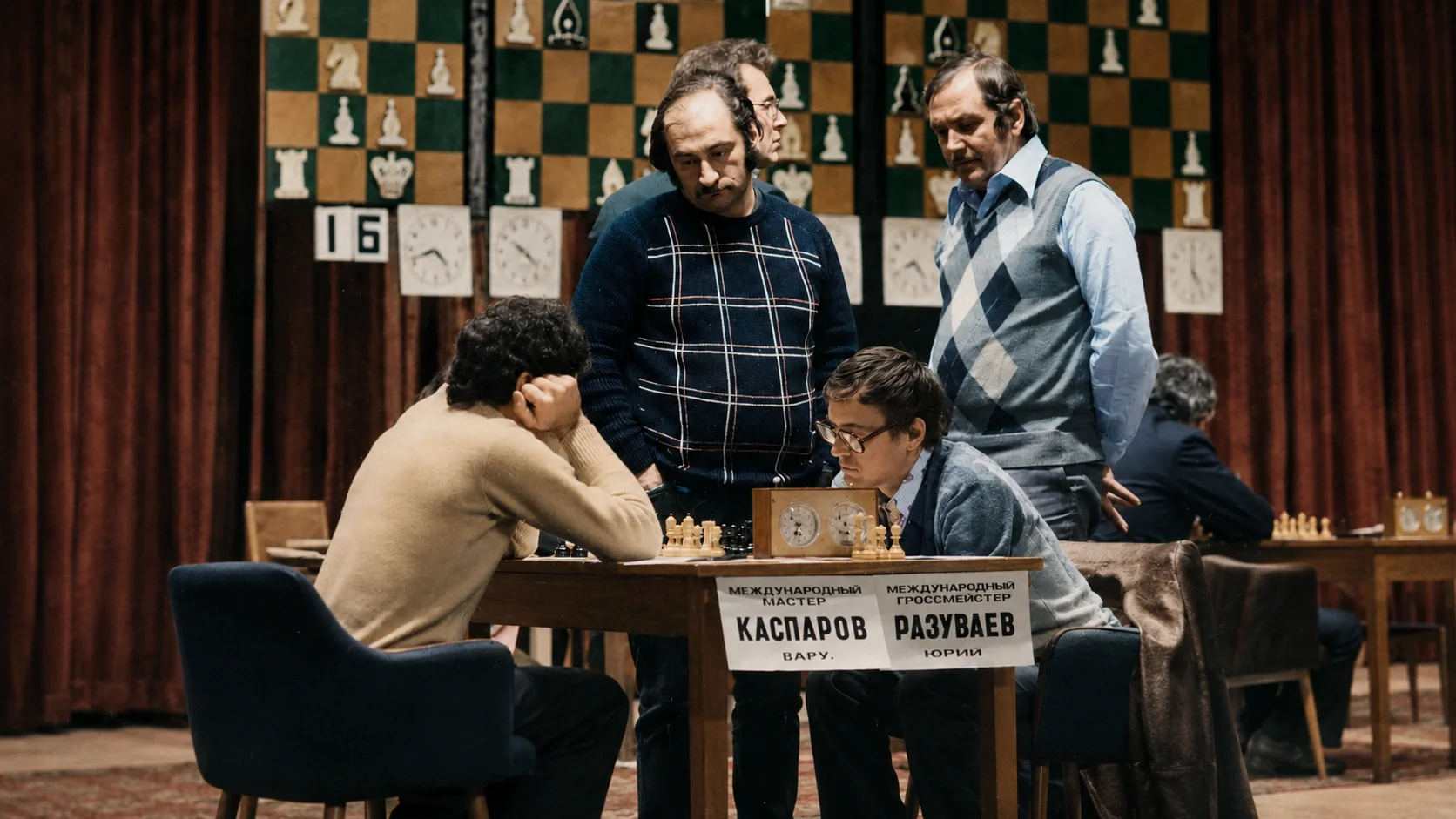
Image source: Douglas Griffin (Remixed)
Yuri Sergeyevich Razuvaev, born in Moscow on October 10, 1945, and died there on March 21, 2012, occupies a distinctive place in late Soviet and post-Soviet chess history because he was simultaneously a strong grandmaster, a first-rate coach, an organizer of training for trainers, and a serious chess writer. Russian Chess Federation memorials and FIDE documents consistently present him as a historian by academic formation, a Botvinnik-school product, a long-serving national-team coach, and one of the central architect-teachers linking the classical Soviet training tradition to the internationalized chess culture of the 1990s and 2000s. His playing record was substantial rather than world-championship level, yet it included repeated Soviet Championship participation, major international first prizes, a gold-winning Soviet student team appearance in 1971, European Club Cup success with Burevestnik, a match appearance for the USSR against the Rest of the World in 1984, and an archived FIDE peak of 2590, world No. 46, in July 1991.
His deepest influence came through teaching. FIDE’s own Trainers Committee summary credits him with assisting Botvinnik’s school, coaching Anatoly Karpov during the 1973-1978 period, assisting Vasily Smyslov’s school, chairing the Russian trainers committee, and later heading the FIDE Trainers Committee. Testimony by Alexandra Kosteniuk, Evgeny Tomashevsky, Vladimir Kramnik, Boris Gelfand, and others depicts a coach who quickly identified the essentials, prescribed concrete corrections, integrated chess with psychological and lifestyle guidance, and prized classical structures and disciplined study. In institutional terms, his committee work helped establish trainer titles, certificates, academies, and a more formal international pedagogy of coaching.
As a writer and theoretician, Razuvaev is remembered less for a single eponymous opening system than for high-level analytical work across the opening, middlegame, and endgame, especially in Queen’s Gambit structures and the Catalan. Russian memorial sources highlight his famous novelty 13.h4 in a Queen’s Gambit context, while Anatoly Karpov called him one of the main specialists in the Catalan. His best-known books were the 1980 Akiba Rubinstein, co-authored with Valery Murakhveri, and the 1981 Transition to the Endgame, co-authored with Gennady Nesis. The Rubinstein volume had an unusually long-lasting influence: Boris Gelfand later described it as one of the books that most shaped his understanding of chess.
Historiographically, Razuvaev remains under-described compared with larger Soviet figures such as Botvinnik, Karpov, Kasparov, or Dvoretsky. The source base is rich in obituaries, memoirs, institutional notices, and memorial compilations, but relatively poor in independent archival biography, especially in English. There are also minor data discrepancies across sources, including the dating of his Dubna tournament victory and of his honored-coach recognition. The broad picture is nevertheless stable: Razuvaev was one of the key transmitters of Soviet chess culture into the modern global training era, and his professional afterlife is visible in FIDE’s Yuri Razuvaev Award for grassroots education and social impact.
Life and formation
The firmest biographical facts come from Russian Chess Federation memorials. They identify Razuvaev as a Muscovite, born on October 10, 1945, educated as a historian, and dead in Moscow on March 21, 2012, after a prolonged illness. The same official sources describe him as a historian by profession who graduated from the History Faculty of Moscow State University and captained the university chess team while playing first board. This academic formation is not a trivial biographical aside. In obituaries about him, the word “historian” often appears alongside “grandmaster,” “trainer,” and “journalist,” suggesting how contemporaries understood his intellectual profile: methodical, historically minded, and unusually literate even within the cultivated Soviet chess milieu.
His formative years in chess were tied to the Botvinnik school. Russian Federation sources state that he joined Mikhail Botvinnik’s group in the early 1960s, and a federation historical article gives 1963 as the year when the first Botvinnik-oriented youth improvement schools were organized under the sports society Trud, with Razuvaev among the first cohort alongside Yuri Balashov, Gennady Timoshchenko, Boris Zlotnik, and the 12-year-old Anatoly Karpov. Later recollections by Karpov and Kasparov, published by the federation, return repeatedly to this 1963 beginning. The institutional and stylistic significance is substantial: Razuvaev’s later pupils and colleagues consistently associated him with logical, classical, positionally grounded chess, precisely the educational ethos identified with Botvinnik’s school.
Family information is much thinner. Federation memorials securely identify his widow as Natalia and his son as Alexander. A 2022 remembrance by Alexander Razuvaev on the Russian Federation site is one of the rare family-centered testimonies, and the federation's memorial coverage from 2015 and 2020 also publicly names Natalia. Beyond these points, official sources are sparse. This scarcity is itself a source issue: although Razuvaev became a public figure in chess, the documentary record available through federation and FIDE channels remains overwhelmingly professional rather than domestic.
Competitive career
Razuvaev’s over-the-board career developed in the strong Soviet environment of the late 1960s through the 1990s. Obituaries in ChessBase, Chess.com, and The Week in Chess agree that he became an International Master in 1973 and a Grandmaster in 1976. Russian Federation pages describe him as a repeated participant in Soviet Championship finals during the 1970s and 1980s. His archived FIDE rating peak, as preserved in the July 1991 list on OlimpBase, was 2590, placing him 46th in the world. That was not super-elite status, but it securely places him among the notable world grandmasters of his generation.
His team results were especially impressive. In the 1971 World Student Team Championship at Mayagüez, the Soviet team won the title by a wide margin, and Razuvaev scored 7 out of 7 as second reserve, a perfect score in his assigned games. With Burevestnik, he was part of a side that won the European Men’s Club Cup twice; OlimpBase’s Burevestnik record credits him with two team golds across his appearances. In 1983, within the Soviet team championship and Spartakiad structures, he led the Russian SFSR contingent with 7 out of 8 and finished first individually on his board. These are not decorative side notes. Both official and retrospective sources stress that Razuvaev was especially effective in team environments, where reliability, preparation, and pedagogical intelligence were particularly valuable.
His best-known representative appearance outside regular tournaments came in the 1984 USSR versus Rest of the World match. The Russian Federation and database sources agree that he scored 2:2 against Robert Hübner. Chess.com’s obituary adds the useful contextual detail that he replaced Tigran Petrosian, who was absent because of illness. The result, four steady draws against a higher-rated opponent, fits the recurrent description of Razuvaev as controlled, strategic, and unusually dependable.
His tournament victories stretched across two decades. Russian Federation sources emphasize Dubna and Polanica-Zdrój in 1979; Zalaegerszeg in 1981; London in 1983; Dortmund in 1985; and Jūrmala in 1987. ChessBase, Chess.com, Chessdom, and TWIC extend the latter list with Pula and Protvino in 1988, Reykjavik in 1990, Leningrad in 1992, Tiraspol in 1994, and Reggio Emilia and San Sebastian in 1996. The overall picture is of a grandmaster who was not a perpetual challenger candidate but who remained internationally relevant, especially in open and invitational circuits, for a long time.
Contemporaries linked his practical style to both his education and his training lineage. Karpov recalled that Razuvaev followed theory closely and remained one of the principal Soviet specialists in the Catalan, and he also praised his stable play and endgame ability. Russian Federation memorials likewise connect his youth with Botvinnik to a “logical positional” style. This helps explain why his influence outlasted his peak competitive years: his own games served as models of structural understanding rather than merely tactical spectacle.
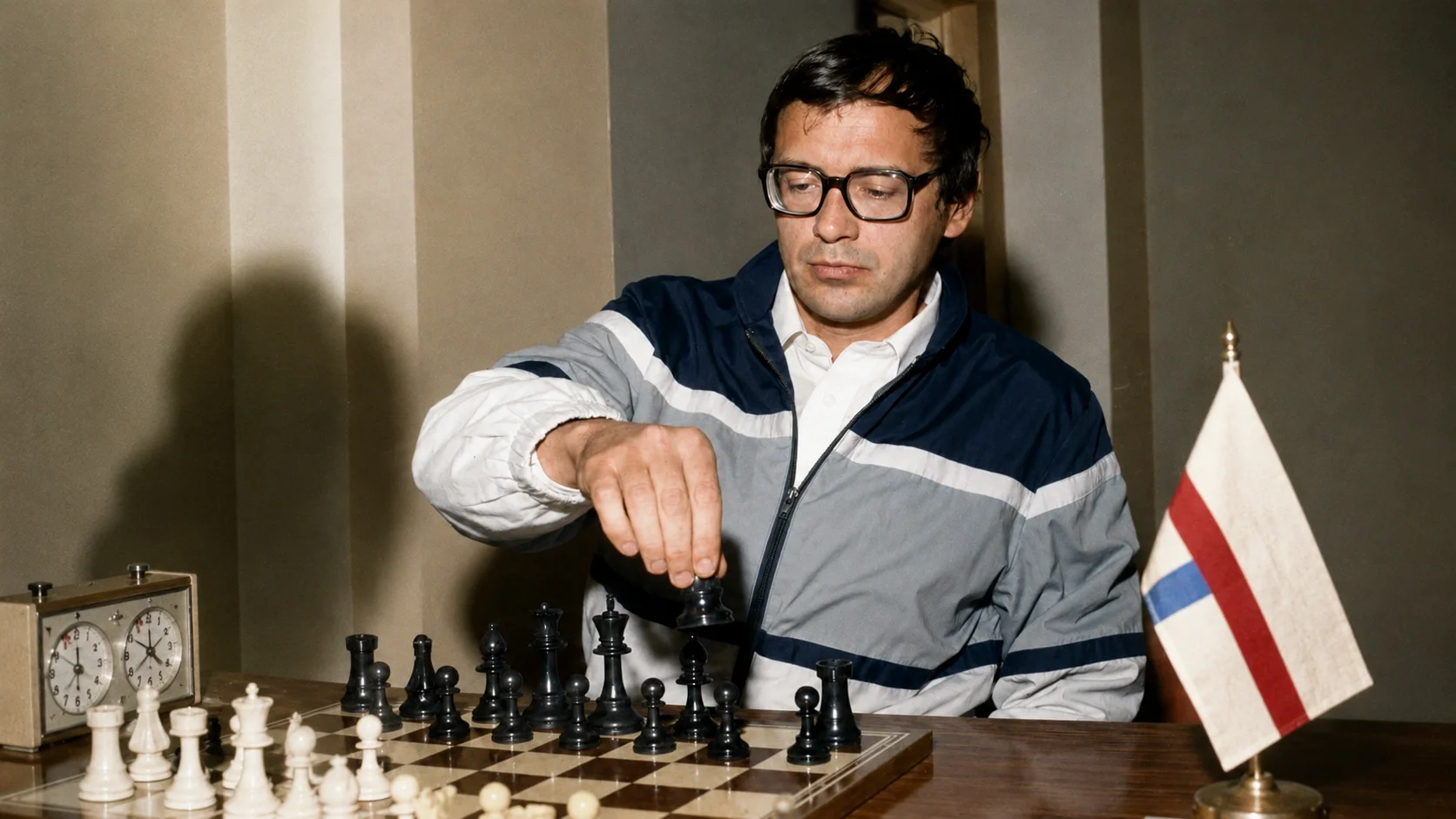
Image source: Douglas Griffin (Remixed)
Coach, teacher, and mentor
The most authoritative short account of his coaching chronology is the FIDE Trainers Committee profile from 2005. It states that he assisted Botvinnik’s school from 1969 to 1974, coached Anatoly Karpov from 1973 to 1978 together with Semyon Furman, assisted Vasily Smyslov’s school from 1978 to 1982, led the children’s chess club Lokomotive from 1984 to 1988, chaired the Russian Chess Federation trainers committee from 1982 to 1994, and, from 1998 onward, chaired the FIDE Trainers Committee. Russian Federation obituaries independently confirm his work with Karpov, the USSR national team at European team championships, and the 1980 Olympiad, the Russian national team thereafter, and the Italian national team in the 1990s. A 2006 Italian Olympiad press kit names him as the coach of Italy’s men’s first team.
His relation to Karpov was especially significant. Karpov wrote that he first met Razuvaev in the Botvinnik school in 1963 and later had him as a trainer at the 1973 interzonal and in matches against Polugaevsky and Spassky. Karpov’s retrospective tone is revealing: he did not portray Razuvaev as a subordinate helper but as part of a well-balanced collective whose composition genuinely contributed to his early ascent to the world championship. In Soviet chess culture, where seconds were often invisible in public narrative, that is a serious acknowledgment.
Among his formal pupils, the best-attested are Alexandra Kosteniuk and Evgeny Tomashevsky. Russian Federation obituaries name both, and the New in Chess memorial preview explicitly says that, formally speaking, Kosteniuk and Tomashevsky can be regarded as his pupils. Kosteniuk’s own account is unusually detailed: she attended sessions at Razuvaev’s school in the early 1990s, began working with him again after the 2004 Calvià Olympiad, studied the Ruy López with him, began solving studies blindfold at his recommendation, and credited him with restoring her belief that she could still reach a high level. Tomashevsky, soon after winning the 2009 European Championship, said Razuvaev’s contribution to his recent success was “enormous” and praised his gift for showing the core of a problem, his tact, and his erudition.
The same memorial preview broadens the circle considerably. It says that, beyond his formal pupils, Razuvaev helped many prominent grandmasters over the years, including Karpov and Magnus Carlsen, and notes specifically that Fabiano Caruana studied Catalan subtleties with him in 2008. Vladimir Kramnik’s foreword adds a more intimate layer. Kramnik recalls that Razuvaev, then head coach of Russia, helped secure his selection for the Manila Olympiad after Dortmund 1992 and later continued to advise him. Kramnik also says that Boris Gelfand worked with Razuvaev until the latter’s death. These testimonies suggest that Razuvaev’s real sphere of influence was broader than a formal teacher-student roster can capture. He functioned as a consultant, diagnostician, and intellectual reference point for elite players across national boundaries.
His teaching style emerges with unusual clarity from the testimony of pupils and colleagues. Kosteniuk stressed his methodical planning, his belief in “correct” classical chess, and his practical capacity to identify why results had gone wrong and what needed immediate correction. Tomashevsky emphasized his tact and his ability to isolate the essence of a problem. Kramnik described a coach who saw to the root of things, structured large masses of games and mistakes into concise conclusions, and linked chess performance to psychological balance, rest, and broader life habits. This combination of exact diagnosis, broad culture, and pedagogical restraint helps explain why so many tributes speak less of inspiration alone than of usable guidance.
He also pursued pedagogy beyond elite coaching. The New in Chess memorial preview, reflecting Kramnik’s foreword, reports that Razuvaev worked with scientists on cognitive questions, devised an original method for developing children’s abilities through chess, and tested it in ordinary schools in different Russian regions, allegedly raising achievement among weaker pupils. A 2008 FIDE Chess in Schools commission document records him, as chairman of the Trainers Committee, supporting a Moscow FIDE education center and joint work on methodological and pedagogical problems in children’s chess education. This was not merely tournament coaching being passed down. It was an attempt to theorize chess as a tool of mental development.
Chess theory, writing, and pedagogy
Razuvaev’s own professional identity included author, journalist, and analyst, and official Russian sources place real weight on that aspect of his work. The Russian Chess Federation obituary lists two especially popular co-authored books: Akiba Rubinstein (1980), with Valery Murakhveri, and Transition to the Endgame (1981), with Gennady Nesis, and also notes his many articles. The federation’s later “person of the day” profile describes the Rubinstein book as one of the best in the famous Soviet series on great players, and the Moscow-region federation page repeats that these two books became particularly well known.
The Rubinstein book is particularly important for assessing Razuvaev’s intellectual legacy. The 2023 English edition preview reproduces the original 1980 Soviet bibliographic description, which states that Murakhveri wrote the biographical chapter while Razuvaev supplied the annotations to selected games and the substantive chapters “A Mosaic of Highlights,” “Rubinstein and Chess Theory,” and “The Endgame.” The same preview notes that the original Soviet edition was part of the prestigious “Outstanding Chess Players of the World” series and had a print run of 75,000. Boris Gelfand’s foreword to the English edition is even more revealing: he writes that this was one of the books that had the strongest impact on him, praises Razuvaev’s gift for clear explanation, and explicitly ties the book to his own development in openings, middlegames, and endgames.
The memorial volume Devoted to Chess, previewed by New in Chess and Google Books, helps map Razuvaev’s wider thematic range. Its collected writings include “My Gambit,” “The Four Knights Opening,” “The Gambit Syndrome,” “A Game of Ghosts,” “In the best traditions of the Soviet school of chess,” “The Botvinnik System,” “How to develop your intellect,” and a lesson transcript. This range is analytically useful. It shows that Razuvaev’s writing was not confined to opening preparation or memoir. He moved among theory, pedagogy, training method, history, and the cultural self-understanding of the Soviet school.
As a theoretician, memorial sources emphasize breadth rather than a single narrow specialty. Vladimir Kramnik wrote that Razuvaev contributed ideas to all stages of the game, opening, middlegame, and endgame, and came up with many novelties that quickly found followers. Kramnik singled out his treatment of Queen’s Gambit positions, especially his “famous discovery,” 13.h4. Karpov, from a different angle, called him one of the main experts on the Catalan and said he handled that opening successfully throughout his life with White. The New in Chess memorial preview likewise calls him an “unsurpassed expert on the Catalan.” Primary and near-primary memorial sources, therefore, place his theoretical influence above all in mainstream strategic systems, not in a flashy laboratory sideline.
His analytical reputation also rested on method. The New in Chess memorial preview says he worked masterfully with literature, extracted promising material from primary sources, and developed finished products from it. That phrasing is valuable because it captures something historians of Soviet chess often note more generally: serious opening and strategic work was produced through intensive engagement with existing games, annotations, and historical master practice. Razuvaev appears as a particularly cultivated representative of that model, a historian-player who reprocessed earlier chess culture into modern training and theory.
Institutional service, legacy, and influence
Razuvaev’s institutional significance goes well beyond his own pupils. In Russia, official federation sources place him on the Board of Trustees and say that in the last years of his life, he devoted special attention to school chess and headed the project “Chess Talents in Russia.” Memorial articles and commemorative events show that the federation continued to frame him as a symbol of educational and training culture and of civilized chess professionalism.
Internationally, his central institutional legacy lies in trainer education. FIDE’s 2006 General Assembly minutes state that the report of Chairman GM Razuvaev was approved and describe the major achievement of the previous six years as the establishment of a system of titles and certificates for trainers. The same minutes discuss trainer licensing, continental academies, and the Moscow academy project. A 2009 FIDE trainer-course invitation lists Razuvaev among the lecturers on modern training, teaching strategies, and tactics across all three phases of the game. In other words, he did not merely hold a title; he helped build the framework through which coaching itself became more professionalized and internationally standardized.
That institutional legacy is evident in honors postdating his death. FIDE’s trainer awards include the Yuri Razuvaev Award. In 2019, it was presented for contributions to trainer education, and FIDE’s 2020 announcement explained that the category would henceforth more directly recognize grassroots education. The FIDE handbook later codified the Yuri Razuvaev Award as recognizing special contributions to grassroots education and social impact. This is a significant clue to how the international chess community chose to memorialize him. Botvinnik is associated with elite open results, Dvoretsky with junior excellence, Petrosian with trainer education, and Razuvaev with the educational and social reach of chess at the base. That alignment is a historical judgment in institutional form.
Russian memorial practice points in the same direction. The Chess Federation of Russia organized online memorial events in his name, with participation from Kramnik, Nepomniachtchi, Gelfand, Tomashevsky, Potkin, Lautier, and others who had worked with him. Federation reporting from 2020 also notes special prizes for games played “in the style of Yuri Razuvaev.” Such commemorations are selective acts of memory: they do not celebrate him chiefly as a tournament star, but as a stylistic and pedagogical reference point for later generations.
Taken together, the Russian and international evidence support a clear legacy claim. Razuvaev helped transmit the Soviet chess school into the post-Soviet and truly global eras in three converging ways: by carrying Botvinnik-school habits into coaching; by mentoring a chain of strong players from Karpov and Kramnik to Kosteniuk, Tomashevsky, and younger international elites; and by turning the education of trainers into an explicitly organized field within FIDE. That combination is unusual. Many strong Soviet grandmasters coached; fewer also shaped the institutions that defined what coaching would mean internationally.
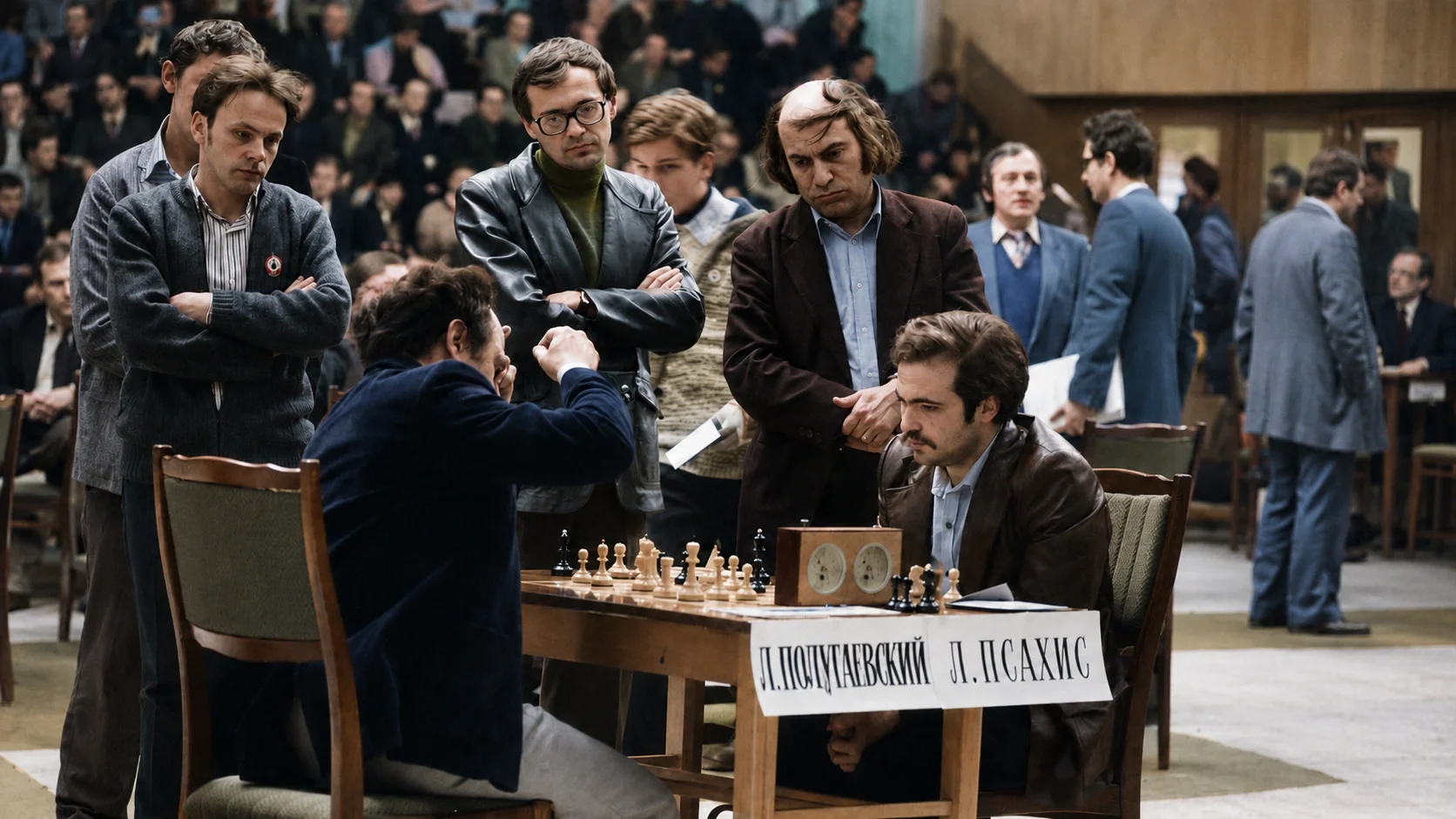
Image source: Douglas Griffin (Remixed)
Historiography and unresolved questions
The source base on Razuvaev is broad but uneven. Official Russian and FIDE materials are strongest on public roles: his education, titles, coaching appointments, federation service, and memorial status. Database and obituary sources, such as OlimpBase, ChessBase, TWIC, and Chess.com, provide tournament and rating information. The most intellectually revealing source is the memorial volume Devoted to Chess and its Previews, because it collects tributes, writings, and training reflections from world-class players and colleagues. Yet it is also unmistakably commemorative in tone. For analytical work, it is invaluable for professional memory and coaching methods, but less suitable as a detached critical biography.
Several small factual discrepancies recur. One example is the dating of his Dubna victory: official Russian federation notices place it in 1979, while major obituary sources in English often list Dubna 1978. Another is the honored-coach date: Russian federation sources say he received the Honored Coach of the RSFSR title in 1976, while the 2005 FIDE Trainers Committee profile summarizes him as an honorary trainer of Russia since 1977. These are not major substantive disagreements, but they show the need for caution when moving between federation memory, FIDE administrative summaries, and later compiled obituaries.
There are also real gaps. Family details remain sparse in authoritative public sources. Widow Natalia and son Alexander are well attested, but I did not locate a robust official account of his parents, early home environment, or a fully documented burial record in the primary and quasi-primary materials reviewed here. Likewise, English-language writing on Razuvaev is dominated by obituary and memorial genres rather than by a standalone critical biography. Finally, published peak rating figures vary across compilations; for precision, the safest reference point is the archived FIDE list on OlimpBase, which lists him at 2590 and world No. 46 in July 1991.
The balanced historical judgment, then, is that Razuvaev was not a forgotten tournament giant so much as an undersynthesized chess intellectual. His greatest significance lies in the durability of his pedagogical and institutional influence. He belongs in the history of Soviet and Russian chess not only as a high-caliber grandmaster, but also as one of the key teachers and organizers who carried the culture of analytical, responsible, classically grounded chess into the late twentieth and early twenty-first centuries. The memorial rhetoric calling him a “chess academician” is plainly laudatory, but after review of the source record, it is not empty rhetoric. It captures the unusual span of his contribution.
