Anatoly Lutikov
By Jack de Nijs for Anefo
Introduction
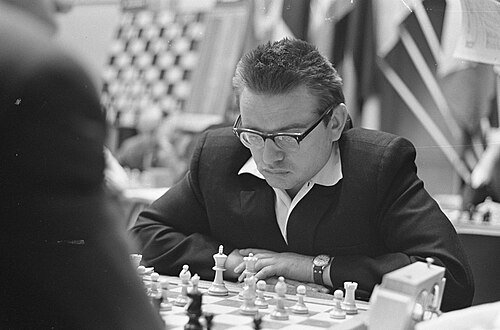
Anatoly Stepanovich Lutikov (Анатолий Степанович Лутиков, 5 February 1933 to 23 October 1989) belonged to the exceptionally strong tier of Soviet grandmasters whose careers unfolded largely outside the world championship cycle. His record included two RSFSR championships, six championships of the Moldavian SSR, a clear third place in the 1968-69 USSR Championship, an undefeated second place at Beverwijk in 1967, and gold-medal performances for Soviet teams. On the inaugural official rating lists, he stood among the world’s leading fifty players.1
Lutikov’s historical importance extends beyond those results. His career illuminates the life of a predominantly self-taught professional whose development took place in clubs, military competitions, regional chess organizations, and collective analysis. He became known for tactical imagination, rapid judgment, and a strong instinct for the initiative. He also worked for years as a trainer, introducing serious chess culture to industrial and provincial centers far from Moscow’s most celebrated institutions.
His delayed international title, regional mobility, and posthumous reputation help explain why he remains less familiar than several contemporaries whom he defeated. The surviving record presents a player of genuine international strength whose opportunities, methods, and influence were distinctively his own.

By Eric Koch for Anefo
Early Life and Chess Formation
Lutikov was born in Leningrad on 5 February 1933. The accessible record of his family is fragmentary. A Russian biographical dossier reports that his mother died during the Siege of Leningrad while his father was serving at the front. Lutikov was evacuated to the Yaroslavl region, spent approximately a year in a children’s home, and eventually returned to Leningrad after relatives were located. The dossier does not identify his parents by name or occupation, so the family history cannot presently be reconstructed in greater detail.2
His formal education was curtailed by material necessity. After seven years of school, he entered factory employment as an apprentice draftsman. He later attended a technical school and worked in a design bureau attached to the Leningrad Metal Works, then named for Stalin. Alexey Suetin, who knew him well, recalled that Lutikov wished to pursue higher education but never obtained the opportunity.3
Lutikov discovered chess comparatively late. According to his own recollection, in 1946 he and a friend entered a chess room while waiting for a public lecture on penicillin. The thirteen-year-old became absorbed in the play and remained until the room closed. His first instructional book was Emanuel Schiffers’s Self-Tutor of Chess. Its numerous short, combinational games strongly influenced his emerging conception of chess.4
At fifteen he joined the chess section of the Leningrad Palace of Pioneers. His development was extraordinarily rapid: Nikolai Krogius remembered meeting him in July 1948 when Lutikov held third-category strength; within about six months he had reached the first category. He briefly encountered the systematic training methods of Vladimir Zak, later famous for his work with Boris Spassky. Lutikov’s independent temperament led him away from a fixed curriculum, and much of his subsequent education came through playing and analyzing at the Chigorin Chess Club.5
Two other influences were especially important. Andrei Angaforov introduced him to the games of Alexander Alekhine and to the attacking traditions of the King’s Gambit. Lutikov copied Alekhine games into a notebook that he preserved for many years. Alexander Tolush, one of Leningrad’s foremost attacking masters, became both an example and an informal teacher. Tolush’s combination of practical aggression, psychological pressure, and willingness to accept risk was close to Lutikov’s own emerging outlook.
In 1949 Lutikov represented Leningrad in the All-Union junior team competition alongside Spassky, Viktor Korchnoi, Alexander Geller, and Vladimir Lyavdansky. The Leningrad team won. This group demonstrates the remarkable density of the city’s postwar chess culture, although Lutikov’s path remained more closely connected to open club play and independent analysis than to a single formal coaching school.
Rise in Competitive Chess
By early 1950, Lutikov had reached candidate-master level. His early tournament play already displayed the combination of volatility and competitive courage that would characterize his career. At the 1951 Chigorin Memorial, an uneven overall result included victories over Mark Taimanov, Korchnoi, and Vladimir Alatortsev. Suetin also recalled a trade-union team event at which the still-teenaged factory worker scored 3½ points from four first-board games against Vasily Smyslov, Alexander Kotov, Tolush, and Lev Aronin. Such performances established his reputation before he possessed an official master title.
Lutikov was drafted into the Soviet armed forces in 1953. Military service proved an important competitive phase. He won the Armed Forces Championship in 1954 after defeating Vladimir Novopashin 5½-2½ in a playoff. At the USSR team championship in Riga that year, he scored 8 points from 10 games for the Central Army Sports Club, the best individual result in the competition, and received the title Master of Sport.
He also took chess beyond elite competition while serving. Krogius records that Lutikov conducted simultaneous displays, including blindfold exhibitions, and demonstrated grandmaster games to service personnel. These activities anticipated his later coaching work.
In 1955 he won the RSFSR Championship with 14 points from 19 games, finishing ahead of Lev Polugaevsky and Krogius. He lost only once. During the same year, he helped the RSFSR team win the Soviet team championship and scored prominently on first board. Krogius regarded him as an especially effective team competitor: he played quickly, rarely suffered from time pressure, and responded strongly to collective responsibility.
After demobilization in 1956, housing difficulties complicated a return to Leningrad. Lutikov moved to Chelyabinsk, where he worked as a club trainer. He gave exhibitions at the tractor and metallurgical plants and traveled to Korkino, Kopeisk, and other industrial communities. His lessons drew heavily on Alekhine’s games and on positions from his own practice. Former pupils remembered a lively, question-driven method built around discovery and concrete calculation.
That year he represented the Soviet Union at the World Student Team Championship in Uppsala. The USSR won, and Lutikov scored 6½ from 7 as a reserve, the best percentage on the Soviet team.6 In 1958 he moved to Novosibirsk, where Irina Alexandrovna, his future wife, was living. Marriage brought greater personal stability. Working through the Spartak sports society, he and Krogius contributed to the city’s expanding chess culture through coaching, team preparation, and sustained analytical work.
His competitive breakthrough followed quickly. In the 1958 USSR Championship semifinal in Moscow, Lutikov finished first with 12 points from 15 games, recording nine wins and six draws. In his USSR Championship debut at Tbilisi in 1959, he scored 9½ from 19 and remained near the leaders for much of the event. Later that year he won his second RSFSR Championship, completing the tournament without defeat.
Major Career Achievements
Lutikov’s first individual tournament victory abroad came at Bad Salzungen in 1960, where he scored 7 points from 11. He moved to the Moldavian SSR around 1962 and became one of the republic’s leading chess figures. Standard reference records credit him with six Moldavian championships, in 1963, 1964, 1965, 1966, 1968, and 1977.
His performance in the 1964-65 USSR Championship in Kyiv signaled his arrival among the country’s stronger grandmaster-level competitors. He finished in the upper half of the field, and his victory over former world champion Mikhail Tal became one of the tournament’s most discussed games. Its significance lay in the reputation it reinforced: Lutikov could create difficult, unbalanced problems even for the most accomplished attacking players. Other encounters from this period also showed disciplined defensive resources, broadening the image of him as a purely tactical specialist.
At the 1965 European Team Championship in Hamburg, Lutikov scored 6½ from 8 as a reserve. The Soviet Union won the team championship, and his result earned the individual gold medal for his board.7 FIDE awarded him the international master title in 1967.
The strongest international result of his career came at the 1967 Hoogovens tournament in Beverwijk. Lutikov scored 10½ from 15 without losing a game, finishing half a point behind Spassky. His six victories included a first-round success against Bent Larsen. The field also contained leading grandmasters such as Svetozar Gligorić, Efim Geller, Lajos Portisch, and Borislav Ivkov. The result demonstrated that Lutikov could sustain disciplined play across a major round-robin event, an important development for a player previously associated with fluctuating tournament form.
His finest Soviet championship followed in Alma-Ata in 1968-69. Lutikov scored 11½ from 19 and finished clear third, one point behind the joint winners Alexander Zaitsev and Polugaevsky. He won nine games, the highest total in the event.9 The Soviet federation awarded him its domestic grandmaster title in 1969.
The distinction between the Soviet and FIDE titles is significant. Lutikov had been a national master since 1954, yet he received the FIDE grandmaster title only in 1974, at the age of forty-one. Krogius believed that limited access to international norm tournaments slowed his advancement. The documented record supports the narrower observation that many of Lutikov’s best results occurred in domestic events or foreign tournaments without the required title category. Krogius’s broader explanation remains an informed insider’s interpretation and lacks archival corroboration in the sources consulted.
Lutikov continued to earn important international results during the 1970s. He shared first place with Vlastimil Hort at Leipzig in 1973, a result that preceded his FIDE grandmaster title. At Albena in 1976 he scored an undefeated 9½ from 12 and won by a point and a half. The official July 1972 rating list placed him at 2545, tied for thirty-eighth in the world.10 Since FIDE’s published Elo system was still new, this figure captures only one phase of his career, but it confirms his standing within the international elite.
By Jack de Nijs for Anefo
Style and Reputation
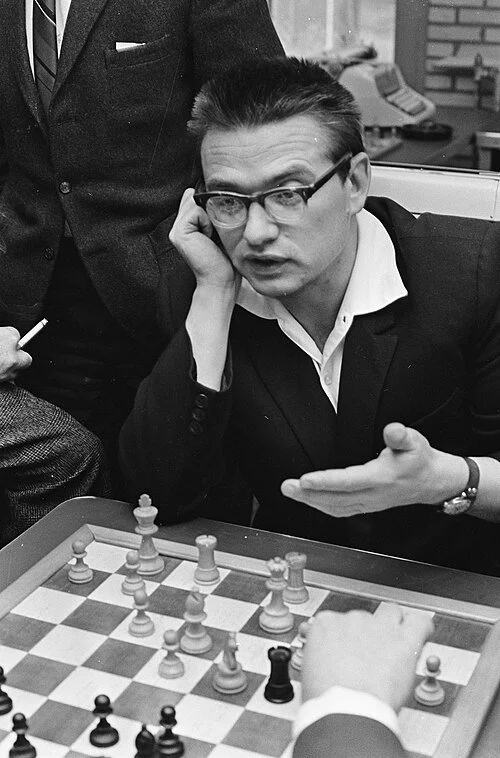
Lutikov described himself succinctly: “By nature I am a tactician.”11 The statement fits his formative study of Schiffers, Alekhine, and Tolush. He excelled at recognizing moments when an apparently stable position could be transformed by a pawn break, exchange sacrifice, or unexpected change in the direction of attack.
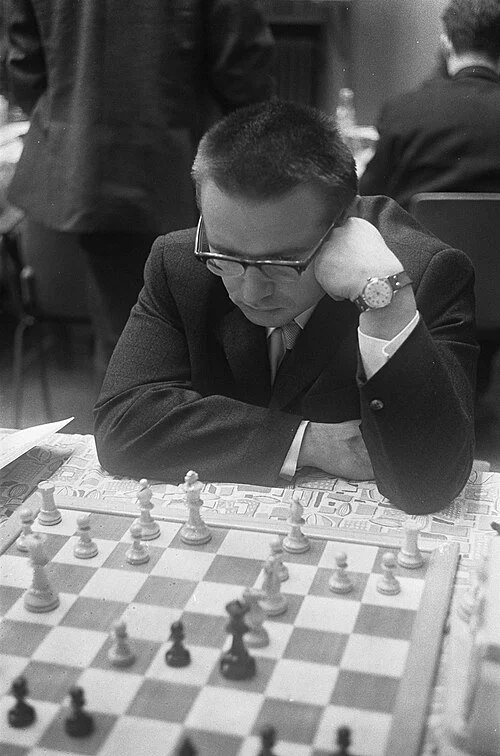
His chief strengths were intuitive judgment, rapid calculation, and an acute feeling for initiative. He often selected moves quickly, giving opponents little psychological respite. This speed was founded on pattern recognition and concrete tactical vision. In team competitions, where reliability and time management carried particular value, these qualities made him an important selection.
Lutikov’s attacking chess was rarely reducible to a search for immediate combinations. His best games show a willingness to accumulate small dynamic advantages and to keep several tactical possibilities alive. Against very strong opposition, he frequently created positions in which familiar strategic rules offered limited guidance. That capacity helps explain victories over Tal, Korchnoi, Paul Keres, David Bronstein, Geller, Polugaevsky, Taimanov, Yuri Averbakh, and Rashid Nezhmetdinov.
His contemporaries also identified areas that demanded more deliberate work. Krogius and Suetin observed that long maneuvering phases, extended technical endings, and systematic opening preparation, especially with Black, came less naturally to him than immediate dynamic problems. His tournament record nevertheless shows considerable development in these areas. The undefeated Beverwijk performance, in particular, combined tactical alertness with restraint and sustained defensive accuracy.
Lutikov was also an exceptional blitz player. According to his later recollection, he played approximately thirty informal blitz games with fifteen-year-old Bobby Fischer during Fischer’s 1958 visit to Moscow and won roughly two-thirds of them. No formal score sheet or independent match record survives, so the episode should be treated as Lutikov’s reported recollection. Its plausibility rests on his established standing in Soviet blitz circles, where his speed and tactical reflexes were widely respected.
Among colleagues he was commonly known as “Luka.” Accounts by Krogius, Suetin, and Genna Sosonko depict an independent, intellectually curious man who read widely and enjoyed opera and film. Chess was his profession and primary form of expression, yet his interests were broader than the specialized image of a tournament player.
Contributions Beyond Tournament Play
Lutikov never produced the volume of published analysis associated with several Soviet contemporaries. His principal contribution outside competition came through direct teaching and collective analysis.
His work in Chelyabinsk brought master-level instruction to factory clubs and satellite industrial towns. In Novosibirsk, his partnership with Krogius helped strengthen the local Spartak organization and the city team. Krogius names V. Tribushevsky, V. Petryaev, Yuri Karpenko, Yuri Nikaskin, and Vladimir Vanin among the Novosibirsk players who benefited from their analytical work.5 Later, in Tiraspol, Lutikov continued to coach young players and remained associated with the chess culture of the Moldavian SSR.
His teaching appears to have been highly personal. He preferred concrete positions, practical questions, and the reconstruction of a master’s thought process. This approach reflected his own education through books, club analysis, consultation games, and extensive play. He encouraged pupils to search actively for resources instead of memorizing conclusions.
Lutikov also contributed to opening practice. Sosonko credited him with bringing the sequence 1.d4 Nf6 2.c4 Nc6 into serious Soviet tournament play during the late 1960s. Earlier examples of the system exist, so Lutikov’s role is best understood as an inventive, high-level advocate. The opening later became widely known as the Black Knights’ Tango. During visits to the Netherlands, he analyzed unusual opening ideas with the Dutch master Dick van Geet, another player attracted to strategically unconventional positions.
For many years Lutikov hoped to write an instructional book based on his own games. He envisioned a systematic manual using his successes and errors to explain practical decision-making. Illness and unstable working circumstances prevented its completion. After his death, his widow, Irina Alexandrovna, preserved the original materials, and his son, identified as O. A. Lutikov, helped bring them into print. The resulting volume, Shakhmatnoe nasledie A. S. Lutikova (The Chess Legacy of A. S. Lutikov), compiled by A. A. Alexandrov and O. A. Lutikov and published by Nauka in Novosibirsk in 1993, partially fulfilled that ambition.
Later Life and Historical Legacy
Lutikov’s later years were affected by diabetes and by the insecure employment available to many chess professionals whose principal work lay outside the most prestigious national institutions. At different times he was employed as a trainer, sports instructor, or methodological adviser. His career took him from Leningrad to Chelyabinsk, Novosibirsk, Tiraspol, Yaroslavl, and Anapa, and then back to Tiraspol.
He died in Tiraspol on 23 October 1989, aged fifty-six. A few later databases give 15 October or list Anapa as the place of death. The date and location used here follow the Russian Chess Federation profile, the 1993 biographical collection, and memoir accounts by Suetin and Sosonko.
Post-Soviet commemoration has been strongest in Tiraspol and the surrounding region, where tournaments bearing his name continue to be organized. This local memory is appropriate. Lutikov was a product of Leningrad’s formidable chess culture, yet much of his working life was devoted to building chess communities in regional centers. His impact consequently survives through institutions and pupils as well as through tournament crosstables.
The posthumous collection of his games remains the essential source for his career. Its memoirs require the usual caution applied to retrospective testimony, but the convergence among Krogius, Suetin, family materials, tournament records, and contemporary reporting produces a coherent portrait: an independent and predominantly self-taught player, a dangerous opponent to the Soviet elite, a gifted practical analyst, and a committed regional trainer.
Eric Koch for Anefo
Historical Assessment
Anatoly Lutikov deserves attention because his career reveals the depth of Soviet chess beyond the small circle selected for world championship competition. At his best, he performed at clear international grandmaster strength: he challenged Spassky at Beverwijk, finished third in one of the strongest USSR championships, won major team medals, and remained among the world’s leading fifty players into the 1970s.
His historical identity is equally tied to how he reached that level. Wartime disruption, limited formal education, club culture, military chess, self-directed study, and regional coaching all shaped his development. His games preserve a distinctive imagination founded on initiative and rapid tactical judgment. His teaching carried that practical tradition into Chelyabinsk, Novosibirsk, and Tiraspol. Together, those achievements give Lutikov a substantial place in the history of Soviet chess.
Notes and Sources
Contemporary Soviet coverage includes P. Baranovsky, “Всесоюзные юношеские соревнования,” Шахматы в СССР, no. 10 (1949), pp. 281-286; V. Antoshin, “Победа А. Лутикова,” Шахматы в СССР, no. 3 (1960), pp. 82-84; and B. Baranov, “Крутыми дорогами,” Шахматы в СССР, no. 7 (1969), pp. 14-15. Digitized issues are indexed in the Soviet chess periodical archive.
Russian Chess Federation, “Anatoly Lutikov: Person of the Day”. Name variants found in international records include Anatoli Lutikov, Anatoly S. Lutikov, and the French transliteration Loutikov. ↩ ↩2
Digitized Russian biographical dossier on Lutikov. Its account of the family’s wartime experience is valuable, although the underlying archival sources are not identified in the accessible version. ↩
Alexey Suetin, “Нелегкая жизнь шахматиста” (“The Difficult Life of a Chess Player”), in A. A. Alexandrov and O. A. Lutikov, compilers, Шахматное наследие А. С. Лутикова (Novosibirsk: Nauka, 1993). Online transcription. ↩ ↩2
O. A. Lutikov, preface to Шахматное наследие А. С. Лутикова. The preface incorporates Lutikov’s own autobiographical recollections and acknowledges Irina Alexandrovna’s preservation of his papers. Online transcription. ↩ ↩2
Nikolai Krogius, “Боец с открытым забралом” (“A Fighter with Open Visor”), in Шахматное наследие А. С. Лутикова. Online transcription. Krogius was both a long-term friend and frequent rival, which gives his essay unusual value while also requiring awareness of its memorial character. ↩ ↩2 ↩3
OlimpBase, World Student Team Championship, Uppsala 1956. Krogius’s memoir gives Lutikov’s score as 4½ from 5; the event table gives 6½ from 7. The latter has been used here. ↩
Genna Sosonko, “Лука (А. Лутиков)” (“Luka: A. Lutikov”), in Мои показания (My Testimony) (Moscow: RIPOL Classic, 2003). The English quotation in the article is a translation from the Russian. Online text. ↩ ↩2
A. A. Alexandrov and O. A. Lutikov, compilers, Шахматное наследие А. С. Лутикова (Novosibirsk: Nauka, 1993), 304 pages. ↩
For Tiraspol’s account of his regional work and continuing memorial tournaments, see the local historical profile of Lutikov. ↩
