Ян Тимман
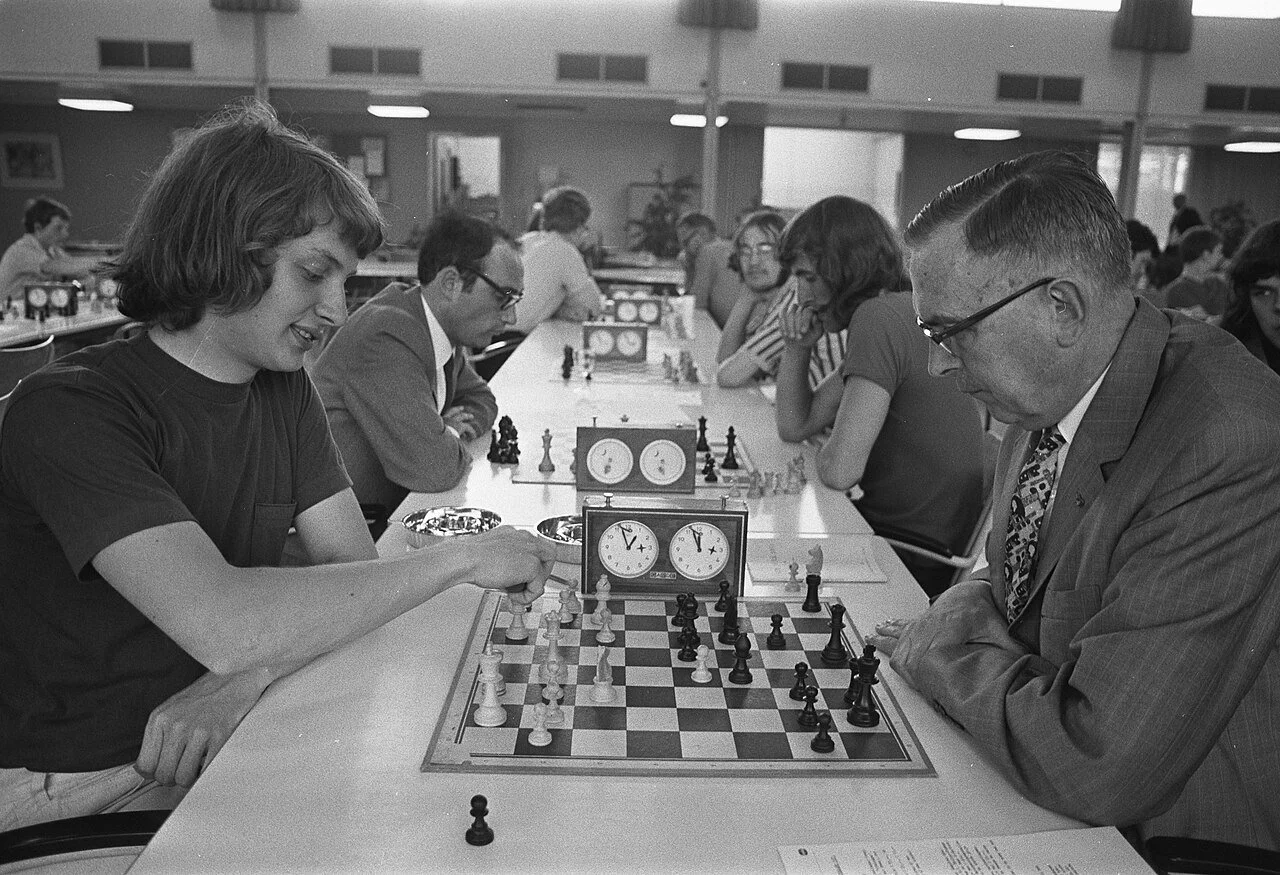
Timman in play against Euwe. Anefo
Introduction
Jan Hendrik Timman occupies a distinctive place in late twentieth-century chess history. Born in Amsterdam on December 14, 1951, and deceased in Arnhem on February 18, 2026, he was a nine-time Dutch champion, a recurrent World Championship candidate, a FIDE World Championship finalist in 1993, and at his strongest the player most often identified as the leading non-Soviet grandmaster of his era. FIDE’s obituary emphasized his imaginative style and literary legacy, while Dutch and international institutions alike continued, well into 2025 and 2026, to honor him as one of the central figures in modern chess culture. In Soviet and Russian usage his name appears straightforwardly as Ян Тимман, a small sign of how fully he belonged to the chess conversation on both sides of the East-West divide.
A careful historical reading suggests that Timman deserves attention for more than being “the Best of the West.” He was at once a world-class tournament player, a serious analyst of his own games, an important editor and author, and one of the very few elite over-the-board grandmasters to become a major endgame-study composer. That combination helps explain why his reputation has endured among players, historians, and readers who care about chess as a cultural practice as well as a sport.
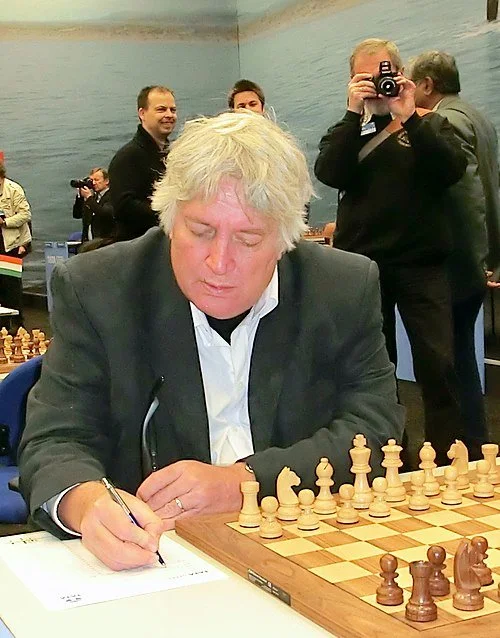
Jan Timman, chess grandmaster from the Netherlands. Stefan64
Early Life and Chess Formation
Timman came from a mathematically educated Dutch family. His father, Reinier Timman, taught applied mathematics and theoretical mechanics at Delft, and his mother had also studied mathematics. Family memory connected the household to Max Euwe, since Timman’s mother had been taught mathematics by the former world champion, and Euwe later took a practical interest in the young Jan’s development. Timman grew up in Delft, learned chess around the age of eight, and first encountered the game through his father and his older brother Ton, who would himself become a FIDE Master.
His education initially followed the path his parents expected. He attended gymnasium and briefly enrolled in mathematics, but he abandoned formal study and chose the far less secure life of a professional chess player. That decision was not merely youthful improvisation. By his mid-teens he had already won important youth events, followed world championship play closely through Botvinnik and Tal, and developed a habit of intensive self-study. His first important international result was third place in the 1967 World Junior Championship in Jerusalem, and in 1971 he earned the International Master title. In 1974 he became a grandmaster, only the third Dutch player to do so after Euwe and Jan Hein Donner.
Several formative influences stand out. Hans Bouwmeester was his first real trainer, and Soviet and Russian recollections, drawing on Genna Sosonko, stress that Bouwmeester did more than show him classical endings and Botvinnik games. He taught Timman how to study independently. Timman himself repeatedly named Botvinnik, and to a lesser extent Smyslov and Fischer, as decisive influences on his chess education. Euwe also helped arrange financial support through a special Timman fund or committee, making it easier for him to commit to chess full time. Those relationships are important because they explain why Timman’s later play combined broad strategic culture, independent analysis, and a willingness to test himself against the very strongest traditions in chess.

Jack de Nijs for Anefo
Rise in Competitive Chess
Timman’s rise was substantial, though not instantaneous. He broke through internationally in the early 1970s, sharing first at Hastings 1973-74 and then stacking up strong performances at Sombor, Netanya, Reykjavík, Amsterdam, and other first-rate events. His early career included a revealing mixture of promise and incompleteness. Timman later wrote that his discipline was not always ideal, and that only around 1978 did his play stabilize enough for a sustained push toward the world elite. That self-assessment is worth taking seriously, because it fits the external record: great talent appeared early, yet full consistency arrived a little later than it did for some of his contemporaries.
Another part of his formation came from direct contact with stronger or more established figures. Russian material notes that his mid-1970s matches with Viktor Korchnoi and Boris Spassky, although lost, hardened him and pushed him toward more serious opening and analytical work. Douglas Griffin’s archival work adds a further detail that is easy to overlook: in 1979 Timman and Lev Polugaevsky played an eight-game “secret match” in Breda as preparation for their respective interzonals, and Timman won 4.5 to 3.5. This was not a publicity stunt. It shows that by the end of the 1970s Timman was already treated by major Soviet players as a serious professional equal, someone worth preparing with in match conditions.
His rise was also tied to the World Championship cycle. He reached zonal and interzonal levels in the 1970s, and in 1979 at Rio de Janeiro he came painfully close to qualifying for the Candidates, missing by half a point after losing only one game but drawing too many. That near miss was historically important. It showed that Timman had moved from promising grandmaster to genuine contender. His decisive breakthrough came in 1985, when he won the Taxco Interzonal without a loss, scoring nine wins and six draws. From that point onward, his candidacy for the world title was no longer hypothetical.
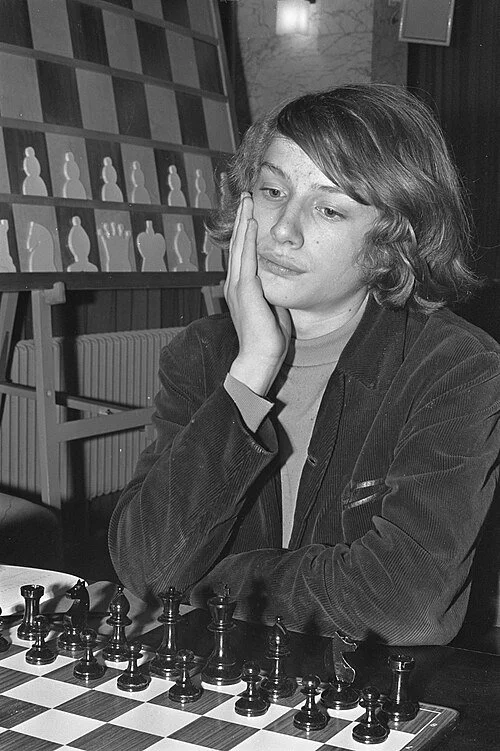
Jack de Nijs for Anefo
Major Career Achievements
Timman’s peak phase stretched from the late 1970s into the early 1990s. By January 1982 he was second on the world rating list behind Anatoly Karpov, and later his rating reached 2680. During the 1980s he won or shared first in a sequence of elite events that included Amsterdam IBM, Wijk aan Zee, Linares, the Euwe Memorial, and the 1989 World Cup in Rotterdam. In team competition he represented the Netherlands in thirteen Olympiads from 1972 through 2004, played first board on eleven occasions, and won the individual gold medal on board one at Haifa in 1976.
The shape of his world title efforts is central to his historical profile. He first entered the Candidates in 1985 after defeating Mikhail Tal in a playoff at Montpellier, then lost heavily to Artur Yusupov in 1986. He returned stronger in the next cycle, winning the Tilburg Interzonal in 1987 and then defeating Valery Salov, Lajos Portisch, and Jonathan Speelman before losing the Candidates final to Karpov in 1990. In the following cycle he beat Robert Hübner, Viktor Korchnoi, and Yusupov, only to lose the 1993 Candidates final to Nigel Short. When Kasparov and Short broke with FIDE, Timman became Karpov’s opponent for the official FIDE world title and lost the 1993 match by 12.5 to 8.5. The technical fact is simple. The historical point is more interesting. Timman reached the title match through a route altered by institutional crisis, yet his place there was not artificial. It rested on nearly a decade of repeated presence at the deepest end of the Candidates.
Only a few individual games are needed to explain his reputation. His victory over Karpov at Mar del Plata in 1982 became one of his own candidates for his best win, and Dutch reporting still treated it as exemplary of his energy and ambition. His victory over Kasparov at Hilversum in 1985, though it came in a lost match overall, was later remembered as Kasparov’s first defeat as reigning world champion and as a concentrated display of Timman’s creative, adventurous style. These games are historically useful because they reveal why Timman’s standing was never merely statistical. He could beat the very best in games that looked unmistakably like Timman games.
His later career still produced notable moments. The most striking was his 1991 Immopar rapid triumph in Paris, where he eliminated Kamsky, Karpov, Anand, and Kasparov in succession. It did not redefine classical chess history, but it did demonstrate that Timman remained, even after the peak of his title chances, a player capable of defeating the entire hierarchy in a compressed elite format.

Timman accepting an award from Euwe. Anefo
Style and Reputation
Timman’s own assessment of his chess is unusually helpful because it is both lucid and unflattering. He said he was probably better at attacking than defending, and especially strong at taking the initiative and judging positions once he had seized momentum. At the same time, he admitted to overlooking simple things more often than he would have liked. In Timman’s Triumphs he also noted a recurring tendency to get dubious positions with Black because he was often playing for a win rather than for safety. That combination of initiative, broad understanding, optimism, and occasional tactical carelessness appears again and again in outside descriptions of his play.
Contemporaries and later observers broadly agreed on the essentials. FIDE described him as imaginative and combative. Dirk Jan ten Geuzendam and Dutch commentators called him a chess romantic, while also stressing that the bohemian image could be misleading because Timman was in fact extraordinarily productive and hardworking. Max Pam called his play aggressive and perhaps overly optimistic. Peter Doggers described him as a “total chess player,” with both attacking and positional resources, and emphasized the unusual width of his opening repertoire for the period. Russian material, again drawing on Sosonko, praises his strategic feeling, work ethic, and love of analysis from a young age. The consensus is therefore quite stable. Timman was not a reckless tactician. He was a highly cultivated, strategically literate player whose taste for complex, fighting positions sometimes pushed him beyond prudence.
His reputation among contemporaries also depended on his personality. Donner was a major personal influence, and Timman later said that from Donner he had learned more about life than about chess. Dutch reporting after Timman’s death repeatedly returned to the same picture: an intellectually curious, culturally literate figure with strong interests in literature, art, and music, someone who fit naturally into Amsterdam’s artistic circles and who retained a deep attachment to the older, more human chess culture of books, analysis, and long games. This does not explain his results by itself, but it helps explain why his name carries a certain texture in chess memory.
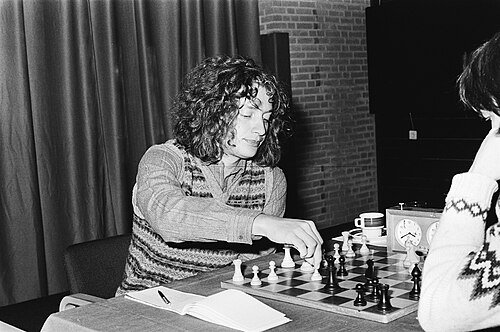
Fernando Pereira / Anefo
Contributions Beyond Tournament Play
Timman’s work away from the board was substantial enough to form a second career. New In Chess described him as the magazine’s first editor in chief and stressed that he remained intellectually central to the publication through articles, annotations, and editorial advice until the end of his life. In Dutch recollection, one sign of his discipline was that after learning of his illness he still prepared a reserve column for the magazine. That detail is useful not for sentiment, but because it captures something repeatedly emphasized by those who worked with him: the supposed bohemian was also a man of sustained professional seriousness.
As an author, Timman belongs in the first rank of postwar chess writers. FIDE singled out The Art of Chess Analysis, The Art of Attacking Chess, and Timman’s Titans. The World Chess Hall of Fame and New In Chess both emphasized that his books did more than present games. They transmitted memory, style, and historical judgment. Timman’s Titans won the English Chess Federation Book of the Year for 2017, a fitting award for a work that fused chess history with personal testimony.
His later years deepened rather than narrowed his chess identity. New In Chess recorded that in the last decade of his life endgame studies had become the most important part of his chess world. He published The Art of the Endgame in 2011, 100 Endgame Studies You Must Know in 2024, and in 2025 brought out Timman’s Studies, a collection spanning compositions from 1971 to 2025. He received the title of FIDE Master of Chess Composition in 2022. This body of work is historically significant because very few players of genuine world-class practical strength have also made lasting contributions as composers. Timman was one of them.
He also played a part in chess institutions. By his own account he served as vice-president and later president of the Grandmasters Association, and Kasparov’s history of professional chess identifies Timman as a key figure in the organization’s attempt to professionalize elite chess in the late 1980s. That effort did not permanently reorder world chess, but it shows Timman engaging not only with games and books, but with the structure of professional chess itself.

By Fotograaf Onbekend / Anefo
Historical Legacy
Timman’s historical legacy begins with Dutch chess, where he was the strongest homegrown player after Euwe and the figure who most powerfully renewed national chess excitement in the late twentieth century. The KNSB had already made him an honorary member in 1991, and even in old age he continued to represent Dutch chess publicly, returning to the national championship in 2024 after an eighteen-year absence and more than half a century after his debut. He announced the end of his active playing career late in 2025. In October of that year he was inducted into the World Chess Hall of Fame.
His wider legacy lies in the special kind of counterweight he provided to Soviet dominance. Timman was not a Soviet player, not a defector, and not a political symbol in the crude sense. He was something more chess-specific and, for that reason, more enduring: a Western grandmaster whom Soviet players, trainers, annotators, and institutions had to treat as a real rival. Russian and Soviet-oriented sources remember his training with Dutch and Soviet mentors, his matches with Tal, Korchnoi, Spassky, Yusupov, and Polugaevsky, and his status as the strongest Western challenger of the period. That pattern of attention reflects a minor but important historical truth. Timman was not simply adjacent to the Soviet school. He entered its field of force and remained there for decades.
A reasonable final assessment is that Jan Timman deserves attention today because he preserved and embodied a model of grandmasterhood that has become rarer. He was elite enough to fight for the crown, reflective enough to explain chess to readers, historically minded enough to write about predecessors with authority, and artist enough to devote major energy to endgame studies. If one asks why Timman still feels alive in chess history, the answer is not only that he nearly became world champion. It is that, in games, books, annotations, and studies, he left behind an unusually full record of how a great player thought and what kind of chess life he believed worth living.
Dutch chess grandmaster Jan Timman. 10 May 2025, Voorschoten. Vysotsky (Wikimedia), CC BY-SA 4.0 <https://creativecommons.org/licenses/by-sa/4.0>, via Wikimedia Commons
Notes and Sources
This profile relies chiefly on institutional and primary-adjacent sources: FIDE’s obituary, the Dutch federation’s obituary, Timman’s own published reflections in Timman’s Triumphs and The Art of the Endgame, New In Chess memorial and podcast notes, the World Chess Hall of Fame profile, and Timman’s own recorded assessments of his strengths, weaknesses, and influences as preserved in recent interviews and book excerpts. Those sources are especially valuable because they combine documented career facts with Timman’s own voice.
For historical context and cross-checking, I also used Peter Doggers’ obituary on Chess.com, the Russian Chess Federation’s profile of Ян Тимман, NOS reporting and interviews with Dutch contemporaries, Douglas Griffin’s archival work translating Soviet annotations and commentary, and selected reference resources such as 365Chess for individual game dates and OlimpBase for Olympiad confirmation. Reputable databases were used only to verify dates, results, and event structure, not as the main basis for interpretation.
