Бобби Фишер
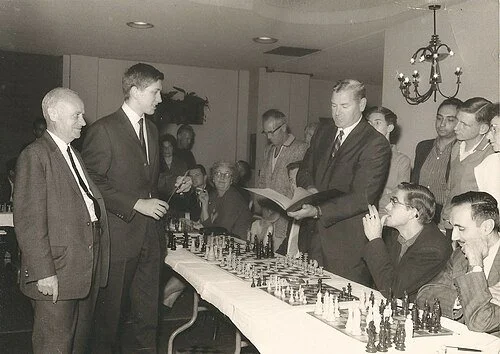
Harry Borochow and Bobby Fischer at the Ambassador Hotel, Wednesday, February 1, 1961, Los Angeles. Fischer played simultaneously with 50 opponents, won 40 games, lost three and drew seven. Borochow was the referee.[1]
Introduction
Robert James “Bobby” Fischer stands at the center of modern chess history because his career combined extraordinary competitive achievement, unusually strong documentary visibility, and a legacy that remains morally complicated. Born in Chicago on March 9, 1943, raised in Brooklyn, Fischer became the eleventh world champion in 1972 by defeating Boris Spassky, ending a 24 year run of Soviet control of the classical title. The historical importance of that victory is hard to overstate, yet any careful profile must also reckon with his long withdrawal from competition, his later legal troubles, and the antisemitic and conspiratorial public statements that darkened his final decades.
For serious readers of chess history, Fischer repays close study for a second reason. He was not simply a prodigy who peaked in Reykjavík. He was a self-directed student of the game, a major author, an opening theoretician, a practical reformer of time controls, and the figure through whom an individual American player, working largely outside a state system, forced the Soviet chess establishment to treat one rival as a strategic problem. That interpretation is supported by both official retrospectives and the surviving Soviet chess press, which followed his games from his early teens onward.
Early Life and Chess Formation
Fischer was born to Regina Wender Fischer, an unusually educated and mobile single mother whose daughter Joan, Bobby’s older sister, gave him the inexpensive chess set that started everything. Public records named Hans Gerhardt Fischer as his father, although later archival reporting drew attention to evidence suggesting that physicist Paul Nemenyi may have been his biological father. Because that evidence is indirect and biographers have not spoken with one voice, it is best treated as a documented biographical dispute rather than an absolutely settled fact.
The decisive fact in Fischer’s formation was not formal schooling but entry into New York chess culture. World Chess Hall of Fame materials identify Carmine Nigro as an early teacher and show Fischer at the Manhattan Chess Club by 1955, already impressive enough that club officials made an exception for so young a player. Soon afterward Jack Collins became the crucial adult presence in Fischer’s chess life. Collins’ home, the Hawthorne Chess Club, gave Fischer constant access to books, analysis, strong junior opposition, and a semi-private training environment that included talents such as William Lombardy and Raymond Weinstein. Collins was not a “coach” in the later Soviet institutional sense, but he was an indispensable mentor.
That informal education quickly outpaced ordinary adolescence. Hall of Fame material places Fischer in Collins’ home almost continuously from the summer of 1956 to the summer of 1958, the exact span in which he rose from strong master strength to world-class promise. He attended Erasmus Hall High School, but his intellectual life was already reorganized around chess, clubs, periodicals, and analysis rather than classrooms. Even in adulthood, contemporaries remembered him as someone whose real schooling had taken place over boards, at club tables, and in study of collections and journals.
Another formative feature was Fischer’s relationship to Soviet chess literature. Douglas Griffin’s work with the Soviet press shows not only that Fischer was avidly read in Russian chess periodicals, but also that Soviet annotators assumed he was following their analyses. That reciprocal attention is historically important. From an early age, Fischer studied the strongest available chess culture in the world while simultaneously becoming one of its most scrutinized foreign subjects.
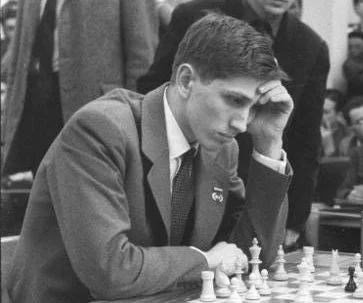
By Bundesarchiv, Bild
Rise in Competitive Chess
By the second half of the 1950s, Fischer had become a phenomenon. US Chess notes that he was U.S. Junior Champion at 13, U.S. Open Champion at 14, and the youngest grandmaster in history at 15, a record that stood until Judit Polgár broke it in 1991. World Chess Hall of Fame materials add the key intermediate landmark: his 1957-58 U.S. Championship victory made him the youngest U.S. champion, and his famous 1956 win over Donald Byrne, later labeled the “Game of the Century,” announced him to the wider chess world as more than a domestic prodigy.
Fischer’s first great international phase came with precocity and instability together. FIDE’s museum biography stresses that he was the youngest-ever participant in the 1959 Candidates and that, at 16, he was not yet ready to overcome the strongest Soviet grandmasters. After winning the Stockholm Interzonal in 1962, he entered Curaçao as a major contender but finished fourth. The broad shape of his ascent is therefore clearer than any single result: teenage brilliance, early immersion in elite competition, then a period in which immaturity, disputes, and incomplete competitive continuity slowed the expected coronation.
Those interruptions are central to understanding Fischer. He was powerful enough to challenge the summit of world chess long before he became champion, yet he was also temperamentally resistant to structures he judged unfair or mediocre. FIDE’s official retrospective notes that he voluntarily missed two championship cycles before returning in far stronger form. This is one of the keys to his historical profile. The raw talent was evident early, but the adult Fischer did not build his career in a regular institutional rhythm. He advanced in violent surges, on his own terms where possible, and often at the cost of continuity.
Major Career Achievements
Any concise statement of Fischer’s achievements must begin with domestic domination. He won all eight U.S. Championships in which he played, and in 1963-64 he scored a perfect 11/11, still the only perfect score in the history of that event. World Chess Hall of Fame sources record not only the perfect score but his extraordinary cumulative championship record of 74/90, with just three losses across all his U.S. title appearances. These are not decorative statistics. They show that Fischer’s authority in American chess was established years before he became world champion.
Internationally, the decisive crescendo came between 1970 and 1972. FIDE’s history of the Candidates calls 1971 “Fischer’s dominance” and summarizes the sequence that has become canonical: 6-0 over Mark Taimanov, 6-0 over Bent Larsen, 6½-2½ over Tigran Petrosian, then victory over Spassky by 12½-8½ in Reykjavík. The World Chess Hall of Fame adds another striking fact about the same ascent: Fischer compiled 20 consecutive wins in world championship qualifying events, a record that still frames discussion of peak match dominance.
The magnitude of that run was visible even in the early years of the Elo system. FIDE records that when the first official FIDE rating list appeared in 1971, Fischer topped it on 2760 and was the only player above 2700. By the time he reached the 1972 title match, official and museum retrospectives describe him as so far ahead competitively that his challenge to Spassky had become the central event of world chess. That is why Reykjavík became more than a championship. It became the culminating public test of whether a solitary outsider could break a system.
His 1972 victory altered chess culture beyond elite circles. World Chess Hall of Fame figures show that U.S. Chess membership rose from 30,844 in 1972 to 59,250 the following year, the clearest statistical expression of the “Fischer boom.” FIDE’s centennial awards later named the 1972 Spassky-Fischer match the most memorable FIDE tournament event of the century, describing it as the match that ended Soviet dominance and inspired that boom. These retrospective judgments are strong, but they are not exaggerations. They are institutional acknowledgments of a real shift in chess’s public profile.
The final achievement of this phase was paradoxical. Fischer was expected to defend the title against Anatoly Karpov in 1975, but FIDE’s museum biography records that he refused and lost the championship by default. The effect was to freeze his aura in an unusual form. He left the classical title not by defeat over the board, but by withdrawal from the system that crowned him. This preserved the sense of unfinished greatness while also limiting the full historical range of his prime.
Style and Reputation
Contemporaries described Fischer not as a specialist but as a universal player of unusual objectivity and self-discipline. Anatoly Karpov, in a Russian interview later reproduced in translation, called him a “universal” player with unique powers of work and preparation, achieved largely on his own. Garry Kasparov, quoted in FIDE’s museum materials, praised the objectivity of Fischer’s play, seeing in it something anticipatory of computer-age exactness. This convergence between two later world champions is important. They were not merely praising his results. They were identifying a type of chess intelligence.
The reputational picture becomes even sharper in the testimony of direct opponents. Boris Spassky’s well known verdict, preserved by FIDE, was that playing Fischer was “a question of survival.” Mark Taimanov, reflecting on his 1971 loss, said it felt as if he had encountered “a computer that didn’t make mistakes.” These are memorable lines, but they are useful because they pinpoint the features opponents kept returning to: precision under pressure, relentless competitive seriousness, and an ability to make technically difficult play look inevitable.
On the board, Fischer’s strengths were broad. Official Hall of Fame material emphasizes opening preparation and endgame technique, and his best games support that assessment without requiring mythologizing. The Byrne game of 1956 remains central to his public legend because it revealed tactical imagination at thirteen. Game 6 against Spassky in 1972 remains central because it showed something different, a classical positional command so convincing that it became one of the touchstones of his mature reputation. These games are best cited as emblems, not as exhaustive explanations. Fischer’s standing rests on complete competitive craft, not on a handful of brilliancies.
His weaknesses were harder to locate in his chess than in the conditions around it. There is relatively little evidence that peak Fischer had a systematic over-the-board deficiency comparable to the famous weak points of some other champions. The recurring vulnerability lay instead in extremity of temperament, scheduling disputes, distrust of institutions, and an inability to remain stably embedded in competition for long stretches. World Chess Hall of Fame documentation on the broken 1961 Reshevsky match, together with the later 1975 title default, shows how often conflict outside the move sequence shaped the arc of his career.
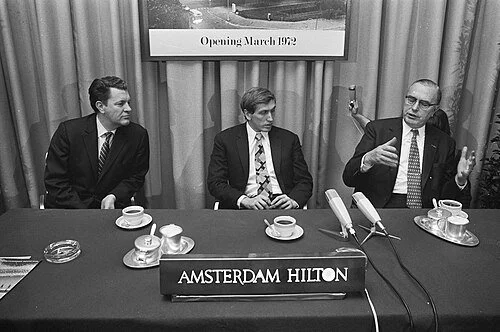
By Bert Verhoeff for Anefo
Contributions Beyond Tournament Play
Fischer’s importance extends well beyond his tournament record. FIDE’s centennial awards named My 60 Memorable Games the best chess book of the century, praising its universality, representative game selection, and enduring literary status. That judgment aligns with a longstanding consensus among players and historians. The book is valuable not because Fischer was infallible, but because he combined annotation, self-criticism, strategic explanation, and competitive honesty at a very high level. In the literature of chess instruction, it remains one of the rare books that serious players revisit across generations.
He also worked as a popularizer. Edward Winter’s research documents Fischer’s chess column in Boys’ Life during the second half of the 1960s, a reminder that at the height of his rise he was also writing for a wider readership. That contribution is easier to overlook because it belongs to periodical culture rather than grand tournament history, yet it reveals a player who, for a time, participated in the educational side of American chess rather than standing wholly apart from it.
Two later contributions were structural. In 1988 Fischer filed the patent for a digital chess clock that incremented time after each move. The patent text makes clear that his design aimed to reduce the distortions of time scrambles and to make better chess possible under modern time controls. Today “Fischer increment” is routine in tournament practice, which means one of his most durable legacies is built into the administrative rhythm of the game.
His advocacy of Chess960 belongs to the same reforming impulse. FIDE’s history of Chess960 credits Fischer as a major popularizer of the form, records his rule discussions with Susan Polgar and Pal Benko in Budapest after 1992, and notes that he formally introduced “Fischer Random Chess” to the public in Buenos Aires on June 19, 1996. Whether or not one regards Chess960 as equal to orthodox chess, it represents a serious attempt by Fischer to address a real concern of late twentieth-century elite play, namely the overexpansion of memorized opening preparation.
Historical Legacy
Within Soviet and international chess culture, Fischer occupied a singular place. Douglas Griffin’s survey of Soviet chess journalism shows that his games were followed in Russian-language publications from the 1956 Byrne game onward, and FIDE’s museum biography characterizes him as the man who “single-handedly” disrupted Soviet dominance. That phrasing is inevitably compressed, because no one player acts outside institutions entirely. Even so, it is a reasonable historical interpretation to call Fischer the most consequential foreign rival the Soviet chess establishment faced in the postwar classical title era, because he was the outsider who did not merely threaten the system but broke its hold on the world championship.
His later life is inseparable from his legacy. After nearly two decades away from official competition, he returned in 1992 for an unofficial rematch with Spassky in Yugoslavia, publicly defying a U.S. Treasury order. UPI reported his theatrical rejection of that order at the opening press conference, and the Los Angeles Times later reported his federal indictment over the sanctions violation. After years as an émigré, Reuters summarized the next stage: detention in Japan in 2004 over a revoked U.S. passport, then Icelandic citizenship in 2005. He died in Reykjavík on January 17, 2008.
No sober assessment can ignore the public ugliness of Fischer’s final decades. Reuters and other obituaries record the antisemitic statements that increasingly defined his public presence after his chess career had effectively ended. Those views do not erase the chess achievements, but they do alter the tone of remembrance. Fischer’s legacy is therefore double. He remains one of the most important players who ever lived, yet he also stands as a warning that genius at the board neither guarantees moral seriousness nor protects a life from disintegration.
Fischer deserves close attention today because he changed chess in several distinct ways at once. He raised the standard of individual preparation, demonstrated what one player outside the Soviet system could accomplish, produced enduring chess literature, influenced time controls and variant play, and generated a public wave of interest that reshaped American chess culture for a generation. He also left behind an unfinished career and a damaged public self that force historians to distinguish admiration for play from admiration for person. That combination, greatness without simplification, is why he remains unavoidable.

Gregor and Jacqueline Piatigorsky watching Bent Larsen (left) and Bobby Fischer playing chess. Players are here for the Piatigorsky Cup competition.
Notes and Sources
This profile prioritized official and primary-adjacent sources where possible, especially FIDE retrospectives and museum materials, World Chess Hall of Fame documentation, US Chess historical pieces, Reuters reporting, and the U.S. patent record for Fischer’s clock. For Soviet and post-Soviet reception, I relied on Douglas Griffin’s archival work on the Soviet chess press and translated Russian interviews at Chess in Translation, which are especially useful for how Spassky, Karpov, Taimanov, and others remembered Fischer from within the chess culture he challenged.
On disputed family background, the public record names Hans Gerhardt Fischer, while later archival reporting, drawing on FBI-related material and biographical investigation, pointed toward Paul Nemenyi as the likely biological father. Because that conclusion remains an inference from documentary evidence rather than a publicly adjudicated family statement by Fischer himself, I treated it cautiously. On historical interpretation more broadly, the key distinction is between documented facts, such as results, titles, publications, patents, and official sanctions, and reasoned judgments, such as the claim that Fischer was the Soviet system’s most consequential foreign rival. The latter is an interpretation, though a strongly supportable one given the title break in 1972 and the sustained Soviet attention his career received.
