Ilya Smirin
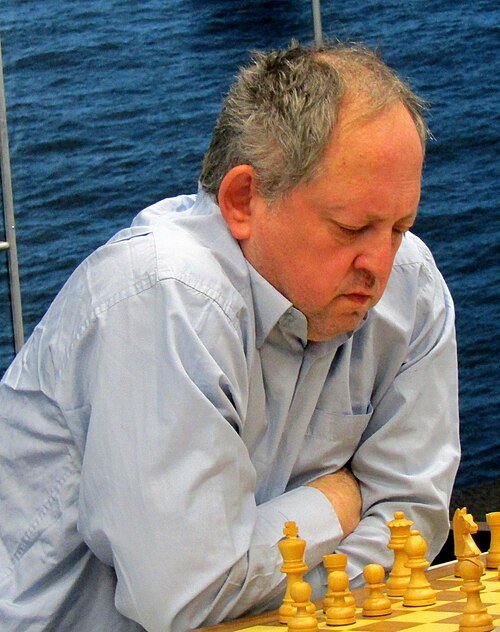
Stefan64, CC BY-SA 4.0 <https://creativecommons.org/licenses/by-sa/4.0>, via Wikimedia Commons
Introduction
Ilya Smirin belongs to the last generation whose formation and early successes took place within the Soviet chess system. He emerged from Vitebsk, survived the demanding qualification structure of the USSR Championship, became a grandmaster in 1990, and then built most of his international career as an Israeli player. At his peak, he reached 2702 and No. 13 on the July 2001 FIDE list. His significance also rests on longevity, a distinctive approach to dynamic chess, a major role in Israeli team competition, and two unusually personal instructional books.
English sources alternate between Ilya Smirin and Ilia Smirin. FIDE currently uses “Ilia”; the Russian form is Илья Юльевич Смирин. This article uses the familiar English spelling Ilya. The best-supported birth date is 12 January 1968 in Vitebsk, then in the Byelorussian Soviet Socialist Republic. The Russian Chess Federation and a Russian-language interview conducted for his fiftieth birthday both give 12 January. Older FIDE-derived data reproduced by OlimpBase give 21 January, so a minor archival discrepancy remains.
Early Life and Chess Formation
Smirin grew up in an educated, secular Jewish family. His father, Yuliy Isaakovich, taught physics, electrical engineering, and electronics at a Vitebsk technical college. His mother, Maya Izrailevna, worked as an engineer at the city’s carpet factory. His father taught him the rules and brought him to the local chess and draughts club when he was seven. In another recollection, Smirin placed the beginning of organized study at about eight, after losing to a family acquaintance’s son. The accounts are compatible: chess entered the home first, followed shortly by club instruction.
His later move to Israel had a precedent in his family. Smirin recalled that six of his paternal grandfather Isaac’s brothers had emigrated to Palestine during the 1920s. Those branches used the Hebrew surname “Zmirin”. Smirin retained the spelling by which he was already known. The family history gave his destination a personal dimension beyond professional chess.
Vitebsk offered a small, productive chess environment. Smirin’s first trainers were Lev Meltzer and Lev Pak. Pak’s achievement was striking: he helped develop four grandmasters from the city, Smirin, Andrey Kovalev, Evgeny Agrest, and Rakhil Eidelson. Smirin later emphasized Pak’s practical support, including taking pupils to events where the local training pool could no longer supply adequate opposition. His own school team, Vitebsk School No. 10, won the all-Union Belaya Ladya school championship in Panevezys in 1980. The team included Agrest. Abram Gelfand’s retrospective account, written by Boris Gelfand's father, records the result and the first meeting that year between Smirin and Boris Gelfand.
Books had an equally important formative role. Smirin has repeatedly identified Mikhail Tal and Iakov Damsky’s Attack with Mikhail Tal and Eduard Gufeld and Efim Lazarev’s book on Leonid Stein as decisive early reading. He returned to them many times and associated them with his attraction to initiative, sacrifice, and risk. He also attended sessions of the Tigran Petrosian chess school. Tal and Stein supplied an imaginative ideal. Petrosian’s school and the Belarusian coaching structure added disciplined analysis.
In 1985 Smirin entered the Belarusian State Institute of Physical Culture in Minsk, where chess and draughts formed a specialist course. He and Gelfand studied in the same intake. Smirin had attended a specialized mathematics class in Vitebsk and recalled being strong in mathematics, physics, and the humanities. He also described the institute’s academic program with unusual candor, saying that the credential was largely formal and that the arrangement gave him time to pursue professional chess. He graduated with a qualification as a chess teacher-trainer. During his Minsk years, he worked with the theoretician Albert Kapengut and with Ilya Botvinnik. He and Gelfand also served in the same sports company during their compulsory military service, which allowed both men to continue competing.
The relationship with Gelfand became one of the enduring personal links of Smirin’s career. They were junior rivals, fellow students, army teammates, and later members of the Israeli national team. Andrey Kovalev had a practical role as Smirin’s friend, trainer, and second during part of his early career. These relationships place Smirin within a recognizable Belarusian network. His chess identity remained highly individual.
Rise in Competitive Chess
Smirin won silver at the 1986 USSR junior championship in Daugavpils. His decisive breakthrough as a senior came in 1987. He won the adult championship of the Byelorussian SSR, then shared first place in the all-Union qualifying event at Norilsk with Gelfand, Alexey Vyzmanavin, and Konstantin Lerner. The result advanced him to the First League of the USSR Championship at Sverdlovsk, which he won outright. In the Soviet system, this was more than another tournament success. The First League was the final filter for admission to the national championship, and winning it placed a nineteen-year-old master directly among the country’s strongest grandmasters.
At the 1988 USSR Championship in Moscow, Smirin was the only participant without an international title. The field included Garry Kasparov, Anatoly Karpov, Vasily Smyslov, and Mikhail Tal. Tal withdrew after the first round because of illness. Smirin defeated Smyslov and exceeded the international master norm by a full point. He finished outside the title race and confirmed that his qualifying success could survive contact with the Soviet elite. He won the First League again in the next championship cycle and returned for the 1989 final, then played the 1990 final as well. FIDE awarded him the International Master title in 1989 and the Grandmaster title in 1990, as confirmed by his official FIDE profile.
The Rilton Cup of 1988-89 supplied an important international step. Smirin won the event and, according to Abram Gelfand’s account, earned his second international master norm and first grandmaster norm there. This sequence illustrates the compressed pace of his rise: Belarusian champion, First League winner, USSR finalist, international master, and grandmaster within roughly three years.
Smirin moved to Israel in the summer of 1991. His own detailed account gives that date and says his parents followed at the end of the year. Some later institutional biographies use 1992, which was the year he first represented Israel in the Chess Olympiad and won the Israeli championship. The distinction is best understood as the difference between physical arrival in 1991 and the start of his formal international career for Israel in 1992. During a later period in Baltimore, he studied computer science and played on the chess team at the University of Maryland, Baltimore County, according to an archived university chess page and Abram Gelfand’s account.
Major Career Achievements
Smirin entered the international top tier quickly after emigration. In 1993 he finished second in a European zonal and reached both the FIDE and Professional Chess Association qualification events. He did not advance to the Candidates stage. His later appearances in four FIDE knockout world championships between 1999 and 2004, followed by World Cups in 2005, 2009, and 2015, show sustained access to the championship cycle without a breakthrough into its final phases.
His rapid-chess reputation developed alongside his classical career. In a 2013 interview, Smirin recalled qualifying through four events in the 1994 Intel circuit, defeating Vassily Ivanchuk in match play, and drawing two rapid matches with Viswanathan Anand. These results were significant because they showed that his intuitive, initiative-driven play transferred well to shorter time controls during the first era of heavily sponsored professional rapid chess.
The strongest classical period of his career ran from the late 1990s through the early 2000s. He won the New York Open in 2000, shared first with Alexei Dreev at Dos Hermanas in 2001, and won the grandmaster tournament at Biel in 2002. The July 2001 FIDE list placed him at 2702 and world No. 13, according to the historical rating record. His rating was more than a symbolic threshold. At that moment, it represented stable membership in the narrow group invited to elite round robins and major team events.
One event captures his standing particularly well. In the 2002 rapid match between Russia and the Rest of the World in Moscow, Smirin scored 4 points from 9 games and defeated former world champion Karpov and reigning classical world champion Vladimir Kramnik. The Rest of the World won 52-48. These games deserve mention because they condensed Smirin’s reputation into a prominent public setting: he was capable of creating difficult, unbalanced problems for the most accomplished positional players of his era. The Russian Chess Federation’s profile records his individual score and both victories; a contemporary and retrospective ChessBase account confirms the match context.
Smirin continued to produce notable open-tournament results after his rating peak. He won the Acropolis International in 2007, took the World Open on tiebreak in 2014 after several earlier shared first places, and shared first there again in 2015. These selected events show a player who remained dangerous in large, demanding Swiss tournaments long after his peak ranking.
His Israeli record was still more consequential. He represented Israel in ten Chess Olympiads from 1992 through 2014 and was part of the team that won bronze at Khanty-Mansiysk in 2010. Israel also won silver at the European Team Championships of 2003 and 2005 with Smirin in the lineup. OlimpBase records twelve European Team Championship appearances through 2023, with a score of 50.5 from 86 games, and individual World Team Championship medals in 2005 and 2015. His long association with the Ashdod club extended the same role into club chess. Israeli federation records still list Ashdod as his club.
The national championship record requires a source caution. The Israeli federation’s historical register through 2022 credits Smirin with titles in 1992 and 2002. He then finished first in the championship designated 2023, completed at Acre in January 2024, scoring an undefeated 7 from 9. The official event record places him first on tiebreak. Contemporary local reports called this his fourth title. The federation register makes it his third listed title. The discrepancy has not been satisfactorily explained in the available records, so the individual years are safer than an unqualified total.
Style and Reputation
Smirin’s style is often described as attacking, and his own testimony gives that label substance. He wanted positions with initiative, asymmetry, and scope for independent judgment. The King’s Indian Defense became his most recognizable weapon with Black. The Sicilian Defense supplied a related field of dynamic structures. His choice was aesthetic and practical. In a 2019 Russian-language interview, he connected his taste directly to the books on Tal, Stein, and Rashid Nezhmetdinov that he read as a boy.
The tactical surface can obscure the positional basis of his play. Smirin’s best attacks usually grew from a willingness to accept structural weaknesses, material imbalance, or restricted space in exchange for active pieces and long-term pressure. He was especially effective at sustaining counterplay in positions that a more safety-oriented player might simplify. Tournament director Jeroen van den Berg summarized the contemporary public view when he described Smirin as a strong grandmaster, appreciated by fans for his bold attacking style, in an Israeli Chess Federation report.
His own comments also identify a limitation. Smirin repeatedly said that rote memorization was never his preferred route to strength. He chose openings rich in ideas and acknowledged that the growing volume of computer-assisted preparation made elite chess more mechanical and more memory-dependent. Abram Gelfand reported Smirin’s retrospective belief that insufficient sustained work had limited his highest achievements. Both points should be treated as self-assessment. The competitive record supports a cautious interpretation. Smirin could defeat world champions and win elite events. His results varied more sharply than those of the small group who remained permanent Candidates contenders.
His strengths were clearest in practical decision-making, tactical alertness, and the conversion of dynamic compensation into concrete threats. Rapid chess amplified those qualities. His weaker periods often coincided with the preparation and consistency demands of the highest level. This combination explains both his reputation and his historical position. He reached the world’s top fifteen, then spent far longer as a formidable tournament and team professional than as a regular member of the championship elite.
Contributions Beyond Tournament Play
Smirin’s most durable instructional contribution is literary. King’s Indian Warfare, published by Quality Chess in 2016, grew from a suggestion by Boris Avrukh and publisher Jacob Aagaard. Smirin spent about two years writing it in English and organized the book around 49 deeply annotated games. Computer analysis checked the tactics. His explanations emphasized plans, judgment, and aesthetics. A Russian translation by Andrey Elkov appeared in 2017. Grandmaster Matthew Sadler named it his favorite chess book of 2016 in New in Chess. The publisher’s description and Smirin’s 2018 account of the writing process support the publication history.
Sicilian Warfare, published in late 2020, continued the same method. Smirin used his own games with both colors to explain how characteristic Sicilian imbalances develop after the opening phase. The two books form an intellectual self-portrait. They preserve a way of thinking about dynamic positions that had been cultivated through Soviet-era books, coaching, and over-the-board practice, then tested during the computer era. Their focus begins where memorized theory gives way to evaluation and choice. The publisher’s record gives the publication date and scope.
Smirin holds a formal teacher-trainer qualification and has taught in advanced camps and online. Publicly available evidence does not establish a long-term role as an elite player’s principal coach or world-championship second. His documented pedagogical influence is therefore clearest through books, lectures, and short-form instruction.
He also developed a substantial career as a commentator. His major debut came during the 2012 Anand-Gelfand world championship match in Moscow, following an invitation from organizer Andrey Filatov. He later worked on Russian Chess Federation and FIDE broadcasts and described commentary as a creative process.
A lesser-known institutional episode occurred in 2017, when Smirin joined former Israeli federation spokesman Lior Aizenberg in asking FIDE to act after Israeli players were denied entry to the World Rapid and Blitz Championships in Riyadh. Their appeal invoked FIDE’s non-discrimination rules and sought safeguards for future events, as reported by the Jewish News Syndicate. This was advocacy by a player whose own career had depended heavily on open international access after leaving the Soviet Union.
Later Career and Historical Legacy
Smirin’s longevity is exceptional even within the durable generation born in the late 1960s. Winning the 2023 Israeli championship event at age fifty-six was a substantive competitive achievement. In the July 2026 FIDE list, he still held a standard rating of 2568, as recorded by his FIDE profile. The Israeli federation continued to list him with the Ashdod club and among the country’s leading active players. He also remained involved in European team competition into his mid-fifties.
Historically, Smirin is best understood through three connected settings. Vitebsk and Minsk gave him the coaching culture, competitive filters, and chess literature of the late Soviet period. Israel gave him a national team and club structure in which a Soviet-trained immigrant could become a central representative player. The international circuit supplied the arena in which his dynamic style reached world No. 13, produced victories over leading champions, and remained viable across several decades.
His career also illuminates the difference between championship fame and historical significance. Smirin never reached a Candidates match and never became a permanent member of the small super-elite. His record includes victory in the Soviet First League, three USSR Championship finals, a rating above 2700, ten Olympiads for Israel, a central part in the country’s most successful team era, and two respected books that explain his chess in his own voice. Few players combine all of those forms of evidence.
Historical Assessment
Ilya Smirin deserves attention today as a major representative of the final Soviet-trained generation and as one of the players who helped establish Israel as a serious force in international team chess. His career links local coaching in Vitebsk, the severe selection system of the late USSR, post-Soviet migration, and the global professional circuit. His finest results show elite strength; his books explain the convictions behind that strength; his long team service gives the career institutional weight. A careful assessment also includes the unevenness that kept him outside the final world-title stages and the 2022 broadcast episode that curtailed his commentary work. Taken together, the record presents a distinctive grandmaster whose historical importance extends well beyond a list of tournament victories.
Notes and Sources
Birth date and name forms. The Russian Chess Federation profile and the 2018 Belisrael interview give 12 January 1968. The OlimpBase reproduction of older FIDE lists gives 21 January. Current FIDE usage is “Ilia Smirin”; Russian sources use Илья Юльевич Смирин.
Family, education, emigration, and authorship. The two-part Russian-language interview at Belisrael, part one and part two, is the principal first-person source. It covers his parents, extended family, institute years, trainers, move to Israel, club career, writing process, and views on preparation.
Early development and Soviet career. The Russian Chess Federation’s biographical profile provides a concise institutional account. Abram Gelfand’s “Friends and Rivals” memoir supplies eyewitness detail on Belaya Ladya, the Gelfand relationship, the 1987 qualifying cycle, the 1988 USSR Championship, and Smirin’s Minsk coaches.
First-person account of Soviet chess formation. Smirin’s 2019 interview with Realnoe Vremya is especially useful for his recollections of Vitebsk, Lev Pak, Albert Kapengut, formative books, army service, clubs, and the effects of computers on preparation.
Titles and ratings. The FIDE player profile confirms his federation, identification number, and IM and GM title years. OlimpBase’s historical FIDE record confirms 2702 and No. 13 in July 2001.
Team competitions. OlimpBase provides event-by-event records for the Chess Olympiad, European Team Championship, and World Team Championship. The Israeli federation’s player record confirms his continuing Ashdod affiliation.
Israeli championships. The federation’s historical champions register lists 1992 and 2002. The federation’s official 2023 event page records his first-place finish in January 2024. Contemporary reports describing it as a fourth title conflict with the federation register.
Books. Quality Chess and New in Chess provide publication records for King’s Indian Warfare and Sicilian Warfare. Smirin’s 2018 interview supplies the first-person account of composition and translation.
Commentary. The Russian Chess Federation profile and Smirin’s 2013 Jewish.ru interview cover his 2012 debut.
Method. Tournament and title claims were checked against federation or rating records wherever possible. Interviews are used for recollection, motivation, and self-assessment. Interpretations of style and career limitations are identified as such and are grounded in Smirin’s own comments and the documented competitive record.
