Abram Khasin
Introduction
Abram Iosifovich Khasin, Russian Абрам Иосифович Хасин, was born in Zaporizhzhia on 15 February 1923 and died in Essen, Germany, on 6 February 2022. He was a Soviet international master, an ICCF correspondence grandmaster, and an Honored Coach of the USSR. He qualified for five Soviet championship finals, represented the USSR with exceptional success in correspondence Olympiads, and trained several generations of prominent players.1
Khasin’s historical stature rests on the combination of these achievements. His tournament record places him among the strong Soviet masters immediately below the world-title contenders. His work as a teacher and correspondence player extended his influence far beyond his own results. The circumstances under which he built that career, following severe wartime injury and amid continuing health and financial constraints, give his biography unusual force, though they should never be allowed to eclipse the quality of his chess.
Early Life and Chess Formation
Khasin was born into a Jewish family in Soviet Ukraine. His parents moved to Kyiv soon after his birth. In a late-life interview, Alexander Krotov recalled fragmentary childhood memories of a family stay in Palestine during the 1920s, apparently connected to work on kibbutzim. The subject was subsequently avoided within the family, and Khasin said that he never learned the full circumstances of either the journey or the return.2
The family’s position became precarious in 1932. Yad Vashem records that Khasin’s father was arrested by the NKVD. Khasin later remembered witnessing a public trial that ended with his father’s death sentence. Krotov’s article describes the father, a minor storehouse employee, as having been accused in connection with the famine in Ukraine. Since the published biographical sources do not reproduce the judicial file, the exact charge and circumstances remain unverified. What is documented through Khasin’s testimony is the effect on the family: eviction from their apartment, dependence on relatives, and a lasting fear of attracting official attention.23
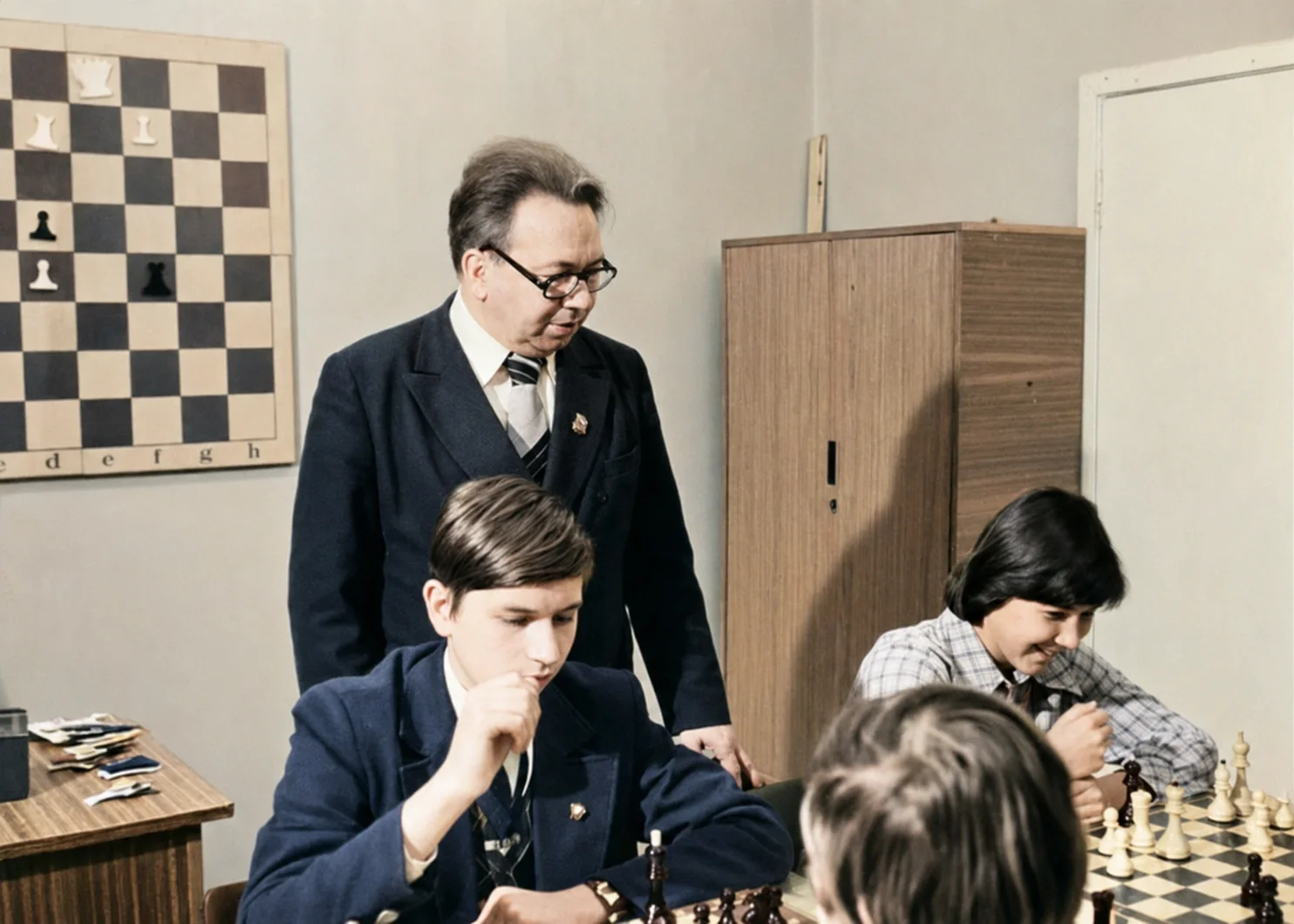
Khasin learned chess by watching his elder brother. He played in a neighborhood club, abandoned the game after several discouraging defeats, and entered the chess section of the Kyiv Palace of Pioneers only in autumn 1939, when he was sixteen. His late start makes the speed of his progress striking. Under the influence of the respected trainer Alexander Konstantinopolsky, he advanced through the Soviet categories and became a candidate master. David Bronstein, already one of the outstanding young players in Kyiv, became a lifelong friend. Before the war, Khasin also worked as a lathe operator and attended a workers’ preparatory faculty in the evenings. In 1941 he qualified for the Kyiv city championship final, which was abandoned after the German invasion.12
The family was evacuated to the Perm region. Khasin’s poor eyesight initially kept him out of military service, but he volunteered and insisted on front-line duty. Institutional records from the Moscow Palace of Pioneers identify him as a private serving with a 120-millimeter mortar crew in the 928th Mortar Regiment, 252nd Rifle Division, on the Stalingrad and Don fronts. In December 1942, he was critically wounded during an air attack. He spent approximately eighteen months in hospitals and underwent several operations, including the amputation and later re-amputation of both legs below the knee.4
Khasin was discharged in 1944. He entered the English department of the Moscow Institute of Foreign Languages and graduated in 1948. Obtaining suitable employment was difficult during the increasingly antisemitic atmosphere of the late Stalin period, but he eventually became an English teacher. Former pupil Oleg Basilashvili remembered a disciplined, emotionally controlled teacher who gradually secured the respect of an unruly class. This experience in formal education preceded Khasin’s long career as a chess instructor.12
Rise in Competitive Chess
Khasin resumed serious tournament play after the war and established himself within the exceptionally competitive Moscow chess community. His major breakthrough came in the 1955 Soviet championship semifinal, which he won ahead of a field containing Yuri Averbakh, Vladimir Simagin, Lev Polugaevsky, Viacheslav Ragozin, and other established masters. That result earned him a spot in the 1956 Soviet final.
He eventually played in five USSR championship finals: Leningrad 1956, Moscow 1957, both the winter and autumn championships of 1961, and Tallinn 1965. His best final placings were thirteenth in the autumn 1961 championship at Baku and again in 1965. These finishes did not put him among the championship leaders, but qualification itself required repeated success against master and grandmaster opposition. His Moscow record was often stronger. He shared third-place groupings in 1955, 1957, and 1961, finished third in 1958, and took second place in 1963.56
Khasin later offered a candid explanation for the difference between his qualifying performances and his results in the finals. Month-long tournaments placed severe demands on his health, and the fourth and fifth hours of play were especially difficult. He often declined during the concluding rounds. He also had to maintain regular employment and support his mother, which limited his access to leave, current chess literature, and sustained preparation. Crowded halls and filming disturbed his concentration. These explanations are Khasin’s own retrospective assessment, recorded by Krotov, and should be understood as testimony rather than a statistical demonstration.2
Team competitions could bring out his best play. At the 1958 Soviet Team Championship in Vilnius, representing Moscow, he scored 5½ points from six games and produced the best result on the sixth board. This supports his own observation that responsibility to a team sharpened his concentration.7
Major Career Achievements
Khasin’s first foreign international tournament came at Hastings in 1963-64, when he was already forty. He later recalled learning unofficially that Soviet officials had previously considered the travel and transport costs associated with his disability an obstacle. No archival decision confirming that explanation has been published. Konstantinopolsky and Bronstein supported his eventual selection, and Khasin’s command of English helped make him a practical choice as head of the Soviet delegation.8
At Hastings he began with four consecutive victories and led alone after five rounds with 4½ points. He finished with 6/9, sharing third place with László Lengyel behind Mikhail Tal and Svetozar Gligorić. The result demonstrated that a player largely known for domestic Soviet competitions could compete successfully in a strong Western event.9 FIDE awarded Khasin the title of International Master in 1964.
By the late 1960s, medical advice led him to reduce his over-the-board schedule. Correspondence chess provided a competitive form better suited to lengthy analysis conducted at home. Khasin became an ICCF grandmaster in 1972 and finished fourth in the eighth individual World Correspondence Championship, played from 1975 to 1980.5
His team record in correspondence chess was particularly distinguished. The USSR won the sixth, seventh, and eighth Correspondence Olympiads. Khasin finished first on his board in all three, scoring 6½/8, 6/9, and 11/12 respectively. The last of these was an extraordinary 91.7 percent score. He later represented the USSR in the ninth Olympiad and in European team competition.10 The ICCF records establish that he was a three-time Olympiad team winner, correcting some later biographical accounts that describe him as a two-time winner.
Style and Reputation
Alexander Kalinin, Khasin’s pupil and later biographer, characterizes him as an active positional player. His games typically show a preference for sustained pressure, sound development, and positions containing practical opportunities for initiative. He could calculate precisely when the position required it, yet his attacking play usually grew out of strategic preparation. His victories over such players as Tigran Petrosian, Paul Keres, David Bronstein, Mark Taimanov, and Lev Polugaevsky explain the respect he commanded even though he never entered the Soviet championship elite.11
Khasin’s resourcefulness was central to his reputation. He remained dangerous in inferior positions and was comfortable conducting a prolonged struggle. His correspondence results demonstrate analytical depth and disciplined handling of complex positions. His team performances suggest that a defined collective responsibility helped him overcome some of the concentration problems he experienced in crowded individual events.
Endurance across long round robins was a recurrent limitation. Khasin himself also identified restricted preparation time and uneven confidence in major public events. These factors help explain a career in which impressive individual games and semifinal results did not lead to a place among the regular Soviet title contenders.
His name survives in opening literature through the Khasin Variation of the Rubinstein Nimzo-Indian. The association is evidence of serious theoretical work, though opening theory formed only one part of his chess identity. Svetozar Gligorić devoted a chapter to “Khasin’s Variation” in his 1985 book Play the Nimzo-Indian Defence.
Contributions Beyond Tournament Play
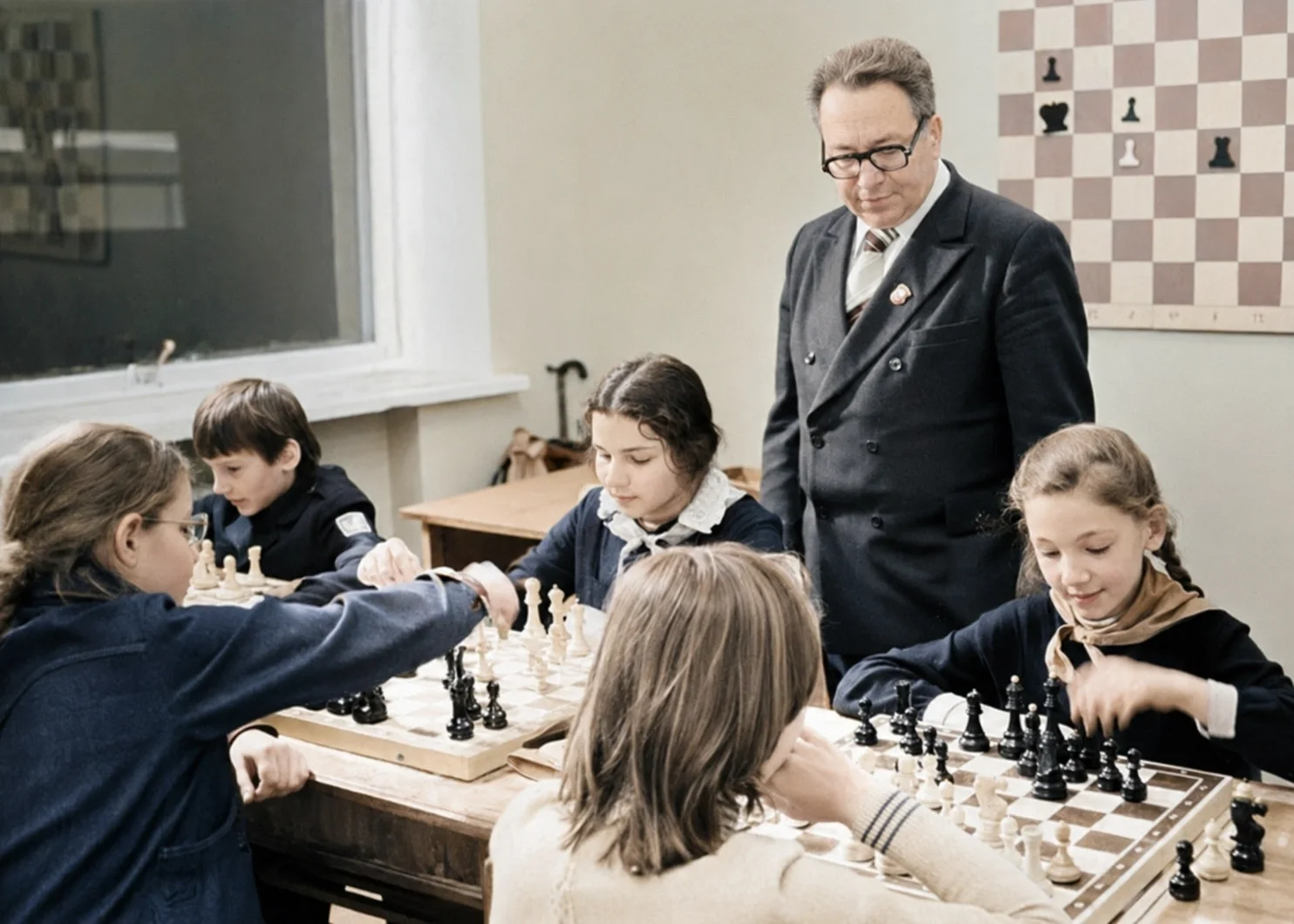
Teaching became Khasin’s principal contribution to Soviet chess. He worked at the USSR Central Chess Club from 1958 to 1974, later taught at the national sports boarding school, and served as senior chess trainer at the Moscow Palace of Pioneers from 1978 to 1985. He was named an Honored Coach of the USSR in 1968. He also coached Moscow teams and the Soviet student team during the 1960s.46
Among the players with whom he worked were women’s world champion Olga Rubtsova, Elena Fatalibekova, Yuri Razuev, Boris Gulko, Evgeny Bareev, Yakov Murey, Leonid Yurtaev, Alexander Kalinin, and Vladimir Chuchelov. The exact relationship varied. Some were long-term pupils; others received preparation or consultation at particular stages. Khasin assisted Rubtsova during her world-title career and repeatedly served as Bronstein’s second at Soviet championships.18
Accounts by his pupils emphasize method. Khasin maintained an extensive opening card index and allowed students to consult it freely. His lessons centered on independent analysis, sustained work, and the willingness to continue fighting in difficult positions. At a 2025 memorial event, Kalinin and Viktor Cherny stressed that Khasin did not overload young players with memorized variations. He wanted them to form judgments for themselves.12
This approach helps explain his unusually wide coaching legacy. Gulko and Bareev became leading grandmasters. Razuvaev, Kalinin, and Chuchelov developed substantial reputations as trainers. Khasin’s influence therefore continued through pupils who became teachers themselves. His earlier profession as an English instructor was relevant: discipline, clarity, and sensitivity to differences between students had been part of his working life before he entered full-time chess education.
Later Life and Historical Legacy
Khasin continued to play after the end of his main over-the-board career, including senior events and occasional club chess. In 2002 he moved with his family to Essen. Gulko later recalled receiving telephone calls from his former teacher and learning that Khasin still visited a local chess club and occasionally played in German league fixtures at a very advanced age. This is a pupil’s recollection, but it accords with the continued engagement described in federation memorials.13
He died nine days before his ninety-ninth birthday. Russian and international obituaries understandably emphasized his survival after Stalingrad. Chess historians should maintain a broader perspective. Khasin built a credible international playing career, became one of the strongest correspondence players of his generation, and influenced Soviet chess through decades of teaching.
Genna Sosonko’s biographical essay, first published as “If It’s Necessary” in New in Chess in 2008 and later revised as “Zest for Life,” helped introduce Khasin’s story to English-language readers.14 The most substantial Russian work is Alexander Kalinin’s 2025 book Istinnoe prizvanie: Zasluzhennyi trener SSSR Abram Khasin (A True Calling: Honored Coach of the USSR Abram Khasin). It contains approximately 150 games, many of which are annotated by Khasin, together with recollections from pupils and colleagues.15
Abram Khasin deserves attention today because his career joins three important forms of chess achievement: repeated success in the strongest national chess environment of his era, sustained excellence in international correspondence play, and teaching that shaped future grandmasters and trainers. His life also reveals how health, employment, institutional policy, and personal history could influence a Soviet master’s opportunities. He was neither a forgotten world-title contender nor simply an inspirational survivor. He was a formidable professional whose deepest historical contribution emerged through analysis, education, and the achievements of his pupils.
Notes and Sources
Russian Chess Federation, “Ушел из жизни заслуженный тренер СССР Абрам Иосифович Хасин (1923-2022),” 6 February 2022; and “Абрам Хасин,”Person of the Day.
Alexander Krotov, “Жизнь и судьба Абрама Хасина: солдата, учителя, гроссмейстера,”Партнер, no. 2 (233), 2017. This extended interview is the principal source for Khasin’s own recollections of childhood, employment, health, and competitive psychology.
Yad Vashem, “Abram Khasin (1923-2022),”Jews in the Red Army research project.
Moscow Palace of Pioneers, “Бессмертный полк Московского дворца пионеров,” institutional record of Khasin’s unit, wounds, decorations, and Palace employment.
For championship context, see Bernard Cafferty and Mark Taimanov, The Soviet Championships (London: Everyman Chess, 1998), together with the Russian Chess Federation profile cited above.
“Хасин Абрам Иосифович,”Спортивная страна, for Moscow championship placings and coaching appointments.
OlimpBase, 1958 Soviet Team Championship individual results.
Alexander Krotov, “Беседы с Абрамом Хасиным: Таль, Хасин и Гаприндашвили в Гастингсе,” 8 March 2017. The explanation for Khasin’s delayed foreign travel is explicitly retrospective and unofficial.
Hastings 1963-64 crosstable and games; see also John Saunders’s BritBase event archive.
ICCF, Abram Khasin player record. The relevant primary event records include the sixth Olympiad, seventh Olympiad, and eighth Olympiad.
Alexander Kalinin, Истинное призвание: Заслуженный тренер СССР Абрам Хасин (Moscow: Russian Chess Federation Library, 2025).
Russian Chess Federation, “Во Дворце пионеров почтили память А. И. Хасина,” 21 May 2025.
Boris Gulko, “Шахматы в Москве две трети века назад,” a pupil’s recollection of Khasin at the Central Chess Club and in later life.
Genna Sosonko, “If It’s Necessary: Abram Khasin’s Zest for Life,” New in Chess 2008, no. 3, 68-77; listed in the magazine’s online archive. A revised version appears as “Zest for Life” in Sosonko’s The Essential Sosonko.
Russian Chess Federation, announcement of Kalinin’s 2025 Khasin biography. Alternate forms useful for research include Abram Khassine, Abram Chassin, and the German Abram Iossifowitsch Chassin.
