Nikolay Krogius
Introduction
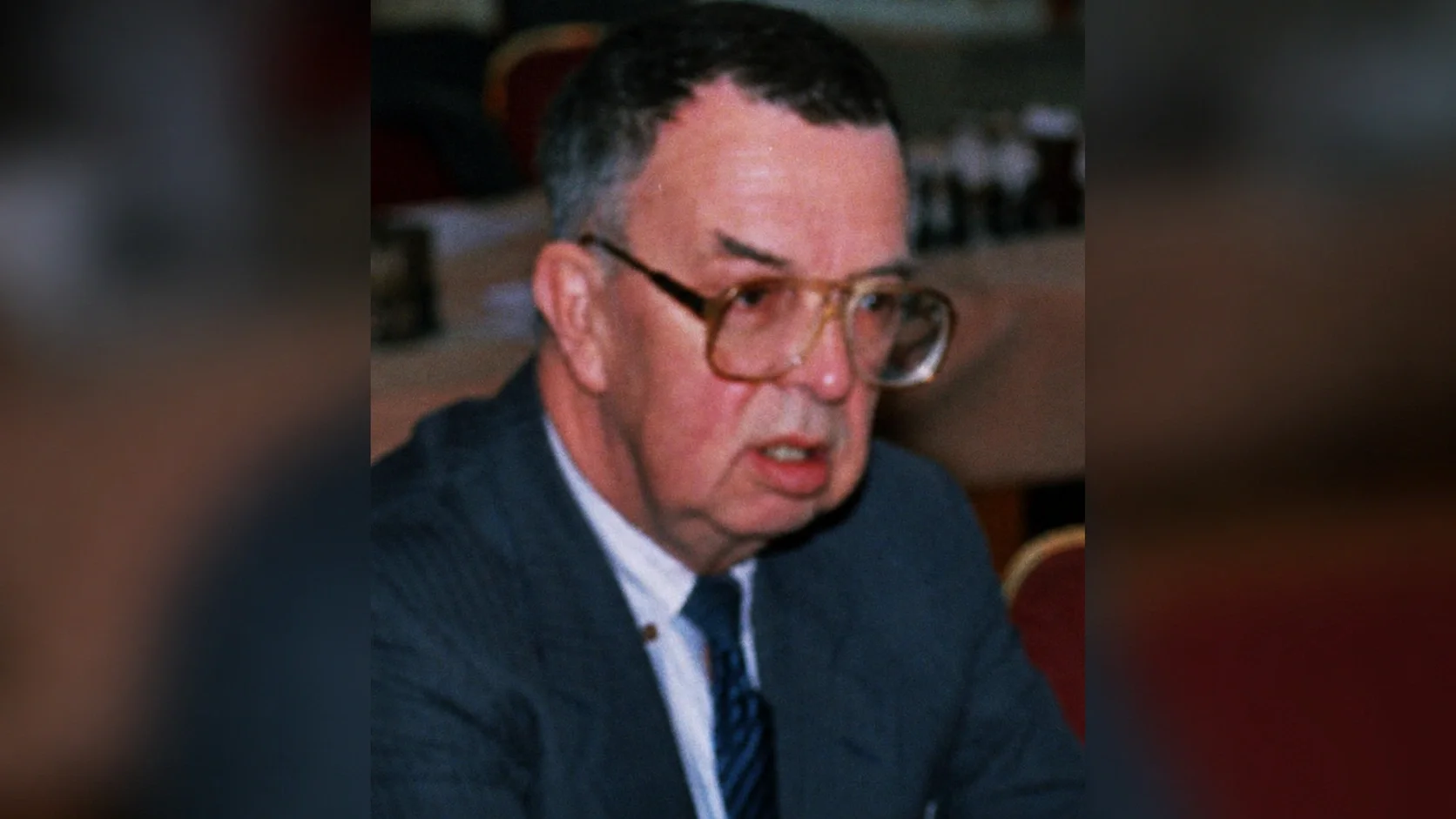
Nikolay Vladimirovich Krogius (Russian: Николай Владимирович Крогиус; 22 July 1930 - 14 July 2022) held an unusually varied position in Soviet chess. English sources alternate between Nikolai and Nikolay; French publications sometimes use Kroguius or Kroguious. He was an international grandmaster, a university psychologist, a trainer of Boris Spassky, a prolific author, and one of the senior officials responsible for Soviet chess during the 1980s.
Krogius never entered the small group of Soviet players who became world championship contenders. His historical significance rests on a broader body of work. He brought formal psychological training to grandmaster practice, helped prepare Spassky for matches against Tigran Petrosian and Bobby Fischer, and later exercised substantial authority within the Soviet sports administration. The first two roles earned enduring respect. The third remains controversial.
Early Life and Chess Formation
Krogius was born in Saratov into a highly educated family. A detailed study published by Saratov University identifies his father as the artist Vladimir Ludvigovich Brennert and his mother as Elena Avgustovna Krogius, a chemist and university teacher. His maternal grandfather, August Adolfovich Krogius, was a doctor of medicine, professor of psychology, and an early Russian specialist in the psychology of blindness. The grandfather died in 1933, when Nikolay was still a small child, so any claim of direct intellectual mentorship would be speculative. The family background nevertheless helps explain why academic life remained a plausible vocation alongside chess. Elena Ryaguzova’s 2022 study is the strongest source for these details.
Krogius later recalled that his first chess set came during the Second World War, when he obtained a pocket set from a passing Red Army soldier in exchange for tobacco. He then received a chess book associated with Efim Bogoljubow. This story comes from Krogius’s recollections and should be treated as memoir evidence rather than independent archival documentation. The Russian Chess Federation’s obituary preserves the account.
His formal development began at the Saratov Palace of Pioneers under Serafim Svechnikov and continued at the House of Teachers under Nikolay Aratovsky, an influential regional trainer. Krogius became a candidate master in 1947 and won the junior championship of the Russian republic in 1948. These results placed him among the strongest members of the Soviet generation that came of age immediately after the war.
Chess did not displace education. Krogius entered the psychology division of the philosophy faculty at Leningrad State University, where he studied under the prominent psychologist Boris Ananyev. His diploma thesis examined the relationship between sensory and logical thought through the then-dominant Pavlovian theory of signaling systems. Krogius later said that Ananyev offered him a postgraduate path if he reduced his tournament commitments. He declined and graduated in 1953. The episode, although known through later recollection, captures the choice that shaped his life: he would pursue chess and psychology together.
Rise in Competitive Chess
Krogius received the Soviet Master of Sport title in 1952, the same year that he shared the RSFSR championship with Lev Aronin. He later won the republican championship again in 1964. These titles were substantial achievements in a system where republican competitions served as difficult gateways to national events.
His first USSR Championship final came at Riga in 1958. Krogius scored 9.5 points from 18 games and shared ninth through eleventh places. David Bronstein, writing about the championship, called the newcomer “a very cultured chess player” whose work had a logical and scientific foundation. The description remained apt throughout Krogius’s career. Europe Échecs reproduces Bronstein’s assessment and the 1958 result.
Krogius eventually appeared in seven USSR Championship finals between 1958 and 1971. He generally finished in the middle of the field. That record defines both his strength and his competitive ceiling. Repeated qualification demonstrated genuine grandmaster quality in the Soviet Union’s exceptionally deep domestic system, but he never became a championship medalist or advanced into world championship qualification.
Major Career Achievements
Krogius made his international debut at Varna in 1960 and shared first place with Bulgarian grandmaster Nikola Padevsky. At the Chigorin Memorial in Sochi he finished in a tie for third and fourth in 1963, then won the 1964 tournament. FIDE awarded him the international master title in 1963 and the grandmaster title in 1964. He later shared first at Sochi in 1967 and won again at Varna in 1969. FIDE’s institutional obituary confirms the Varna and Sochi results that led to his grandmaster title.
He was also considered a dependable team player. At the 1965 European Team Championship in Hamburg, Krogius played ninth board for the gold-medal Soviet team, scoring 4.5 points from eight games. OlimpBase provides the complete team and board record. His selection is revealing. Soviet officials had many grandmasters available, yet trusted Krogius in a major international team competition.
By the early 1970s, his tournament career was giving way to psychology, coaching, writing, and administration. This was not simply retirement by a player whose results had declined. Krogius had been developing those other fields throughout his competitive career.
Style and Reputation
Contemporary descriptions emphasize positional judgment, disciplined calculation, opening preparation, and a preference for positions that could be understood through coherent plans. His university training reinforced his reputation for approaching chess analytically. Soviet reference accounts also described him as an opening and middlegame theoretician and an unusually conscientious analyst.
The label “scientific” should not be confused with cautious or bloodless play. His victory with Black against Mark Taimanov in the 1958 USSR Championship is a useful corrective. Krogius accepted a strategically difficult position, found persistent counterplay, and exploited complications after Taimanov’s advantage began to slip. The game supports a more precise description of his style: a logical positional foundation combined with resourcefulness in defense and a willingness to complicate when the position required it. The Europe Échecs retrospective includes the game with historical commentary.
His principal strengths were preparation, pattern recognition, defensive tenacity, and the ability to study an opponent as an individual. His tournament record supports a limited conclusion about his weaknesses: he did not sustain the dominance or consistency needed to become a Candidates-level player. Attempts to identify a single technical defect would go beyond the documentary evidence. Krogius also divided his attention among competition, research, teaching, and writing, though it cannot be proved that specialization would have taken him into the world championship cycle.
Psychology, Scholarship, and Chess Training
Krogius’s work in psychology was a professional academic career, not a title adopted for publicity. From 1963 he taught at the Saratov Pedagogical Institute. In 1969 he defended a candidate dissertation, roughly comparable to a doctoral dissertation, titled “Psychological Analysis of Chess Thinking.” He moved to Saratov State University in 1970, became head of its psychology department in 1978, and in 1980 completed the higher Soviet degree of Doctor of Psychological Sciences with a dissertation on mutual perception in conflict activity. Ryaguzova’s university study documents this academic progression.
Krogius was not the first scholar to investigate chess thinking. Soviet psychologists and chess masters such as Veniamin Blumenfeld had preceded him. His distinctive contribution was to combine psychological concepts with sustained experience in elite competition and match preparation.
His early books included Человек в шахматах (The Human Being in Chess, 1967), with a preface by Spassky, and О психологии шахматного творчества (On the Psychology of Chess Creativity, 1969). Psychological Preparation of a Chess Player appeared in revised form in 1979, while Psychology of Chess Creativity followed in 1988. An English edition, Psychology in Chess, was published in 1976. WorldCat records the English-language edition.
The practical core of Krogius’s system consisted of three connected forms of study. A player should analyze the opponent’s repeated errors, opening choices, time usage, annotations, and competitive behavior. The player should also examine his own concentration, emotions, reactions to defeat, and conduct in time pressure. Finally, preparation should account for the interaction between two people, including confidence, nonverbal behavior, risk, and psychological pressure.
This framework anticipated several subjects now familiar in performance psychology. Much of Krogius’s evidence was observational and case-based, so it should not be mistaken for present-day experimental cognitive science. Its historical value lies in the systematic language it gave players and trainers for discussing attention, emotion, self-knowledge, and opponent-specific preparation.
Boris Spassky and Match Preparation
Krogius’s closest association with a world-class player was his work with Boris Spassky. Alongside Igor Bondarevsky and other members of Spassky’s circle, Krogius helped prepare the challenger for the 1969 return match against Tigran Petrosian. Krogius later described an intensive training period at Dubna in which the team studied Petrosian’s games, comments, repeated errors, thinking times, and behavior, while combining daily chess work with physical exercise and walks. Spassky won the match and became world champion.
Krogius continued with Spassky’s team for the 1972 match against Bobby Fischer. He traveled to Reykjavík with Spassky, Efim Geller, and Iivo Nei. His match diary is valuable participant testimony, particularly for reconstructing the team’s internal atmosphere and reactions to Fischer’s conduct. It remains the account of an interested participant, written from within the Soviet delegation, and should be read with that limitation in view. An English translation begins with Krogius’s account of the team’s journey and early days in Reykjavík.
Krogius’s presence did not make him the sole psychological architect of Spassky’s preparation. Bondarevsky, Geller, Nei, and Spassky himself had distinct analytical and personal roles. Krogius’s importance lay in treating knowledge of the opponent as a structured research problem and in connecting that research to practical decisions.
Douglas Griffin’s translations of contemporary Soviet material provide further evidence of Krogius’s analytical standing. They include Krogius’s published work and annotations from Shakhmaty v SSSR, including material connected with the 1972 Spassky-Fischer match and Soviet championship play.
Author, Editor, and Commentator
The Russian Chess Federation credits Krogius with approximately twenty books and 150 articles, although totals vary when translations and revised editions are counted separately. His subjects ranged from practical training and chess psychology to conflict behavior, endgames, and memoir.
With Alexander Golubev and Leonid Guttsait, Krogius produced a substantial two-volume study of Boris Spassky in 2000. He also collaborated with Lev Alburt and Al Lawrence on Just the Facts! Winning Endgame Knowledge in One Volume. The latter received the 2000 Chess Journalists of America award for Best New Book, as confirmed by the CJA award archive.
Krogius served for years on the editorial board of 64-Shakhmatnoye Obozreniye and later wrote a chess column for Pravda. His memoirs, Chess: Game and Life (2011) and Grandmaster’s Notes (2014), are especially useful for studying how he wished to explain his official career and the Karpov-Kasparov era. As with all memoirs by institutional participants, their factual detail should be separated from retrospective self-justification.
Chess Administration and Controversy
In 1981, Krogius became head of the Chess Administration within the USSR State Sports Committee. This was a state administrative office, not a ceremonial federation appointment. It placed him near decisions involving national teams, international representation, tournament organization, and the official management of leading players. He was also vice-president of the USSR Chess Federation from 1981 to 1990, headed the chess department at the State Central Institute of Physical Culture from 1981 to 1983, became an international arbiter in 1985, and served as a FIDE vice-president from 1986 to 1990. He received the Soviet Order of the Badge of Honor in 1981.
Krogius captained the Soviet side in the 1984 USSR versus Rest of the World match in London. In 1990, he headed Anatoly Karpov’s delegation for Karpov’s final world championship match against Garry Kasparov. These appointments indicate the confidence placed in him by the late Soviet sporting establishment.
His administrative record remains disputed. Mark Dvoretsky and other chess figures later accused him of using official authority unfairly and of placing bureaucratic interests above those of individual players. Dvoretsky’s published retrospective interview presents an openly hostile view. Yury Averbakh and Boris Gulko also left strongly critical recollections, summarized in the Europe Échecs profile.
Krogius rejected this interpretation and defended the administration’s record in later interviews and memoirs. The surviving public evidence is dominated by participant testimony, institutional obituaries, and polemical recollection. Specific allegations should therefore not be presented as settled findings without archival corroboration. The defensible conclusion is narrower: Krogius became a powerful official, his decisions affected prominent careers, and his exercise of that authority generated lasting resentment.
Later Life and Post-Soviet Career
Krogius returned to serious competition in senior events during the 1990s. At the 1993 World Senior Championship in Bad Wildbad, he scored 8.5 points from eleven games, sharing the highest score in a five-player tie. Mark Taimanov received the official title on tiebreak; Krogius was placed fifth within the tied group. FIDE records the shared leading score.
In 1998, he moved to the United States to join his family. Krogius later emphasized that the move was personal, not an ideological emigration, and he retained Russian citizenship. He continued writing and remained connected with Russian chess culture through memoir, journalism, and correspondence.
Krogius died in New York on 14 July 2022, eight days before his ninety-second birthday. He was ninety-one. The Russian Chess Federation, FIDE, and Saratov University each commemorated a different part of his career: grandmaster, Spassky trainer, chess psychologist, university scholar, and official.
Notes and Sources
Elena V. Ryaguzova, “Николай Владимирович Крогиус: шахматная партия длиною в жизнь”, Izvestiya of Saratov University: Educational Acmeology and Developmental Psychology, vol. 11, no. 4, 2022, pp. 384-390. This is the best single scholarly account of Krogius’s family, education, academic career, research, and recollections.
The Russian Chess Federation obituary provides institutional dates, honors, publications, family recollections, and a valuable captioned photograph collection.
The FIDE obituary confirms his international titles, Varna and Sochi results, coaching work, later senior competition, and institutional roles.
OlimpBase’s Hamburg 1965 record supplies the board-by-board evidence for Krogius’s European Team Championship appearance.
Georges Bertola’s Europe Échecs retrospective preserves Bronstein’s contemporary assessment, photographs, a representative game, and later criticism. Its political and administrative claims rely heavily on retrospective testimony and require cautious attribution.
Krogius’s translated 1972 match diary is useful as a primary participant account. It is evidence of what Krogius observed and believed, not a neutral history of the match.
Douglas Griffin’s translated archival material preserves contemporary Soviet annotations and publication context. Edward Winter’s Boris Spassky dossier provides further bibliographical and historical context for literature about Spassky, including the tradition to which Krogius’s later two-volume work belongs.
Historical Assessment
Nikolay Krogius deserves attention because one life connects several central practices of Soviet chess: elite competition, psychological research, world championship preparation, publishing, and state administration. His results establish him as a strong international grandmaster. His books gave practical form to the study of attention, emotion, self-analysis, and opponent preparation. His years in office reveal the authority and unresolved tensions of the late Soviet chess system. Few figures permit all of these dimensions to be examined so directly through a single career.
