Tigran Gorgiev
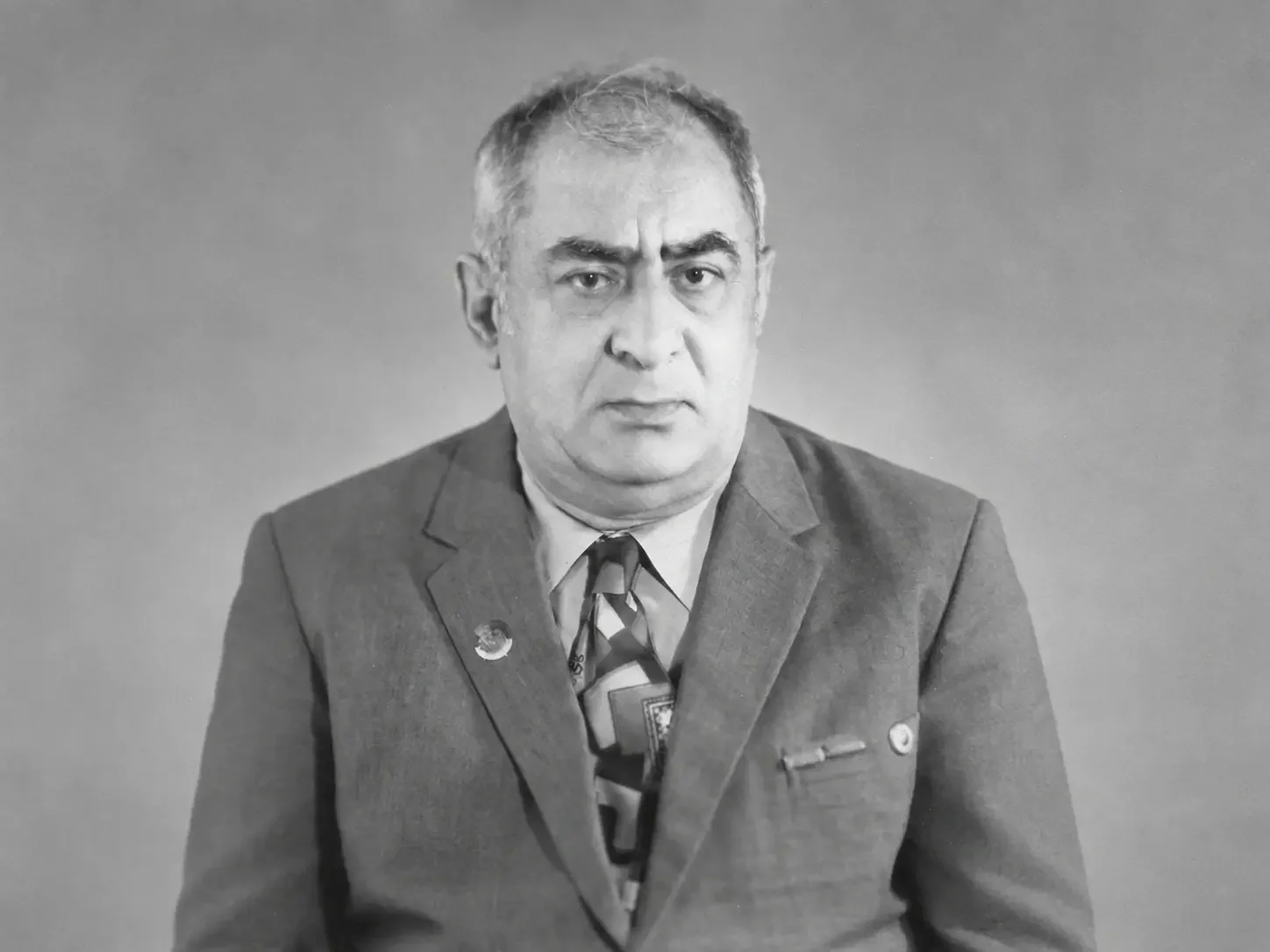
Archiv Bondarenko, CC BY-SA 3.0
Introduction
Tigran Borisovich Gorgiev, or Тигран Борисович Горгиев, was born on 30 August 1910 in Kizlyar and died on 13 December 1976 in Dnipropetrovsk. In the formal record of world chess composition, he appears not as an over the board star but as a Soviet master of the endgame study, an International Judge from 1956 and an International Master for chess compositions from 1969. Official WFCC title records also credit him with 66.67 album points, a total that left him just short of the grandmaster threshold in composition. Any serious profile of Gorgiev therefore has to be centered on study composition, criticism, judging, and chess culture rather than on tournament praxis in the usual sense.
He belongs to the generation that turned the Soviet endgame study into a major artistic field between the late 1920s and the postwar decades. A contemporaneous Soviet anthology from 1955 placed him among the composers who emerged in the second half of the 1920s and helped shape the subsequent development of study art. Later specialist historians continued to treat him as a central figure, especially in the line that linked the Platov brothers and Troitsky to the later Soviet masters of form, counterplay, and thematic richness.
For readers of Soviet chess history, Gorgiev deserves attention because he exemplifies an especially revealing Soviet type: the provincial prodigy who became both a scientist and a culture builder, and who used newspapers, clubs, books, and official institutions to extend chess composition beyond a narrow specialist circle. His story also shows how Soviet chess culture was not confined to Moscow and Leningrad, but ran through Kizlyar, Makhachkala, Rostov, Odessa, and Dnipropetrovsk.
Early Life and Chess Formation
Gorgiev was born into a respected Kizlyar family. Later regional reporting and Sergey Tkachenko’s biographical reconstruction agree that his father, Boris Gorgiev, was a prominent local lawyer and philanthropist, well known in the town for charity and civic activity. Tkachenko’s reconstruction further indicates that Gorgiev’s mother died while he was still a child. These details cannot all be checked from surviving primary civil records available online, so they are best treated as well supported biographical reconstruction rather than fully documented archival certainty.
The formative chess story is clearer. Gorgiev himself later recalled, and later biographers repeat, that he learned the game from an uncle who worked as a bookbinder. The uncle first beat him quickly, then stopped playing once the child began to win. In a small town with few strong opponents, Gorgiev compensated through reading. Contemporary retrospective accounts connect his development to the great Soviet chess boom after the Moscow 1925 tournament, which reached even Kizlyar through newspapers, books, and local organizational enthusiasm. That combination of scarcity in local opposition and abundance in printed chess culture helps explain why he moved so naturally from practical play toward studies and composition.
His first published study appeared in 1927 in Izvestiia. The 1955 anthology Sovetskii shakhmatnyi etiud identifies that debut as the start of a remarkably rapid ascent. By the late 1920s he was already winning prizes, and by 1955 one Soviet source counted about 175 published studies, 80 distinctions, and 9 first prizes, figures that capture how quickly he established himself in the prewar Soviet study scene. Later sources give much larger lifetime totals, which suggests continuing composition, republication, and possibly differing methods of counting versions and corrections.
Two formative influences named in the 1955 Soviet anthology were Vasily Platov and Nikolai Grigoriev. That detail is especially important. It places Gorgiev not merely in a chronological generation, but in a lineage of Soviet study thinking concerned with dynamic interaction, hidden resources, and the transformation of ostensibly static endgames into dramatic struggle.
Rise as a Soviet Study Composer
The early rise was not simply a string of prizes. It also involved an intellectual position about what a study should be. In his 1929 article “Bor'ba figur” or “Battle of Pieces,” Gorgiev argued against what Soviet writers described as the mechanistic tendency of Henri Rinck, setting against it a more vivid conception of struggle between the units on the board. A later specialist survey of Soviet study history reinforces this point, presenting Gorgiev’s article as part of a broader shift from older themes of trapping toward richer interaction and counterplay. In other words, Gorgiev was already helping define the aesthetic program of the Soviet study, not just contributing examples to it.
His practical reputation within composition rose early as well. In the 1955 anthology, one of his 1929 studies is accompanied by the note that Troitsky considered it the best work in that year’s championship of Soviet chess composers. Whether one treats that verdict as absolute or as Troitsky’s distinguished opinion, it shows that Gorgiev was being taken seriously at the highest level before he turned twenty. That is one of the clearest early markers of his stature.
A narrower but helpful point concerns chronology. Gorgiev’s first creative phase belongs to the late 1920s and 1930s, but it did not continue uninterrupted. The biographical record shows a young man who first worked as a schoolteacher and local education inspector, then entered medical study in Makhachkala in 1934, graduated in 1939, and increasingly had to balance science with chess. The war years and the demands of medical research curtailed his output. This interruption is important because it helps explain why his career has distinct phases rather than a single uninterrupted arc.
Mature Career in Medicine and Chess
From 1934 to 1939 Gorgiev studied at the Dagestan Medical Institute. Later biographical accounts indicate that wartime displacement took him and his family to Kazakhstan in 1941, while health problems, including tuberculosis, kept him out of military service. After the war he returned to Makhachkala, completed advanced medical work, and later, in the 1960s, reached the rank of doctor of medical sciences. These details help prevent a false picture of Gorgiev as a purely literary chess figure. He was a full professional scientist whose chess work coexisted with a demanding medical career.
The decisive second phase of his chess life began after his move to Dnipropetrovsk in 1954, where he joined the Institute of Gastroenterology as head of a laboratory and later rose to deputy director for scientific work, at times serving as acting director. Both ChessBase’s summary of Tkachenko’s research and Dmytro Markin’s local chess history treat this move as the beginning of his most productive mature period in both science and composition. After 1955, his compositional output rose sharply again.
This mature period brought his principal formal achievements. Official and specialist records agree that he became International Judge in 1956, Master of Sport of the USSR in chess composition in 1959, and International Master in 1969. Tkachenko’s published preview also describes him as a five time finalist in Soviet study championships. Markin’s regional history adds more concrete competitive markers: in the first USSR team championship in composition in 1956, his entry for the Ukrainian second team was judged the best; in the third team championship in 1960 he again finished near the top; he won important Ukrainian study competitions in 1962 and 1963; and he placed in the VII and VIII USSR championships for studies. Those are not every award, but they are enough to show that he was not only famous in retrospect. He was institutionally successful inside the strongest composition culture in the world.
One caution is required. Markin notes that a prize winning study from the III FIDE competition of 1960 to 1962 was later found to be unsound. That is not an incidental blemish. It is part of the historical truth of pre engine study composition, where many celebrated works by leading composers were later corrected, refined, or partially displaced. Gorgiev’s reputation survived such revisions because it rested not on a single untouchable masterpiece but on a large body of original ideas, recurring motifs, and sustained cultural work.
Style, Ideas, and Reputation
Gorgiev’s own aesthetic program is unusually well documented. Later Soviet and post Soviet sources repeatedly cite the principle he stated in his article “Characteristic Features of the Soviet School” and restated in Izbrannye etyudy: the ideal study should begin from a light and natural position, close to practical play, and should unfold a bright and original idea through active and inventive struggle by both sides. That compact formula may be the best single summary of his artistic purpose.
At the same time, later historians do not reduce him to “naturalness” alone. Markin describes his work as multifaceted, with a large share devoted to romantic designs, problem like themes transferred into studies, geometric motifs, positional draw ideas, and grotesque constructions. ARVES, the leading international study society, also associates him with the grotesque style and with domination studies. The tension here is revealing. Gorgiev advocated positions that felt game like, yet he remained willing to push them toward theatricality, geometry, and paradox. A fair historical reading is that he wanted the study to feel alive before it felt artificial, even when the internal mechanism was highly composed.
His reputation among specialists rests especially on compact force. Tkachenko’s English preview calls him the “Maestro of Practical Studies,” and the book’s foreword places his short studies in a pedagogical tradition valued by strong practical players as well as by composers. Modern culture confirms that afterlife. Jan Timman’s 100 Endgame Studies You Must Know includes a Gorgiev study among its selected canon, which is a quiet but significant sign that his work still functions as instructional material for serious players, not only as historical memorabilia for composition specialists.
A motif even bears his name. Specialist histories mention the “Gorgiev blow,” and later commentators use the phrase as shorthand for one of his characteristic tactical finishes. That kind of naming is not granted lightly in endgame study culture. It indicates a contribution that became repeatable and recognizable beyond its original setting.
Contributions Beyond Study Composition
Gorgiev’s contribution to chess exceeded the writing of studies. In Dnipropetrovsk he served as chairman of the composition commission of the regional chess federation and, for five years, as chess columnist for the city newspaper Dnepr vechernii. Markin adds that he worked as a correspondent for many local newspapers and did not restrict himself to composition, writing on practical chess as well. ChessBase’s summary of Tkachenko’s work further credits his newspaper columns with encouraging new composers such as the Semenenkos and Griva. These details place him in the Soviet ecosystem of instruction and cultural transmission, where the columnist and organizer could be as influential as the title holder.
His published output was substantial. Besides the author collection Izbrannye etyudy of 1959, he coauthored Osada chernogo korolia with Valentin Rudenko in 1960 and Shakhmatnyi etiud na Ukraine with Filipp Bondarenko in 1966. Retrospective sources also credit him with more than a hundred articles on composition. Those partnerships are historically significant because they connect Gorgiev to the strongest Ukrainian and Soviet composition networks of his time. He was not an isolated genius but a node in an active regional and all Union culture of books, columns, competitions, and theory.
One lesser known side of his life sits outside chess almost entirely. Gorgiev was a serious medical researcher whose work on bactericidal treatments entered Soviet medical practice. Tkachenko’s preview describes the long struggle around “Gorgiev’s bactericidal fluid,” later marketed under the name Ecteritsid, while a later patent description explicitly traces the antiseptic back to Gorgiev’s 1947 work on bactericidal factors in fish oil. Even if one leaves aside the account of bureaucratic injustice in Tkachenko’s narrative, the record is enough to show that Gorgiev’s scientific life was real, productive, and publicly consequential. That dual career is not a decorative biographical footnote. It is part of what made him unusual.
His ties to place also remained strong. Kizlyar opened a chess club in the 1970s, described by ChessBase as the first in Dagestan, and Gorgiev supported it with a newspaper column for Kizliarskaia pravda. Later recollections state that the club was named after him after his death and that he donated a substantial chess library to it. The evidentiary status of every local commemorative detail is not uniform, but the broad picture is robust: Gorgiev was remembered not only in metropolitan composition circles but also as a local cultural patron in his native town.
Legacy and Historical Assessment
Gorgiev died of a heart attack in Dnipropetrovsk in December 1976. His posthumous standing rests on several layers. The official layer is clear in the WFCC records, where his titles remain fixed and his album point total still places him very high among twentieth century study composers. The literary layer is preserved in Soviet anthologies, in later historical writing by Tkachenko and Markin, and in centenary commemoration. The pedagogical layer survives in modern anthologies and in the continued circulation of his studies among trainers and solvers.
There is also a geographic legacy. Modern records and recollections situate him across several cultural homes at once: Armenian by origin, born in what is now Russia, professionally fulfilled in Soviet Ukraine, and commemorated in both Kizlyar and Ukrainian composition history. Even the current WFCC database codes him under both RUS and UKR, which reflects how difficult it is to fold his life neatly into a single national historiography. He is best understood as a Soviet composer whose memory now belongs to several successor traditions.
The concise historical assessment is this: Tigran Gorgiev deserves attention today because he helped define what the Soviet endgame study was trying to become. He argued for vivid struggle over mechanism, sought positions that retained contact with practical chess, produced a large body of memorable studies, influenced younger composers through print culture and organization, and did all of this while sustaining an independent scientific career of considerable substance. He was not the most famous Soviet chess figure, but he was one of the clearest examples of how Soviet chess composition combined artistry, pedagogy, institutional life, and intellectual ambition in a single person.
Notes and Sources
The most valuable sources for Gorgiev’s profile are a mix of contemporary and later specialist materials. For early standing and self presentation, the key document is the 1955 Soviet anthology entry on him in Sovetskii shakhmatnyi etiud, which records his generation, influences, early publication history, prize record to that date, medical profession, and theoretical articles. For official title data, the most reliable sources are the WFCC title lists and composition point records. For narrative biography, the strongest modern specialist source is Sergey Tkachenko’s research, accessible through both his English language book preview and the ChessBase article based on his work. For his Dnipropetrovsk years and local role, Dmytro Markin’s Anthology of Dnepropetrovsk Chess is especially useful. Local Kizlyar memory is illuminated by Dagestanskaia Pravda, while his medical work is confirmed by later patent literature that cites his 1947 publication.
One source problem should be stated explicitly. The number of Gorgiev studies varies across sources. The 1955 anthology speaks of about 175 published studies at that time; later obituaries and specialist books usually give around 400 for his lifetime output; ARVES gives a broader figure of more than 500 composed. The safest conclusion is that the lower number reflects an earlier snapshot of published work, while the higher numbers reflect later lifetime accounting and perhaps different treatment of versions, joint works, and corrections. A careful historian should therefore avoid pretending that a single exact total is beyond dispute.
