Iivo Nei
Introduction
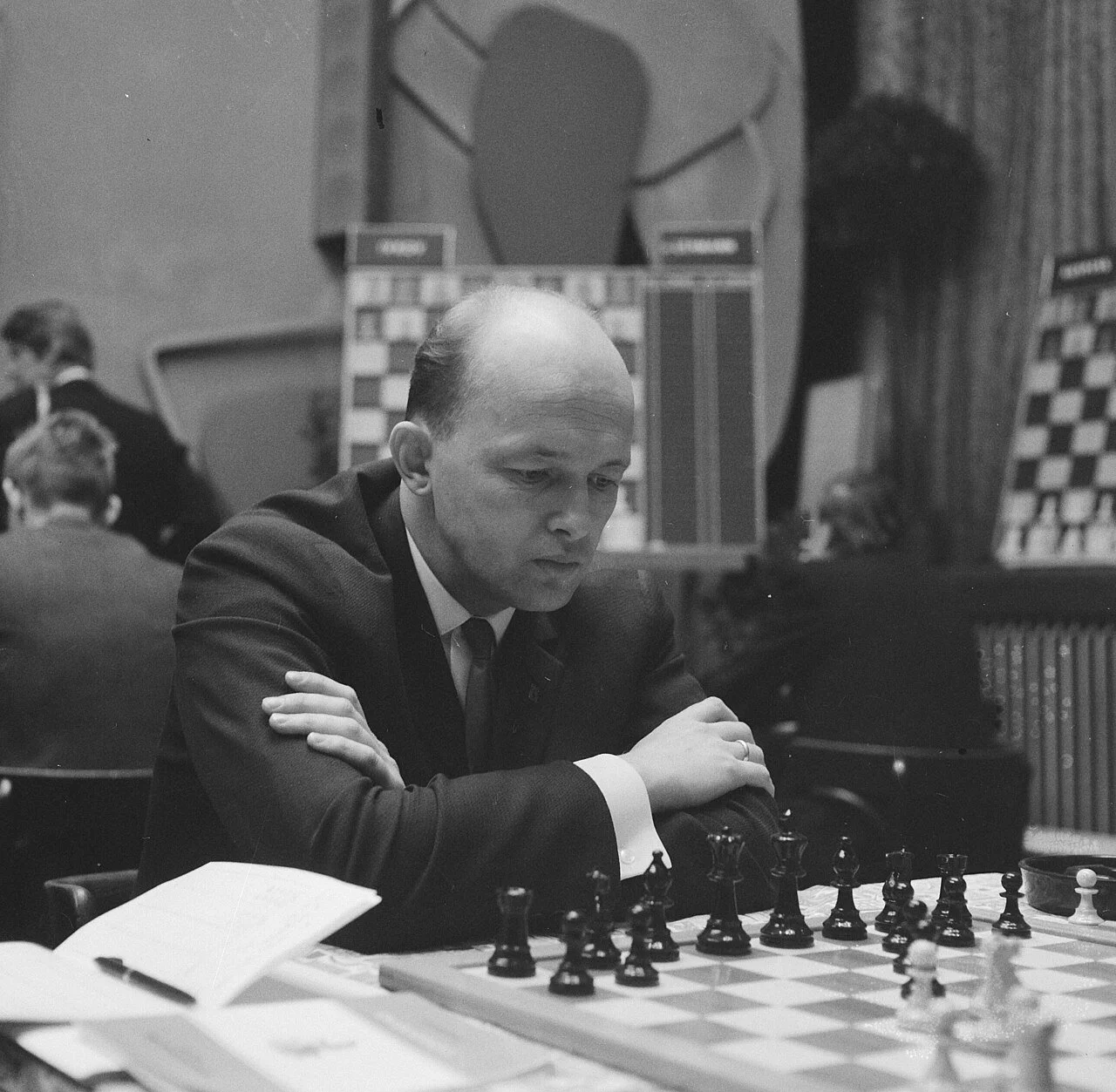
Iivo Nei, the long-time Estonian and earlier Soviet master born in Tartu on 31 October 1931, was awarded the International Master title in 1964 and the Honorary Grandmaster title by FIDE in February 2024.
Nei deserves attention not only because he won major titles inside Estonia, but because he occupied an unusually durable position in twentieth-century and post-Soviet chess culture. He was a leading Estonian competitor of the Keres era, a capable Soviet master who could survive the density of Soviet qualifying events, a second and trainer entrusted with elite assignments, a chess educator in print and on television, and later an administrator who helped shape institutional chess life in Estonia and the Baltic zone. In other words, his significance is cumulative rather than reducible to one spectacular tournament or one famous scandal.
Early Life and Chess Formation
The documented core of Nei’s early biography is relatively firm even if public sources are not rich in personal detail. The Estonian sports biographical lexicon records that he was born in Tartu, finished 5th secondary school in Tartu in 1949, graduated from Tartu State University as a physicist in 1954, and began playing chess at age 5. Publicly accessible reference sources also note that his younger brother, Mati Nei, later became Estonian champion in 1990, which shows that chess was not incidental within the family circle, even if surviving open sources do not give a fuller domestic portrait.
On formative influence, one should be careful. FIDE’s 2024 career summary states that Nei started playing chess inspired by Paul Keres, while a Russian Chess Federation profile places the young Nei within the general Estonian generation that came of age “on the wave” of Keres’s success. That is highly plausible, especially given Nei’s later long collaboration with Keres, but it is still best read as informed contextual evidence rather than as a verbatim autobiographical confession from Nei himself. Even with that caution, the outline is clear enough: Nei emerged from the extraordinarily strong Estonian chess culture that Keres had helped galvanize, and he did so early.
His precocity was visible almost immediately in Soviet youth competition. FIDE records him as third in the strong 1947 USSR Juniors in Leningrad, and in 1948 he tied for first with Viktor Korchnoi in Tallinn. An independent tournament record for the 1948 event confirms the shared first place. These results are historically revealing. They show that Nei’s talent was not merely local or provincial. Before he was twenty, he was already competitive with players who would become central Soviet grandmasters.
Rise in Competitive Chess
Nei’s rise within adult Soviet chess followed the path that serious Soviet masters had to negotiate, not quick foreign invitationals, but ferocious domestic qualifying events. He won the Estonian championship for the first time in 1951, when he was only nineteen, and would later become an eight-time national champion. Contemporary Estonian newspaper coverage of the 1951 title already presented him as a talented young player whose earlier all-Union junior success had marked him out.
A revealing episode came in 1959. In the Tallinn semifinal of the USSR Championship, Nei tied with Leonid Stein on 11/15 and then won the additional four-game match by 2.5 to 1.5. That result is easy to underrate in retrospect because Stein later became one of the strongest Soviet players of the 1960s, but that is precisely why the match is important. Nei was not a picturesque local master hovering on the edge of serious chess. He was strong enough to defeat Stein in direct qualifying play under Soviet championship conditions.
OlimpBase’s championship statistics, together with Russian federation material, credit Nei with four USSR Championship finals. The Soviet final was one of the most difficult tournaments in the world to reach, so repeated qualification is itself a substantial measure of class. His overall placing in those finals was not enough to make him a Soviet title contender, but it confirmed him as a durable member of the wider Soviet elite. That distinction is important in assessing his historical level. Many excellent Soviet masters never became household names outside the USSR, yet the competitive environment there was stronger than that of most national championship circuits elsewhere. Nei belonged to that category of serious, proven professionals.
Major Career Achievements
The most visible line in Nei’s tournament record is his eight Estonian titles, in 1951, 1952, 1956, 1960, 1961, 1962, 1971, and 1974. That spread, from the early 1950s to the mid-1970s, indicates not a brief flash of success but longevity. It also places him among the most decorated national champions in Estonian chess history.
His standing in the Baltic regional circuit was also substantial, although the exact counting of “Baltic” victories varies by source. FIDE’s 2024 summary credits him with wins in Baltic Republics events in 1961, 1962, 1963, and 1964, while the Russian Chess Federation profile refers more narrowly to three Baltic tournament victories, naming 1956, 1961, and 1963. That discrepancy probably reflects differing definitions of which closely related competitions should be grouped together. It can be stated with confidence that Nei was a recurring winner and one of the dominant Estonian figures in Baltic competition in the early 1960s.
The decisive international breakthrough came at Beverwijk 1964, the Hoogovens tournament, later known as Corus and then Tata Steel. There Nei tied for first with Paul Keres, ahead of players such as Lajos Portisch, Borislav Ivkov, Bent Larsen, and Bruno Parma. The tournament crosstable shows that this was not a lucky draw-heavy finish. Nei scored wins against Portisch, Larsen, Klaus Darga, Jan Hein Donner, Theo van Scheltinga, and Chris van den Berg. FIDE explicitly identifies this result as his major break, and Douglas Griffin likewise treats it as the peak of his international tournament career. It was this Beverwijk result that brought him the International Master title in 1964.
After Beverwijk, Nei remained internationally credible even if he did not convert that period into the grandmaster title by normal norms. FIDE highlights fifth place at Beverwijk 1966, shared fourth to sixth at Zinnowitz 1966, and shared second to third at Tallinn 1969. Official rating evidence shows that he remained strong by international standards: the June 1967 list placed him at 2540, and the 1970 FIDE list still listed him at 2510. Those figures do not prove that he was a full grandmaster in practical achievement, but they do show that his peak strength was not marginal. He stood in the zone where many Soviet players were objectively near-GM level, yet not all of them received enough international chances to complete the title.
Style and Reputation
Russian federation material describes Nei as a player of universal style, and that characterization fits the available evidence. He was not remembered primarily as a system specialist, a pure tactician, or an endgame technician of one narrow school. His best results came from adaptability, sound preparation, and the ability to exploit chances against stronger reputations when positions opened in his favor. His authorship of general instructional and opening works also supports the picture of a player with wide theoretical interests rather than one confined to a single stylistic niche.
One game that helps explain his reputation, without requiring a move-by-move study, is his victory over Tigran Petrosian in the 1960 USSR Team Championship. Douglas Griffin, drawing on Nei’s own notes from Shakhmaty v SSSR, calls it a “startling victory” over the “famously hard-to-defeat” Petrosian and reconstructs it as a sharp, energetic attacking performance. The point is not that one win over Petrosian made Nei a challenger-class player. The point is that contemporaries considered the game remarkable enough to annotate and preserve. It captures the higher ceiling in Nei’s play: against world-class opposition, he could sometimes produce forceful, memorable chess.
The limitations in his career are also visible. He qualified repeatedly for the hardest Soviet events and could beat top players, but he did not sustain that level often enough, or on a broad enough international stage, to make the grandmaster title inevitable in the normal way. Griffin suggests that restricted travel and limited foreign opportunities were part of the explanation, and that interpretation is plausible given both his rating strength and the relatively selective international itinerary summarized by FIDE. Still, without archival federation files, that causal claim should remain a careful historical inference rather than a proven certainty.
Contributions Beyond Tournament Play
Nei’s broader contribution to chess may be even more significant than his tournament record. FIDE’s 2024 summary states that he worked as an assistant with both Nona Gaprindashvili and Maia Chiburdanidze, and Gaprindashvili’s own memoir confirms that in one of her matches with Alla Kushnir, her trainer was Aivars Gipslis and her second was “master Ivo Nei.” This is exactly the sort of evidence that historians value, a later official summary reinforced by a first-person contemporary participant. Nei was therefore trusted inside the Soviet system at the highest level of women’s world championship preparation.
He also served on Boris Spassky’s team for the 1972 world championship match against Bobby Fischer, alongside Efim Geller and Nikolai Krogius. Here one reaches the most famous and most delicate episode in Nei’s public biography. Russian Federation accounts, drawing largely on later recollections by Krogius and others, state that Nei was brought in partly because he was athletic, played good tennis, and could help Spassky maintain form and morale, and because he spoke foreign languages. The same accounts add that his contact with Robert Byrne, chess columnist of The New York Times, led to suspicion inside the Soviet camp, his departure from Reykjavik after the seventeenth game, and a subsequent two-year restriction on foreign travel. These points are well attested as recollections and later interpretations. What is beyond dispute is that Nei later co-authored the 1974 book Both Sides of the Chessboard with Byrne, and that the book itself presented him as a Spassky insider at Reykjavik. The more dramatic vocabulary of “spy” belongs to later polemical retellings and should be treated with caution.
His literary and pedagogical output was large enough to stand on its own. DIGAR records the Keres and Nei primer Maleaabits, published in 1969 and reissued in 1978. Google Books and specialist historical work also document the Byrne and Nei collaboration Both Sides of the Chessboard, while Douglas Griffin notes the Keres and Nei book 4x25 from 1975, a substantial annotated collection on Fischer, Spassky, Korchnoi, and Larsen. FIDE’s 2024 summary adds that Nei authored several books in Estonian and German. Contemporary Estonian newspapers further show him editing chess columns in children’s and youth publications in the early 1960s, which is a useful reminder that he was already functioning as a public educator long before the television era.
That public educational role widened dramatically with television. Estonia’s public broadcaster, ERR, notes that the memorable television program “Malekool” first aired in January 1974 and that Nei hosted it on Estonian Television for 16 years. In the Estonian context, this was not a trivial side activity. It meant that Nei was one of the visible public faces of chess pedagogy for an entire generation. The chess column editor of the early 1960s had become the television teacher of the 1970s and 1980s.
Institutionally, ESBL credits him with serving as director of the Tallinn Chess School from 1966 to 1992, later also as director of the Paul Keres Chess House, vice chairman of the chess federation from 1964 to 1989, and then as FIDE representative and Baltic zone president in the post-Soviet 1990s. FIDE independently confirms his long service as FIDE representative in Zone 1.7, covering Estonia, Latvia, and Lithuania. This administrative record is essential to understanding Nei historically. He was not only a player who stayed in chess. He became one of the people through whom Estonian chess was organized, taught, and internationally represented.
As a coach, his best-known pupil was Lembit Oll, but ESBL entries for various Estonian players also show Nei training a wider range of juniors and, later, masters, including Monika Tsõganova, Kaja Paidla, Viktoria Baškite, and Tuulikki Laesson. That pattern reinforces the picture of a long pedagogical career rather than a single famous coaching success.
Historical Legacy
Nei’s historical legacy is easiest to grasp if one resists the temptation to define him only by what he was not. He was not a world championship candidate, not a Soviet champion, and not, in the usual over-the-board norm sense, a grandmaster during his prime. Yet that negative framing obscures his real place in chess history. He was a strong Soviet-era Estonian master who repeatedly proved himself in elite domestic competition, achieved a genuine international peak at Beverwijk, collaborated closely with Paul Keres, served world champions and challengers as assistant and second, trained later generations of Estonian players, educated a mass audience through print and television, and helped administer Baltic chess after the collapse of the USSR. Few chess lives are so fully distributed across competition, teaching, writing, broadcasting, and institution-building.
The 2024 award of the Honorary Grandmaster title by FIDE can therefore be read as a retrospective correction, not because Nei had been secretly a full grandmaster all along in every conventional sense, but because his total contribution and sustained strength were plainly larger than the bare line “IM” suggests. Interestingly, FIDE’s profile still lists his original formal title as International Master while separately recording the long career and the honorary distinction. For historians, that split is useful. It reminds us that chess titles capture only part of a career’s significance.
Nei deserves attention today because he embodies a chess legacy that can be overlooked if one looks only at world championship cycles and grandmaster totals. He was one of the principal carriers of Estonian chess culture from Keres's era into the post-Soviet period. His best competitive years showed real international class. His later decades helped preserve, teach, and institutionalize chess for others. That combination makes him not merely an accomplished player from a strong region, but a historically consequential figure in the continuity of Estonian and Soviet chess culture.
Notes and Sources
The strongest sources used here were official and semi-official reference materials, especially FIDE’s 2024 honorary grandmaster announcement and current FIDE profile; the Estonian sports biographical lexicon; Estonian federation championship records; ERR’s history of the television program Malekool; contemporary Estonian newspaper items from DIGAR; Gaprindashvili’s memoiral account naming Nei as her second; and specialist historical work by Douglas Griffin drawing on Soviet-era publications and annotations. Where sources diverged, as in the exact counting of Nei’s Baltic victories, the disagreement has been identified rather than smoothed over. Where later recollection governs the evidence, above all in the Reykjavik controversy of 1972, that status has been stated explicitly.
