Samuel Reshevsky
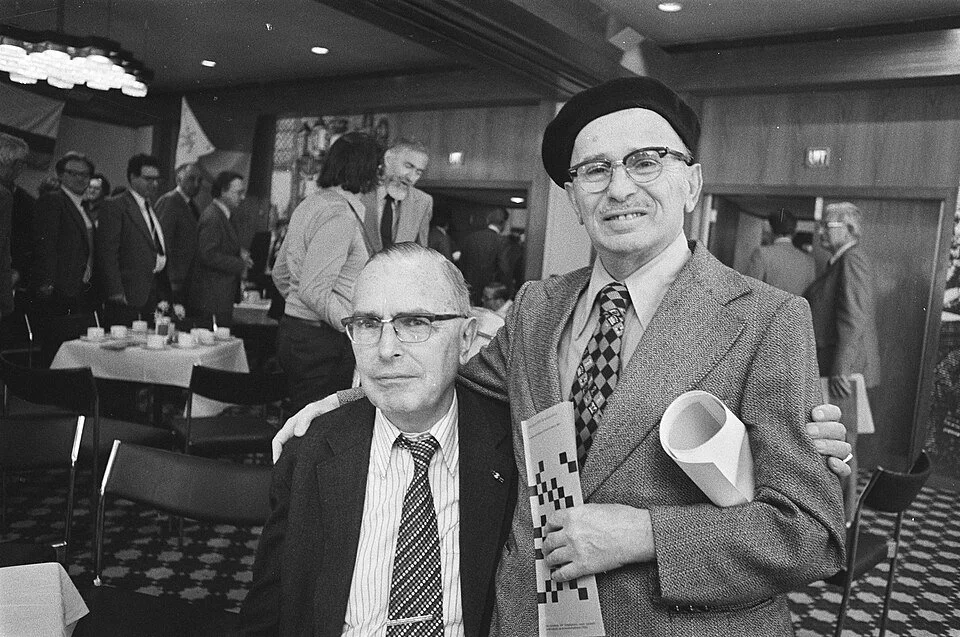
Hans Peters for Anefo
Introduction
Samuel Reshevsky occupies an unusual place in twentieth century chess. He was born in Polish lands under the Russian Empire, made his name first as a European child prodigy, built his adult career in the United States, remained a publicly observant Orthodox Jew, and for roughly three decades stood among the strongest non Soviet challengers to Soviet supremacy. Standard reference works usually give his birth as November 26, 1911, in Ozorków, near Łódź, under the name Szmul Rzeszewski. Yet Edward Winter has drawn attention to documentary evidence, including a 1919 Łódź registration card, that points instead to 1909, while Reshevsky himself insisted in a 1991 interview that 1911 was correct. Even that uncertainty is historically instructive, because Reshevsky’s life was shaped from the start by the publicity, mythmaking, and commercial pressures attached to prodigy culture. Russian sources render his name as Самуил Решевский or Самуэль Решевский, a reminder that although he was never a Soviet player, he was deeply present in Soviet chess discourse as a recurring foreign benchmark.
For a site concerned with Soviet chess history, Reshevsky deserves attention less as a peripheral American than as a central outside rival. The Soviet chess establishment measured itself against him repeatedly, from interwar elite tournaments to the postwar championship cycle and the great U.S. versus USSR team encounters. The World Chess Hall of Fame describes him as a serious world championship contender from the mid 1930s to the mid 1960s, and the Russian Chess Federation’s own profile presents him in similar terms, emphasizing how long he remained in the title race against Soviet opposition.
Early Life and Chess Formation
Reshevsky came from a Jewish family in Ozorków, and Russian biographical notices describe him as the sixth child in a poor or modest household. He learned chess at about age four and became a sensation almost immediately. By age eight he was giving simultaneous exhibitions in Europe and the United States. Andrea Graus, in a modern academic study, treats Reshevsky as an early case of the child prodigy as international celebrity, stressing how his tours turned extraordinary ability into a commercial public spectacle. Edward Winter’s research into contemporary reports shows just how intense that fascination was, down to the press fixation on his age, demeanor, and exhibition scores.
That early fame had educational and moral costs. Child welfare authorities in New York scrutinized the strain of exhibition life and the lack of formal schooling. A standard biographical reference notes that legal action was brought against Reshevsky’s parents in 1922 on charges of improper guardianship, and that the case ended only after evidence of religious schooling was produced and an outside sponsor was appointed to report on the boy’s welfare. Around this period Julius Rosenwald became an important benefactor, and later accounts agree that his support was tied to Reshevsky’s completing a proper education. Whatever the exact sequence, the broad result is clear. The prodigy phase did not flow directly into a normal professional chess life. Instead, Reshevsky largely stepped back from constant top level competition during his teens in order to study. Sources differ slightly on the exact year, but they agree that he studied accounting at the University of Chicago before fully re entering elite chess.
His religious formation also became a permanent structural fact of his career. Contemporary Jewish press coverage from the 1955 Moscow match against Botvinnik reported that Reshevsky refused to begin or continue games in a way that would violate the Sabbath. Later summaries, both Jewish and general chess references, repeat the point that he would not play on Shabbat or Jewish holidays. This was not a decorative biographical detail. It affected scheduling, match arrangements, team composition, and his public image throughout his life.
Rise in Competitive Chess
Reshevsky’s adult rise was not the usual story of a child wonder simply aging into mastery. It was a return. The World Chess Hall of Fame notes that he stepped away from chess as a teenager to concentrate on education, then came back around age twenty and quickly established himself again by winning the U.S. Open in 1931 and sharing that title in 1934. This pattern is important for historical assessment. Reshevsky was not only gifted, he was unusually durable. He had to reconstruct an elite career after an interrupted adolescence, which makes his later standing even more impressive.
His international breakthrough came in the mid 1930s. The same Hall of Fame profile places special emphasis on Margate 1935, where he finished ahead of José Raúl Capablanca. That event, and especially his win over Capablanca, became one of the fixed points in his historical reputation because it demonstrated that the former child prodigy was now fully credible against the established world elite. By the late 1930s he was posting the sort of results that defined a genuine title aspirant, including top finishes at Nottingham, Kemeri, and AVRO. Russian federation material likewise marks 1935 through 1938 as the phase in which Reshevsky emerged as one of the world’s leading players.
His rise also had a geopolitical dimension, though it should not be overstated. Reshevsky was not a symbolic American figure in the later Fischer sense, but by the end of the 1930s he had become one of the very few Western players whom Soviet masters had to treat as a serious long range threat. That perception helps explain the sustained Soviet interest in his play, an interest visible not only in tournament books and memoirs but also in the Soviet press material later recovered and translated by Douglas Griffin.
Major Career Achievements
Domestically, Reshevsky won the U.S. Championship eight times, a record eventually matched by Bobby Fischer. The World Chess Hall of Fame highlights his early sequence of clear first places in the 1930s and 1940s, and both Russian and English language reference sources describe him straightforwardly as an eight time national champion. That statistic alone would secure his place in American chess history. What gives it wider significance is that those successes were earned while he was also pursuing accounting work and while the strongest years of his career overlapped with the ascent of Soviet chess.
Internationally, the central fact is that Reshevsky was a championship level player for far longer than most master narratives allow. He was one of the participants in the 1948 world championship tournament and finished tied for third with Paul Keres, behind Botvinnik and Smyslov. The World Chess Hall of Fame regards Zurich 1953 as his best chance to qualify for a title match. Its summary is unusually blunt, stating that collusion among the Soviet representatives contributed to his ending in a second place tie rather than first. That claim should be handled carefully, but not evasively. It rests not simply on rumor but on later testimony from participants, including David Bronstein, and on retrospective accounts summarized by Garry Kasparov and other historians. At minimum, the available evidence strongly suggests that Reshevsky faced a level of coordinated resistance unavailable to the Soviet players themselves.
Another episode requiring careful handling is the 1950 Candidates. FIDE’s own retrospective says that Reshevsky and Reuben Fine opted not to play, while noting a second version according to which U.S. State Department restrictions prevented travel to Hungary. Edward Winter, drawing on later testimony, adds that Reshevsky himself claimed in 1991 that the decision was his. The most responsible historical conclusion is that the public explanation remained unsettled, but that missing Budapest cost him a significant early postwar chance.
His credentials were not limited to the individual title cycle. Reshevsky was part of the U.S. team that won Olympiad gold at Stockholm in 1937, and official FIDE museum material describes that team as led by him. Over a span of thirty seven years, he represented the United States in eight Olympiads. He also remained dangerous into old age, with the official Reykjavík Open history recording that he shared first in 1984. That late result was more than a curiosity. It confirmed that his chess strength was not merely the residue of childhood genius, but the product of a very long competitive intelligence.
A few individual encounters are worth naming because they changed how he was seen. The 1935 victory over Capablanca signaled his arrival. His 1948 win over Botvinnik inside a world championship event showed that he could beat the eventual champion in direct competition. His board one success against Botvinnik in the 1955 USSR versus USA match renewed his standing at precisely the moment many observers considered the Soviet system nearly unassailable. These are not merely famous games. They are milestones in the public construction of Reshevsky as the strongest persistent foreign rival to Soviet predominance before Fischer.
Style and Reputation
Reshevsky’s style is best understood through the testimony of contemporaries. A 1952 profile in Time called attention to his “glacial self-control” and to the widespread belief among masters that he behaved as if no position were beyond saving. That is a revealing formulation, because it captures both the admiration and irritation he provoked. Reshevsky was rarely theatrical at the board. His authority came from tenacity, precision, and the practical conviction that resistance could outlast appearances.
The World Chess Hall of Fame summarizes him as a master of both positional and tactical play. American commentary from the early 1960s, preserved in a Chess Life snippet, compared Pal Benko to “a minor Reshevsky,” saying that both players excelled at exploiting small positional advantages and that Reshevsky usually kept the draw in hand even after inaccuracies. That is a sharp contemporary judgment, even if the same source also complained of a certain “sterility.” In effect, opponents saw him as technically oppressive, strategically flexible, and psychologically exhausting. He was not restricted to one brand of chess. He was simply harder to beat than many more obviously flamboyant grandmasters.
His weakness was equally famous. Reshevsky consumed huge amounts of time in the opening and often reached severe time pressure. That habit became part of his legend. Soviet and American observers alike returned to it because it seemed the one persistent flaw in an otherwise championship caliber player. Soviet commentary on his 1955 game with Botvinnik, as summarized by Douglas Griffin, even notes Botvinnik’s surprise at the speed with which Reshevsky later chose a dangerous continuation, suggesting that his time management could itself become a strategic drama within the game. Historically, this flaw likely explains part of why he remained slightly outside the rank of world champion despite decades near the summit.
His reputation among peers mixed respect with unease. In the United States he was the chief obstacle for rivals such as Reuben Fine, and later he became an older antagonist for Fischer. In Soviet chess culture he was respected precisely because he was difficult to classify as merely local or provincial. He could win technical endings, defend grim positions, and seize tactical chances when they arose. That combination made him, in Soviet eyes, the kind of foreign player who had to be prepared for seriously.
Contributions Beyond Tournament Play
The clearest documented contributions outside direct competition were literary and pedagogical. Reshevsky on Chess, published in 1948, was presented as autobiographical as well as instructional. Later books included How Chess Games Are Won, Great Chess Upsets, and The Art of Positional Play. Even from bibliographic evidence alone, a pattern is visible. Reshevsky wrote not as an abstract theorist of openings but as a practical guide to strong play, annotated games, positional understanding, and the handling of decisive moments. That profile fits his over the board character. He taught through concrete struggle rather than through system building in the Botvinnik mold.
There is less evidence that he had a large historical role as organizer, trainer, or second in the institutional sense. His documented extra competitive presence lies more in authorship, journalism, and public symbolism. He wrote for major American chess periodicals, and his books continued to circulate long after the peaks of his playing career. This is easy to miss because his name is so often framed only through titles and tournaments, yet his pedagogical afterlife has been real. Later generations continued to encounter “Reshevsky” not only as a player in databases but as the author of some of the twentieth century’s most widely reprinted game collections and instructional texts.
An overlooked part of his contribution is biographical rather than literary. Reshevsky embodied a model of elite chess life outside the fully professional Soviet structure. He studied accounting, worked as an accountant, observed strict religious practice, and still remained a world class player for decades. Contemporary profiles repeatedly singled out that dual identity. It is one reason later writers have called him the greatest accountant in chess history. That phrase is light in tone, but it points to something substantial. His career demonstrated that the highest levels of chess excellence in the mid twentieth century were not produced only by state systems or by total professionalization.
Historical Legacy
Reshevsky’s legacy rests on more than an accumulation of results. He played eleven of the first twelve world champions and defeated seven of them. He won the U.S. Championship eight times. He remained a factor in Olympiad and international play over a span of nearly four decades. Even in advanced age he was still capable of headline results, such as sharing first at Reykjavík in 1984. Those facts describe an unusually broad and durable career.
For Soviet chess history, his real importance lies in the pressure he exerted from outside the Soviet system. He was one of the few foreign players whom Soviet memoirists, journalists, and institutions kept returning to as a serious rival. The repeated Soviet attention to his games, including analytical treatment in periodicals and the later preservation of that material by historians such as Douglas Griffin, reflects genuine respect. So does the recurring Soviet and post Soviet acknowledgment that Zurich 1953 came very close to becoming Reshevsky’s moment. He was not a Soviet player, and he should not be absorbed into Soviet history improperly. Yet he belongs inside that history as one of its most persistent external tests.
A concise historical judgment would be this. Reshevsky deserves attention today because he joined three identities that are too often studied separately: child prodigy, mature championship contender, and long lived practical teacher of the game. He was not a theorist on the Soviet institutional model, nor a romantic stylist in the Tal mold, nor a solitary phenomenon like Fischer. He was something rarer, a sustained world class rival whose stubbornness, positional intelligence, religious seriousness, and professional independence gave chess history one of its most distinctive careers. In any account of the players against whom Soviet chess defined itself, Samuel Reshevsky belongs near the center.
Notes and Sources
This profile relies first on documentary and near contemporary material, then on established historians and institutional retrospectives. For primary or near primary evidence, I used the 1952 Time profile on Reshevsky’s temperament, the 1955 Jewish Telegraphic Agency report on his Sabbath observance in Moscow, older Chess Life snippets on the 1961 Fischer match dispute and on contemporary American assessments of his style, and archive metadata for his own books. For specialist historical interpretation, Edward Winter is especially important on the birth year controversy and the prodigy years, Douglas Griffin on Soviet press treatment of the Botvinnik encounters, and Andrea Graus on Reshevsky as an early global child celebrity. Institutional anchors include the World Chess Hall of Fame, FIDE’s historical retrospectives and museum pages, the Russian Chess Federation’s bilingual profile, US Chess on Olympiad history, and the official Reykjavík Open history.
Two points require explicit caution. The first is the birth year. Conventional references usually retain 1911, but Winter’s documentary work has made 1909 impossible to dismiss, while Reshevsky’s own 1991 statement still defended 1911. The second is Zurich 1953. Soviet collusion against Reshevsky is widely reported by later participants and historians, and even the World Chess Hall of Fame states it directly, but it remains a conclusion built from retrospective testimony and institutional context rather than from a single decisive archival document. In both cases, the responsible approach is to distinguish secure fact from strong but interpretive historical reconstruction.
