Vladimir Akopian
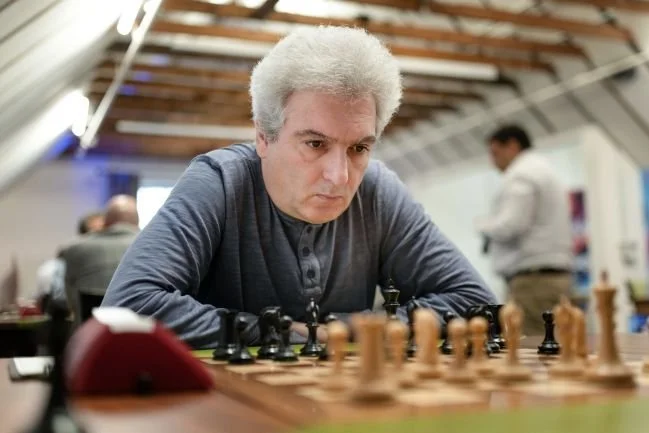
Akopian at the 2026 US Senior Chess Championship. Image Source: Armenian Chess Federation. https://chessfed.am/en/news/datail/340
Introduction
Formed in the closing years of Soviet chess, Vladimir Akopian became a central figure in independent Armenia’s emergence as a leading team nation. His individual record includes world titles at under-16, under-18, and under-20 level; a place in the final of the 1999 FIDE knockout world championship; a best world ranking of No. 11 in January 2003; and a peak rating of 2713 in July 2006. His historical profile also includes long national-team service, rigorous analytical work, elite seconding and coaching, and a substantial body of chess composition.
His name appears in several forms. Armenian sources use Վլադիմիր Հակոբյան, normally transliterated as Vladimir Hakobyan. Russian sources use Владимир Эдуардович Акопян, from which the established FIDE spelling Vladimir Akopian derives; Akopyan and Akopjan also occur. This article follows the FIDE form. He should not be confused with the Armenian-American grandmaster Varuzhan Akobian.
His career links three institutional settings: Soviet specialist youth training, Armenia’s post-1991 team program, and the international circuit of club play, seconding, and coaching. Across them, Akopian established a reputation for versatile play, resilience, and independent analysis.
Early Life and Chess Formation
Akopian was born on 7 December 1971 in Baku, capital of the Azerbaijan Soviet Socialist Republic, into an Armenian family. In a long Russian-language interview with Vladimir Barsky, he described his father as a physicist who worked at Baku’s Institute of Space Research and played chess at Soviet first-category strength. His mother taught at a music school. He was an only child and grew up speaking Russian. Music remained a parallel interest: he learned guitar, wrote songs, and later named Vladimir Vysotsky among his influences.
Accounts of his first chess teacher differ because they describe separate stages. His father showed him the game at five. International Master Suren Abrahamian, his mother’s uncle, recognized the child’s unusual aptitude and advised the family to place him in a specialist school. Alexander Aslanov was his first formal trainer there, followed by Alexander Morgulev, whom Akopian credited with developing his positional understanding. He entered chess school at six and reached first category by eight. These accounts are complementary: his father introduced the game, Abrahamian recognized his aptitude, and Aslanov became his first formal trainer.
The move from Baku to Yerevan was planned through family and chess institutions. At the 1985 Spartakiad in Volgograd, representatives of the Armenian federation invited Akopian and his mother to consider relocating. His father wanted to live in Armenia and found teaching work in Yerevan. Access to the respected trainer Oleg Ivanovich Dementiev was decisive. The family moved in 1986, when Akopian was fourteen. Since he initially knew little Armenian, he continued in a Russian-language school. He later entered the trainers’ faculty of the Armenian State Institute of Physical Culture and graduated in 1992.
Dementiev guided him for about five years, a period that encompassed all three world youth and junior titles. Akopian also attended four sessions of the Botvinnik-Kasparov school. His recollections describe a demanding program of game presentation, collective analysis, training games, simultaneous exhibitions with clocks, and assigned study. Mikhail Botvinnik’s influence was especially psychological. Before the 1986 World Under-16 Championship in Río Gallegos, Botvinnik urged him to control risk and avoid defeat. Akopian scored 8.5 out of 11 without a loss.
Even reaching that event illustrates the strength and depth of late-Soviet junior chess. Akopian first had to defeat Mikhail Ulibin in a six-game selection match, 3.5-2.5, winning the final game after five draws. He later observed that qualifying from the Soviet Union could feel harder than the international tournament itself. He won the World Under-18 Championship at Aguadilla in 1989, then took the World Under-20 title at Mamaia in 1991 on tiebreak after sharing first with Ulibin on 10.5 out of 13. Armenian federation records and Armenian interviews give 1989 for the under-18 title; the 1988 date repeated by several derivative English profiles is incorrect.
The Mamaia victory came about four months before the formal dissolution of the Soviet Union. It also came shortly before a personal loss. Dementiev died in October 1991. Akopian continued to speak of him as the coach whose concise interventions could change his entire competitive outlook. That emphasis on psychological clarity remained visible throughout Akopian’s career.
Rise in Competitive Chess
FIDE awarded Akopian the international master title in 1988 and the grandmaster title in 1991. The latter was not an automatic consequence of winning the World Junior Championship. By Akopian’s account, he had already completed the title requirements before Mamaia. Earlier norms had left him short of the required number of games, and a shared first place with Ivan Sokolov at Nikšić in 1991 supplied the remaining condition.
In the Soviet Union’s final year, Akopian played in the last USSR Championship, a 64-player Swiss in Moscow, and shared first with Michael Rohde in the U.S. Open in Los Angeles. From 1992 onward he represented Armenia. The new national team won bronze at its first Olympiad in Manila, with Akopian already occupying a leading board. He later recalled that Armenia’s first several team campaigns were played without fees during the severe economic conditions of the early 1990s. Income from international open tournaments financed further travel. This is Akopian’s first-person account, and it helps explain the practical commitments behind Armenia’s early national-team continuity.
His individual standing rose steadily. The Yerevan club won the European Club Cup in 1995 with an all-Armenian roster, and Akopian won the Armenian championship in 1996 and 1997. These achievements preceded his finest individual season. In 1999 he collected strong open results and reached the final of the FIDE knockout world championship at Caesars Palace in Las Vegas.
The event took place during the divided-title era, when FIDE’s official championship and the line associated with Garry Kasparov were separate. Akopian’s result should therefore be described precisely as runner-up in the 1999 FIDE knockout world championship. He defeated Maia Chiburdanidze, Rogelio Antonio Jr., Evgeny Bareev, Kiril Georgiev, Sergei Movsesian, and Michael Adams. He entered the six-game final against Alexander Khalifman having gone undefeated through nineteen games. Khalifman won the final 3.5-2.5.
Akopian later gave a notably measured assessment of the format. He did not consider short knockout matches an ideal method for identifying the strongest player, and he said that his view would have remained the same had he won the title. His recollection is valuable evidence for how one finalist understood the contested status of the title in 1999.
His post-1999 calendar combined elite invitations, open tournaments, club leagues, and team events. He won the category 17 tournament at Enghien-les-Bains in 2001 and reached number 11 on the January 2003 world list. His club record included Russian Team Championship titles in 2002, 2004, 2006, and 2008. In 2004 he defeated reigning classical world champion Vladimir Kramnik in the opening round at Wijk aan Zee and reached the quarterfinals of the FIDE knockout championship in Tripoli. His rating reached 2713 in July 2006. He won the 2007 Gibtelecom Masters in Gibraltar with 7.5 out of 9, then shared second with Peter Leko at the strong Nalchik FIDE Grand Prix in 2009. These results show a player who remained capable of elite tournament performances well beyond the immediate aftermath of Las Vegas.
Major Career Achievements
Akopian’s national-team record is the largest sustained achievement of his mature career. OlimpBase records eleven Armenian Olympiad appearances from 1992 through 2014, comprising 122 games and a score of 78.5 points: 42 wins, 73 draws, and seven losses. Armenia won bronze in 1992, 2002, and 2004, followed by gold in 2006, 2008, and 2012. Akopian received silver for the second-best overall rating performance in 2002, individual gold on board two in 2008, and individual silver on board three in 2012.
During the 1990s and early 2000s Akopian often carried board-one responsibility. With Levon Aronian later established on the first board, Akopian supplied exceptional strength on boards two and three. In Turin in 2006 he scored 9 out of 12 without defeat. In Dresden in 2008 he scored 8 out of 11, again undefeated, with a tournament performance rating of 2813. In Istanbul in 2012 he scored 7.5 out of 10 without a loss. The official Armenian record confirms him on every one of the country’s three Olympiad gold-medal teams.
Armenia also won the 2011 World Team Championship at Ningbo. Akopian scored 6 out of 9 on board three and earned the individual silver medal on that board. By his retrospective count, he played forty-two games across Armenia’s four gold-medal events, won nineteen, and lost none. The event records support the unbeaten total. Captain Arshak Petrosian described Akopian as an exceptionally stable team player.
Akopian and Petrosian attributed part of this success to a team culture in which players shared analysis freely, reviewed difficult results without recrimination, and often began with a physical board before using a computer to check conclusions. Akopian credited Petrosian with maintaining that atmosphere. His close friend Karen Asrian was also central. The two spent long sessions reanalyzing classical games and endgames, then used a computer at the end of the process to test their ideas. Asrian’s sudden death in 2008 ended a close personal and analytical partnership, yet the habits of shared work remained part of Armenia’s team practice.
The social meaning of the Olympiad successes in Armenia was acknowledged formally. Akopian and his teammates received state honors after the victories, culminating in Armenia’s Order of Honor following the 2012 gold medal. Such recognition places his team career within the public culture of independent Armenia without reducing the achievements to national symbolism.
Style and Reputation
Akopian consistently described himself as a universal player with a preference for dynamic positions. He resisted a simple division between tactical and positional chess. His early teachers supplied different parts of that synthesis: Morgulev strengthened his positional sense, Dementiev sharpened competitive judgment, and the Botvinnik-Kasparov school reinforced disciplined analysis. Akopian studied Alexander Alekhine, Leonid Stein, Bent Larsen, Bobby Fischer, and Boris Spassky, a group united by active piece play and practical pressure across varied openings.
His best chess combined strategic control, tactical alertness, and endgame technique. He sought winning chances with both colors and accepted long defensive tasks without losing concentration. Across Armenia’s four title-winning events, Akopian was undefeated in forty-two games, scoring nineteen wins against upper-board opposition. This combination of security and active scoring supports his reputation for practical control.
Two famous results illustrate his competitive range without requiring detailed game analysis. In the 2002 Russia versus Rest of the World match in Moscow, he defeated Kasparov in the final round and helped the Rest of the World win the match. The game was rapid, a distinction often omitted in short biographies. At Wijk aan Zee in 2004, his victory over Kramnik was classical. Together, the victories illustrate the quality of his judgment against the foremost players in both rapid and classical competition.
Akopian’s own account helps explain the shape of his individual career. He enjoyed analysis, classical games, and endgames more than extensive opening memorization, adopted computer-centered preparation gradually, and preserved time for family, music, and friendships alongside professional chess. This ordering of priorities supported a long and varied career, although it differed from the intensive preparation schedule he associated with a classical world-title campaign. Botvinnik, as Akopian later recalled, believed that he possessed championship potential if he matched Kasparov’s workload. The remark is best read as evidence of Botvinnik’s confidence in his talent.
Among contemporaries, his reputation rested on steadiness, independent analysis, and the ability to test an idea without deference to its author. He told ChessPro that he and Asrian found corrections while checking published analyses, including positions in Kasparov’s My Great Predecessors. ChessPro’s introduction also linked this analytical work to revisions in later editions. In the absence of edition-level documentation, the secure conclusion is that Akopian and Asrian independently tested and corrected published analysis.
Levon Aronian supplied a useful external view. He regarded Akopian’s style as more positional than Akopian’s own description might suggest and emphasized his extraordinary chess memory. Aronian recalled Akopian reconstructing old blitz games and retrieving analytical ideas years later. These views are compatible: Akopian’s intentions were dynamic, while his play rested on positional judgment, memory, and accumulated pattern knowledge.
Contributions Beyond Tournament Play
Akopian’s work as a second demonstrates the trust elite players placed in his judgment. He helped Alexei Shirov prepare for the projected match with Kasparov that was never played. He later joined Peter Leko’s team for the 2004 match with Kramnik. Akopian described his role as that of a critical tester, examining opening ideas and identifying weaknesses before they reached the board. His preference for skepticism and practical verification suited this form of collaborative work.
Coaching became a major part of his professional life. He worked with the Qatar national team from 2004 to 2007 and trained Mohammed Al-Modiahki, Zhu Chen, and Mohammed Al-Sayed. He also served as a chess technical expert at the 2006 Asian Games. After returning to Armenia, he trained younger players including Robert Hovhannisyan, Tigran L. Petrosian, Avetik Grigoryan, Haik Martirosyan, and Shant Sargsyan. His later appointments included the Armenian Chess Federation, Sharjah Chess Club, and work with the United Arab Emirates. Emirates News Agency records him accompanying the UAE men’s team as coach at the 2024 Olympiad. FIDE awarded him the Senior Trainer title in 2015.
He also contributed written analysis to Chess Informant, with particular interest in middlegames and endgames. His method was rooted in human analysis first and computer checking afterward. That sequence linked his Soviet training to modern tools without turning the machine’s output into the whole argument.
Chess composition is the most easily overlooked part of Akopian’s record. His first problem was composed at twelve and later published by the Soviet composer and study specialist Alexander Sarychev. Russian Chess House issued 150 Chess Problems and Studies in Russian, and Akopian continued composing on a much larger scale. His recent book Pushing Horizons: The Chess Legacy of GM Vladimir Akopian brings together twenty-five memorable games, fifty fragments, seventy-five studies, and 150 problems. The publisher’s description records 300 selected items in all.
The book is both retrospective and creative. Its studies and problems occupy more entries than its games and fragments, and Akopian identifies the problem section as his favorite. The predominance of studies and problems in the volume confirms that composition was an independent, long-term part of his chess practice.
Later Life and the American Chapter
Akopian married Kristine, whom he met through the Yerevan Chess House, in 1997, and they have three sons. In an Armenian interview he said that the family moved to the United States in early 2020 for educational opportunities and chess work. FIDE records his transfer from the Armenian to the United States federation on 5 June 2021. That date concerns sporting representation; it should not be used to infer the timing of citizenship or residence. He has remained connected to Armenian chess and has said that he returns regularly.
His transition away from Armenia’s national team took place gradually. After the 2012 Olympiad he wanted to make room for younger players, yet he returned for the 2014 Olympiad and was part of Armenia’s bronze-medal squad at the 2015 World Team Championship. By 2024 he described himself as almost retired from full-time tournament play, while continuing private teaching, academy work, online seminars, and federation coaching.
Competition has continued at senior level. Akopian won the 2024 U.S. Senior Championship with 7 out of 9, finishing undefeated and clinching the title with a round to spare. In 2026 he shared first in the classical stage with Alexander Onischuk on 6.5 out of 9, then won their playoff 3-1. As of August 2026, he is a two-time U.S. Senior Champion. The senior titles show that the resilience and technical steadiness evident in his Armenian team years remained competitive strengths late in his career.
Historical Legacy
Akopian’s career spans the institutional transition from late Soviet chess to the international culture that followed. Baku’s specialist schools, the Botvinnik-Kasparov program, and Dementiev’s coaching shaped him; independent Armenia then provided the setting for his most sustained public contribution. From the country’s first Olympiad medal in 1992 through its three gold medals, he supplied upper-board strength across generations.
The 1999 FIDE final remains his most visible individual result, supported by a best world ranking of No. 11, a 2713 peak rating, major tournament successes, and long service in elite team events. His analytical partnership with Karen Asrian, his work under Arshak Petrosian, and his later coaching show how individual expertise could become collective practice.
Akopian deserves attention today for the full range of his career: elite individual results, a foundational role in Armenia’s team successes, rigorous analytical work, international coaching, and prolific composition. His career provides a direct human link between late Soviet training and the global chess culture that followed.
Notes and Sources
Armenian biographical interviews. The most detailed family and early-life account is Mediamax, “Վլադիմիր Հակոբյան. Իմ բոլոր երազանքները կատարվել են” (5 August 2013). Later-life, national-team, coaching, and compositional evidence comes from Mediamax Sport, “Վլադիմիր Հակոբյան. Մարզիչն այնպիսի դիպուկ խոսքեր էր օգտագործում, որ չհաղթելն անհնար էր” (9 October 2024) and NEWS.am Sport, “Վլադիմիր Հակոբյան․ Ուրախացնում են մեր երիտասարդ շախմատիստների նվաճումները” (18 February 2023). These are first-person sources and are identified as recollection where appropriate.
Russian-language primary interview. Vladimir Barsky’s extensive ChessPro interview, “Владимир АКОПЯН: С ПРИЦЕЛОМ НА ПЕРВОЕ МЕСТО!” (23 August 2011), is the principal source for family occupations, education, the Botvinnik-Kasparov school, early post-Soviet conditions, Karen Asrian, analysis, seconding, Qatar, and Akopian’s self-assessment. A later interview, Vestnik Kavkaza, “Владимир Акопян: Процесс поглощения шахмат компьютером, к счастью, идет медленно” (15 October 2012), supports his description of himself as a universal and dynamically inclined player.
English-language primary interview. Sagar Shah’s two-part ChessBase interview, “The Life Story of Vladimir Akopian, Part One” and “So Near Yet So Far, Part Two” (2019), supplies detailed testimony on his coaches, youth qualification, grandmaster norms, style, 1999 championship, work with Leko, Armenian team results, and later coaching.
Official Armenian record. The Chess Federation of Armenia’s history and achievement register confirms Akopian’s 1986 and 1989 youth titles, the 1995 European Club Cup, Armenian championships in 1996 and 1997, Olympiad rosters and medal years, and World and European team results. Its Armenian version is available here. The official record establishes the Olympiad gold years as 2006, 2008, and 2012.
FIDE identity and titles. Akopian’s official FIDE profile confirms FIDE ID 13300032, IM in 1988, GM in 1991, FIDE Senior Trainer in 2015, and the federation transfer dated 5 June 2021. The current federation field documents sporting representation only.
Youth and Olympiad statistics. OlimpBase’s World Junior record gives Akopian’s four under-20 championship appearances and the 1991 Mamaia result. Its Olympiad player record provides the eleven-event aggregate, board assignments, results, performance figures, and individual medals. OlimpBase is used here as a specialist statistical reference alongside official federation records.
1999 FIDE championship. FIDE’s official round-by-round results confirm Akopian’s route and the 3.5-2.5 final score. Mark Crowther’s contemporary The Week in Chess 251 reports the final and event chronology. The article uses “FIDE knockout world championship” because the title was divided in 1999.
World ranking and peak rating. ChessBase’s contemporary publication of the January 2003 rating list places Akopian at world number 11 with 2703. A contemporary July 2006 FIDE-list report records his peak rating of 2713 and world number 16 position on that list.
World and European team events. The official Ningbo 2011 site and The Week in Chess event report confirm Armenia’s World Team Championship victory. OlimpBase’s board results record Akopian’s 6 out of 9 and individual silver on board three. Arshak Petrosian’s contemporary comments on stability and team practice appear in the Russian Chess Federation interview “Компьютер у нас работает где-то сбоку” (26 September 2012).
Selected tournament checks. The ChessBase Gibraltar report confirms clear first with 7.5 out of 9 in 2007. The Week in Chess 756 records his shared second place at the 2009 Nalchik Grand Prix. The Week in Chess 410 confirms that the 2002 Kasparov game occurred in a rapid team match. The 2004 FIDE knockout results confirm his quarterfinal finish.
Club and coaching record. The Saint Louis Chess Club biographical record lists his four Russian Team Championship titles and his appointments with Qatar, the Armenian Chess Federation, and Sharjah Chess Club. Emirates News Agency records his coaching role with the UAE men at the 2024 Olympiad. These institutional sources supplement Akopian’s interview testimony about individual pupils and duties.
Contemporary assessment by Aronian. Levon Aronian’s 2011 Crestbook conference is the source for his assessment of Akopian’s positional strengths and exceptional memory. It is used as contemporary testimony, not as a substitute for the game and event record.
Composition and authorship. Russian Chess House issued Akopian’s 150 Chess Problems and Studies; the publisher’s 2020 edition record identifies the author and work. Thinkers Publishing’s official page for Pushing Horizons: The Chess Legacy of GM Vladimir Akopian gives its contents, ISBN 9789493435087, and Akopian’s account of composing his first problem at twelve.
Armenian state recognition. The Armenian president’s 10 September 2012 decree names Akopian among the Olympiad champions awarded the Order of Honor. Contemporary Armenpress reports document the Movses Khorenatsi Medal after Turin 2006 and the Medal for Services to the Fatherland, first class, after Dresden 2008.
United States senior championships. US Chess reports his 2024 title, clinched with a round to spare, and his 3-1 playoff victory over Alexander Onischuk in 2026. The 2024 Saint Louis event page and 2026 Saint Louis event page supply the final classical scores. These establish two U.S. Senior titles as of the research date.
Corrections to recurring secondary errors. The under-18 title belongs to 1989, as shown by Armenian official and first-person sources. The Armenian Olympiad gold years are 2006, 2008, and 2012. A contemporary report confirms that Akopian shared first in the 1991 U.S. Open with Michael Rohde. His win over Kasparov in 2002 was rapid. His 2011 World Team individual medal was silver on board three. The 1991 World Junior title and his 1991 GM title were separate achievements.
