Alla Kushnir

Hoogovens 1973. W. Punt for Anefo
Introduction
Alla Shulimovna Kushnir (11 August 1941 - 2 August 2013) occupied an unusual place in twentieth-century chess. Between 1965 and 1972 she challenged Nona Gaprindashvili for the women’s world championship three times. She lost the first two matches by 4.5-8.5 and the third by the narrowest possible margin, 7.5-8.5. After leaving the Soviet Union for Israel in 1974, she helped her new country win the 1976 Women’s Chess Olympiad and advanced to the 1978 Candidates final. She then ended her competitive career by choice and built a second career as a classicist, epigrapher, and numismatist at Tel Aviv University.
Kushnir is sometimes reduced to the label “three-time challenger.” The description is accurate but incomplete. She repeatedly requalified under changing championship formats, won individual and team gold at every Olympiad she played, and remained a credible title contender after the institutional rupture of emigration. Her later scholarship also became part of the working literature on the coinage, civic eras, and inscribed weights of Hellenistic and Roman Palestine. The two careers need to be assessed together.
The sources require care. Russian and Israeli reference pages disagree over whether she emigrated in 1973 or 1974. Lyudmila Belavenets, Kushnir’s close friend and longtime match assistant, gives the exact date as 27 August 1974, and the Great Russian Encyclopedia also uses 1974. This profile follows those more specific accounts. Publicly accessible, reliable sources say little about Kushnir’s parents or childhood household, so no unsupported family genealogy is supplied here. Her name appears in Russian as Алла Шулимовна Кушнир, in Hebrew as אלה קושניר, and in later academic work as Alla Kushnir-Stein or Alla Stein.
Early Life and Chess Formation
Kushnir was born in Moscow on 11 August 1941, just over seven weeks after Germany invaded the Soviet Union. Reliable published sources consulted for this profile say little about her parents, their professions, and the family’s wartime experience. No authoritative source establishes that she came from a chess household. Her first securely documented chess setting was the Lenin District House of Pioneers in Moscow. 12
At twelve she joined a girls’ group at the chess club of the Krasnaya Shveya factory. The instructor was Grigory Levenfish, a former Soviet champion and a grandmaster with an exacting conception of positional play. Belavenets, another member of the group, recalled that Levenfish did not simplify his teaching for children. He discussed weak squares, backward and isolated pawns, and counterplay in the language he used with adult players. His comments about women could be openly disparaging, but he privately recognized Kushnir and Belavenets as talented. The group eventually contracted to the two girls. It is reasonable to connect this concentrated instruction with the positional judgment for which Kushnir later became known, though the link remains an interpretation. 2
Her progress was rapid. In 1958, aged sixteen, she won the Moscow women’s championship. 1 FIDE awarded her the Woman International Master title in 1962. 19 Belavenets identifies Boris Persits as Kushnir’s first mature coach and Vladimir Yurkov as his successor. Kushnir and Belavenets represented the Trud sports society, helped one another at tournaments, and worked within the network of coaches and collective preparation on which Soviet elite chess depended. Belavenets assisted Kushnir during all three world-title matches; the Russian Chess Federation records that Yurkov trained and seconded her in each match. 219
Chess did not displace formal education. Kushnir graduated in 1963 from the editorial and publishing faculty of the Moscow Polygraphic Institute. 1 This background did not lead to a documented career in chess publishing. The same source base that records her education preserves very little about her private family life. One important exception comes from Belavenets. When Kushnir traveled to the 1964 Candidates tournament in Sukhumi, her son Pavel was only a month old. Belavenets cared for the infant during games, Kushnir then returned to feed him, and Kushnir’s husband also helped. The episode records the practical conditions under which a new mother pursued the highest level of women’s chess. 2
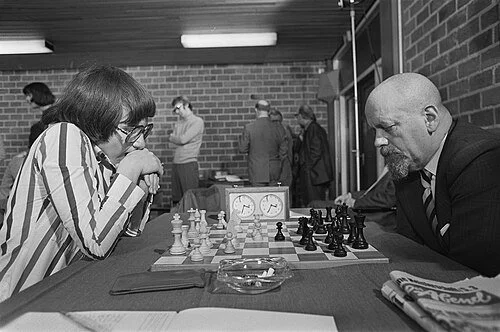
Hoogovens 1976. By Rob Mieremet / Anefo
Rise in Competitive Chess
Kushnir entered the Soviet women’s championship in the late 1950s and soon belonged to its leading group. She finished fifth in 1959 and shared second and third in the December 1962 championship. In 1963 she shared third and fourth with 13/19, then defeated Valentina Kozlovskaya 2.5-0.5 in a playoff. Because that championship also functioned as a FIDE zonal event, the result qualified her for Sukhumi. Her decisive international advance occurred there in 1964. 18
Kushnir, Milunka Lazarević, and Tatiana Zatulovskaya tied for first in the Candidates tournament with 12.5 points from 17 games. A double-round-robin playoff at Moscow’s Central Chess Club followed in December. Kushnir scored 2.5 from four, half a point ahead of Lazarević, and earned the right to challenge Gaprindashvili. 3 The result had more than statistical value. She had managed the tournament while caring for a newborn and then won a second event against the same two rivals. It began a sequence of three consecutive championship qualifications.
The first title match was played in Riga in 1965. Gaprindashvili won 8.5-4.5, with Kushnir scoring three wins, three draws, and seven losses. 20 The same overall score recurred in 1969, after Kushnir had won the 1967 Candidates tournament at Subotica outright with 13.5 from 17. The second match was divided between Tbilisi and Moscow; Kushnir scored two wins, five draws, and six losses. 4
These defeats can obscure the difficulty of returning to a title match. Kushnir did not receive three automatic rematches. In 1964 she survived a three-way tie and playoff. In 1967 she finished a full point ahead in the Candidates. When the qualifying system changed to knockout matches, she defeated Zatulovskaya 5.5-4.5 in 1971 and then Nana Alexandria 6.5-2.5. The third qualification therefore rested on sustained success against successive generations of elite Soviet players. 20
Major Career Achievements
The 1972 challenge
The 1972 match in Riga was Kushnir’s closest approach to the world title. Gaprindashvili led 6.5-3.5 after ten games, but Kushnir won games eleven and fourteen and reduced the deficit to one point. The final two games were drawn, leaving the champion ahead 8.5-7.5. No detailed game analysis is needed to identify the historical meaning of this result. Kushnir had converted two earlier, substantial match defeats into a contest that remained open until the final sessions. Her four wins against Gaprindashvili in 1972 also showed that the match could not be explained as prolonged damage limitation. 5
Gaprindashvili’s later memoir treats Kushnir as her principal long-term rival. It also emphasizes the effect of the rivalry on the champion’s own decisions: repeated matches against a thoroughly prepared and resilient opponent encouraged Gaprindashvili to choose practical, rational solutions rather than seek spectacle for its own sake. That testimony is retrospective and comes from one side of the rivalry, but the results support its central point. Kushnir learned from earlier defeats and returned stronger. 5
Soviet championship and international standing
Kushnir’s only Soviet women’s championship title came in the 1970 event at Beltsy. She and Maaja Ranniku each scored 14 from 19. Their six-game playoff ended 3-3, and Kushnir won the first additional game to take the title. The form of that victory suits her competitive profile: she secured a national championship only after the scheduled tournament and match had both failed to separate the leaders. 6
Selective international results reinforce that the championship challenges were not isolated peaks. Kushnir won strong events in Belgrade and Moscow in 1971 and at Vrnjačka Banja in 1973. Her Soviet honors included the title Honoured Master of Sport in 1972. FIDE awarded her the Woman Grandmaster title in 1976; claims that she was already a grandmaster in 1962 confuse that title with the Woman International Master designation she received that year. 1
Olympiad success
Kushnir played only three Women’s Chess Olympiads, winning team and individual gold at each one. On second board for the Soviet Union, she scored 8.5/9 at Lublin in 1969 and 7/8 at Skopje in 1972. At Haifa in 1976 she played first board for Israel and scored 7.5/8. Her combined Olympiad record was 23 points from 25 games: 21 wins, four draws, and no losses. 7
The Haifa result needs its full context. The Eastern-bloc teams, including the Soviet Union, did not attend, leaving an incomplete field. Israel’s gold remains an official result, and Kushnir’s personal score remains exact. The achievement also represented a rare transfer of elite chess expertise from the Soviet system to a comparatively small national program. Kushnir, Luba Kristol, Olga Podrajanskaya, and Lea Nudelman were all recent immigrants. Their victory became a defining result in Israeli women’s team chess. 78
Style and Reputation
Kushnir’s reputation is best reconstructed from the testimony of opponents and coaches, checked against the character of her results. Gaprindashvili described her as exceptionally well prepared, hardworking, and difficult to dislodge. She rarely made simple errors, understood classical positional structures deeply, and defended tenaciously. Even when her position was inferior, an opponent could not safely reduce attention. 5
Her positional play was active. Soviet trainer Igor Zaitsev credited Kushnir with fine positional feeling and a frequent search for combinational paths. Her strongest play joined structural judgment to concrete calculation. She could accumulate a lasting advantage and make a position sharp when the tactical basis justified it. The large number of decisive games in her Candidates and championship matches supports the picture of a player who sought active decisions instead of routine safety. 1
Gaprindashvili also identified a limitation. In her assessment, Kushnir was less secure when a position demanded an original decision in sudden, unusually sharp complications. This judgment should be treated as an opponent’s analysis, not as a settled technical verdict. It does help explain the contrast between Kushnir’s excellent preparation and positional control, and the match reversals that could occur when Gaprindashvili changed the character of the struggle. Kushnir’s occasional tactical oversights were costly in a short match. Her response was often impressive: the 1972 comeback showed an ability to recover psychologically and to keep posing concrete problems after a damaging start.
One later game deserves mention because of its historical rather than analytical significance. At the 1975 Lone Pine Open, Kushnir defeated American grandmaster Larry Evans. The World Chess Hall of Fame describes the result cautiously as one of the earliest tournament victories by a woman over a grandmaster. Exact claims of a “first” are difficult because definitions of titles and event types vary, but the result demonstrated that Kushnir’s strength was not confined to women’s events. 9
Emigration, Israel, and the Final Championship Cycle
According to Belavenets, Kushnir left the Soviet Union on 27 August 1974. She had been due to play Marta Shul, later Marta Litinskaya, in the next Candidates cycle. Kushnir wanted to contest the match after departure as an Israeli representative. Soviet officials would not accept that arrangement, and after discussions with chess administrator Viktor Baturinsky and national women’s coach Alexander Konstantinopolsky, she withdrew and emigrated. This account is more specific than institutional summaries that place her move in 1973. It also shows how emigration could interrupt a championship claim before play began. 2
Her return to the cycle was decisive. Representing Israel, she shared first with Elena Akhmilovskaya at the 1976 Roosendaal Interzonal, both scoring 9.5/13. In the Candidates matches she defeated Irina Levitina 6-3 and Elena Fatalibekova 6.5-3.5. She then faced the teenage Maia Chiburdanidze in the 1978 Candidates final at Bad Kissingen and lost 6.5-7.5 over fourteen games. Chiburdanidze went on to defeat Gaprindashvili for the world title later that year. 10
It is tempting to describe the loss to Chiburdanidze as the event that drove Kushnir from chess. Belavenets’s testimony gives a different chronology. During the Roosendaal Interzonal, Kushnir told her that she intended to leave competitive chess after the cycle whether she became world champion or not. The Candidates final was her last major recorded event, but retirement had already become a considered decision. She was thirty-six and still an elite contender when she left competitive chess. 2
Contributions Beyond Tournament Play
There is no substantial documented record of Kushnir establishing a later career as a chess trainer, opening theoretician, organizer, or commentator. She gave interviews and contributed to the culture of Soviet team preparation, but she left no known body of chess books or public instruction comparable to her tournament record. A useful primary-source trace is her 1970 interview “О себе и о других...” in Шахматы в СССР. The Russian State Public Scientific-Technical Library’s Kushnir bibliography also identifies Belavenets’s 2001 retrospective “Её крутой поворот,” later excerpted by the Russian Chess Federation. 11
Her major contribution beyond tournament play occurred in a different discipline. In Israel, Kushnir studied classics and archaeology and joined the Department of Classics at Tel Aviv University, later becoming professor emerita. Her research centered on ancient numismatics and Greek and Latin epigraphy, especially the history of Hellenistic and Roman Palestine. The National Library of Israel catalogs her dissertation, Studies in Greek and Latin Inscriptions on the Palestinian Coinage under the Principate, in 1990. Her supervisor Benjamin Isaac lists his supervision in 1989-1991 and records that the doctorate was awarded with distinction. 12
Kushnir-Stein’s scholarship combined coin legends, civic dating systems, inscribed lead weights, archaeological context, and literary evidence. She worked on the chronology of the Herodian rulers, the civic eras used by Roman cities in Palestine, and the institutional information preserved on coins and weights. Her publications were generally concise articles and collaborative works rather than a single-author monograph. With Arie Kindler she produced A Bibliography of the City Coinage of Palestine in 1987. Later studies addressed Agrippa I and Agrippa II, Palestinian city coinage, religious sensitivities in civic iconography, and Hellenistic weights. 13
An especially important collaborative role was her work on the Corpus Inscriptionum Iudaeae/Palaestinae, a multilingual corpus of inscriptions from the age of Alexander to Muhammad. Tel Aviv University lists her among the editors. She was responsible for inscriptions on weights and had delivered a complete manuscript and photographs for that section before her death. The third volume, published in 2014, was dedicated to her memory. 14
Her influence also passed through graduate supervision and editorial service. She advised research on Herodian and First Revolt coinage and served on the editorial board of Israel Numismatic Research. 17 In January 2013 the Israel Museum awarded her the Ya’akov Meshorer Numismatic Prize. She was the prize’s fourth recipient, its first Israeli recipient, and its first woman recipient. At the ceremony, Haim Gitler described her chronological work as indispensable for research on ancient Palestine. 1315
Benjamin Isaac’s academic obituary presents a scholar with a sharp, self-critical mind and a preference for concise argument. It also records a cost of that self-criticism: her innovative dissertation remained unpublished as a monograph. She retired from teaching in 2009 but continued to publish, edit, and supervise. She died in Tel Aviv on 2 August 2013 after a short illness, nine days before her seventy-second birthday. Reliable sources do not specify the illness, and no cause should be inferred. 1316
Historical Legacy
Kushnir’s chess legacy rests first on repeated qualification. Three world-title matches can look, in summary, like three failures against one champion. In their competitive context they show that Kushnir repeatedly emerged from very strong qualifying fields, adapted when the qualifying system changed, and narrowed the gap against Gaprindashvili from four points to one. She then reconstructed an international career after emigration and came within one point of another title match in 1978.
Her Olympiad record adds a second dimension. Kushnir won team and individual gold for two countries and did not lose a game in twenty-five appearances. The 1976 result linked her Soviet formation to the development of Israeli women’s chess. Acknowledging the absent Eastern bloc teams at Haifa gives the result proper context; it does not erase her near-perfect performance or the institutional significance of Israel’s victory.
Her relationship with Gaprindashvili also deserves a balanced reading. Gaprindashvili was the stronger match player across their three contests and retained the title each time. Kushnir was the opponent who obliged her to defend it repeatedly and, by the champion’s own later account, to refine her practical approach. Their rivalry is historically important because it records learning on both sides rather than a static hierarchy.
The second career prevents Kushnir from being understood only through the title she never won. She transferred habits central to elite chess, including disciplined preparation, pattern recognition, exact chronology, and collaborative analysis, into the study of ancient evidence. That connection is an interpretation, not a claim made explicitly in the sources. The scholarly record itself is concrete: a doctorate awarded with distinction, specialist publications, graduate supervision, editorial work on a major inscription corpus, and the Meshorer Prize.
Kushnir was inducted into the World Chess Hall of Fame in 2017. 9 The honor recognized a competitive career that had long been overshadowed by the champion she pursued. Her academic colleagues had already commemorated a different record of achievement through the prize, obituary, and posthumous dedication of Corpus Inscriptionum Iudaeae/Palaestinae volume III.
Historical Assessment
Alla Kushnir deserves attention today because she was the central challenger of Gaprindashvili’s early reign, an Olympian with an undefeated record, and a player who proved her strength again after leaving the Soviet system. Her closest world-title match, her role in Israel’s 1976 team gold, and her 1978 Candidates final place her securely among the leading players of her era. Her later career adds unusual depth: she left public competition and became a respected scholar whose research entered the specialist literature of numismatics and epigraphy. A careful assessment sees an elite competitor who repeatedly earned another attempt, knew when she wanted to stop, and achieved authority in a second demanding field.
Notes and Sources
Great Russian Encyclopedia, “Кушнир Алла Шулимовна”. [Russian.] Concise reference entry for education, Soviet titles, major results, style assessment, and 1974 emigration date.
Lyudmila Belavenets, “Памяти Аллы Кушнир”, Russian Chess Federation, 11 August 2013. [Russian.] Excerpts from Шахматная семья Белавенец. This is the principal first-person source for Kushnir’s early training, son Pavel at Sukhumi, coaches, exact departure date, interrupted 1974 qualification, and planned retirement.
OlimpBase, 1964 Candidates crosstable and Moscow playoff record. See also the Russian Chess School’s specialist account, “Пятый турнир претенденток”. [Russian.]
OlimpBase, 1969 Women’s World Championship match. Event-level score and game record. For Kushnir’s 1967 qualification, see “Шестой турнир претенденток”. [Russian.]
Nona Gaprindashvili, “Многолетний спор”, chapter from Предпочитаю риск. [Russian.] Retrospective first-person assessment of Kushnir’s preparation, style, resilience, and the three matches. Match scores were checked against OlimpBase’s 1972 championship record.
“Чемпионат СССР по шахматам среди женщин 1970”. [Russian.] Event summary citing contemporary reports in Шахматы в СССР, no. 3 (1971), and 64, no. 48 (1970). Used for the Beltsy result and playoff procedure.
OlimpBase, Alla Kushnir’s Women’s Olympiad record. Complete board, team, and individual medal record for 1969, 1972, and 1976. See also the Haifa 1976 event page for the absent federations.
Israeli Chess Federation, memorial profile of Alla Kushnir-Stein. [Hebrew.] Israeli team composition, Haifa result, final Candidates cycle, and account of her retirement. Its 1973 emigration date conflicts with Belavenets’s exact 1974 date.
World Chess Hall of Fame, “Alla Kushnir”. Hall of Fame profile, including the Larry Evans result and 2017 induction. Its 1973 emigration date is not followed here.
OlimpBase, Roosendaal 1976 Women’s Interzonal, 1977 Candidates semifinals, and 1978 Candidates final; Russian Chess Federation, Elena Fatalibekova profile; Israeli Chess Federation memorial profile. Used together for Kushnir’s 1976-1978 cycle.
Russian National Public Library for Science and Technology, “Алла Кушнир. Чемпионский калибр”. [Russian.] Bibliography identifying Alla Kushnir, “О себе и о других...,” Шахматы в СССР, 1970, no. 7, p. 15, and Lyudmila Belavenets, “Её крутой поворот,” 64 - Шахматное обозрение, 2001, no. 10, p. 51.
National Library of Israel, catalog record for Studies in Greek and Latin Inscriptions on the Palestinian Coinage under the Principate; Israel Academy of Sciences and Humanities, Benjamin Isaac curriculum vitae; Tel Aviv University, Department of Classics staff listing, 2010-2011. Used for thesis date, supervision, distinction, and professor emerita status.
“Kushnir-Stein Receives Meshorer Numismatic Prize”, CoinsWeekly, 14 February 2013. Detailed overview of her scholarly subjects, retirement, and the prize citation. For the 1987 bibliography, see the WorldCat catalog record.
Tel Aviv University, Corpus Inscriptionum Iudaeae/Palaestinae project record. For her completed work on inscriptions on weights and the posthumous dedication, see the preface to volume III and the university’s volume record.
Israel Museum, Ya’akov Meshorer Numismatic Prize recipients. Institutional confirmation of the 2013 award.
Benjamin Isaac, “Alla Kushnir-Stein (1941-2013)”, Scripta Classica Israelica 33 (2014). Scholarly journal obituary and the principal source for her scholarly character, continuing work, and death after a short illness.
Donald T. Ariel, curriculum vitae; Tel Aviv University, Robert Deutsch profile; Israel Numismatic Research, volume 1 front matter. Used for Kushnir-Stein’s graduate supervision and editorial-board service.
1959 USSR Women’s Championship, December 1962 USSR Women’s Championship, and 1963 USSR Women’s Championship. [Russian.] Event compilations based on contemporary Soviet chess periodicals and reference works.
OlimpBase, Alla Kushnir memorial record; Russian Chess Federation, Vladimir Yurkov profile. Used for Kushnir’s FIDE titles and Yurkov’s role as trainer and second.
OlimpBase, 1965 world-title match, 1971 Candidates semifinal, and 1971 Candidates final. Event-level records for Kushnir’s first title match and third qualification.
