The World Chess Championship of 1937
Introduction
The World Chess Championship of 1937 was a return match between the Dutch champion Max Euwe and the Russian-born French representative Alexander Alekhine. Its formal opening took place at Hotel De Witte Brug in The Hague on 4 October. Play began the following day and circulated through nine Dutch cities. Alekhine recovered the title by 15½-9½, with ten wins, four losses, and eleven draws in the 25 games that counted for the championship.
That summary conceals much of the event’s historical interest. Euwe led after five games. Alekhine then seized control with a four-game winning surge, but after 20 games, his advantage was still only 11-9. The final score became lopsided only when he took 4½ points from the last five title games. Both players later said that the six-point margin exaggerated the difference between them over the course of the match.
The event was also more than a sporting reversal. It was staged as a traveling national spectacle, supported by newspapers, local committees, radio, and newsreel coverage. It unfolded while FIDE was trying, unsuccessfully, to impose order on the selection of future challengers. In the Soviet Union, where neither contestant officially represented the state, the games were treated as serious analytical material. Mikhail Botvinnik’s later book on the match became one of the clearest records of that Soviet technical engagement.
One date requires immediate clarification. Most databases give 5 October to 4 December, because the 25th game began on 4 December. Contemporary Dutch reports indicate that it was adjourned and completed on 7 December, when Euwe resigned and Alekhine regained the crown. Five contractually required friendly games then continued to 16 December. The championship proper therefore ran from 5 October to 7 December, even though 4 December remains the conventional database end date.
Historical Setting
Euwe had won the 1935 championship from Alekhine by the narrowest possible margin, 15½-14½. His victory was no temporary ceremonial upset. During the two years that followed, he remained among the leading tournament players, and in July 1937 he won the Bad Nauheim quadrangular ahead of Alekhine. The rematch consequently tested an established champion against a former champion whose results since 1935 had been strong in places but uneven overall.
The return match did not arise from a qualifying tournament, a federation nomination, or a discretionary act of generosity by Euwe. Article 14 of the contract signed before the 1935 match obliged Euwe, if victorious, to play Alekhine again provided that the former champion requested the match and fulfilled the agreed financial conditions. The arrangement was confirmed in Amsterdam on 19 June 1936 for October 1937. Alekhine was therefore the challenger by contractual right.
This distinction is important because a separate argument about future qualification was unfolding around the match. At its Stockholm congress in August 1937, FIDE rejected a Dutch proposal for a candidates tournament that would have included the loser of the rematch together with leading players such as José Raúl Capablanca, Botvinnik, Reuben Fine, Salo Flohr, Paul Keres, and Samuel Reshevsky. FIDE instead nominated Flohr as the intended challenger for a later match. Euwe conditionally accepted a future role for FIDE if he retained the title, while Alekhine stated that he did not regard its decision as binding. None of this selected the challenger in 1937. It revealed that the championship was being played under an old private-contract system at precisely the moment when pressure for a public and durable succession process was becoming difficult to ignore.
The contrast between the contestants was familiar but often oversimplified. Euwe, 36, combined elite chess with a professional life in mathematics and education. Alekhine, 44 at the opening and 45 later in the match, had been world champion from 1927 to 1935. He was born in Moscow, had left Soviet Russia in 1921, and represented France. That political and national description is more accurate than calling the contest Soviet against Dutch or Russian against Dutch.
Later accounts often reduce the two Euwe-Alekhine matches to a story in which alcohol caused Alekhine’s defeat in 1935 and abstinence produced his victory in 1937. Alekhine’s drinking is well documented, and a more disciplined regime may have helped him. The precise sobriety claims, however, rest heavily on retrospective and sometimes contradictory testimony. The players’ own post-match explanations placed far more emphasis on preparation, competitive form, fatigue, and psychology. The result demonstrates a restored Alekhine, but it does not establish a single-cause explanation for that restoration.
Organization, Format, and Field
The match was organized by the Nationaal Nederlandsch Comité Wereldkampioenschap Schaken, commonly called the Euwe-Aljechin Committee. Its chairman was the Amsterdam lawyer and chess organizer Max Levenbach; the other committee members named at the opening were G. van Dam, Th. Liket, G. van Harten, and A. H. Strick van Linschoten. Local newspapers, clubs, civic authorities, and venue committees helped stage individual games. The Royal Netherlands Chess Federation and a FIDE representative participated ceremonially, but neither body was the match organizer.
The opening ceremony at Hotel De Witte Brug was a formal public occasion. J. R. Slotemaker de Bruïne, the Dutch minister responsible for education, arts, and sciences, delivered an address; Alekhine and Euwe spoke; and Levenbach supervised the drawing of lots. Surviving radio audio and Polygoon newsreel film preserve the ceremony. The first title game was played the next day at the Dierentuin in The Hague.
The 25 championship games were held in The Hague, Rotterdam, Amsterdam, Haarlem, Leiden, Groningen, Zwolle, Eindhoven, and Delft. The principal venues included the Dierentuin in The Hague, the Diergaarde and Doelen in Rotterdam, and Krasnapolsky in Amsterdam. Elsewhere the match occupied concert halls, civic assembly rooms, and a Philips venue in Eindhoven. This traveling arrangement distributed ticket revenue and publicity while turning the contest into a national event rather than one confined to a single chess club or hotel.
The contract envisaged 30 games. To win the title, a player had to reach 15½ points and record at least six victories; at 15-15 after 30 games, Euwe would retain the championship. Contemporary summaries disagree about some hypothetical continuation provisions if neither player had reached six wins, so it is safest not to reconstruct them beyond those secure clauses. The time control was 40 moves in two and a half hours, followed by adjournment, with the next move sealed. Adjourned-position analysis was therefore a central competitive skill, not a peripheral afterthought.
Only Euwe and Alekhine were contestants, but the supporting cast was unusually distinguished. Géza Maróczy served as match director. Reuben Fine was Euwe’s second and also reported for the Nieuwe Rotterdamsche Courant. An attack of appendicitis after the third game required surgery, and Reshevsky temporarily replaced him; Fine returned by game nine. Erich Eliskases seconded Alekhine. Flohr annotated the games for the Algemeen Handelsblad, while Keres, Hans Kmoch, Savielly Tartakower, William Winter, and other masters were present in journalistic or organizational roles. Emanuel Lasker also visited briefly. In effect, a two-player match drew a substantial part of the international chess elite to the Netherlands. There was no player withdrawal or major dispute between a contestant and the committee; Fine’s medical emergency was the chief disruption.
The absence of Capablanca, Botvinnik, Keres, Fine, Flohr, and Reshevsky from the board was not the product of an elimination system. They were potential claimants under discussion for later title cycles. The 1937 contest had already been contractually assigned to Alekhine.
Main Course of the Championship
Euwe began with authority. He won the first game, Alekhine answered in the second, and two draws followed. Euwe’s victory in game five gave the champion a 3-2 lead and appeared to confirm that his 1935 success had not exhausted his capacity to trouble Alekhine.
The direction changed sharply in games six through ten. Alekhine scored 4½ points from those five games, winning games six, seven, eight, and ten. By the end of the sequence he led 6½-3½. The run did more than create a numerical cushion. It demonstrated that his preparation could survive early setbacks and that he could repeatedly steer the match toward positions in which Euwe faced difficult practical decisions.
The middle phase was far more competitive than the final score suggests. Games 11 through 15 were split evenly. Euwe’s win in game 13 reduced the deficit, but Alekhine answered in game 14. Euwe struck again in game 17, after which he trailed by only two points. Draws in games 18, 19, and 20 left Alekhine ahead 11-9. With ten nominally scheduled games still available, the championship had not become a formality.
The decisive phase began in game 21. Alekhine won it, then won game 22. Euwe missed his last substantial opportunity to interrupt the run in game 23, which was drawn. Alekhine closed with victories in games 24 and 25. His 4½ out of 5 in the final block exactly matched his earlier 4½ out of 5 surge in games six through ten. Those two bursts, rather than uniform domination from start to finish, explain the match result.
Game 25 began at the Dierentuin in The Hague on 4 December. It was adjourned after move 40 with Alekhine two pawns ahead. On 7 December the game was completed and Euwe resigned after Alekhine’s 43rd move. Alekhine had reached 15½ points and had far exceeded the six-win requirement. He became the first former world champion to regain the recognized title after losing it.
Winner and Key Contender
Alekhine’s victory rested on breadth rather than one spectacular weapon. In a first-person account published after the match, he described an opponent-specific program: studying Euwe’s games and articles from the intervening two years, preparing new ideas without revealing them in earlier tournaments, and altering his choices when Euwe’s own preparation proved dangerous. After defeats in games one and five, for example, he abandoned the lines that had failed rather than defending them for reasons of pride.
Euwe’s assessment was equally revealing. He credited Alekhine’s opening work, strategic construction, tactical resourcefulness, endgame play, and especially his handling of adjourned positions. He also identified a recurring weakness in his own performance: difficulty holding positions that were objectively drawable but slightly unpleasant. This is more precise than saying simply that Alekhine attacked better or that Euwe collapsed.
Euwe did use that last word about his finish. He attributed it to both physical and psychological causes, including fatigue and the discouragement of failing to reduce Alekhine’s lead in games 18 through 20. In game 21, he recalled being unable to form a coherent plan. Alekhine likewise treated the 21st game as virtually decisive and agreed that the final six-point difference overstated the gap in form. Their explanations are interesting testimony, not neutral scientific findings, but the unusual agreement between winner and loser fits the score’s internal shape: 11-9 after 20 games, followed by a severe late break.
The result ended Euwe’s two-year reign, but it did not invalidate his 1935 championship. He had led early, recovered from a three-point deficit, and remained within two points after 20 games. Alekhine himself argued that Euwe’s play in the first 20 games was at least as good as in 1935. Euwe also declined to demand an immediate second return match, acknowledging that other challengers had stronger claims.
For Alekhine, the victory restored both title and authority. He would remain champion until his death in 1946, although he never again played a world championship match.
Critical Games and Turning Points
Game six acquired the greatest immediate symbolic force. Alekhine entered a prepared complication and offered a piece at a very early stage. The concept placed Euwe under severe practical pressure and marked the beginning of Alekhine’s three consecutive wins. Later Soviet analysis by Botvinnik praised the conception while questioning its objective soundness and locating Euwe’s decisive error in his response. That distinction is useful: the game was historically decisive as match play even if later analysis did not certify every part of Alekhine’s idea.
Game 13 was Euwe’s most important act of resistance. It stopped the sense of an uninterrupted Alekhine advance and was celebrated in contemporary coverage as the finest game of the match to that point. Euwe’s second recovery win, in game 17, brought him within two points and prepared the tense series of draws that followed.
Game 21 was the central late turning point because both contestants identified it as such. Euwe’s position did not disintegrate due to a single elementary oversight. His play lost direction; Alekhine took the initiative, and the defeat shifted the psychological balance of the match. Game 22 then converted that change into a four-point lead.
Botvinnik’s notes preserve a lesser-known detail from Game 23. Citing the Armenian analyst Genrikh Kasparian, he gave Euwe a winning continuation at move 28. Euwe chose another rook move, and the game was drawn. A single missed opportunity cannot explain a six-point final margin, but this was the last moment at which Euwe might have checked Alekhine’s closing momentum before games 24 and 25 settled the title.
Contemporary Reception
The match occupied a conspicuous place in Dutch public culture. Its opening was recorded for radio and cinema newsreels, a government minister took part, and newspapers did not merely report the event but helped stage it. Chess Review contrasted extensive Dutch coverage with the sparse treatment in most American newspapers, identifying the New York Times as the principal exception. It pointed to the Nieuwe Rotterdamsche Courant placing Fine on its front page and to the Algemeen Handelsblad sponsoring nine games and employing Flohr as annotator. The match did reach beyond specialist columns: The New Yorker used the excitement around game six for a short cultural item on the continuing intellectual vitality of chess.
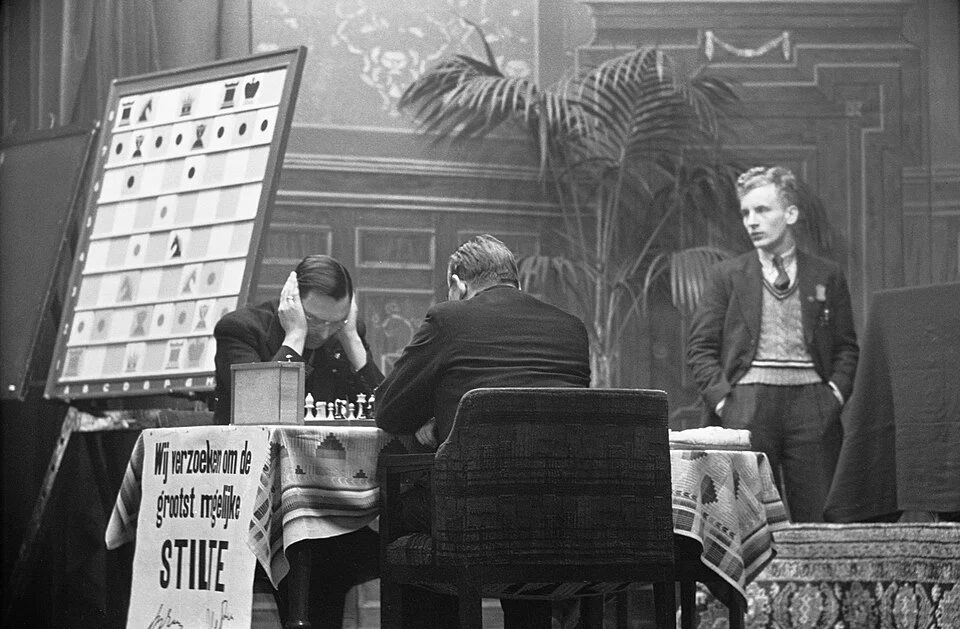
The 14th game in Zwolle illustrates how this national machinery worked locally. The Zwolse Courant brought the match to the Buitensociëteit, sold tickets through outlets in 45 towns and villages, and promoted the event on its front pages. The hall placed the players on a stage, reserved a press area, displayed the positions on a large demonstration board, and provided tables where spectators could follow the game on their own sets. Two telephone lines and an ANP telex installation served rapid reporting. About 300 people attended. The details show a pre-digital live event already organized around simultaneous physical spectatorship and remote news distribution.
Contemporary enthusiasm should still be reported with attribution. A November 1937 item in CHESS claimed that membership of the Dutch Chess Federation had doubled since the 1935 match and that Euwe was receiving 3,000 letters a week, requiring two full-time secretaries. Those figures are valuable evidence of how the chess press represented the boom, although they are not an independently audited membership series.
The gathering of master-journalists gave the match an international interpretive audience as well. Fine, Flohr, Tartakower, Kmoch, Keres, and others transmitted not only results but immediate judgments about preparation and playing style. The surviving Polygoon film of the closing ceremony shows Levenbach addressing both players, Alekhine receiving a laurel wreath, and the two contestants speaking into the microphone. The ceremony’s tone was public and civic, not merely private and contractual.
Soviet Reception and Significance
The match was not a Soviet championship, had no Soviet participant, and should not be retrofitted into a story of Soviet title possession. Alekhine was a Russian émigré and French representative whose relationship with Soviet institutions remained politically fraught. Its relevance to Soviet chess culture lay chiefly in observation and analysis.
That engagement was immediate. The year-end double issue 11-12 of Shakhmaty v SSSR for 1937 included match games with annotations by Botvinnik and Ilya Rabinovich. Its colophon shows that it was typeset after the match and approved for printing in January 1938, so it is best understood as an immediate retrospective rather than live round-by-round reporting. In 1939 the state publisher Fizkultura i Sport issued Botvinnik’s Match-revansh Alekhin-Eive na pervenstvo mira, a 216-page book with a print run of 5,000. Botvinnik annotated all 25 title games. He later placed the work within the development of his own analytical method, saying that the project helped him refine his ability to study and explain grandmaster play.
The publisher presented the rematch as the leading chess event of 1937 and as valuable study material for young Soviet players. That language reveals an institutional priority: elite foreign match play could be absorbed into a domestic culture of systematic instruction, even when its winner stood outside Soviet-organized chess. The book does not prove that the 1937 match led to Soviet supremacy later. It does show that a future world champion treated Euwe-Alekhine as a complete analytical corpus rather than as a collection of a few brilliancies.
Legacy and Historical Assessment
The most visible legacy was personal. Alekhine became the first deposed champion to win back the crown, and the achievement strengthened the historical standing of his match preparation and competitive resilience. Euwe’s loss, meanwhile, has often been read too harshly. The course of the match and the players’ own testimony show a credible champion who remained competitive until a late deterioration in results.
The institutional legacy is equally important. The contest was the last world championship conducted wholly through the old system of private agreements between champion, challenger, and local organizers. FIDE was already debating selection rules, but it had no authority over this rematch and could not bind the eventual winner to its chosen challenger. War prevented the projected matches of the late 1930s, Alekhine died while holding the title in 1946, and FIDE filled the vacancy through the 1948 championship tournament. The 1937 match did not itself create the postwar system, but it exposed the fragility of the order that system replaced.
The five friendly games played after the title was decided have produced a persistent statistical trap. They ended with two wins for Euwe, one for Alekhine, and two draws, so the aggregate of all 30 games was 17½-12½ to Alekhine. That is not the championship score. The official title result is 15½-9½ after 25 games. The exhibitions are historically useful because they show the contract being honored and Euwe recovering from the decision, but they should not be included in the title record.
Later judgment has generally emphasized the match’s fighting quality. In 1946 the Australian master and editor C. J. S. Purdy judged it, on balance, the greatest world championship match yet played, while acknowledging that it was less accurate than Capablanca-Alekhine in 1927. That was one influential contemporary-era assessment, not a timeless consensus. More securely, the record supports three conclusions: the match remained competitive much longer than its final margin implies; Alekhine’s preparation and adjournment work were central to his success; and the event joined high-level chess to an unusually developed Dutch network of press, venues, and public spectatorship.
The World Chess Championship of 1937 deserves attention today because it combined a rare sporting reversal with a revealing institutional transition. Alekhine’s recovery was emphatic but not effortless, Euwe’s resistance was stronger than the score alone suggests, and the surrounding dispute over future challengers showed that private championship governance was nearing its limit. Its Dutch public record and Botvinnik’s Soviet analytical response also make it an unusually rich case study in how a world-title match could become civic spectacle, international news, and instructional material at the same time.
Notes and Sources
Alexander Alekhine, The World’s Chess Championship, 1937: Official Account of the Games, edited by Harry Golombek, with annotations by Alekhine and Max Euwe, London, 1938. See the Open Library author and edition record. The book covers the 25 title games and five subsequent exhibition games.
Edward Winter, “Max Euwe (1901-81)”. The sections on the return-match contract, fan mail, match conditions, and the five exhibition games reproduce or identify contemporary documents, including Article 14 of the agreement signed on 28 May 1935.
Edward Winter, “World Championship Disorder”. This documentary survey cites FIDE congress records, the British Chess Magazine, CHESS, the American Chess Bulletin, Chess Review, and the Schweizerische Schachzeitung for the 1936 confirmation of the rematch and the 1937 dispute over future challenger selection.
Chess Review, 1937, especially the November and December issues, searchable full-year text at the Internet Archive. The coverage records the match conditions, Fine’s illness and replacement, Dutch and American press treatment, the international master-journalists, and contemporary evaluations of the games.
Max Euwe, “How I Lost the Title,” and Alexander Alekhine, “How I Regained the Title,” reprinted from the Manchester Guardian in Chess Review, February and March 1938. See the searchable 1938 volume at the Internet Archive. These are the principal first-person sources used for preparation, fatigue, psychology, adjournment analysis, and the players’ shared view that the final margin was exaggerated.
Edward Winter, “Alekhine and Alcohol”. The article compares conflicting testimony and documents why a simple intoxication-versus-sobriety explanation of the 1935 and 1937 results is unsafe.
De Avondpost, 2 October 1937, “De groote Strijd om den Wereldtitel”. This contemporary advance schedule is the basis for the cities, starting dates, and named venues.
Netherlands Institute for Sound and Vision, “Opening Schaakmatch Euwe-Aljechin”, 4 October 1937. The archive holds 21 minutes and 50 seconds of opening audio and identifies Hotel De Witte Brug and Max Levenbach.
Polygoon Hollands Nieuws, opening newsreel for the championship, Netherlands Institute for Sound and Vision collection. The film identifies the ministerial address, the players’ speeches, Levenbach’s drawing of lots, and the venue. The file is marked public domain on its archival description page.
Polygoon Hollands Nieuws, newsreel of Alekhine’s restoration as champion, Netherlands Institute for Sound and Vision collection. It shows Levenbach, the laurel presentation, and brief microphone remarks by both players.
De Telegraaf, 5 December 1937, front-page report on the adjourned 25th game, and De Maasbode, 8 December 1937, “Aljechin herovert het wereldkampioenschap”. The latter reports the resumption on 7 December, Euwe’s resignation after three further moves, and the title ceremony. Read together, these primary sources correct the common assumption that the title was already decided on 4 December.
Zwolse Historische Vereniging, historical account of the 14th game based on the Zwolse Courant, especially the section “Euwe-Aljechin.” It supplies the Buitensociëteit venue, ticketing network, demonstration-board arrangements, press communications, and approximate attendance.
Douglas Griffin, “Botvinnik’s book on the 1937 Euwe-Alekhine World Championship match”. Griffin documents the 1939 Soviet edition, its print run, Botvinnik’s later description of the project, and provides English translations of the annotations to all 25 title games.
Mikhail Botvinnik, Матч-реванш Алехин-Эйве на первенство мира (октябрь-декабрь 1937 г.), Moscow-Leningrad: Fizkultura i Sport, 1939. See the Russian digital catalog and scan record, which gives the publication data, contents, and publisher’s description.
Digital archive index for Шахматы в СССР, 1937, numbers 11 and 12. These issues include match games annotated by Botvinnik and Ilya Rabinovich.
Douglas Griffin’s translations of Botvinnik’s notes to game six, game 21, and game 23. These support the limited discussion of critical games and the missed opportunity in game 23.
365Chess tournament record, used only to cross-check the official 25-game score and individual results. Contemporary newspapers and the match book take precedence for adjournment completion dates and disputed venue headers.
Edward Winter, “C. J. S. Purdy”, for Purdy’s 1946 retrospective judgment of the match. It is cited as a dated historical assessment, not as a universal ranking.
Christelijk sociaal dagblad voor Nederland De Amsterdammer, 5 October 1937, “De match Euwe-Aljechin. Officieel geopend”. This report identifies the committee members, Maróczy as match director, the governmental and federation representatives, the seconds, and the opening ceremony’s invited chess figures.
Provinciale Overijsselsche en Zwolsche courant, 6 December 1937, “Alle partijen zullen worden gespeeld”, for the committee’s statement that all 30 contractually scheduled games would be played even after the title was decided; and Groninger dagblad, 17 December 1937, “Het slot van de match Euwe-Aljechin”, for the final friendly game and the 17½-12½ aggregate.
The New Yorker, “The Talk of the Town,” 13 November 1937, for a contemporary American cultural response to the sixth game. Its presence qualifies, but does not overturn, Chess Review’s complaint about weak general newspaper coverage in the United States.
