Gennadi Kuzmin
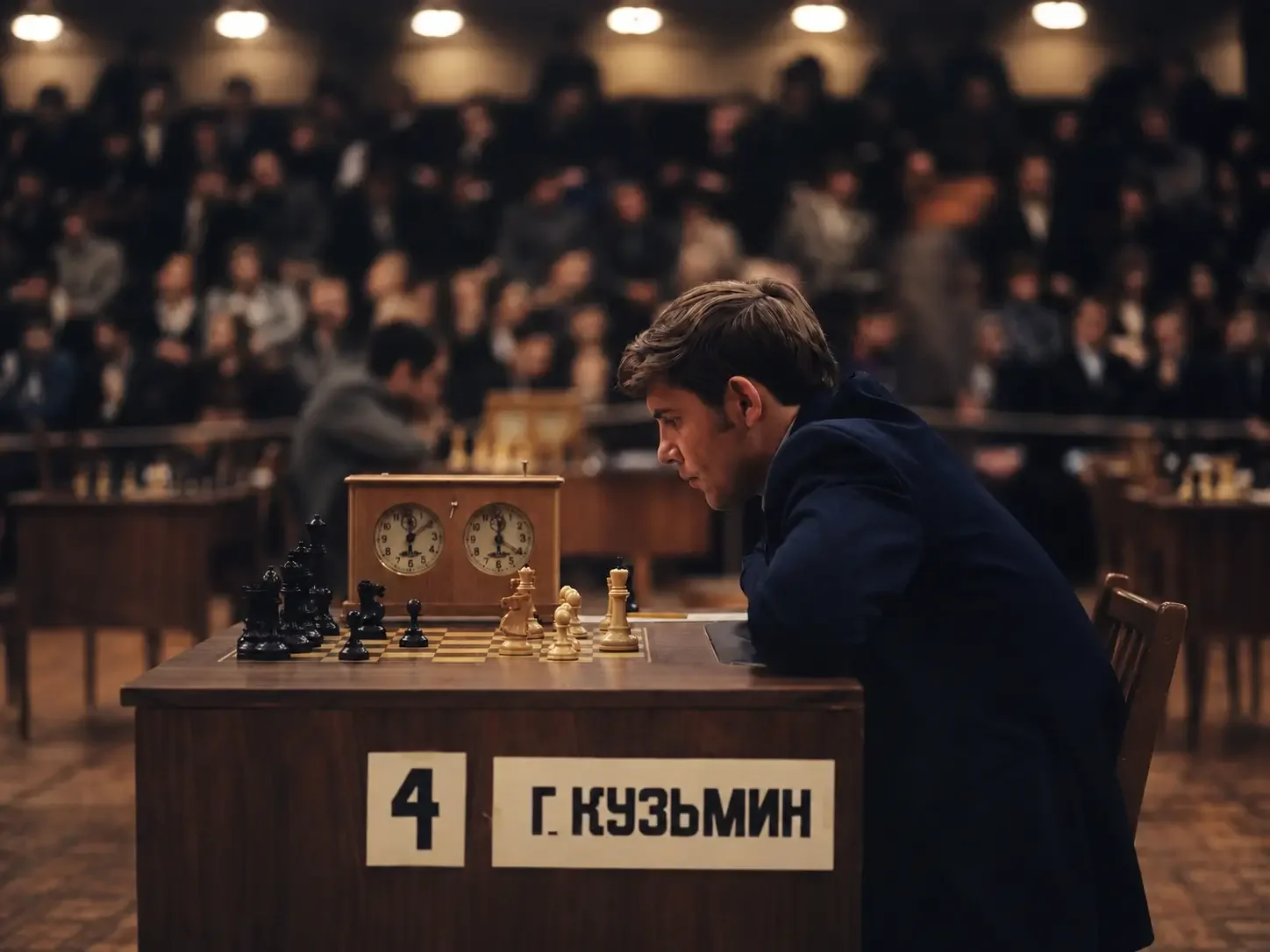
Introduction
Gennadi Pavlovich Kuzmin was one of the strongest grandmasters based in the Ukrainian SSR during the 1970s. Born in 1946, he reached the world top 15, played in two Interzonal tournaments, shared second place in one of the strongest USSR championships, and helped the Soviet Union win both the European Team Championship and the Chess Olympiad. His later work was at least as consequential. As a trainer and second, he contributed to Maia Chiburdanidze's long reign as women's world champion and to Ruslan Ponomariov's victory in the 2001 to 2002 FIDE World Championship.
English sources variously render his first name as Gennadi, Gennady, or Hennadiy. In Russian, he was Геннадий Павлович Кузьмин; in Ukrainian, Геннадій Павлович Кузьмін. This article follows the spelling Gennadi Kuzmin.
Kuzmin's career rewards careful study because several familiar summaries contain small but significant errors. He played ten USSR Championship finals, not eleven. The European team title came at Bath in 1973, not 1972. At Nice in 1974 he won team gold and an individual bronze medal, despite later reports of two gold medals. Current Ukrainian Chess Federation records recognize him as champion in 1969 and 1999; his equal score with Igor Novikov in 1989 produced second place on tie-break. These corrections produce a sharper historical profile. His standing rests on sustained evidence: elite results, exceptional team performances, and a coaching record that joined the Soviet and independent Ukrainian eras. (2, 13, 25, 33, 45)
Early Life and Chess Formation
Kuzmin was born on 19 January 1946 in Mariinsk, Kemerovo Oblast, in the Russian Soviet Federative Socialist Republic. During childhood, he moved to Voroshilovgrad, the industrial city now called Luhansk, where most of his chess training and much of his later teaching took place. Publicly accessible biographical sources give little reliable information about his parents or their occupations. Adrian Mikhalchishin and Oleg Stetsko write that Kuzmin was raised by his mother and did not know his father. No independent family record has surfaced, so that detail remains published secondary testimony. (4, 6, 34)
Kuzmin supplied a simple account of his chess beginnings late in life. Speaking to students in Luhansk in 2016, he recalled living near the First of May Park, entering its chess pavilion at about six, and discovering a community of local players. He had no sense at the time that the game would become his profession. Dmitry Kryakvin's later biographical essay identifies Kuzmin's principal formative coach as Yakov Abramovich Morgulis, a locally respected teacher whose own competitive rank was only second category. Morgulis encouraged active play in the Sicilian and King's Indian Defenses and insisted that dynamic ambitions had to remain positionally sound. The combination is relevant to Kuzmin's mature style: coordination and counterplay underpinned his pursuit of the initiative. (3, 4)
His education proceeded alongside chess. A July 1968 issue of Sovetsky Sport, previewing the World Student Team Championship, listed the 22-year-old Kuzmin as a student of the Luhansk Machine-Building Institute. The Encyclopedia of Modern Ukraine states that he graduated there. This technical education was typical of Soviet players who acquired a profession as they progressed through the sports system. Kuzmin ultimately made chess his life's work. (5, 27)
His rise was unusually fast for a player outside the leading chess centers. Kuzmin won the USSR junior championship in 1963 and fulfilled the Soviet master standard at seventeen; later accounts date his Master of Sport designation to 1964. In 1965 he qualified for the adult USSR Championship final. His first appearance produced a modest score. Qualification itself placed a teenager from Voroshilovgrad inside the country's highest competitive tier. He returned to the final in 1967, then became a regular contender in the 1970s and 1980s. (4, 6, 33)
Rise in Competitive Chess
The World Student Team Championships gave Kuzmin valuable international experience and an early role within Soviet team culture. He represented the USSR in 1966, 1967, 1968, and 1971. The team won gold on all four occasions. Across those events, he scored 30 points from 38 games, including 25 wins, and earned two individual board gold medals. Soviet student teams included future grandmasters and served as a proving ground for players who had not secured regular invitations abroad. (7)
By 1969 Kuzmin had won the Ukrainian championship jointly with Vladimir Savon. The planned playoff was abandoned for organizational reasons, and both players were declared champions. (40) His wider breakthrough came in the early 1970s. At Sochi in 1970, in a tournament pitting younger masters against established grandmasters, he scored 9/13 and defeated Viktor Korchnoi in both of their games. A contemporary Shakhmaty v SSSR report said the participants regarded his victory among the masters as fully deserved and singled out the imaginative quality of his play. He won the All-Union tournament of young masters in 1971. These results marked his transition from promising Soviet master to a credible member of the national elite. (6, 41)
The 1972 USSR Championship in Baku transformed that standing into a place in the world championship cycle. Kuzmin scored 12.5 from 21 and shared third through fifth with Savon and Mikhail Mukhin, behind Mikhail Tal and Vladimir Tukmakov. Because the championship also served as a FIDE zonal, the three tied players entered a double round-robin playoff for two Interzonal places. All finished on 2 from 4; the tie-break inherited from the championship eliminated Mukhin, sending Kuzmin and Savon forward. (8, 9)
Kuzmin's first Interzonal, held in Leningrad in 1973, was a strong result without yielding further qualification. He scored 9.5 from 17 and finished seventh in an eighteen-player field. Only the top three advanced to the Candidates matches. FIDE awarded him the grandmaster title that year. Earlier in 1973 he had shared third at the Capablanca Memorial in Cienfuegos, scoring 15 from 21 behind Vasily Smyslov and Wolfgang Uhlmann. (10, 11)
His finest individual championship result followed in Moscow later that year. Kuzmin scored 10.5 from 17, with five wins, one loss, and eleven draws. He shared second through sixth with Karpov, Tigran Petrosian, Korchnoi, and Lev Polugaevsky, one point behind Boris Spassky. The field contained four former world champions, the next world champion, and much of the Soviet grandmaster establishment. A shared placing in such company was persuasive evidence that Kuzmin's rating and Interzonal qualification reflected genuine elite strength. (12)
Major Career Achievements
Kuzmin's peak extended from 1973 to 1974. At the European Team Championship in Bath in 1973, he scored 3 from 5 on board eight as the USSR won team gold; his result earned the board silver medal. At Hastings 1973 to 1974, he shared first with Tal, László Szabó, and Jan Timman. The May 1974 FIDE list placed him at 2600, tied around fifteenth in the world. That ranking helps recover the contemporary scale of his reputation. Participation in the world championship cycle was entirely consistent with his standing. (13, 14, 15)
The 1974 Nice Olympiad provided his most visible team success. Used as the Soviet second reserve, Kuzmin remained unbeaten and scored 12.5 from 15, with ten wins. The USSR won the Olympiad by a wide margin, and Kuzmin's percentage earned individual bronze on his reserve board. Some later obituaries called this an individual gold. OlimpBase's reconstruction of the board standings places James Tarjan and Frans Kuijpers fractionally ahead on percentage. The correction leaves the essential point intact: Kuzmin was one of the team's most productive scorers. (16, 17)
His absence from the 1976 Biel Interzonal became an important episode in later accounts of his career. Russian retrospective sources report that a special FIDE selection process initially favored Kuzmin and that contemporary published lists named him, allowing him to skip the Soviet zonal. Smyslov ultimately received the place. Kuzmin and several later commentators regarded the change as an unjust replacement. The surviving public record does not supply a complete administrative paper trail. Allegations involving a fictitious illness or political patronage must therefore remain attributed recollections. What can be said with confidence is that Kuzmin was rated at a world-class level, was expected by informed observers to play, and was absent when the tournament began. (4, 18)
Kuzmin returned to the cycle through results at the board. He won the USSR Championship First League in 1977 (42). He then shared third through fifth in the 1978 Lvov zonal. A playoff in Tallinn in early 1979 sent him and Vitaly Tseshkovsky to the Riga Interzonal. There Kuzmin scored 9 from 17 and shared eighth through tenth. He therefore never advanced from an Interzonal to the Candidates stage, the clearest competitive boundary in an otherwise distinguished career. (19, 20)
His international record remained substantial after his peak. He won Reggio Emilia outright in 1976 to 1977 and shared first at Dortmund in 1981 with Jonathan Speelman and Ľubomír Ftáčnik. In 1994, at forty-eight, he shared first in the large Cappelle-la-Grande Open. Within Soviet team competition, he helped the Ukrainian Republic win in 1979 and 1981. In independent Ukraine, he remained a valuable player for Danko-Donbass, contributing to multiple national club titles. These results show that his competitive value extended well beyond the early 1970s. (21, 22, 23, 24, 39)
The Ukrainian championship record requires exact wording. Kuzmin was joint champion with Savon in 1969. In 1989, he and Igor Novikov each scored 10.5 out of 15; Novikov received the title on the Berger tiebreak. (45) In 1999 Kuzmin, Alexei Bezgodov, and Stanislav Savchenko each scored 6 from 8, with Kuzmin credited with the title. Many biographies consequently call him a three-time champion. The federation's current list and the 1989 tie-break support two official titles and one additional equal-first score. (25, 26)
Style and Reputation
Contemporary descriptions and later testimony converge on an unusually independent practical player. A 1965 report in Shakhmaty v SSSR praised the nineteen-year-old's tactical vision and pursuit of the initiative, then identified persistence in defense as his leading quality in that event. Mark Taimanov's notes to their 1973 Interzonal game likewise emphasized Kuzmin's original preparation, courageous defensive decisions, and unexpected saving resources. This evidence supports the standard description of him as universal, initiative-seeking, tenacious, and inventive in defense. (35, 36)
Yuri Razuvaev and Mikhail Postovsky's contemporary account of Kuzmin's 1977 First League victory adds an important qualification. They called him original and highly inventive, noted the new opening ideas he had prepared for the event, and emphasized his composure and decisiveness in sharp positions. Kuzmin was the only unbeaten player. This assessment shows that the occasional improviser was also capable of concentrated, effective preparation. (42)
Vyacheslav Dydyshko's notes to their game at Minsk in 1982 called one of Kuzmin's choices unstereotyped and characteristic of him, then praised the accuracy of his technical conversion. The assessment is useful evidence that Kuzmin's originality extended into quieter phases of play. (43)
Kryakvin records Kuzmin's colleagues as saying that many grandmasters preferred established roads and Kuzmin made his own. Kuzmin acknowledged that he sometimes reached the board without detailed theoretical knowledge and had to invent. His originality therefore arose partly from strength and partly from necessity. (4)
His strongest play featured active piece coordination, rapid recognition of counterplay, and a willingness to accept structural or material risk when the initiative justified it. The celebrated 1973 win over Evgeny Sveshnikov, involving successive bishop sacrifices, became a concise emblem of that approach. Its historical value lies in the reputation it created, not in any single tactical sequence. Sveshnikov later remembered the defeat as a severe punishment for abandoning his usual opening choice. (18)
The same independence could produce uneven opening preparation. Kuzmin's own admission that he sometimes improvised early helps explain both the freshness of his positions and the variability of his results. Notes from the 1979 Riga Interzonal report that he had forgotten a known early move; Polugaevsky and Orest Averkin also observed that passive defense did not suit him. (44) He reached the world top 15. Neither Interzonal produced a Candidates place. Reducing his chess to tactical originality would still be misleading. Kateryna Lagno, who analyzed and played blitz with him at the Kramatorsk school, emphasized his deep understanding of counterplay and his ability to explain difficult positions in simple terms. Zahar Efimenko remembered how quickly he generated ideas; Viktor Moskalenko stressed his originality as both player and coach. These are retrospective personal assessments. Their agreement with the games and results gives them interpretive weight. Lagno also explicitly stated that Kuzmin was never her official coach, an important distinction in tracing his influence. (18)
His originality left a small but identifiable trace in opening practice. Modern specialist sources credit Kuzmin with an early a-pawn thrust in a main Scheveningen structure that later became associated with Goloshchapov and Volokitin. Grigory Serper has also argued that Kuzmin played an important Richter-Rauzer idea before it was widely attributed elsewhere and allows for independent discovery. These are limited priority claims. They show that Kuzmin contributed practical theoretical ideas as well as inventing solutions for a single game. (37, 38)
Contributions Beyond Tournament Play
By the 1980s Kuzmin was increasingly combining competition with high-level training. His first major work in the women's world championship system was with Lidia Semenova during her rise through the Candidates cycle. He later consulted Andrei Sokolov. His most sustained elite partnership was with Maia Chiburdanidze from 1984 to 1993. During that period she successfully defended the world title against Irina Levitina in 1984, Elena Akhmylovskaya in 1986, and Nana Ioseliani in 1988 to 1989, then lost the title to Xie Jun in 1991. Later Russian accounts describe Kuzmin as a major generator of ideas within her team. The documented duration of the partnership makes clear that his role extended across several match cycles. (27, 4)
The formal honors followed the work: Honored Trainer of the Georgian SSR in 1984, Honored Trainer of the USSR in 1991, and Honored Trainer of Ukraine in 1992. Kuzmin and Chiburdanidze also coauthored Olympiad-90: Selected Games, a 143-page annotated book on the Novi Sad Olympiad published in Tolyatti in 1991. It appears to have been his principal book-length publication. His historical identity is that of a practical analyst and educator who also produced occasional written work. No substantial corpus supports describing him as a prolific author or the founder of a named opening system. (27, 28)
After the Soviet collapse, Kuzmin worked within the new Ukrainian chess structure and remained closely tied to Luhansk and the wider Donbas training network. He served with the Ukrainian women's national team in the early to mid-1990s. Sources that credit that team with bronze at the 1997 European championship are incorrect, since Ukraine did not participate in that event. (46) The reliable claim is the institutional role itself. The Encyclopedia of Modern Ukraine identifies Kuzmin as senior trainer of Ukraine's youth team in 1999; that team, including Ponomariov, Pavel Eljanov, Alexander Zubov, Efimenko, and Andriy Volokytin, won the Children's Chess Olympiad at Artek. (27, 29)
His work with Ponomariov offers the clearest primary evidence of Kuzmin's coaching method. In a detailed 2020 retrospective, Ponomariov recalled that Kuzmin traveled with him to Moscow as his second for the 2001 FIDE knockout championship. Kuzmin taught him the Ruy Lopez, recommended lodging near the Kremlin venue so that he could rest before same-day tie-breaks, steadied him after a painful loss to Alexander Morozevich, and supplied fresh opening ideas during the event. Ponomariov later remembered that, when his computer failed, Kuzmin kept instilling optimism before each game. For the January 2002 final against Vasyl Ivanchuk, the team expanded to include Veselin Topalov and others. Kuzmin held a central role within that collaborative effort. (30, 31)
At the local level, Kuzmin taught or guided Alexander Areshchenko, Valery Aveskulov, Artur Frolov, Gennadi Ginsburg, and other young players. His contact with Lagno was informal but substantial. Accounts of his teaching consistently emphasize plans, coordination, and the search for active resources. A 2008 Russian Chess Federation report documents him leading a session at the Elista Chess Academy's grandmaster school, with lectures, individual work, simultaneous exhibitions, and post-game analysis. At seventy, he was still teaching at Luhansk Children's and Youth Sports School No. 4 and giving public simultaneous exhibitions. (32, 3)
One locally remembered episode captures the civic dimension of his career. Kryakvin relates that, after the 1974 Olympiad, a regional official offered Kuzmin a personal reward, possibly a larger apartment. Kuzmin reportedly asked for a chess club for Voroshilovgrad instead. The club then served the city for decades. No independent archival confirmation has been located, so the episode belongs in the record as an attributed memorial recollection. It is consistent with his long practice of returning from tournaments to demonstrate games and discuss general principles with local players. (4)
Later Life and Historical Legacy
Kuzmin continued to live and teach in Luhansk into his seventies. Kryakvin writes that he married at fifty, had no children, and outlived his wife; these personal details have not been independently documented. Serious illness restricted his final years. Memorial accounts state that he continued working at the chess school until his health made attendance impossible. He died in Luhansk on 28 February 2020, aged seventy-four. The Ukrainian Chess Federation described him as an outstanding Ukrainian player and trainer and confirmed his coaching honors in Georgia, the USSR, and Ukraine. (1, 4)
His historical standing has three foundations. First is the competitive peak: two Interzonals, a share of second in the 1973 USSR Championship, a 2600 rating around the world top 15, and an exceptional Olympiad score. Second is longevity across institutions, from Soviet student teams and republic championships to independent Ukrainian club and national-team chess. Third is the transmission of practical knowledge. Chiburdanidze's match team, Ponomariov's championship campaign, and the Luhansk and Kramatorsk schools connected Kuzmin to several generations of elite players.
Gennadi Kuzmin deserves attention today because his career enlarges the usual picture of Soviet chess excellence. He reached the highest international qualifying level from a regional chess culture, remained an original and formidable grandmaster for decades, and converted his practical insight into durable coaching influence. His name belongs in the history of both Soviet competition and Ukrainian chess education.
Notes and Sources
Ukrainian Chess Federation, 2020 archive, entry for 28 February 2020. Official notice of Kuzmin's death and coaching honors. The notice calls him a two-time Ukrainian champion.
OlimpBase, Gennady Kuzmin Olympiad record. Used for team and individual medal verification.
Luhansk Information Center, report and Kuzmin recollections, 24 November 2016. Contains Kuzmin's first-person account of discovering chess and documents his later teaching.
Dmitry Kryakvin, "Жизнь не по первой линии", Russian Chess Federation. A substantial retrospective biography. Personal stories and claims about administrative decisions are treated as attributed recollections.
Sovetsky Sport, no. 166, 17 July 1968, Yandex newspaper archive. Contemporary evidence that Kuzmin attended the Luhansk Machine-Building Institute.
Russian Chess Federation obituary, 28 February 2020. Useful summary of his early and competitive career. Its dating of the European Team Championship and its account of Biel require correction or qualification from other sources.
OlimpBase, World Student Team Championship player record. Four appearances, four Soviet team gold medals, two board gold medals, and a cumulative 30 from 38.
OlimpBase, 1972 USSR zonal playoff. Crosstable and tie-break explanation.
Douglas Griffin, "Vladimir Savon (1940-2005)". Specialist historical discussion of the 1972 USSR Championship and subsequent playoff.
Douglas Griffin, "The Leningrad Interzonal, 1973". Uses contemporary Soviet press and annotated game sources.
OlimpBase, Capablanca Memorial 1973. Full event crosstable, used to resolve conflicting summaries of Kuzmin's placing.
Douglas Griffin, "Anatoly Karpov at the 41st USSR Championship". Contemporary-source-based reconstruction of the championship and its final standings.
OlimpBase, Kuzmin's European Team Championship record. Confirms Bath 1973, team gold, and board silver.
Hastings International Chess Congress, previous winners. Official event history for the 1973 to 1974 four-way tie.
FIDE rating list, May 1974, preserved by OlimpBase. Kuzmin is listed at 2600 in the group around fifteenth place.
OlimpBase, Nice 1974 individual medal reconstruction. Confirms Kuzmin's unbeaten 12.5 from 15 and individual bronze.
OlimpBase, Soviet team at Nice 1974. Team roster and gold-medal result.
Chess.com obituary and contemporary testimonials, 29 February 2020. Used for direct recollections by Lagno, Efimenko, Areshchenko, and Moskalenko. Its Nice medal description is contradicted by OlimpBase.
OlimpBase, Kuzmin's 1981 world championship cycle record. Used for the Lvov zonal and Tallinn playoff sequence.
Chessgames, Riga Interzonal 1979. Event record and games.
OlimpBase, Reggio Emilia 1976 to 1977. Full crosstable.
365Chess, Dortmund 1981. Event record and shared first place.
Cappelle-la-Grande Open historical record. Used for Kuzmin's 1994 shared first place.
OlimpBase, Soviet republic team championship record. Confirms Ukrainian team victories in 1979 and 1981.
Ukrainian Chess Federation, historical list of men's champions. Lists Kuzmin in 1969 and 1999 and Novikov in 1989.
OlimpBase, Ukrainian Championship 1999. Final ranking and scores. The page's round-by-round pairing record is incomplete, but its final standings are clear.
H. A. Rudnytskyi, "Кузьмін Геннадій Павлович," Encyclopedia of Modern Ukraine. Used for coaching roles and formal honors. Its birth date is erroneous and has not been followed.
Russian National Electronic Library catalog record for Olympiad-90: Selected Games. Authoritative bibliographic record for the Chiburdanidze and Kuzmin book.
OlimpBase, Ukraine at the 1999 Children's Chess Olympiad. Team composition and result.
Ruslan Ponomariov, 2020 retrospective interview, Terrikon. Detailed first-person account of Kuzmin's work as his second.
Ruslan Ponomariov, 2011 reader conference, Crestbook. First-person evidence for Kuzmin's psychological support during the Moscow championship.
Russian Chess Federation, Elista grandmaster school report, 3 April 2008. Contemporary institutional record of Kuzmin's teaching program.
OlimpBase, Kuzmin's USSR Championship record. Confirms ten finals and separates Gennadi Kuzmin from Alexey Kuzmin in the 1991 event.
Adrian Mikhalchishin and Oleg Stetsko, Золотой век советских шахмат (Moscow, 2014), pp. 67 to 68. Catalog record from the Russian National Public Library for Science and Technology. Used cautiously for the limited family-background account.
Russian Chess Federation, "Дети Победы". Reproduces a 1965 Shakhmaty v SSSR assessment of Kuzmin's tactical vision, initiative, and defensive persistence.
Mark Taimanov, annotations to Kuzmin versus Taimanov, Leningrad Interzonal 1973, translated by Douglas Griffin from the official Soviet tournament book.
ChessBase, discussion of Kuzmin's Scheveningen idea. Used only to identify the plan's association with Kuzmin, without reproducing analysis.
Grigory Serper, "The Butterfly Effect". Specialist discussion of independent priority for a Richter-Rauzer idea.
OlimpBase, Kuzmin's Ukrainian club record. The ledger is incomplete but supports the claim of multiple national club titles with Danko-Donbass.
64, no. 14 (1969), archive directory, p. 10. Contemporary report of the Ukrainian championship and the decision to declare Kuzmin and Savon joint champions. The issue is listed in the directory as “64 - Шахматное обозрение, 1969, №14(0040).pdf.”
Shakhmaty v SSSR, no. 1 (January 1971), p. 5. Contemporary assessment of Kuzmin's victory among the masters in the Sochi masters versus grandmasters event.
Yuri Razuvaev and Mikhail Postovsky, Shakhmaty v SSSR, no. 1 (January 1978), p. 2. Contemporary account of Kuzmin's 1977 First League victory, including an assessment of his style and preparation.
Vyacheslav Dydyshko, annotations to Kuzmin versus Dydyshko, Minsk 1982, translated by Douglas Griffin from the official tournament book.
Lev Polugaevsky and Orest Averkin, annotations to Kuzmin versus Polugaevsky, Riga Interzonal 1979, translated by Douglas Griffin from the official Soviet tournament book.
OlimpBase, Ukrainian Championship 1989. Final crosstable and Berger tie-break values for Novikov and Kuzmin.
OlimpBase, Women's European Team Championship 1997. Team roster and standings, used to verify that Ukraine did not participate.
