Portorož Interzonal of 1958
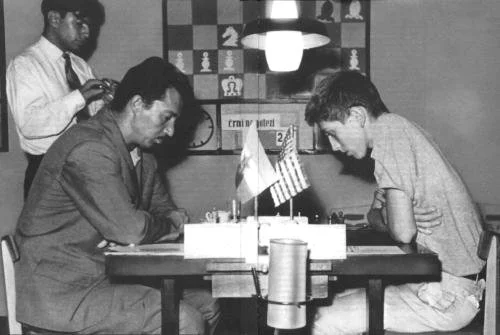
Gligoric and Fischer in Portoroz 1958
Introduction
The Portorož Interzonal of 1958 survives in popular memory chiefly as the tournament in which fifteen-year-old Bobby Fischer became a world championship Candidate. That milestone belongs inside a larger history. Portorož was also Mikhail Tal’s first major individual tournament victory outside the Soviet Union, Tigran Petrosian’s near miss after leading much of the event, Svetozar Gligorić’s half-point pursuit on home soil, and the scene of a late FIDE administrative decision made during active play. Its last qualifying place remained undecided until the final adjourned game ended.
The competitive schedule ran from 5 August to 12 September 1958. The official program printed the wider span from 4 August to 14 September. Twenty-one players met in a single round robin in Portorož, then a Slovenian resort in the Federal People’s Republic of Yugoslavia. Tal won with 13½ points from 20 games. Gligorić finished half a point behind, followed by Petrosian and Pál Benko on 12½, then Friðrik Ólafsson and Fischer on 12. Those six advanced to the 1959 Candidates Tournament. Five players finished only half a point below the line.
Portorož deserves study as a complete event. The tournament brought together FIDE administration, the Yugoslav chess organization, resort culture, Soviet sporting ambition, and a genuinely international field. It also recorded a shift in competitive authority. Tal won the tournament, Fischer changed expectations about the age at which a player could qualify for the Candidates, Ólafsson established Iceland at that level, and Bronstein, a two-time Interzonal winner, failed to advance.
Historical Setting
Portorož was the fourth FIDE Interzonal and the first held outside Sweden. It occupied the middle stage of the three-year world championship cycle: zonal tournaments selected the Interzonal field; the Interzonal supplied most of the Candidates; and the winner of the Candidates earned a match against the world champion. Mikhail Botvinnik had regained the title from Vasily Smyslov in May 1958. Smyslov, as the defeated champion, and Paul Keres, second in the 1956 Candidates, already held places in the next Candidates event.
The Soviet route to Portorož passed through the 25th USSR Championship in Riga, held from 12 January to 14 February 1958 and designated as the Soviet zonal. Tal won his second consecutive Soviet title. Petrosian, David Bronstein, and Yuri Averbakh took the other three Interzonal places. Boris Spassky missed qualification after losing his adjourned final-round game to Tal. The zonal result fully explains his absence; no selection decision or withdrawal was involved.
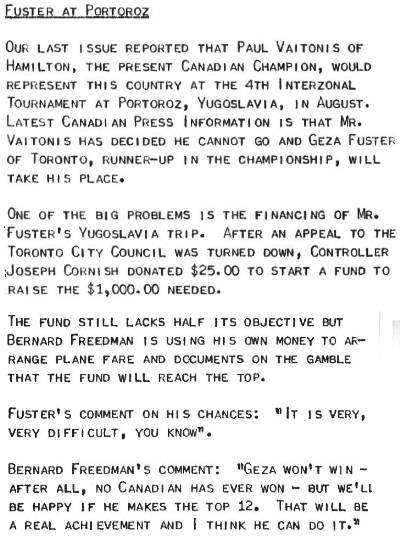
The remaining entrants came through three European zonals and the American, Canadian, Central American, South American, and newly constituted Asian zones. Cardoso’s presence marked the first Interzonal representation of FIDE’s new Asian zone. Two replacements altered the announced field. Samuel Reshevsky, the second United States qualifier behind Fischer, declined; his notice in Chess Life gave no reason. James Sherwin took his place. Canadian qualifier Povilas Vaitonis could not attend, and Géza Füster replaced him. The contemporary Canadian notice does not state why. No one withdrew after play began, and all 210 games were completed.
The field combined established Candidates with players whose international standing was still taking shape. Bronstein had challenged Botvinnik in 1951 and had won both the 1948 and 1955 Interzonals. Averbakh, Petrosian, Gligorić, László Szabó, Luděk Pachman, Oscar Panno, and Miroslav Filip had extensive experience at the highest level. Tal arrived as the twice reigning Soviet champion at twenty-one. Fischer, the United States champion at fifteen, was playing his first full elite tournament abroad. Ólafsson and Bent Larsen embodied the growing strength of Nordic chess. Benko occupied an unusual position: he had qualified through the Dublin European zonal as a Hungarian, had since left Hungary, and was living in the United States without American citizenship. Dragoslav Andrić’s contemporary report noted that no national flag stood on Benko’s table.
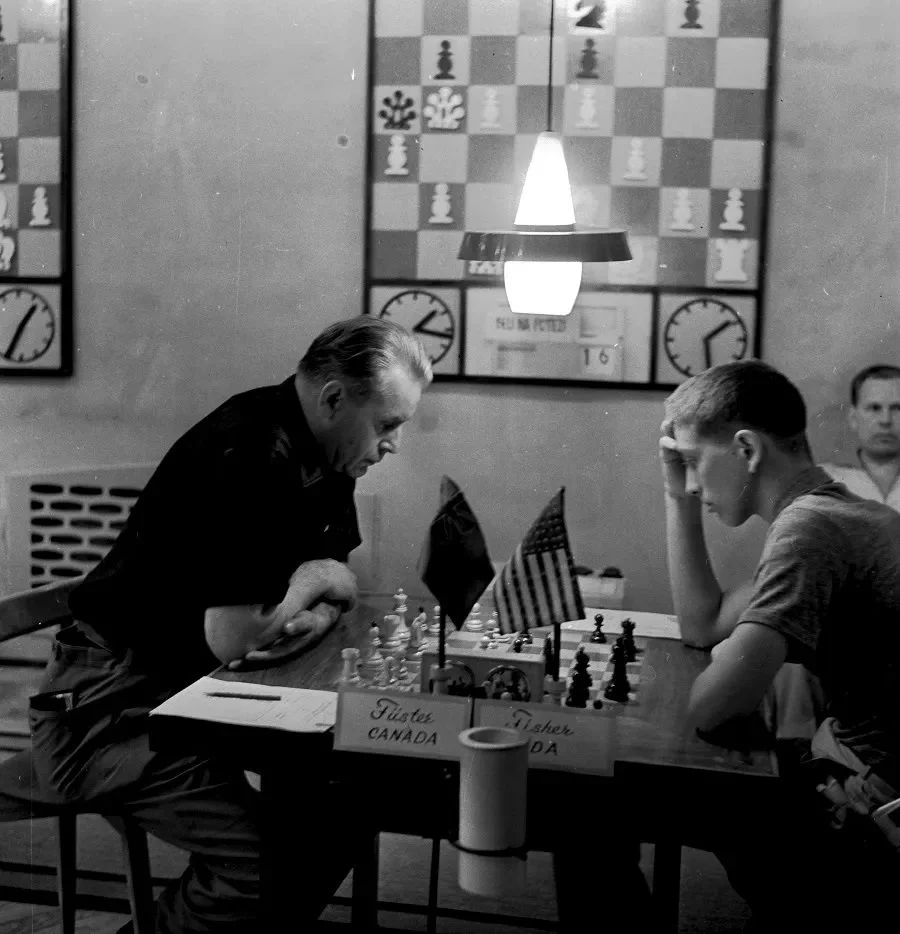
Source: Douglas Griffin, X
Organization, Format, and Field
Portorož was an established Adriatic resort. The Interzonal brought FIDE’s world championship cycle into that seasonal tourist culture. Contemporary Slovenian coverage places the tournament in the renovated Ljudski dom (“People’s Home” or “People’s Hall”), which Andrić’s report in Tidskrift för Schack rendered as the Culture Hall. This evidence conflicts with some later identifications of the Palace Hotel ballroom as the playing venue. Fischer lodged at the Park Hotel, and the closing banquet took place at the Palace Hotel.
The event formed part of FIDE’s world championship cycle and was staged by Yugoslav hosts. Harry Golombek served as chief arbiter, assisted by Vladimir Vuković. The on-site tournament committee consisted of Averbakh, Neikirch, Gligorić, Rossetto, and the Yugoslav official Ozren Nedeljković. This mixed committee of contestants and organizers reflected common mid-century tournament practice. The accessible contemporary record identifies the committee more securely than it assigns every administrative responsibility to a single national federation.
Each player contested 20 games and received one bye across 21 scheduled rounds. Normal sessions ran from 17:00 to 22:00, with a time control of 40 moves in two and a half hours. Adjournment days and six full rest days were built into the long schedule. Twelve cash prizes ranged from 300,000 dinars for first place to 30,000 for twelfth; other players received 2,000 dinars per point, and several special prizes were offered. The opening ceremony included a performance of the FIDE hymn composed by Count Gian Carlo Dal Verme. Portorož maintained its normal tourist entertainment, including the traditional “Portorož Nights” and evening programs. Separately, the Interzonal committee organized an excursion to Socerb, Postojna Cave, and Lipica. The Yugoslav Women’s Championship was held concurrently in nearby Izola, placing the Interzonal within a broader regional chess program.
The setting had a polished public face and some operational imperfections. Andrić described prominent flags, a large results board, crowds at the entrance, and separate rooms for the many journalists. Golombek later recalled electrical failures at important moments. His recollection is retrospective; the contemporary reports cited here do not mention comparable failures.
The tournament’s most consequential administrative event occurred away from the board. The rules announced before Portorož sent five finishers to a seven-player Candidates field with Smyslov and Keres. A national limit of four Candidates meant that only two of the four Portorož Soviets could join the two already seeded. During the tournament, the players petitioned the FIDE Congress meeting in Dubrovnik for eight or nine Interzonal places. According to Golombek’s contemporary report, the Congress could not amend the regulations at such a late stage. FIDE president Folke Rogard used existing nomination powers to add a sixth Portorož qualifier, thereby enlarging the Candidates to eight. A Soviet report published on 31 August described the resulting arrangement as six Portorož qualifiers, an eight-player Candidates tournament, and a five-per-country ceiling. As many as three Soviet qualifiers could therefore have joined Smyslov and Keres.
The decision came late enough that newspapers opening the event still told readers that five would advance. Chess Life later admitted uncertainty about the precise scope of the revised national limit. The ambiguity led to no disputed exclusion because only Tal and Petrosian, among the four Soviet representatives, eventually finished in the top six. The addition of a sixth place had an enormous practical consequence: it allowed both Fischer and Ólafsson to qualify.
Main Course of the Tournament
Tal began with victories over Boris de Greiff and Szabó, then lost to Aleksandar Matanović in round four. It was his only defeat. The setback ended his first spell in the lead and allowed Averbakh and Petrosian to move ahead. Petrosian then became the central figure of the first two-thirds of the tournament. He stood alone at the top after round seven and retained the lead through round fourteen. After eleven rounds he had six wins and five draws.
Tal’s recovery developed through accumulation. Wins over Füster, Rossetto, and Benko in rounds nine through eleven brought him close. The lead was transferred directly through two successive games involving Larsen. Tal defeated the Dane in round fifteen and drew level with Petrosian. In round sixteen Larsen, despite an otherwise disappointing tournament, inflicted Petrosian’s sole defeat. Tal drew with Raúl Sanguineti and then led alone. His round-seventeen victory over Panno increased the margin to a full point and became the most celebrated game of the event.
Gligorić’s second-place finish came from a late surge. He had 6 points from his first 11 games, including losses to Ólafsson and Sherwin. Across his next seven played games, he scored 6 points, defeating Pachman, Rodolfo Cardoso, Oleg Neikirch, Füster, and Rossetto. He completed the event with draws against Benko and Fischer. The result carried special weight in Yugoslavia: the leading home player came within half a point of first and also served on the tournament committee.
The contest for the remaining Candidates' places remained tight. Benko recovered from defeats by Panno and Tal and displayed particular steadiness late in the event. Fischer lost to Benko in round four and to Ólafsson in round eleven, then remained unbeaten over his last ten rounds. Ólafsson’s course was more volatile. Wins over Gligorić, Fischer, Averbakh, and Larsen offset losses to lower-placed opponents, including Sherwin in the penultimate round. He entered the final round needing a win to avoid dependence on a large playoff.
Bronstein followed a different pattern. He entered the final round undefeated and eventually accumulated fifteen draws. That solidity kept him in the qualification race with little margin for one adverse result. Averbakh had shared the early lead and also remained within reach. Matanović, Pachman, and Szabó joined them in the dense group immediately below the qualifying six.
Winner and Key Contenders
Tal’s winning score was 13½ from 20, made up of eight wins, eleven draws, and one loss. The half-point margin understates the competitive tension. Tal and Gligorić each won eight games. Tal’s single loss, against Gligorić’s two, supplied the half-point edge. His victory followed the Soviet championships of 1957 and 1958 and preceded an exceptional performance at the 1956 Olympics in Munich later that autumn. Contemporary Soviet reporting consequently presented Portorož as the third major success in a continuous rise. A near-contemporary Soviet annual placed this sequence under the heading “Birth of a New Challenger.” Retrospect gives that judgment added significance, since Tal went on to win the 1959 Candidates and defeat Botvinnik in 1960.
Petrosian’s 12½ reflected the event’s strongest first half and a restrained finish. After his loss to Larsen, he drew his remaining games and shared third and fourth with Benko. Gligorić’s 13 brought him sole second. Benko’s shared third was especially notable given his unsettled national status. It confirmed his place at the highest level, and he qualified again for the 1962 Candidates.
Fischer and Ólafsson shared fifth and sixth with 12. FIDE registered Fischer and Benko as grandmasters after the tournament, and Sherwin’s score earned the international master title. Ólafsson had been awarded the grandmaster title at the Dubrovnik Congress during Portorož. Fischer became the youngest grandmaster and youngest Candidate recorded to that date. Ólafsson became the first Icelander to reach the Candidates and the country’s first grandmaster.
The line below them was exceptionally narrow. Bronstein, Averbakh, Matanović, Pachman, and Szabó all finished on 11½, sharing seventh through eleventh. Panno and Filip followed on 11. Portorož used no recorded tie-break ordering for the shared places, and later database rankings should not be mistaken for an official separation.
Tal’s victory offered Soviet chess a convincing new contender. From a later historical perspective, the overall outcome was more complex. Only two of the four Soviet entrants advanced. Bronstein and Averbakh fell half a point short in a tie with three strong non-Soviet grandmasters. The outcome demonstrated both the depth of Soviet chess and the increasing capacity of leading players elsewhere to compete successfully across a full FIDE field.
Critical Games and Turning Points
Matanović’s round-four victory over Tal supplied the first important correction to the tournament’s course. It stopped Tal’s opening run and proved that his eventual victory would require recovery. Its historical importance lies in the standings and in Tal’s response across the following weeks.
The Tal-Larsen and Larsen-Petrosian games in rounds fifteen and sixteen formed the clearest pivot in the race for first. Larsen finished well below expectation on 8½. His consecutive encounters first allowed Tal to catch Petrosian and then removed Petrosian from the lead. A single participant outside the leading group thus shaped the title race at its decisive point.
Tal-Panno in round seventeen secured Tal’s full-point lead and acquired a reputation beyond its place in the table. The game’s complications inspired extensive later analysis, and Tal reported that it received the tournament’s prize for the most interesting game. Its value here is historical: it became the game through which later readers most often encountered Tal’s Portorož victory.
Fischer’s 31-move win over Larsen in round eight played a similar reputational role. Fischer later included it in My 60 Memorable Games under the title “Slaying the Dragon.” It supplied early evidence that the young American could defeat an established European rival in direct tactical play. Later analytical work has also assigned retrospective significance to Fischer’s draw with Bronstein in round six, in which Bronstein may have missed winning chances. That judgment belongs to subsequent analysis; the contemporary record establishes a draw whose half point became highly consequential only at the finish.
The final round on 10 September brought several boards into a single qualification drama. Benko drew Neikirch in 22 moves and secured his place. Gligorić offered Fischer a draw after about three and a half hours; Fischer initially declined, later offered one himself, and Gligorić accepted. On learning that result, Tal offered Sherwin a draw and clinched first place. William Lombardy, Fischer’s second, recorded this sequence soon afterward in Chess Review.
Bronstein then lost to Cardoso, his only defeat in 20 games and, according to Lombardy, his first loss in 59 Interzonal games. A win would have qualified Bronstein; a draw would have created a three-way tie on 12 for the last two places, so later claims that a draw alone guaranteed advancement are too strong. The loss secured Fischer’s qualification before the remaining adjournment was resolved. Ólafsson’s game with de Greiff became the last game completed and decided the sixth place outright. Ólafsson’s later account says that de Greiff sealed a weaker move in a position that could otherwise have been drawn. The preserved score ends with 52...Qh6+, at which point de Greiff resigned. Lombardy’s near-contemporary article gives 66 moves, a figure contradicted by the score. The audience applauded Ólafsson’s qualification.
Later retellings often make Fischer’s final draw depend on his seeing Bronstein’s position deteriorate. Lombardy’s near-contemporary account confirms the sequence of draw offers and the state of the other games. Fischer’s exact private calculation remains undocumented. The scoreboard sequence is secure; the decisive glance enters only in later narrative reconstruction.
Contemporary Reception
Portorož attracted sustained press attention in several distinct publics. The Slovenian weekly Tedenska tribuna devoted substantial space to the event. Its 13 August issue presented caricatures of fourteen prominent participants and described the renovated hall, illuminated promenade, rebuilt park, fountain, public sculpture, and flag mast. A 20 August report judged the organization very good, described the hall as bright and cool, recorded applause for Matanović’s victory over Tal, noted spectators’ sympathy for the stateless Benko, and reported the excursion to Socerb, Postojna Cave, and Lipica. On 10 September the tournament reached the paper’s front page as the qualification struggle approached its conclusion.
Andrić’s reports give a detailed contemporary portrait of the public scene. Journalists filled rooms beside the hall, spectators gathered around the outdoor results board, and resort entertainments competed with evening play. During the last Ólafsson adjournment, he wrote that the dance venues and the beach seemed deserted as the other contenders and the public waited for the result. The description is journalistic and impressionistic, and it accords with Lombardy’s report of strong applause at the end of the game.
Soviet coverage was sustained and institutionally relayed. International grandmaster Efim Geller reported from Portorož as a special correspondent for TASS. His dispatches appeared repeatedly in the Russian-language republican newspaper Sovetskaya Estoniya, an official republican party and state newspaper, and tracked leadership changes, adjournments, and the arithmetic of qualifications. A preview by international arbiter Yakov Rokhlin explained the FIDE cycle and the Riga zonal. Early reports still announced five qualifying places, preserving evidence of how the later FIDE decision altered the event in public view. Geller’s final assessment emphasized Tal’s third successive major victory, identified Petrosian as his principal rival for much of the tournament, and reported that Tal’s vivid play had won the general admiration of spectators.
American chess-periodical coverage looked through a different lens. Chess Review called Portorož the strongest tournament in years and described near-delirium at New York’s Marshall Chess Club as Fischer’s final rounds were followed. Lombardy’s eyewitness article emphasized tension, time pressure, and the changing qualification scenarios. Chess Life tracked the FIDE decision and later reported the new titles. The American emphasis on Fischer was understandable. It could also compress a tournament led chiefly by Petrosian and Tal into a prodigy narrative.
Icelandic newspapers gave Ólafsson’s campaign sustained national attention. On 17 August, Morgunblaðið wrote that Portorož chess occupied the thoughts of many Icelanders. Detailed dispatches followed, and Tíminn placed Tal’s victory and Ólafsson’s shared fifth with the “wonder child” Fischer in its 12 September headline. This coverage helps explain why Ólafsson’s last adjournment carried significance far beyond the hall.
The FIDE Congress at Dubrovnik formed part of the contemporary reception because it changed what success at Portorož meant. The players’ collective petition showed dissatisfaction with a five-place cut in such a closely matched field. Rogard’s nomination was an ad hoc decision for this cycle: it enlarged the 1959 Candidates field without establishing a standing six-qualifier rule. Andrić reported Tal arguing that more than six players deserved to advance. In immediate post-event comments published by Tedenska tribuna on 17 September, Gligorić advocated eight or ten qualifiers. The five-way tie half a point below sixth gives their criticism a concrete basis.
Legacy and Historical Assessment
Portorož’s immediate legacy unfolded in Yugoslavia one year later. Tal, Gligorić, Petrosian, Benko, Fischer, and Ólafsson joined Smyslov and Keres in a quadruple round robin played across Bled, Zagreb, and Belgrade. Tal won with 20 points from 28 and defeated Botvinnik the following spring. Portorož therefore stands as the opening international stage of Tal’s direct passage from Soviet champion to world champion.
The event also introduced a new Candidates generation. Three Portorož participants, Tal, Petrosian, and Fischer, later became world champions. That retrospective fact should not erase their different positions in 1958. Tal was already a national champion and won the event; Petrosian was an experienced Candidate who led most of it; Fischer was a fifteen-year-old newcomer who secured the final qualifying score. Their convergence in one field gives Portorož unusual historical density.
Gligorić’s second place remained one of the strongest results of his world championship campaigns. Ólafsson’s qualification and title gave Iceland its first player at the Candidates level. Benko’s performance carried an effectively stateless émigré into the championship cycle. Fischer’s result challenged contemporary assumptions about the minimum age for elite qualification. Bronstein’s elimination provided the sharpest counterpoint: the twice-victorious Interzonal player and former title challenger lost only once, in the final round, and finished half a point outside the six.
The tournament left an unusually rich documentary record. Gligorić and Matanović produced a 413-page tournament book with all 210 games; the British Chess Magazine issued a contemporary quarterly monograph; Yugoslav bulletins, Soviet news dispatches, American reports, Scandinavian magazines, and Slovenian local coverage preserve different perspectives. Reading those sources together corrects several persistent simplifications, including the claim that the Palace Hotel was the venue, the idea of a wire-to-wire Tal victory, and the belief that six qualifying places were fixed before play began.
Portorož deserves attention today because its historical significance emerged from the interaction between sporting results and institutional circumstances. Tal earned first place after overtaking a long-time leader. Rogard enlarged the advancing group through a late presidential nomination. Bronstein’s final-round defeat secured Fischer’s place, and the last adjournment sent Ólafsson forward. The event captured the world championship system at a moment when new players were entering it faster than its rules had anticipated.
Notes and Sources
OlimpBase, Portorož Interzonal 1958. The most useful compact record for dates, zonal routes, field, results, and progression to the Candidates. The signed official tournament program preserves the wider printed span from 4 August to 14 September.
Dragoslav Andrić, reports in Tidskrift för Schack, no. 7, September 1958, pp. 193-195, and no. 8, October 1958, pp. 225-228. These contemporary reports support the schedule, venue, officials, prizes, public setting, Benko’s status, leadership narrative, and post-event comments. Edward Winter’s “Chess and Music” documents the history of Dal Verme’s FIDE hymn.
Tedenska tribuna, 13 August 1958, especially pp. 6 and 12; 20 August 1958, p. 12; 10 September 1958, front page; and 17 September 1958, p. 12. These Slovenian reports document the Ljudski dom, visual presentation, resort setting, spectator interest, final-round attention, and Gligorić’s immediate assessment. The weekly often used a humorous or satirical register. Its comments on renovation expense, resort prices, and hotel management are presented here solely as contemporary reportage and have not been independently verified.
The editorial on p. 291 and William Lombardy, “The Happenings at Portoroz,” pp. 314-315, in Chess Review, October 1958. The editorial supplies the descriptions of the event’s strength and the reaction at the Marshall Chess Club. Lombardy, Fischer’s second, supplied a valuable near-contemporary eyewitness account of the final round and the tournament’s atmosphere.
Harry Golombek, “The F.I.D.E. Congress at Dubrovnik,” British Chess Magazine, October 1958, p. 261, transcribed in John Saunders’s BritBase archive. Golombek records the players’ petition and Rogard’s decision to add a sixth Interzonal qualifier.
Chess Life, 20 June 1958, for Reshevsky’s withdrawal and Sherwin’s replacement; the contemporary Canadian Chess Chat notice, reproduced in Mark Weeks’s zonal archive, for Vaitonis and Füster; Chess Life, 20 July 1958, p. 4, for the pre-event five-place rule and national limit; 20 September 1958, for the Dubrovnik decision; and 20 November 1958, for the title awards.
Yakov Rokhlin, “Накануне межзонального шахматного турнира,” Sovetskaya Estoniya, 2 August 1958, p. 4. This Soviet preview explains the FIDE cycle and the USSR zonal and records the original five-qualifier rule.
Efim Geller’s TASS dispatches include 17 August, 2 September, 9 September, 12 September, and his final assessment on 13 September 1958, all in Sovetskaya Estoniya, p. 4. The 31 August report “По-прежнему лидирует Петросян” in Molodezh Estonii, no. 172, p. 4 records the announced eight-player Candidates field, six Portorož qualifiers, and five-per-country ceiling. Its statement that Holland would host the Candidates was a plan overtaken by later events.
For the Soviet zonal and Spassky’s exclusion, see OlimpBase, 25th USSR Championship and Yuri Averbakh’s later account in “Averbakh on Averbakh”.
Karsten Müller, “Historical riddle solved: M. Tal vs O. Panno”, for the game’s later analytical reputation and Tal’s report of its special prize; “Endgame riddle: Fischer vs Bronstein, Portorož 1958”, for the retrospective assessment of Bronstein’s winning chances; and Bobby Fischer, My 60 Memorable Games, game 2, for his later presentation of Fischer-Larsen.
Friðrik Ólafsson’s retrospective account is summarized with documentary extracts in “The Chess Saga of Friðrik Ólafsson”. FIDE’s Ólafsson obituary confirms his title and historical standing in Icelandic chess.
Harry Golombek, Chess: A History, for the chief arbiter’s later recollection of Portorož, including the lighting failures. His retrospective characterizations are cited here as later testimony.
Svetozar Gligorić and Aleksandar Matanović, Das Interzonen-Turnier Portoroz 1958 (Hamburg: Das Schach-Archiv, 1959), 413 pp.; and 1958 Interzonal Tournament, Portoroz, B.C.M. Quarterly, no. 2 (London, 1958).
Icelandic reception is documented in Morgunblaðið, 17 August 1958, p. 20, and Tíminn, 12 September 1958, p. 8.
The subsection “Рождение нового претендента” within L. Abramov’s opening survey in I. Z. Romanov and M. A. Beilin, eds., Шахматы за 1958-1959 годы (Moscow: Fizkul’tura i sport, 1960), begins on printed p. 35. The Portorož table appears on printed p. 38. Google Books catalog record.
FIDE, “History of the Candidates”, for the 1959 Candidates format, cities, result, and its place in the championship cycle.