Evgeni Sveshnikov
Introduction
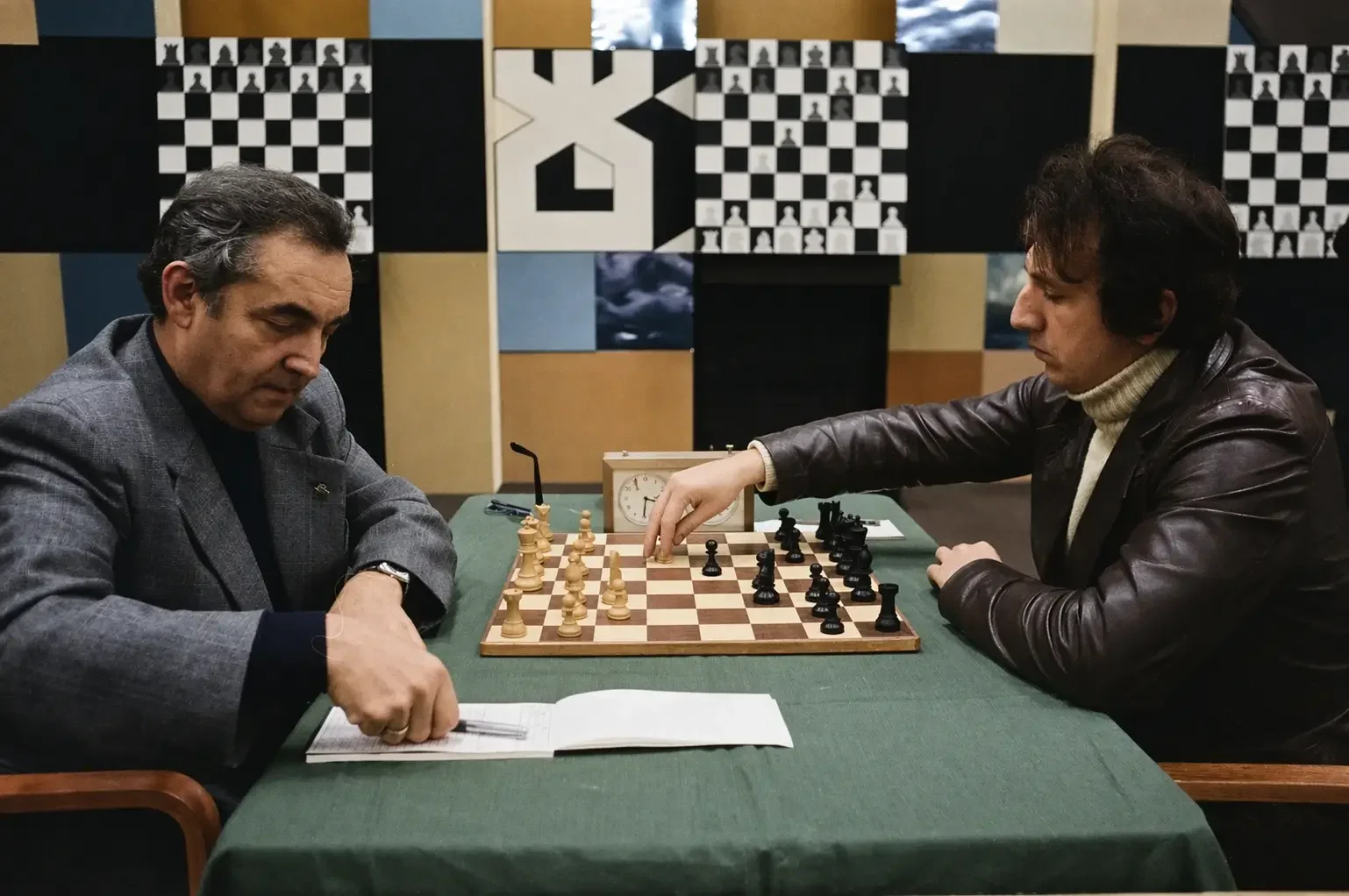
Evgeni Ellinovich Sveshnikov (11 February 1950 to 18 August 2021) occupies an unusual place in modern chess history. He never reached the Candidates stage of the world championship, yet his surname became part of the game’s permanent vocabulary. The Sveshnikov Variation of the Sicilian Defense, still widely called the Chelyabinsk Variation in Russia, changed elite opinion about what Black could permit in return for activity. Its development also offers a useful lesson in historical attribution: Sveshnikov and his Chelyabinsk colleague Gennadi Timoshchenko built on earlier experiments by Emanuel Lasker, Carl Kieninger, and Jiří Pelikán, then supplied the analysis, repeated practice, and explanatory framework that turned an eccentric line into a major system.
That achievement can obscure the rest of Sveshnikov’s career. He was a formidable Soviet grandmaster, a winner of strong international tournaments, a member of gold-medal Soviet teams, a three-time Latvian champion, a world senior champion, an engineer by training, and a long-serving teacher and author. He also became an unusually persistent advocate for the professional interests of chess players. His historical importance lies not in an eponym alone, but in the way he joined scientific habits of analysis, competitive conviction, and an independent conception of chess culture. (Russian Chess Federation biographical profile; FIDE obituary)
Early Life and Chess Formation
Sveshnikov was born in Chelyabinsk and spent his earliest years in the city’s Zarechye district. His mother, Tatiana Nikolaevna Sveshnikova, was a physician; his father, Ellin Ivanovich Koparushkin, had competed in weightlifting and taught physical education. The family used his mother’s surname. His parents separated after his fourth year of school, and after a brief period in Dzerzhinsk, he returned to Chelyabinsk, where his grandmother, Vera Petrovna, a nurse, played a central role in his upbringing.
In a long 2008 interview, Sveshnikov placed his family history within the upheavals of the Stalin period. He recalled that his paternal grandfather, an early Bolshevik, lost his party membership, employment, and home in 1935, while relatives on his mother’s side were dispossessed and sent from the Nizhny Novgorod region to mining work near Kopeisk. He also said that his maternal grandfather was sent to construction work on the White Sea Canal and died after returning. These details are valuable as Sveshnikov’s own testimony about the family memory in which he grew up, but the accessible sources do not independently document each episode. (Vladimir Stog’s interview with Sveshnikov, Russian Chess Federation)
His organized chess study began at about twelve in the Chelyabinsk Palace of Pioneers under Leonid Aronovich Gratvol. Gratvol became the decisive formative influence. Sveshnikov later described him as almost a second father and preserved his teaching method: an idea should first be made intelligible through a model game, not reduced to a list of variations to memorize. Sveshnikov also attended the All-Russian youth school, where he heard leading Soviet trainers including Igor Bondarevsky and Viktor Golenishchev. This combination of a devoted local mentor and access to a wider Soviet training network helps explain both his Chelyabinsk identity and his command of the analytical methods of the period.
Other relationships connected that local formation to the Soviet elite. Sveshnikov later named Efim Geller and Lev Polugaevsky as his principal teachers in mature chess. In 1968 he spent a month in Jūrmala sharing a house and analyzing with Rashid Nezhmetdinov. Mikhail Tal was his idol; in 1976 Tal proposed that he move to Riga as a sparring partner, but Sveshnikov remained after Chelyabinsk officials provided housing. The episode is revealing: he already had access to the highest Soviet circles, yet continued to build his career from a regional base. (ChessPro memoir of Sveshnikov’s Latvian connections; ChessPro sixtieth-birthday portrait)
At fourteen, Sveshnikov suffered a serious hip injury after jumping from a roof into snow. Surgery and restricted movement followed. In his own account, the enforced concentration accelerated his chess development. He attended Chelyabinsk School No. 31, which emphasized mathematics, and later said that he chose to study mathematics partly because he believed it would help his chess. The claim reflects his intellectual self-conception more than a demonstrable causal law, but the link between structured analysis and practical decision-making remained central to his career.
After school, he entered the automotive and tractor faculty of the Chelyabinsk Polytechnic Institute, specializing in internal-combustion engines. He graduated in 1972 and remained in a departmental laboratory as a research engineer under Gennady Dmitrievich Dragunov. Sveshnikov recalled working long days on engine design problems and preparing a Candidate of Sciences dissertation on combustion-chamber form, although he never defended it. Chess eventually displaced engineering as his profession, but his later writing retained an engineer’s preference for systems, recurring positions, and claims tested by practical use. (Sveshnikov interview on childhood training and his chess school; ChessPro sixtieth-birthday portrait)
Rise in Competitive Chess
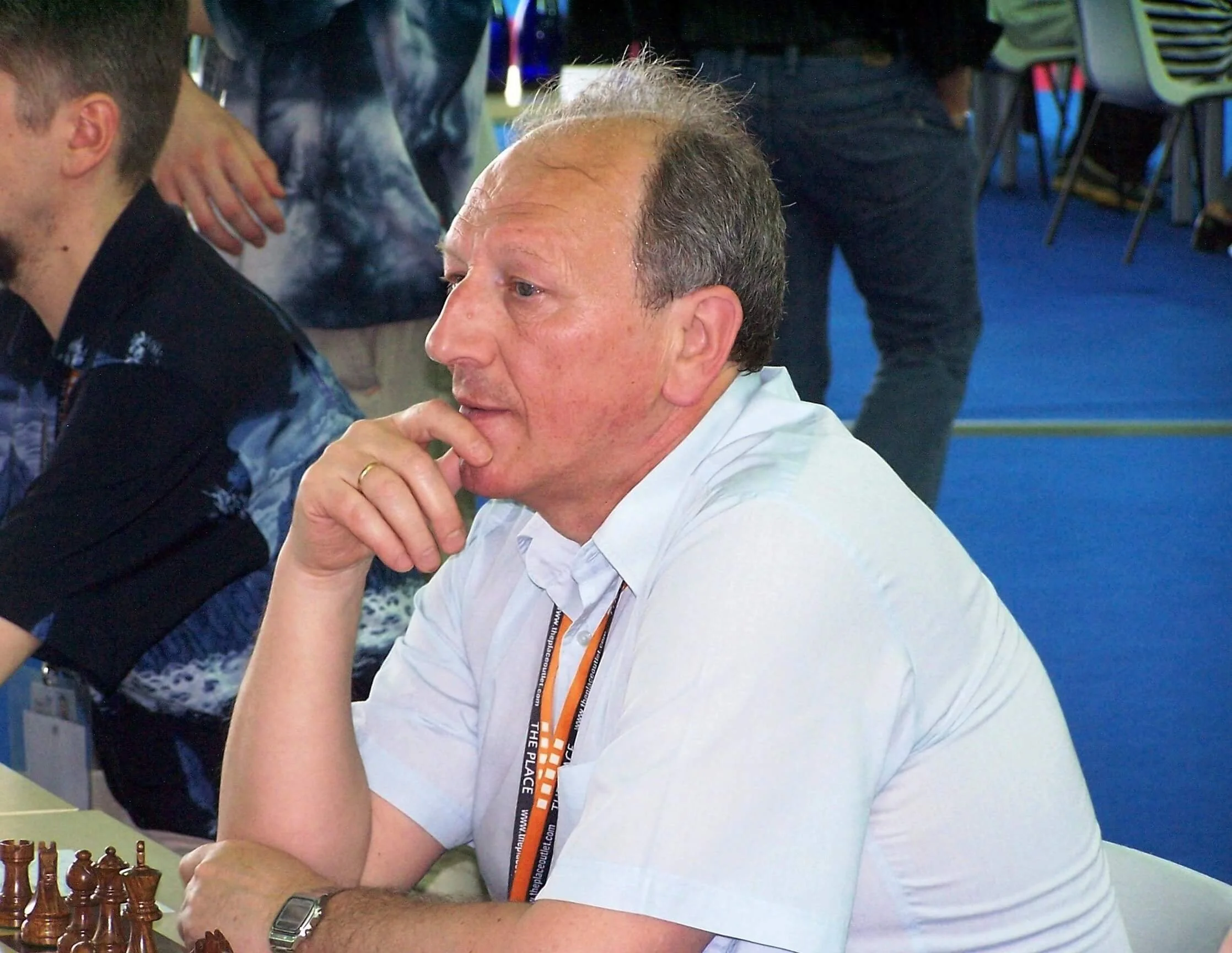
Sveshnikov achieved the Soviet master norm at seventeen and, in the same year, played in the 1967 USSR Championship, a large Swiss-system final in Kharkov. A score of 7 from 13 against an exceptionally strong national field established him as more than a promising junior. Over his career he appeared in nine USSR championships; his best final placing was shared fifth through eighth in 1978, with 9 from 17. The series stretched from the mass Swiss of 1967 to the final USSR Championship in 1991, an important measure of sustained strength in a system whose qualifying stages were themselves demanding.
His breakthrough as an adult came in 1973. He won the USSR Young Masters Championship, advanced to the Soviet Championship semifinals, and qualified for the Moscow final. After nine rounds he had one win and eight draws and remained well placed among a field filled with leading grandmasters. He then contracted pneumonia and finished with 6.5 from 17. The final score alone therefore gives an incomplete picture of the event. Sveshnikov’s recollection of the illness is autobiographical, while the score and tournament record are independently verifiable. He then served for two years in Chelyabinsk as a junior lieutenant and technical deputy company commander. In retrospect, he regarded military service as the period that decisively redirected him from engineering toward professional chess.
During the middle of the decade he consolidated that standing. He shared first at Děčín in 1974, won an All-Union tournament in 1975, shared first with Lev Polugaevsky at the 1976 Chigorin Memorial in Sochi, and won the USSR Young Masters event again in 1976. He received the international master title in 1975 and the grandmaster title in 1977. Team selection supplied another indication of Soviet confidence in him. At the 1976 World Student Team Championship he scored 6.5 from 7, taking team gold and the individual gold medal on board four. At the 1977 European Team Championship in Moscow he scored 4 from 5 as second reserve, again earning both team and individual gold. (FIDE obituary; OlimpBase, 1976 World Student Team Championship; OlimpBase, 1977 European Team Championship)
Major Career Achievements
Sveshnikov’s best tournament years extended well beyond his emergence in the 1970s. He won at Le Havre in 1977 and the Capablanca Memorial at Cienfuegos in 1979, shared third at Wijk aan Zee in 1981, and tied with Sergei Makarychev for the Moscow championship in 1983. His outright victory at Hastings in 1984/85, with 9 from 13 and a full-point margin, was especially significant. Earlier in 1984, according to his own later account, he had been diagnosed with stage-three cancer. He recovered, returned to full competition, and won one of the traditional events on the international calendar. He also shared first at Sochi again in 1985. (FIDE obituary; official Hastings winners list; Tata Steel historical archive for Wijk aan Zee 1981)
Historical rating records help place this record without exaggerating it. Sveshnikov reached equal 25th on the FIDE world list in January 1978 with a rating of 2565 and matched that standing in January 1980 at 2570. His highest published rating, 2610, came much later, in January 1994. The distinction is useful: his highest numerical rating was not his highest ranking. It also shows an unusually long competitive plateau, from the intensely selective Soviet circuit of the 1970s into the much larger international pool of the 1990s. (OlimpBase historical FIDE ratings)
Sveshnikov’s life gradually acquired a second center in Riga. He married twice and had four children. After meeting his second wife, Lyudmila, at the 1985 USSR Championship, he settled in Riga between 1985 and 1986 while remaining a Russian citizen. His son Vladimir became an international master and later a Latvian champion. Residence, citizenship, and sporting affiliation should therefore be kept distinct. Sveshnikov was listed by FIDE for Latvia by July 2002, represented Latvia at four Olympiads in 2004, 2006, 2008, and 2010, and played at the 2011 European Team Championship. An official transfer returned his FIDE registration to Russia in November 2015. He won the Latvian individual championship in 2003, 2008, and 2010. Some international summaries mention only two titles, but Latvian federation records include all three. (FIDE Dubai Open report, July 2002; Latvian Chess Federation champions record; FIDE transfers, 2015)
His final competitive phase was not ceremonial. Beginning on top board in 2016, he helped Russia win five consecutive 65+ World Senior Team Championships through 2020; in the last of them, at age seventy, he scored 5.5 from 6. In 2017, at Acqui Terme, he also won the individual World Senior Championship in the 65+ category with an 8.5/11. Those results completed a career that had begun in the centralized Soviet system and continued through Russian and Latvian chess after 1991. They also confirmed that his analytical discipline remained effective more than half a century after he achieved the master title. (Russian Chess Federation report on the 2016 team championship; FIDE report on the 2020 team championship; Russian Chess Federation report on the 2017 individual title)
Style and Reputation
Sveshnikov’s chess was principled before it was spectacular: active, concrete, and system-oriented. He could calculate sharply, but his distinctive quality was conceptual rather than merely combinational. He looked for positions in which a static concession could be exchanged for time, space, or piece activity, then investigated those positions deeply enough to make the bargain repeatable. In the Sicilian system associated with his name, Black accepts a lasting weakness on the d5 square and a structurally exposed pawn in return for central control, development, and dynamic play. At the time, many masters treated those concessions as strategically suspect. Sveshnikov did not dismiss the traditional rules; he tested the conditions under which their exceptions worked.
The same temperament appeared in his choices with White. He became a major authority on the c3 Sicilian and the Advance Variation of the French Defense, openings that often lead to recognizable pawn structures and long strategic contests. Sveshnikov preferred to understand a limited set of recurring problems at great depth. That specialization made his play identifiable, but it also allowed him to confront prepared opponents on terrain he had examined more thoroughly than almost anyone else. He said that he felt most at home against initiative-seeking opponents such as Tal and Viktor Kupreichik, while the prophylactic restraint of Tigran Petrosian and Karpov posed a different and more difficult problem. This was a preference for generative positions, not a rejection of positional chess. (Sveshnikov on Tal and his preferred kind of struggle)
Contemporaries remembered a deep and original thinker, a dangerous tactician, and an outspoken defender of his conclusions. His confidence could be uncompromising, yet it was tied to a demanding standard of proof: an idea had to survive both analysis and tournament play. His own retrospective judgment was candid. Reconstructing the 1981 USSR Championship, he called the opening his strongest phase, regarded his middlegame play as less exceptional, and identified the fifth hour and adjournment phase as a comparative limitation. Very loose positions requiring a long sequence of exact decisions were not always his preferred task. The same specialization that gave him exceptional authority could also make his intentions easier to anticipate and leave less room for rapid repertoire shifts, but opponents still had to refute ideas he knew in extraordinary depth. (Sveshnikov, “Two Opening Duels of 1981”)
Sveshnikov did not confuse theoretical influence with the very highest competitive rank. He acknowledged that he did not reach the Candidates and argued that adding durable ideas to chess was a distinct form of achievement. His top-25 world standing and strong tournament victories gave that theoretical work sustained practical credibility. (ChessBase portrait, 2010; Chess.com obituary and career survey)
Contributions Beyond Tournament Play
The Chelyabinsk system and historical credit
The variation that carries Sveshnikov’s name had important precedents. Emanuel Lasker used it in his defining central advance against Carl Schlechter in their 1910 world championship match; Carl Kieninger later explored related positions; and the Czech-Argentine master Jiří Pelikán investigated a critical branch in the mid-1950s. For that reason, older Western literature often referred to it as the Lasker-Pelikan. Sveshnikov’s contribution was to help transform a collection of precedents into a coherent modern repertoire.
That work was collaborative. Gennadi Timoshchenko, who trained alongside Sveshnikov under Gratvol, recalled that on 5 June 1965 he lost to the younger player after the characteristic early central advance and that the result prompted the two to study the system together. Their analysis intensified in the late 1960s and early 1970s, and both used the line repeatedly. Sveshnikov later associated its first wider notice with his 1967 victory over András Adorján in a Soviet-Hungarian youth match; the claim is his recollection of the opening’s reception, not independently established evidence of naming. Sveshnikov consistently acknowledged Timoshchenko’s role. The Russian name, Chelyabinsk Variation, usefully preserves the local school and joint labor behind the opening, while the name Sveshnikov Variation reflects the international prominence produced by Sveshnikov’s games, lectures, and publications. Later disagreements over the exact balance of authorship do not alter the central point: the modern system emerged from their shared work in Chelyabinsk on earlier foundations. (Gennadi Timoshchenko interview, part one; Sveshnikov’s 2010 retrospective; Edward Winter, “The Sveshnikov Variation”)
Its subsequent adoption supplies the strongest evidence for the depth of their insight. Valery Salov, Alexei Shirov, and Vladimir Kramnik helped bring the system into elite practice in the 1990s. Boris Gelfand used it in the 2012 world championship match, and Magnus Carlsen made it a principal defensive choice in the 2018 match. No single later success proves every claim Sveshnikov made about the opening, but the system’s survival at the highest level overturned the early assumption that its structural concessions were simply unsound.
Sveshnikov also helped shape the modern form of the related Sicilian move order now called the Kalashnikov or Neo-Sveshnikov. Here too, historical precision is needed. The underlying move had nineteenth-century precedents, and the origin of the name “Kalashnikov” remains uncertain. His role was not solitary invention, but the late-twentieth-century revival and redirection of an older idea into a serious repertoire. (Edward Winter’s historical survey; ChessBase account of the modern Kalashnikov)
Sveshnikov converted this research into literature. His 1988 Russian monograph on the Sicilian system appeared in English as The Sicilian Pelikan in 1989. He later produced substantial works on the c3 Sicilian and the French Advance, including The Complete c3 Sicilian and, with Vladimir Sveshnikov, The Complete French Advance. Father and son also wrote A Chess Opening Repertoire for Blitz & Rapid. These were not compilations of fashionable moves. In his own essays, Sveshnikov emphasized historical credit, model games, typical structures, plans, and endgames, and named other analysts whose work had improved the systems he played. His books therefore presented an opening as a whole family of middlegames and recurring decisions, not as an isolated sequence to be memorized. (Sveshnikov on the c3 Sicilian; Sveshnikov on the French Advance; Google Books record for The Sicilian Pelikan; New in Chess, The Complete French Advance)
Teacher, trainer, and builder of chess culture
Sveshnikov’s pedagogical work carried Gratvol’s local tradition into a wider setting. His later accounts vary with the scope being counted: he described about a decade as one of the leaders of the All-Russian school, working in parallel with Alexander Panchenko, while a 2007 interview placed the broader run of children’s sessions at about fifteen years and twenty-four intensive two-week courses. The program was initially associated with the Polet organization in Chelyabinsk. Among the players who studied in this environment were Andrei Kharlov, Konstantin Landa, and Vadim Milov, all of whom became grandmasters. Sveshnikov later concluded that he had initially emphasized opening preparation too heavily and came to insist that endgame study should develop in parallel. The revision shows that his teaching practice evolved in response to experience.
After the collapse of Soviet institutional funding, he helped continue regional training projects through sponsors and local partnerships, including camps in Satka where Boris Spassky also participated. Official biographies record work as a trainer or second for Anatoly Karpov, Lev Polugaevsky, Alexei Shirov, and Alexandra Kosteniuk, as well as consulting roles with national teams. The assignments varied, so they should not be treated as one continuous coaching post. He also worked occasionally as a formal commentator, including at the 2010 Women’s Grand Prix in Nalchik, an assignment he described at the time as his first in that role. Collectively, these activities show that elite players and organizers valued the same qualities visible in his books: opening depth, direct diagnosis, and a willingness to defend an independent judgment. (Sveshnikov interview on his youth school; Russian Chess Federation profile; FIDE Women’s Grand Prix interview)
He also helped sustain a specifically Chelyabinsk chess identity. Through the Polet team, local schools, lectures, and his insistence on the regional name for the opening, he connected individual achievement to an institutional lineage. This is an easily overlooked contribution. Soviet chess was often described through Moscow and Leningrad, but Sveshnikov’s career shows how a provincial coach, an industrial institute, a factory sports organization, and a circle of ambitious players could produce work with international reach.
Authorial rights and public advocacy
In later years Sveshnikov campaigned for chess players to receive greater control or compensation when their game scores were commercially reproduced. He sometimes framed the issue as intellectual property and used public matches and interviews to press the case. His proposal did not become an adopted FIDE rule or a generally accepted norm, and it should be reported as an advocacy position rather than settled law. Even so, the campaign was consistent with his broader view that professional players were creators of cultural value, not merely suppliers of free material to organizers, publishers, and databases. He also frequently spoke about conditions for veteran professionals and ways to bring spectators closer to serious chess. (Russian Chess Federation interview on ownership of game scores; Russian Chess Federation interview on public chess events)
Historical Legacy
Sveshnikov died on 18 August 2021 at the age of seventy-one. The several accepted forms of his name reflect the geography of his career: Евгений Эллинович Свешников in Russian, Evgeny, Evgeni, or Yevgeny Sveshnikov in English transliteration, and Jevgēņijs Svešņikovs in Latvian. He belonged in meaningful ways to Chelyabinsk, Soviet and Russian chess, and the Latvian chess community that he represented internationally.
His legacy has three connected parts. First, he helped revise strategic judgment in a central branch of the Sicilian Defense. Second, he created an authorial and pedagogical method in which an opening was taught as a system of ideas, model games, and structures. Third, he carried the Chelyabinsk training tradition across institutional ruptures, from the Palace of Pioneers and Polet to post-Soviet regional schools, international coaching, and senior competition. The 2026 Russian Chess Federation volume Selected Games and Memoirs, compiled by Vladimir Barsky from Sveshnikov’s games, interviews, articles, and recollections, is evidence of an ongoing effort to preserve that wider record. (Russian Chess Federation announcement of Selected Games and Memoirs)
Evgeni Sveshnikov deserves attention today because he demonstrated that historical stature in chess can arise from the union of strong play, conceptual invention, and transmission. He was not simply the man after whom an opening was named. He was a competitor who gave an audacious idea practical authority, a teacher who extended a regional school across generations, and an independent professional who insisted that analysis itself was a serious form of chess achievement.
Notes and Sources
The fullest accessible autobiographical source is Vladimir Stog, “The Chelyabinsk Variation of Sveshnikov”, Russian Chess Federation, republishing an interview first printed in Chelyabinsk Sportivny on 20 October 2008. It is the principal source for family history, childhood, education, engineering work, the 1973 championship, marriages, and Sveshnikov’s account of his intellectual formation. Family-history claims are identified in the article as recollections rather than independently verified archival findings.
Vladimir Barsky and Maria Fominykh, “Evgeny Sveshnikov at Sixty”, ChessPro, 2010, is a photographic portrait with extensive first-person captions. It supports details about his engineering work, the Polet organization, his illness in 1984, and his family life. Its recalled score of 4.5 from 5 in the 1977 European Team Championship differs from the surviving event record, which gives 4 from 5 and is followed here.
Maria Fominykh, interview with Sveshnikov on his children’s chess school, e3e5.com, 2007. This is the main source for Gratvol’s teaching, the structure and duration of Sveshnikov’s All-Russian school, named pupils, later regional projects, and Sveshnikov’s reassessment of his curriculum.
Vladimir Barsky, interview with Gennadi Timoshchenko, part one, ChessPro, 2016. Timoshchenko’s recollection supplies direct evidence for the collaborative Chelyabinsk origin of the modern variation and the significance he assigned to their 1965 game.
The Russian Chess Federation’s biographical profile and FIDE’s obituary provide official confirmation of titles, Soviet championship appearances, principal tournament successes, team medals, coaching associations, Latvian representation, senior achievements, and dates of birth and death.
OlimpBase’s historical FIDE list distinguishes Sveshnikov’s best world-list placement, equal 25th in January 1978 and again in January 1980, from his peak published rating of 2610 in January 1994. A precise January 1994 world rank is omitted because the site’s player summary and expanded list do not agree.
A FIDE tournament report from July 2002 lists Sveshnikov for Latvia. The Latvian Chess Federation’s champions record credits him with Latvian championship victories in 2003, 2008, and 2010. This official three-title record is followed here because several otherwise reliable English-language obituaries omit the 2008 title. The official FIDE transfer register for 2015 records his return from Latvian to Russian affiliation; none of these records should be confused with place of residence or citizenship.
Event reports document Sveshnikov’s five successive 65+ World Senior Team titles with Russia: 2016, 2017, 2018, 2019, and 2020. The Russian Chess Federation’s 2017 individual report records his 65+ world title and score.
Edward Winter, “The Sveshnikov Variation”, Chess Notes, documents the Lasker-Pelikan terminology, early precedents, and the uncertain origin of the Kalashnikov name. André Schulz, “70th birthday of Evgeny Sveshnikov”, ChessBase, 2020, provides a concise account of the modern system’s later elite adoption. These are used alongside the first-person Timoshchenko interview, not as substitutes for it.
Frederic Friedel, “Evgeny Sveshnikov turns sixty”, ChessBase, 2010, and Peter Doggers, “Evgeny Sveshnikov (1950-2021)”, Chess.com, 2021, are useful English-language syntheses. Their biographical and tournament claims were checked against federation records or the Russian interviews wherever possible.
Sveshnikov’s first major monograph was Сицилианская защита. Система 5...е7-е5 (Moscow: Fizkultura i sport, 1988). The bibliographic record for its English translation, The Sicilian Pelikan, Collier Books, 1989, confirms that edition. A WorldCat record documents The Complete c3 Sicilian, 2010, and New in Chess provides the publisher’s record for Evgeny and Vladimir Sveshnikov, The Complete French Advance, 2017. Sveshnikov’s own essays on the c3 Sicilian and the French Advance are especially useful for his method and his practice of crediting other analysts.
Sveshnikov’s campaign concerning commercial use of game scores is documented in his Russian Chess Federation interview on ownership. The article treats his formulation as his position and makes no claim that it acquired formal legal or regulatory force.
The Russian Chess Federation announced Vladimir Barsky’s posthumous compilation Selected Games and Memoirs of E. Sveshnikov in 2026. Its appearance postdates Sveshnikov’s death and is cited only as evidence of continuing historical preservation, not as a source consulted for the biographical claims above.
Sveshnikov’s retrospective on two opening duels from the 1981 USSR Championship, ChessPro, 2014, supplies his unusually detailed self-assessment of opening, middlegame, and late-session play. Maria Fominykh’s interview on Mikhail Tal, Russian Chess Federation, 2007, supports the account of his stylistic preferences. Both are treated as first-person assessments, not neutral performance metrics.
OlimpBase crosstables for the 1967, 1978, and 1991 USSR Championships verify the opening, best, and final appearances in Sveshnikov’s nine-final record.
