Max Euwe
Introduction
Machgielis "Max" Euwe, born in Watergraafsmeer near Amsterdam on May 20, 1901, was the fifth World Chess Champion, holding the title from 1935 to 1937. He was also a doctoral mathematician, a schoolteacher, a prolific chess author, and later the third president of FIDE from 1970 to 1978. In Dutch memory he remains the country’s only undisputed classical world champion, but for a Soviet chess history audience his significance is equally clear in another way: Euwe was one of the strongest and most respected non Soviet reference points during the period when the Soviet school was rising to supremacy. Soviet and post Soviet voices did not treat him as a curiosity. They treated him as a serious player, a worthy champion, and an important institutional figure in world chess.
His historical profile has long been distorted by two habits of chess writing. The first is to reduce his 1935 victory over Alekhine to a story about Alekhine’s weaknesses. The second is to treat Euwe’s reign as a brief interruption between more vivid personalities. Yet contemporary and later evidence points to something more substantial. Euwe was a rigorously educated chess thinker, a formidable match player, a leading organizer of postwar international chess, and a man whose influence extended from Dutch popular chess culture to Soviet respect, FIDE politics, chess pedagogy, and even early computer science. Reuben Fine called him "the most underrated player in the world," and that judgment still captures part of the problem.
Early Life and Chess Formation
Euwe’s family background helps explain both his seriousness and his unusual combination of careers. MacTutor’s biographical account records that his parents, Elisabeth and Cornelius Euwe, both played chess, that Cornelius was a teacher, and that Max learned the game at about age five and quickly surpassed them. He excelled in mathematics at school in Amsterdam, won his first tournament at age ten, joined the Amsterdam chess club at twelve, and was already competing in Dutch Chess Federation events by fourteen. Those details are significant because Euwe’s later career never developed along the romantic line of the full time bohemian master. From the beginning, chess and formal study advanced together.
That dual formation continued through university. Euwe entered the University of Amsterdam, earned an honours degree in mathematics in 1923, and completed a doctorate there in 1926. MacTutor identifies Roland Weitzenböck and Hendrick de Vries as supervisors of his dissertation, which dealt with differential invariants. After the doctorate he lectured in mathematics in Winterswijk and Rotterdam and then taught at the Amsterdam Lyceum for Girls from 1926 to 1940. Russian Chess Federation material, reflecting a long standing perception of Euwe, likewise emphasizes that he never regarded himself as a professional chess player and continued to treat teaching and scholarship as his primary occupation.
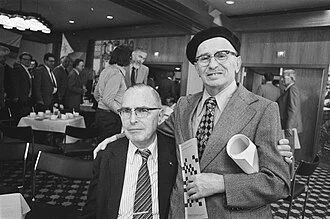
His family life reinforced that pattern. A 1966 Dutch National Archives caption, preserved through Wikimedia Commons, identifies Euwe’s wife as Caroline Bergman and notes that they were celebrating their fortieth wedding anniversary, which places the marriage in 1926. Later summaries, including specialist chess profiles, stress that marriage and family responsibilities restricted his international schedule and often confined elite competition to periods when school duties permitted travel. This is not a trivial biographical detail. It shaped the historical meaning of Euwe’s rise. He reached the top while remaining, in a quite literal sense, an amateur in the older European meaning of the word: not unskilled, but not dependent on chess for a living.
The intellectual side of Euwe’s formation also affected his chess. MacTutor notes that he did not keep mathematics and chess separate, but regarded mathematics as a source of logical and precise method. That description fits both his own later authorship and the testimony of contemporaries. It also helps explain why Soviet and post Soviet commentators often saw him as a precursor to later forms of systematic preparation. Vladimir Kramnik, in FIDE’s Open Chess Museum, explicitly says that although Botvinnik is usually credited with global preparation, Euwe may have been the first to do it in a fully competent and professional way. That is interpretation, not a settled theorem, but it is informed interpretation from a world champion who knew the tradition well.
Rise in Competitive Chess
By 1920 Euwe had already become the leading Dutch player, and in 1921 he won the first of what would become a national record of twelve Dutch championships. Europeana summarizes the pattern succinctly: from 1921 to 1952, he won every Dutch championship he entered, and later added another title in 1955. In 1928 he also became world amateur champion in The Hague. These achievements established him not merely as a local hero but as a durable national standard bearer. Even before his world title, he embodied Dutch chess in a way that few later national champions anywhere have done.
His international ascent was more gradual than that of some champions, but it was real. From December 1926 to January 1927 he narrowly lost a training match to Alekhine by two wins to three, with five draws, a result that suggested he could at least compete seriously with the elite. MacTutor then records strong results at Hastings 1930, where Euwe finished ahead of Capablanca, and in 1932, when he defeated Spielmann in a match, drew matches with Flohr, and took second place behind Alekhine at Bern. Those are exactly the sort of results that made him a legitimate challenger, even if his rise did not have the aura of inevitability associated with Alekhine, Capablanca, or later Botvinnik.
This period also brought him into increasingly direct contact with the emerging Soviet challenge. Douglas Griffin’s work on Soviet tournament books reminds us that Euwe played in the strong Leningrad masters’ tournament of 1934, one of the events through which Soviet organizers tested their new generation against elite Western competition. By 1936, at Nottingham, he was again in the thick of things with Botvinnik, Capablanca, Alekhine, and the other leading players of the day. In other words, Euwe’s pre championship and immediate post championship career intersected directly with the moment when Soviet chess was beginning to define itself internationally. He was not peripheral to that story. He was one of the measuring rods.
A final part of his rise was strategic self discipline. FIDE’s 2021 historical essay stresses that for the 1935 match he worked on his white opening preparation, examined Alekhine’s repertoire with Hans Kmoch, studied endgames with Géza Maróczy, consulted Ernst Grünfeld, and brought Salo Flohr in as a second. That level of preparation fits poorly with the stereotype of Euwe as a tidy schoolteacher who happened to catch Alekhine on a bad stretch. It fits much better with the picture of an intensely methodical contender who knew exactly where his chance lay.
Major Career Achievements
Euwe’s central competitive achievement was, of course, the 1935 world championship match against Alekhine. FIDE’s archival material records that the match lasted 30 games, was played in multiple Dutch cities over about 80 days, and ended with Euwe winning 15½ to 14½. The event turned when he recovered from an early deficit, equalized, and then took control late in the match. The FIDE museum highlights Game 20 as the moment when he began his decisive comeback, and the Max Euwe Centrum singles out Game 26, later celebrated by Tartakower as "the Pearl of Zandvoort," as emblematic of the quality and nerve of Euwe’s play in the crucial phase. Boris Spassky, quoted by the Russian Chess Federation, later wrote that it was "completely obvious" that Euwe played the 1935 match better. That Soviet and post Soviet verdict is important because it directly contests the older tendency to explain the result away.
The rematch in 1937 ended badly for him. Official and near official sources agree that Alekhine regained the title by 15½ to 9½. Euwe began well enough, but his challenge ebbed, and the result was decisive. Even so, the rematch does not convert 1935 into an accident. The better historical reading is that Euwe reached genuine world championship strength, had a comparatively narrow peak, and was then overtaken by a fully remobilized Alekhine. Reuben Fine’s contemporary judgment, cited by Edward Winter, is especially useful here: in the period between the two matches, Euwe had "no superiors." That is not the same as saying he dominated an era. It is stronger, and more precise, than calling him a lucky interlude.
His post title career also deserves attention because it intersects directly with Soviet chess ascendancy. At Nottingham 1936, MacTutor records him only half a point behind the winners, and FIDE’s 2021 essay notes his credible performance at AVRO 1938. After the war he finished second at Groningen 1946, only half a point behind Botvinnik. Douglas Griffin reproduces Botvinnik’s own later comment that had Euwe won the first major postwar tournament, Dutch opinion would have felt justified in asking whether the former champion should simply be proclaimed world champion. That remark, coming from Botvinnik himself, shows how real Euwe’s late claim still seemed in the immediate postwar years. He was not a ceremonial relic. He was a live contender at the hinge between the classical era and the Soviet one.
The decisive transition came with the FIDE world championship tournament of 1948. FIDE’s records show that Euwe, as the only surviving former champion, participated alongside Botvinnik, Smyslov, Keres, and Reshevsky. He finished last, and FIDE’s own retrospective notes that by age forty seven he could not keep pace with Botvinnik in his prime. He still remained strong enough to receive the grandmaster title on FIDE’s inaugural 1950 list and to qualify for Zurich 1953, the first great Candidates tournament of the Soviet era. By then his best years were behind him, but he remained relevant enough to stand inside the new FIDE system whose emergence he had earlier encouraged.
His long run of Olympiad service reinforces the same point. FIDE’s museum profile notes that he led the Dutch team at seven Olympiads, and OlimpBase gives the full span from London 1927 to Varna 1962, with 54½ points from 87 games. That record, extending over thirty five years, underlines both durability and symbolic status. Euwe was not merely the Dutch champion who briefly became world champion. He was, for decades, the public face of Dutch chess in international competition.
Style and Reputation
Euwe’s chess reputation has always carried a slight paradox. On the one hand, he is often remembered as logical, solid, and methodical. On the other, his best games are tactically sharp and sometimes violently complicated. Contemporary descriptions already capture this tension. MacTutor quotes L. Pins and B. H. Wood describing him as "logic personified," accurate and aggressive, capable of striding confidently into very complex positions, yet vulnerable to blunders. The same biography reports W. H. Watts’s impression from Nottingham 1936 that Euwe’s chess projected caution and dogged perseverance, even though he still shared the prize for most wins in the tournament. Taken together, those accounts suggest a player whose caution was not passivity, but disciplined seriousness.
FIDE’s Open Chess Museum offers a compatible summary: Euwe’s play was marked by logic and precise calculation, he was a strong tactician, and he was an expert in opening theory. Russian language accounts go further in describing him as a largely rational and universal player, strong in both the transition from opening to middlegame and in endgames. Botvinnik’s brief verdict in the FIDE museum is notably restrained but telling: "A worthy champion." Kramnik’s later comment that Euwe anticipated the intensive preparation later associated with Botvinnik gives his style a still broader historical significance. Euwe was not just logical in a generic sense. He represented an early form of fully systematized elite preparation.
At the same time, his limitations were real, and serious historians have not ignored them. Winter’s Euwe material preserves Fine’s famous line that Euwe was "the most underrated player in the world," but the same Chess Notes tradition also emphasizes that Euwe’s peak was shorter and his authority less overwhelming than that of Lasker, Capablanca, or Alekhine. That combination of admiration and reservation is probably the soundest historical position. Euwe was not a supreme genius in the Capablanca or Alekhine mold. He was a first rank player who reached championship level through intelligence, work, balance, and psychological steadiness, and who therefore exposes how misleading it can be to judge chess history only by charisma and myth.
His contemporaries also seem to have respected his temperament as much as his moves. Rudolf Spielmann, as quoted in the FIDE museum, called him "a truly noble person, a gentleman from head to toe." Soviet and post Soviet writers often echoed that moral dimension. The Russian Chess Federation article on his 125th anniversary presents him as stubborn, persistent, and fully deserving of his 1935 success, while Spassky’s retrospective approval reinforces the same point from within the Soviet lineage. Euwe’s reputation, then, rested not only on style, but on a rare conjunction of competence, courtesy, and credibility.
Contributions Beyond Tournament Play
Euwe’s work outside tournament play was unusually broad. Europeana records that he wrote more than seventy chess books, including Strategy and Tactics in Chess in 1937, Judgement and Planning in Chess in 1954, and The Road to Chess Mastery with Walter Meiden in 1966. These were not incidental publications from a champion cashing in on fame. They helped define Euwe as one of the most pedagogically influential world champions. His authorship was central to the "Euwe effect" in the Netherlands after 1935, when, according to the Max Euwe Centrum, more than ten thousand new members joined the Dutch federation and "all the Netherlands" played with Euwe’s textbooks in hand.
His educational influence also crossed into Soviet and post Soviet culture. A later widely repeated recollection, preserved in major chess summaries, holds that Gennadi Sosonko used Euwe and den Hertog’s Practische Schaaklessen as a teaching text at the Leningrad House of Pioneers and regarded it as one of the best chess books ever written. Even if one treats that as a retrospective testimonial rather than archival proof, it is highly revealing. Euwe’s instructional writing was not merely Dutch. It was portable into one of the canonical institutions of Soviet chess education. That is a striking form of legacy for a player often described, too narrowly, as an outsider to the Soviet age.
A lesser known but important side of Euwe’s intellectual life was his work on chess as a mathematical object. MacTutor states that in 1929 he published a paper showing that the chess rules then in force did not exclude the possibility of an infinite game, and the Stanford Encyclopedia of Philosophy’s Brouwer bibliography lists that paper, Mengentheoretische Betrachtungen über das Schachspiel, among primary texts relevant to intuitionist thought. Whatever one makes of its mathematical depth relative to Euwe’s other work, the paper is an important reminder that he did not simply use mathematical language metaphorically. He literally contributed to the formal analysis of chess.
His later turn toward computing was equally substantial. MacTutor reports that after the war Euwe became interested in electronic data processing, served as director of the Netherlands Automatic Data Processing Research Centre, chaired a Euratom committee on programming computers to play chess, and later held professorial posts connected with information processing. Tilburg University’s own institutional history states that when its computing center opened in 1964, Max Euwe "laid the foundation for computer science" there. In historical retrospect, that makes him one of the rare world champions whose post playing life entered a second, genuinely academic field at a high level.
His administrative work culminated in the FIDE presidency. Official FIDE pages give his term as 1970 to 1978. Europeana notes that his presidency was marked by repeated conflict with the USSR Chess Federation but also by efforts to improve the organization and regulation of world chess. FIDE’s 2021 historical essay goes further, crediting him with effectively saving the Fischer Spassky match of 1972 through patience and judgment. Here again Euwe appears at a hinge point. As champion he had stood near the beginning of the Soviet era. As FIDE president he presided over the match that momentarily broke Soviet monopoly over the title.
Historical Legacy
Euwe’s legacy begins in the Netherlands but does not end there. His 1935 title had a mass effect on Dutch chess culture. The Max Euwe Centrum states that more than ten thousand people joined the KNSB in the wake of his title and that Euwe’s instructional books became part of everyday Dutch chess life. Europeana notes that many Dutch clubs were founded in 1935, and the continuing commemorative landscape, from Max Euwe Plein in central Amsterdam to the Max Euwe Centre itself, shows how enduring that national memory has been. He became not only a champion but an institution.
For Soviet and post Soviet chess culture, Euwe’s legacy is different but equally important. He was one of the last great Western champions before the Soviet monopoly, one of the key foreign masters against whom Soviet players defined themselves in the 1930s and 1940s, and later a major official who had to manage Soviet power without wholly yielding to it. Griffin’s reconstruction of Groningen 1946, especially via Botvinnik’s own retrospective remarks, shows how seriously Soviet actors regarded Euwe’s standing in the immediate postwar succession crisis. Botvinnik’s public label "a worthy champion," Spassky’s defense of the 1935 victory, and Kramnik’s praise for Euwe’s preparation all suggest a striking continuity of respect across Soviet and post Soviet generations. Euwe was never adopted into the Soviet canon in the manner of Alekhine, Botvinnik, or Smyslov, but he was never dismissed from it either.
There are also quieter elements of his legacy that deserve notice. MacTutor reports that during the war he was involved in underground food relief work, while FIDE’s 2021 historical essay adds that he tried to help Jewish players in occupied Holland. The detailed evidence for those wartime efforts is not fully presented in the brief online sources cited here, so these points should be treated cautiously. Still, their recurrence in reputable historical summaries fits the broader picture of Euwe as a figure whose public reputation rested on reliability and civic seriousness as much as on brilliance over the board.
Euwe deserves attention today because he complicates easy categories. He was not a romantic genius, not a Soviet product, not a mere accident, and not simply a gentleman amateur who enjoyed one astonishing year. He was a mathematically trained, institutionally minded, deeply prepared, historically central chess figure whose career connected prewar international master chess, the Soviet rise, the postwar FIDE order, and the early age of chess computing. If Soviet chess history is partly the history of the rivals, standards, obstacles, and interlocutors against which Soviet dominance defined itself, then Max Euwe belongs near the center of that story, not at its margins.
Notes and Sources
This profile privileges archival and semi archival materials over later anecdote. The strongest online primary and quasi primary materials used here were the FIDE Open Chess Museum and FIDE history pages, FIDE’s 2021 commemorative essay on Euwe, OlimpBase’s Olympiad records, the Max Euwe Centrum’s Dutch historical pages, and Dutch archival image captions identifying Euwe’s wife and anniversary details. These sources are especially useful for dates, titles, event structure, institutional roles, and the afterlife of Euwe in Dutch chess memory.
For analytical framing and historiographical caution, Edward Winter’s Chess Notes remains valuable, especially for the warning against simplistic myths and for preserving contemporary judgments such as Reuben Fine’s assessment of Euwe as an underrated player. Douglas Griffin’s translations and contextual essays are particularly valuable when Euwe intersects with Soviet tournament culture, above all Leningrad 1934 and Groningen 1946. On the mathematical side, MacTutor provides the clearest accessible biographical synthesis, while the Stanford Encyclopedia of Philosophy confirms Euwe’s 1929 chess paper as part of the broader intellectual world around Dutch intuitionism.
The main interpretive caution is that some popular secondary online biographies still recycle errors or overstate claims, especially in early match records and anecdotal material. Where the evidence is thinner, this profile either avoids the point or labels it as interpretation. That restraint is particularly important with Euwe, because his career has often been flattened either into praise of perfect sobriety and method or into dismissal as an accidental champion. The record supports neither simplification. It supports a more interesting judgment: Max Euwe was a genuine world class player, a fully legitimate champion, and one of the most consequential bridge figures in twentieth century chess.
