Alekhine and Bogoljubow in German Internment in 1914
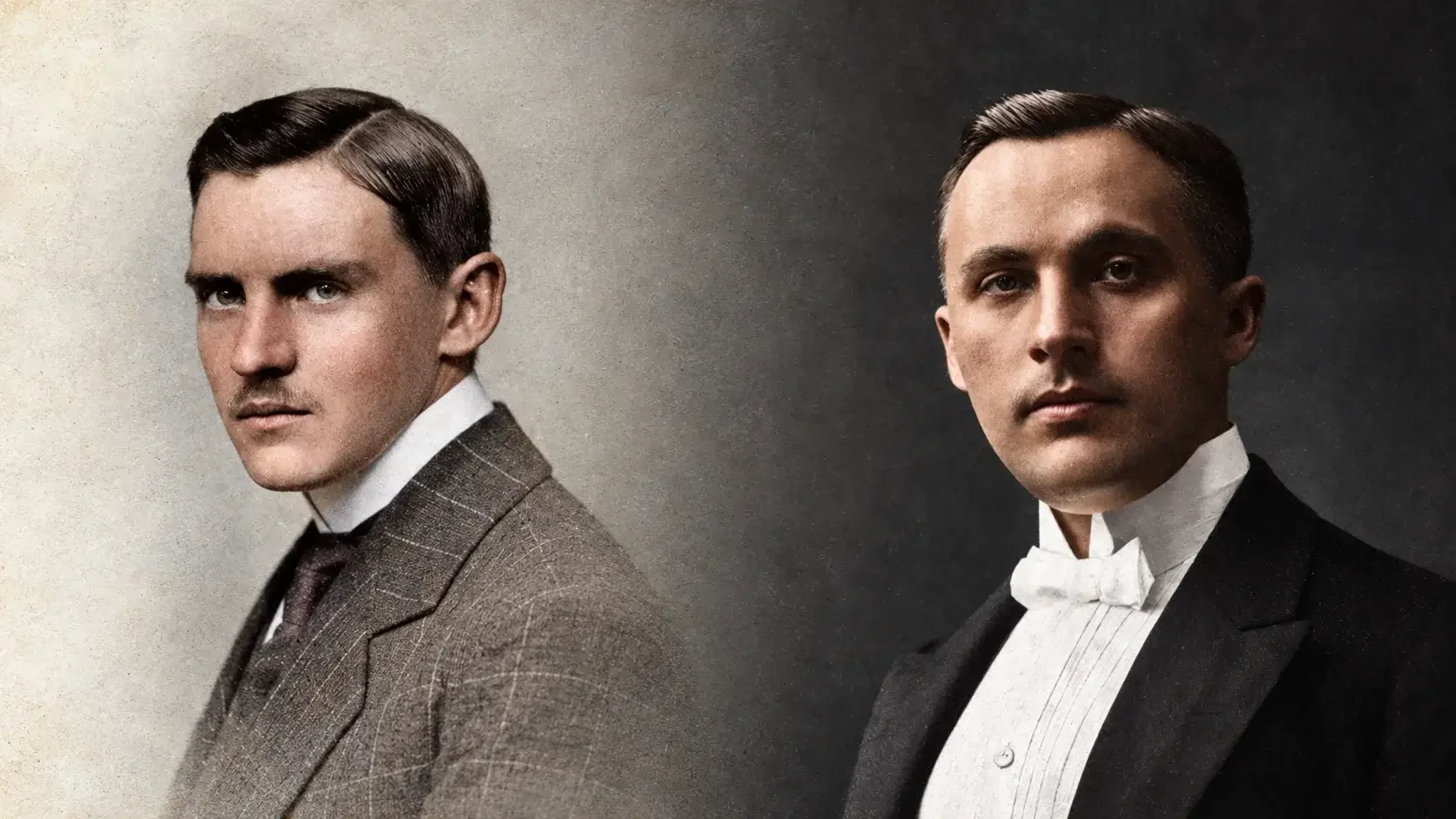
In August 1914, Alexander Alekhine and Efim Bogoljubow shared a prison cell in Rastatt, Germany. They had arrived in the country to play an international tournament. Within weeks, the outbreak of war had made their status as subjects of the Russian Empire grounds for detention. A contemporary chess journal preserves a striking detail of their confinement: two games played against each other without sight of a board. [1, 7]
Their shared experience extended from the disruption of the Mannheim congress through imprisonment in Rastatt and supervised residence in Baden-Baden. It ended when Alekhine obtained permission to leave Germany in September. Bogoljubow remained, eventually joining the other detained players in Triberg. Keeping these stages separate reveals how a brief encounter with wartime imprisonment developed into years of displacement for some of the participants. [7, 10]
The tournament interrupted
The masters tournament of the nineteenth congress of the Deutscher Schachbund began in Mannheim on 20 July 1914. Its venue, the Ballhaus in the palace gardens, accommodated an eighteen-player round robin. Other sections also gave competitors opportunities to establish their standing within the organized chess world. Alekhine and Bogoljubow played in the principal event, facing established masters including Siegbert Tarrasch, Frank Marshall, Dawid Janowski, Milan Vidmar, and Rudolf Spielmann. [4]
Alekhine had recently finished third behind Emanuel Lasker and José Raúl Capablanca at St Petersburg. His play in Mannheim confirmed that achievement: after eleven rounds he had nine victories, one draw, and one defeat. His 9½ points placed him ahead of Vidmar on 8½ and Spielmann on eight. Those became the leading scores of an unfinished competition when Germany declared war on Russia on 1 August. [4]
The congress also fell within a period of international institution-building. Discussions concerned a possible world chess organization, with the Russian organizer Peter Petrovich Saburov involved. Players moving across borders, publishing their games, and cooperating with national associations had made such ambitions plausible. War abruptly exposed the dependence of those connections on freedom of travel and diplomatic relations. [4, 5]
Contemporary sources describe the participants collectively as Russians, a category encompassing different regional and cultural backgrounds. Their detention occurred under Imperial German authorities. Civilian internment is the appropriate general description: these men had come to Germany as chess visitors, and imprisonment did not establish that they were captured combatants. A Swiss chess report in 1915 explicitly called the remaining Triberg group civilian internees. [6]
Arrests and the journey to Rastatt
The first days brought repeated arrests, inquiries, and changes of destination. Alekhine’s later account traced his movements from Mannheim’s main guardhouse through military custody at Ludwigshafen to Rastatt. That sequence included an individual detention at Ludwigshafen, an indication that the players’ experiences were already diverging. [4, 7]
Consular intervention offered limited protection. Alekhine remembered American assistance in obtaining hotel accommodation and subsequent dealings with the Spanish consul, who represented Russian interests. The players received instructions to proceed to Baden-Baden. During the journey, they were arrested at Rastatt. [3]
Boris Maliutin, a fellow detainee, provided a more detailed chronology in a 1916 newspaper account. He dated the departure from Mannheim to the evening of 5 August. The group was arrested at Rastatt and initially placed in military confinement; on 7 August they were transferred to the civilian prison, the Amtsgefängnis. Maliutin described soldiers striking members of the party during the transfer through the town. Alekhine also reported receiving a rifle-butt blow to his leg. Participants recorded these allegations, agreeing on the central episode. [2, 3]
Chess inside the prison
Alekhine identified his Rastatt cellmates in a Russian-language article published in Paris in 1933: Bogoljubow, Ilya Rabinovich, and Samuil Weinstein. He recalled the absence of books, newspapers, and a chessboard. He and Bogoljubow responded by playing for hours from memory. [4, 7]
Contemporary publication strengthens that account. Page 317 of Shakhmatny Vestnik for 1914 contains two games headed as played by both opponents without sight of the board in Rastatt prison. Edward Winter reproduced the page in Chess Notes and linked it to the games recorded by Leonard Skinner and Robert Verhoeven in their comprehensive collection of Alekhine’s play. [1]
The historical value of these scores lies in their circumstances and early publication. They document the continuation of chess during confinement and link later recollection to evidence printed in the year the events occurred. With an opponent who could retain the position in memory, a prisoner could still conduct a complete game despite lacking the equipment ordinarily required.
Descriptions of the conditions require more care. Anthony Gillam’s comparison of the participants’ accounts distinguishes the initial military imprisonment from the subsequent civilian prison, where conditions improved. That improvement was relative. The prisoners still faced restrictions, uncertainty, and disciplinary punishment. [8]
Alekhine’s own memories changed in emphasis. His 1914 interview described harsh treatment. In 1933 he remembered aspects of Rastatt more gently, explicitly measuring them against his later confinement in Odessa. The comparison explains the context of a passage often quoted to suggest that the German imprisonment had been idyllic. It cannot establish that the experience was comfortable at the time. [3, 7]
Under supervision in Baden-Baden
Maliutin’s chronology places the group’s arrival in Baden-Baden on 15 August. Alekhine remained until mid-September. The change brought hotel residence under police supervision and an opportunity to resume sustained chess work. It also left the detainees responsible for their living expenses. [2, 3, 9]
Writing in 1956, Pyotr Romanovsky recalled that most of the players stayed in the same hotel. Alekhine began preparing a collection of games from the 1913–14 All-Russian masters tournament and enlisted Romanovsky’s assistance. Their evenings were occupied by analysis. Romanovsky emphasized Alekhine’s willingness to reconsider conclusions after prolonged work, remembering one occasion when a supposedly settled position required a fresh investigation. His account, written more than four decades afterward, records a collaboration in which he had personally participated. [9]
Alekhine receives permission to leave
Alekhine’s departure followed a medical assessment. In his October 1914 interview, he said he had refused food before examination and persuaded a doctor that he was seriously ill. His account supplies no independently verified diagnosis. [3]
The departure acquired an adventurous reputation in chess literature. A false-passport story circulated, but Alekhine explicitly rejected that detail in a letter published in 1936: “I left Germany (without a false passport) in September 1914.” Gillam’s later research likewise classified the early departures as authorized releases. [10]
Permission to cross the Swiss frontier still left a circuitous journey through France, Britain, and Scandinavia before Alekhine reached Russia. His interview appeared in Petrograd on 13 October under the Julian calendar then used in Russia, equivalent to 26 October in the Gregorian calendar. Dates in this narrative otherwise follow the Gregorian calendar. [3, 10]
Alekhine’s release ended the period in which the two men were detained together. It did not settle Bogoljubow’s position. Medical and administrative decisions divided a group whose members had entered Germany for the same congress. [2, 10]
Bogoljubow and the continuing internment
Maliutin dated the move of the remaining group to Triberg, in the Black Forest, to 23 November 1914. By then Alekhine had returned to Russia. Triberg belongs to the consequences of their shared ordeal and to Bogoljubow’s longer wartime experience. [2]
Private accommodation there involved continuing restrictions. In Maliutin’s account, residents had to report at eleven each morning, return home by nine in the evening, and remain within an authorized area. Receiving letters and remittances was difficult. Financial assistance from Russian chess circles and British supporters helped sustain players who needed to pay their expenses. His testimony makes clear how dependent this form of internment was on money, intermediaries, and functioning communications. [11]
The chess community nevertheless continued to produce work that reached readers abroad. The Schweizerische Schachzeitung published two studies by Alexei Selezniev on page 54 of its 1915 volume. One honored Bogoljubow; the other honored chess friends in captivity. Later that year, its report on the Triberg civilian internees recorded a tournament victory by Bogoljubow. These modest notices preserve both personal acknowledgment within the group and its continuing connection to international chess publishing. [6]
The end of the war did not immediately resolve where the remaining players would live. A report in the February–March 1919 Deutsche Schachzeitung stated that Bogoljubow and Selezniev had left Triberg for Berlin and intended to remain there provisionally until conditions in their homeland became settled. It is evidence of an unsettled future, still being negotiated after years of enforced residence. [12]
Memory and historical consequences
Writing in 1933, Alekhine credited sustained work during enforced residence with strengthening Bogoljubow’s chess. This was a rival’s retrospective assessment, published before their second world championship match. The contribution of internment to Bogoljubow’s subsequent achievements cannot be measured separately. [7]
Their later rivalry gave the prison episode an enduring place in chess biography. By 1929, Alekhine was world champion and Bogoljubow his challenger. The match also connected their careers to another former internee: Romanovsky contributed annotations to the Soviet match book published in 1931. The men who worked and played under wartime restrictions remained part of a much wider chess culture. [13]
The episode deserves attention because it shows how closely chess careers depended on travel, citizenship, money, and personal assistance. It also preserves evidence of intellectual work under severe constraint. Questions remain about the precise administrative grounds for individual decisions and the medical documentation behind Alekhine’s release. Within those limits, their shared internment is a documented encounter between two developing masters whose professional lives had suddenly become subject to the decisions of a wartime state.
Notes and Sources
1. Contemporary blindfold games. Shakhmatny Vestnik, 1914, p. 317, facsimile inspected as reproduced in Edward Winter, Chess Notes 11307, “Bogoljubow v Alekhine”. Winter identifies the corresponding entries in Leonard M. Skinner and Robert G. P. Verhoeven, Alexander Alekhine’s Chess Games, 1902–1946 (Jefferson, NC: McFarland, 1998), p. 108. The book reference was consulted through Winter.
2. Maliutin’s wartime narrative. Boris E. Maliutin, “Два года в Германии (Впечатления гражданско-пленного)” [“Two Years in Germany: Impressions of a Civilian Internee”], Rech, installments dated 29 October and 2 November 1916. Consulted in the Russian extracts reproduced by Sergei Voronkov, “Русский сфинкс 6,” ChessPro, 2008. The newspaper originals were not independently inspected. Maliutin’s detailed sequence is preferred here to the approximate durations in much later memoirs.
3. Alekhine’s 1914 interview. “Злоключения русских шахматистов в Германии (Беседа с А. А. Алехиным)” [“The Misadventures of Russian Chess Players in Germany: A Conversation with A. A. Alekhine”], Vechernee Vremya, Petrograd, 13/26 October 1914. Consulted through Anthony Gillam’s translation and commentary, “Mannheim 1914 and the Interned Russians,” ChessCafe, 6 August 2014, and checked against Voronkov’s Russian reproduction.
4. Mannheim organization and results. Hans-Dieter Müller, “Der 19. Kongreß des Deutschen Schachbundes: Mannheim 1914,” originally published by ChessBase in 2005 and republished by the Deutscher Schachbund in 2014; Brian Almeida, review of Anthony Gillam’s Mannheim 1914 and the Interned Russians, ChessCafe, 20 August 2014. Their compressed internment summaries require comparison with the participant accounts.
5. Saburov and international organization. Edward Winter, “The Saburovs”, 2002, with subsequent updates. Read alongside the congress discussion cited in note 4.
6. Contemporary Swiss evidence. Schweizerische Schachzeitung, vol. 15 (1915), p. 54, Selezniev’s studies and dedications; p. 120, “Triberg,” reporting a tournament among the Russian civilian internees. Both pages inspected in the digitized selection from the 1915 volume. This is a partial scan.
7. Alekhine’s retrospective account. Alexander Alekhine, “Е. Д. Боголюбов (По поводу предстоящего моего матча с ним)” [“E. D. Bogoljubow: On the Occasion of My Forthcoming Match with Him”], Poslednie novosti, Paris, 1 and 2 October 1933. Consulted in Sergei Voronkov’s Russian transcription, “Русский сфинкс 7,” ChessPro, 2009. The original newspaper issues were not independently inspected.
8. Conditions and source comparison. Anthony Gillam, “The Review of Mannheim 1914 and the Interned Russians,” ChessCafe, 17 September 2014. Useful for distinguishing the military and civilian prisons. His discussion of the later favorable recollection should be read alongside Alekhine’s 1933 text.
9. Romanovsky’s recollection. P. A. Romanovsky, “Из встреч с Алехиным (К 10-летию со дня смерти)” [“Encounters with Alekhine: On the Tenth Anniversary of His Death”], Shakhmaty v SSSR, no. 3, March 1956, pp. 87–89. Consulted through an English translation credited to “WilhelmThe2nd,” reproduced by “batgirl,” Chess.com, 21 May 2021, and Voronkov’s Russian extract. The original Soviet pages were not inspected.
10. Release and the passport story. Edward Winter, Chess Notes 8773, “The internees”, reproducing Gillam’s clarification; and “Alekhine: A Collection of Articles,” C.N. 1462, quoting Alekhine’s letter in Les Cahiers de l’Échiquier Français, September–October 1936, p. 338. The letter was consulted through Winter.
11. Triberg restrictions and assistance. Maliutin’s account, as translated in Gillam’s work and excerpted in “Boris Maliutin: Player, Organiser, and One of the WW1 Interned Russians,” by “simaginfan,” Chess.com. These passages were consulted through that intermediary.
12. Departure from Triberg. Deutsche Schachzeitung, nos. 2–3, February–March 1919, p. 50, report on Bogoljubow and Selezniev in Berlin, consulted through the Deutscher Schachbund’s historical transcription, under “Bogoljubow und Selesniew zurück.”
13. Later chess connections. Douglas Griffin, “The Soviet book on the Alekhine–Bogoljubow match of 1929,” 10 April 2021, discussing B. M. Blumenfeld, ed., Match Alekhin–Bogoljubov na pervenstvo mira (Leningrad: Fizkultura i Turizm, 1931).
