Igor Platonov
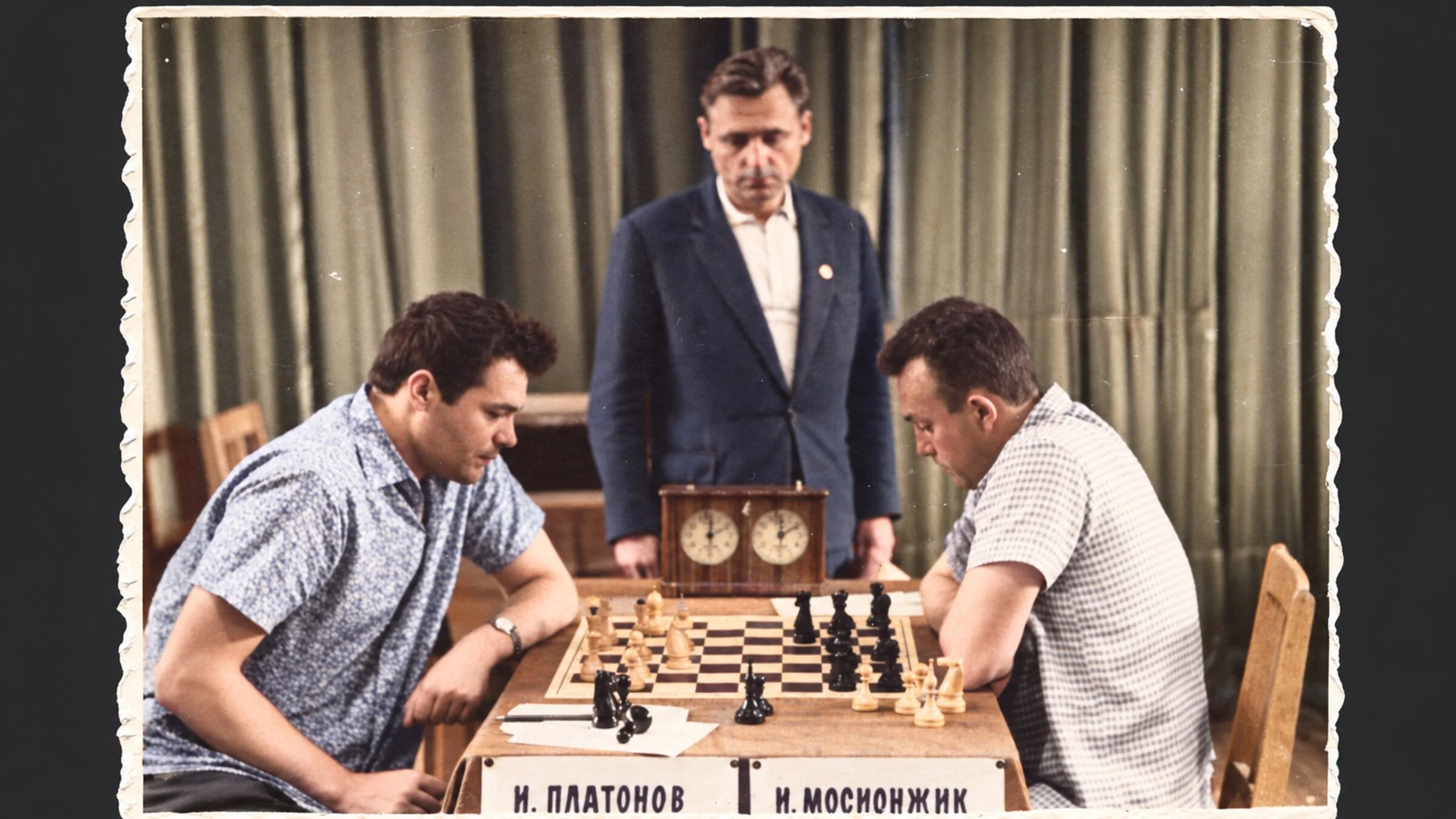
Igor Platonov reached five consecutive USSR Championship finals between 1967 and 1971. At his best, he competed successfully against former world champions and established Candidates, earning the USSR Grandmaster title in 1969. Later, as a teacher, he carried his ideas into another generation of Ukrainian chess. He was murdered in his Kyiv apartment in November 1994, at the age of sixty. [1–3]
Early Life and Chess Development
Igor Vladimirovich Platonov was born in Odessa in January 1934. Sources differ over the day of his birth, giving either 16 or 18 January. He developed his early chess skills partly in Soviet Moldavia before his family settled in Kiev. He followed his father’s professional lead and studied civil engineering. [1, 2]
The Kiev master and writer Efim Lazarev recalled meeting him in 1952, when Platonov was a first-year student at the engineering and construction institute. After graduating in 1957, he chose a career in chess. [4]
His progress brought successive achievements at city, republican, and all-Union levels. He earned the Soviet master title in 1962 and shared the Kiev championship with Lazarev in 1963. A major breakthrough came at the 1964 USSR trade-union championship, where he shared third and fourth with Isaac Boleslavsky, behind Tigran Petrosian and Lev Polugaevsky. [2]
Five Consecutive Soviet Championship Finals
Platonov’s first USSR final, at Kharkiv in 1967, produced one of his finest results. The championship used a large Swiss-system field, and he finished undefeated with 9½ points from thirteen games. Mikhail Tal and Lev Polugaevsky tied for first with 10 points. In the next group, Platonov matched the scores of Evgeny Vasiukov and Mark Taimanov. The final standings place him fifth after the tie was broken, so his result is best described as a shared third-through-fifth finish. [5]
Six wins and seven draws showed his ability to sustain strong play throughout a national championship. His opponents included Polugaevsky and Taimanov, with whom he drew, and Ratmir Kholmov and Lev Alburt, whom he defeated. The result supplied his first qualifying performance toward the Soviet grandmaster title. [5, 6]
At Moscow in 1969 he scored 12½/22, sharing seventh through ninth with Yuri Balashov and Kholmov. He achieved the most victories of any participant. They included wins against Tal, Vasily Smyslov, and Efim Geller. [7]
The finish was especially strong: four wins and two draws in his last six games. In a championship that also served as a world-championship qualifying event, he showed he could challenge established international players over a long tournament. Petrosian and Polugaevsky led the field with 14 points, placing Platonov only a point and a half behind. [7]
His finals run continued through Riga in 1970 and Leningrad in 1971. Across the five championships, the surviving statistical record gives him 96 games and 26 victories. These repeated appearances form the central competitive achievement of his career. [3]
His Soviet Grandmaster Title and International Career
Platonov received the USSR Grandmaster title in 1969. This Soviet sporting distinction had its own qualification process. He never received FIDE’s international grandmaster title. Lazarev’s 1982 book identifies him explicitly as a Soviet grandmaster. [2, 6]
His appearance at Hoogovens in January 1970 brought him into the Netherlands' international tournament circuit. He scored 5½/15 in the main group, sharing twelfth and thirteenth places with Kick Langeweg. Taimanov won the event, which also included Vlastimil Hort, Borislav Ivkov, Lubomir Kavalek, Pál Benko, and Jan Hein Donner. [8]
At the Capablanca Memorial in Cienfuegos in 1972, Platonov finished second with 13/19, behind Anatoly Lein’s 14 and ahead of Zoltán Ribli’s 12. Nine victories and eight draws made this a substantial international success. Lazarev finished runner-up in his survey of Ukrainian chess. Platonov later competed internationally in Kyiv in 1978 and participated in the USSR Championship First League in 1980. [6, 13]
Playing Style and Contemporary Reputation
Lazarev’s contemporary assessment, reproduced by Vladimir Sergeev, describes a player grounded in classical study who sought flexible plans and original solutions. Platonov valued freedom of action and accepted positions that offered both sides possibilities. His tactical ability developed alongside a broader positional understanding. [4]
His victory over Tal at the 1968–69 championship in Alma-Ata attracted particular recognition. Lazarev records that the newspaper Uchitel Kazakhstana awarded it a special prize for a beautiful victory. The award offers contemporary evidence of the impression Platonov’s play made. [6]
The Moscow results of 1969 reinforce this reputation. Victories against Tal, Smyslov, and Geller came within the same competition, against players with markedly different approaches to chess. That range supports an assessment of Platonov as a versatile and resourceful competitor. [7]
Teaching, Organization, and Professional Relationships
Platonov chaired the Ukrainian Chess Federation from 1970 to 1974. His administrative responsibilities therefore overlapped with his strongest competitive years. [1]
Sergeev later credited him with helping establish advanced training for young Ukrainian players and contributing to the introduction of a chess specialization at the Kyiv State Institute of Physical Culture. He remembered Platonov sharing notebooks of positions and training exercises with younger players. [4]
Lev Alburt’s recollections reveal the practical collaboration behind tournament preparation. At the 1971 Soviet final, Alburt worked closely with Platonov, analyzing his adjourned games and following his play from the tournament hall. Such assistance was part of the daily work of serious competition, when players could study unfinished games before resuming them. [9]
Alburt also remembered Platonov as a close friend who easily befriended younger people. He introduced him to Semon Palatnik and Anatoly Machulsky, and they became friends. These recollections give a personal dimension to the teaching career: Platonov belonged to a community in which competitive rivalry, analysis, and friendship frequently overlapped. [9]
Collecting and the Murder in Kyiv
Stamp collecting occupied an important place in Platonov’s life. Alburt recalled that their shared interest in philately connected Platonov with Petrosian. His collection also brought him recognition beyond the chess community. [9, 10]
On 13 November 1994, Platonov was murdered during a robbery at his apartment in Kyiv. According to Adrian Mikhalchishin, as cited in the Russian Chess Federation’s biography, the attackers were seeking his valuable stamp collection. This explanation is a reported account of the motive; the available sources do not establish it through a court finding. [1, 2]
The crime continued to receive press attention. A Kievskie vedomosti clipping reproduced by Sergeev, dated in his caption to 1 October 1996, appeared under the heading “Death of Philatelists.” Its front-page introduction discussed an unsolved killing from two years earlier alongside a more recent solved murder and asked whether the cases were connected. Platonov’s portrait accompanied the report. [10]
The sources consulted do not verify the investigation’s outcome or the attack’s full circumstances.
Legacy
Platonov’s name remained part of Ukrainian tournament life after his death. The Ukrainian Chess Federation’s contemporary archive records the fourth Platonov Memorial in Kyiv in January 2006, a ten-player international round robin held at the Avangard chess school. [11]
His influence as a teacher is also preserved in Roman Vidonyak's testimony. In a 2026 interview with Sagar Shah, Vidonyak identified Platonov as an important influence on his training system. He recalled Platonov’s insistence on developing endurance and the intensity of thought at the board. Vidonyak further described how Platonov had discussed calculation with Alexander Kotov and developed his own approach. These are recollections from a former student about the instruction he received. [12]
The connection gives Platonov a continuing place in the history of chess teaching. His tournament record shows sustained achievement in Soviet competition, while colleagues' and students' recollections preserve the methods, friendships, and generosity through which he contributed to Ukrainian chess.
Notes
Ukrainian Chess Federation, news archive for 2019, entry dated 16 January 2019. Gives Platonov’s life dates as 16 January 1934 to 13 November 1994 and his federation chairmanship as 1970–1974. The historical rating record reproduced by OlimpBase gives 18 January 1934. January 1934 is used in the text because the discrepancy remains unresolved.
Chess Federation of Russia, “Игорь Платонов” [“Igor Platonov”]. Biographical overview and Mikhalchishin’s account of the reported robbery motive. Its numerical errors are corrected using the tournament records below.
OlimpBase, “Soviet Chess Championship: Overall Statistics”, entry for Igor Platonov. Records five finals in 1967–1971, 96 games, and 26 wins.
Vladimir Sergeev, “Тернистый путь Игоря Платонова”, ChessPro, 22 June 2020. Includes recollections and reproduces Efim Lazarev’s assessment from Shakhmaty v SSSR, no. 3 (1970), consulted here through Sergeev.
OlimpBase, “35th Soviet Chess Championship, Kharkov 1967”. Supports the undefeated 9½/13 result and distinguishes the shared score from the final ordering of places.
Yukhym Lazarev, Творчість шахістів України [The Creative Work of Ukrainian Chess Players] (Kyiv: Zdorov’ia, 1982), printed p. 89 and following pages. Digitized book with OCR; supports the Soviet title, Cienfuegos placing, selected later appearances, and the contemporary award for the Tal game. Tournament placings elsewhere are checked against the separate results sources.
OlimpBase, “37th Soviet Chess Championship, Moscow 1969”. Results and game records supporting 12½/22, nine victories, the named opponents, and the closing sequence.
Tata Steel Chess historical archive, “Hoogovenstoernooi 1970: Standings”. Organizer-maintained record of Platonov’s 5½/15 and the tournament field.
Sergey Kim, interview with Lev Alburt, “Лев Альбурт. В борьбе с системой, в согласии с людьми”, ChessPro, 12 January 2018. Firsthand recollections of the 1971 championship, friendships with Platonov, and his shared collecting interest with Petrosian.
Alexander Ilychenko and Sergei Yanovsky, “Смерть филателистов” [“Death of Philatelists”], Kievskie vedomosti, 1 October 1996, date supplied by Sergeev. Front-page clipping, reproduced by ChessPro. Only the legible heading, introduction, and portrait caption are used; the small continuation scan does not support a reliable reading of the full report.
Ukrainian Chess Federation, news archive for 2006, entry dated 8–15 January 2006. Contemporary announcement of the fourth Igor Platonov Memorial in Kyiv.
Sagar Shah, “Coach Roman Vidonyak: Javokhir Sindarov’s Secret Weapon”, ChessBase, 23 April 2026. Firsthand testimony about Platonov’s teaching. The interview’s passing reference to six Soviet finals conflicts with the five documented finals and has not been adopted.
Szachowa Vistula, “Memorials Jose Raul Capablanca”, ninth edition, Cienfuegos 1972. Historical crosstable compilation, checked alongside Lazarev’s 1982 account of Platonov’s second place.

