Alexander Grischuk
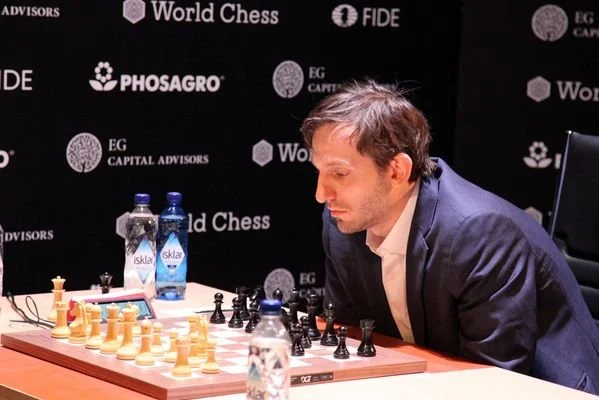
Александр Грищук, Турнир Претендентов 2018
Introduction
Alexander Igorevich Grischuk, also rendered as Aleksandr Grishchuk in some English-language sources, belongs to the small group of post-Soviet players who were both shaped by the old Soviet training culture and fully at home in the faster, more public, more media-driven chess world of the twenty-first century. Born in Moscow in 1983 and awarded the grandmaster title in 2000, he rose from a celebrated Russian junior to a long-term elite player, reached the Candidates stage repeatedly, became world No. 3 at his peak, crossed 2800 in classical rating, and won the World Blitz Championship three times. Those bare facts already place him securely in modern chess history, even before one considers the distinctive way he played and spoke about the game.
Grischuk deserves attention not because he fits a simple heroic template, but because he does not. He never played a world title match, yet for more than two decades he remained a serious presence in world championship qualifying cycles and on Russian national teams. He is also one of the few elite players whose public reputation is inseparable from a recognizable chess personality: ironic, articulate, self-mocking, chronically late on the clock, and still dangerous in exactly those positions where lesser players would collapse. A careful historical appraisal has to hold those strands together.
Early Life and Chess Formation
The official Russian Chess Federation profile places Grischuk’s beginnings clearly in Moscow. His father taught him the moves when he was four, and his formal instruction then passed through three coaches, Mikhail Godvinsky, Maxim Blokh, and Anatoly Bykhovsky. Federation profiles also emphasize how early his talent announced itself: he won Russian youth titles in the under-10, under-12, under-14, and under-16 age groups, finished second in the world under-10 championship, became a master at fourteen, and a grandmaster at sixteen.
The most revealing testimony about his formation comes from Grischuk himself. Writing on Bykhovsky’s eightieth birthday, he recalled that his father approached the coach in 1994, when Alexander was ten, and that the training lasted about a decade. Grischuk added, without hedging, that Bykhovsky “taught me to play chess,” then described the substance of that education in straightforward terms: central play, development, activity of the pieces, and healthy openings such as 1.e4 e5 and 1.d4 d5. He also described Bykhovsky as “like a second father.” That is more than a sentimental recollection. It identifies Grischuk’s chess upbringing with a recognizably Soviet pedagogical ideal, rooted in classical method before specialization.
That background also helps explain the tone of Grischuk’s own later reflections. In the same reminiscence he noted that half his family held doctorates and the other half candidate degrees, a passing remark that suggests the educated, technically minded milieu from which he came. Reliable public profiles are much fuller on his chess education than on his formal schooling, so any detailed claims about university study would go beyond the secure source base. What can be documented is the intellectual texture of his home and training environment, and it fits the player he became.
Rise to the Elite
Grischuk’s first major breakthrough came in November 1999, when he finished first at the Chigorin Memorial in St. Petersburg with 7/9. Contemporary reporting and later federation profiles both treat that result as decisive. It was not just another junior success. It brought him into the orbit of the national team, which in turn accelerated his move from promising youth player to serious international professional.
The following year compressed an unusual amount of ascent into a short time. At the 2000 Olympiad in Istanbul, Grischuk scored 7½/10 on second reserve and took an individual bronze medal while Russia won team gold. In the same broad period he made the semifinals of the 2000 FIDE World Championship, a striking performance for a player still in his teens. FIDE’s retrospective materials explicitly note that this run, achieved at age seventeen, helped move him into the elite. The combination of team reliability and knock-out nerve was already visible.
By 2002 and 2003, the rise was no longer a surprise story but an established fact. At Wijk aan Zee in 2002 he finished second behind Evgeny Bareev, one of the clearest signs that he could compete in an elite round-robin rather than merely spring upsets in open or knock-out events. Russia won a second straight Olympiad gold at Bled later that year, and by July 2003 The Week in Chess had Grischuk up to world No. 6 after a strong rating gain. In other words, the player who had first been noticed as a prodigy had already become part of the top layer of world chess before he turned twenty.
Contender Years and Major Achievements
Grischuk’s mature career is best understood not as one uninterrupted climb, but as a sequence of returns to the inner circle. In 2007 he qualified through the Candidates Matches for the eight-player World Championship tournament in Mexico City. That event itself was disappointing for him, but qualifying at all confirmed his status as a genuine contender, not merely a gifted rapid specialist or national team fixture. In 2009 came one of the best one-year stretches of his career: he won Linares on tiebreak over Vasyl Ivanchuk and then took the Russian Championship outright in Moscow. For a Russian grandmaster of his generation, that pair of victories was a major credential in both international and domestic terms.
The turning point most essential to his historical profile came in the 2011 Candidates Matches. Magnus Carlsen withdrew, Grischuk replaced him, and then defeated Levon Aronian and Vladimir Kramnik in playoff stages to reach the final. He ultimately lost 3½-2½ to Boris Gelfand, but the run remains the closest he came to a world championship match. It also crystallized a recurring theme in his career: in matches and tie-breaks, where calm under pressure becomes as important as opening theory, he was exceptionally hard to eliminate.
Speed chess was never merely an accessory to Grischuk’s classical career. It formed one of its central pillars. He won the World Blitz Championship in 2006, again in Astana in 2012 with 20/30, and for a third time in Berlin in 2015 with 15½/21. Federation profiles and specialist coverage alike underline that he treated rapid and blitz as serious chess, not exhibition formats. That attitude is historically significant because Grischuk belongs to the generation that helped normalize faster time controls as a legitimate arena of elite achievement.
His classical peak came in the mid-2010s. ChessBase recorded him at world No. 3 in May 2014, and 2700chess gives his peak FIDE rating as 2810 in December 2014. In the same broader phase he won the Petrosian Memorial in Moscow. Those results show that even if his public image increasingly centered on blitz and time-scrambles, his classical strength was not secondary. He was, for a time, very close to the summit in the most traditional measure of chess excellence.
The later phase of his career confirmed his resilience. The final standings of the 2017 Grand Prix cycle placed him second overall, good enough to return to the 2018 Candidates. In 2019 he won the Hamburg Grand Prix, then finished first overall in the Grand Prix series with 20 points, which secured his place in the 2020 Candidates. Even well after his absolute classical peak, he continued to force his way back into world championship qualification. More recently, Russian federation coverage recorded him as silver medalist at the 2024 World Rapid Championship in New York, a reminder that his speed-chess class endured into his forties.
Style and Reputation
No discussion of Grischuk can avoid the clock, but reducing him to “the player always in time trouble” is historically lazy. Grischuk himself called his regular descent into severe time pressure “one of my biggest chess shortcomings,” and a FIDE candidate profile likewise referred to it as his “chief shortcoming.” These are useful sources because they keep the point in the right proportion. Time trouble was real, chronic, and often self-inflicted. It was not a myth invented by commentators.
What made the phenomenon historically memorable is that it coexisted with extraordinary survival skills. FIDE coverage repeatedly stressed how well he could continue to play after sinking into dangerous time pressure, and one official report during the 2022 Grand Prix said he had once again shown why he was among the best players in the world under such conditions. In other words, the clock both exposed and advertised his chess character. It revealed his tendency toward overthinking, but also his ability to calculate, improvise, and remain tactically accurate with almost no time left.
Contemporaries inside Russian chess have usually described him not as a narrow specialist but as a fully rounded attacking and practical player. In 2017, Russian Chess Federation president Andrey Filatov called Grischuk “absolutely uncompromising,” “sharp,” “combinational,” and “versatile.” Those adjectives fit the technical record rather well. Bykhovsky’s early training gave him classical foundations, yet his mature play could become extremely complex, and his best performances in knock-outs and rapid events depended on the capacity to make difficult positions live. He was seldom a stylistic minimalist. Even when he chose solid structures, he had a way of making them tactically relevant.
There is also a deeper interpretive point. Grischuk’s style belongs to the engine era, but it is not defined by engine impersonation. He has long been associated with deep calculation, humor, risk, and psychological elasticity rather than with the polished technical inevitability that some later elite players came to embody. That is one reason his games and interviews remained memorable even when his tournament results fluctuated. The player and the public persona reinforced each other.
Contributions Beyond Tournament Play
Grischuk’s contribution to chess extends beyond individual placings because he was, over a very long span, an important team player. Russian federation profiles credit him with Olympiad golds in 2000 and 2002, and official federation coverage also highlights his club achievements, including the Russian team championship with Malakhit in 2014 and European Club Cup titles with the Novosibirsk team Siberia, later Globus, in 2015 and 2017. This strand of his career is easy to overlook if one focuses only on world championship qualification, but it helps explain his standing inside Russian chess. He was trusted in collective competition for years.
His later working relationships also illuminate how he functioned inside the elite. Bykhovsky remained the defining formative mentor, yet in 2016 Grischuk told an interviewer that he had come to the Russian Superfinal with his second, Vlad Tkachiev, and had worked with him for several recent events. In the same interview, when asked whether coaching appealed to him, he replied that it did not, adding that commentary interested him more. That answer is important. It suggests that his extra-competitive contribution to chess has been less that of system-building coach or prolific author, and more that of a public explainer, analyst, and unusually quotable elite witness to the game’s contemporary culture.
His personal life also intersected with chess culture in ways relevant to a historical profile. Official Russian federation coverage publicly linked him first to Ukrainian grandmaster Natalia Zhukova and later to Kateryna Lagno, another elite player of the post-Soviet sphere. This is not trivia. It places Grischuk within a network of top players whose careers crossed Russian and Ukrainian chess institutions before and after the Soviet collapse. His household, in that sense, reflected the transnational and often complicated social world of post-Soviet grandmaster chess.
Historical Legacy
Grischuk’s legacy is strongest in three connected domains. First, he was one of the defining Russian grandmasters after the Kramnik generation, a player who remained relevant from the late 1990s into the mid-2020s. Second, he was one of the outstanding speed-chess players of the modern era, with three world blitz titles and a late-career world rapid silver. Third, he was one of the strongest players of his generation never to reach a world championship match, a judgment supported by his Candidates final in 2011, repeated returns to Candidates play, his world No. 3 ranking, and his 2810 peak rating. That combination is unusual and historically distinctive.
It is also reasonable to see Grischuk as a bridge figure. He was not a Soviet champion in the classical historical sense, since his adult career belongs to the post-Soviet era, yet his chess education was plainly transmitted through Soviet-trained coaches and methods. At the same time, he became one of the elite players most closely identified with rapid and blitz as first-class forms of competition. That dual inheritance, Soviet pedagogical roots and modern speed-chess centrality, gives his career a broader significance than a simple list of titles suggests.
Grischuk deserves attention today because he shows how a great player can leave a major historical imprint without becoming world champion. He was a contender, a team pillar, a three-time blitz world champion, a top-three classical player at his best, and a singular voice in elite chess culture. For readers interested in how post-Soviet chess actually developed after the great Soviet champions were gone, Grischuk is not a side character. He is one of the clearest case studies.

Notes and Sources
This profile uses the forms Alexander Grischuk, Aleksandr Grishchuk, and the Russian Александр Игоревич Грищук as equivalent references to the same player. For biography and institutional context, the most useful primary and near-primary sources were official FIDE materials, the Russian Chess Federation’s profile and interview archive, and archival tournament pages such as the 2011 Candidates site. For results and chronology, I cross-checked specialist records from The Week in Chess, OlimpBase, and 2700chess. For interpretive texture, I used carefully selected interviews and specialist reportage from ChessBase and ChessPro where those materials aligned with the official record.
One small textual caution is worth stating explicitly. FIDE’s 2020 introductory profile for the Candidates incorrectly lists Grischuk’s third World Blitz title as coming in 2016. Official event coverage and other federation records show that the correct year was 2015, in Berlin, and that is the dating followed here. I have also avoided making unsupported claims about formal schooling, because the strongest public sources on Grischuk are rich on chess training and competition, but comparatively thin on university or non-chess educational biography.
