Nana Alexandria
Introduction
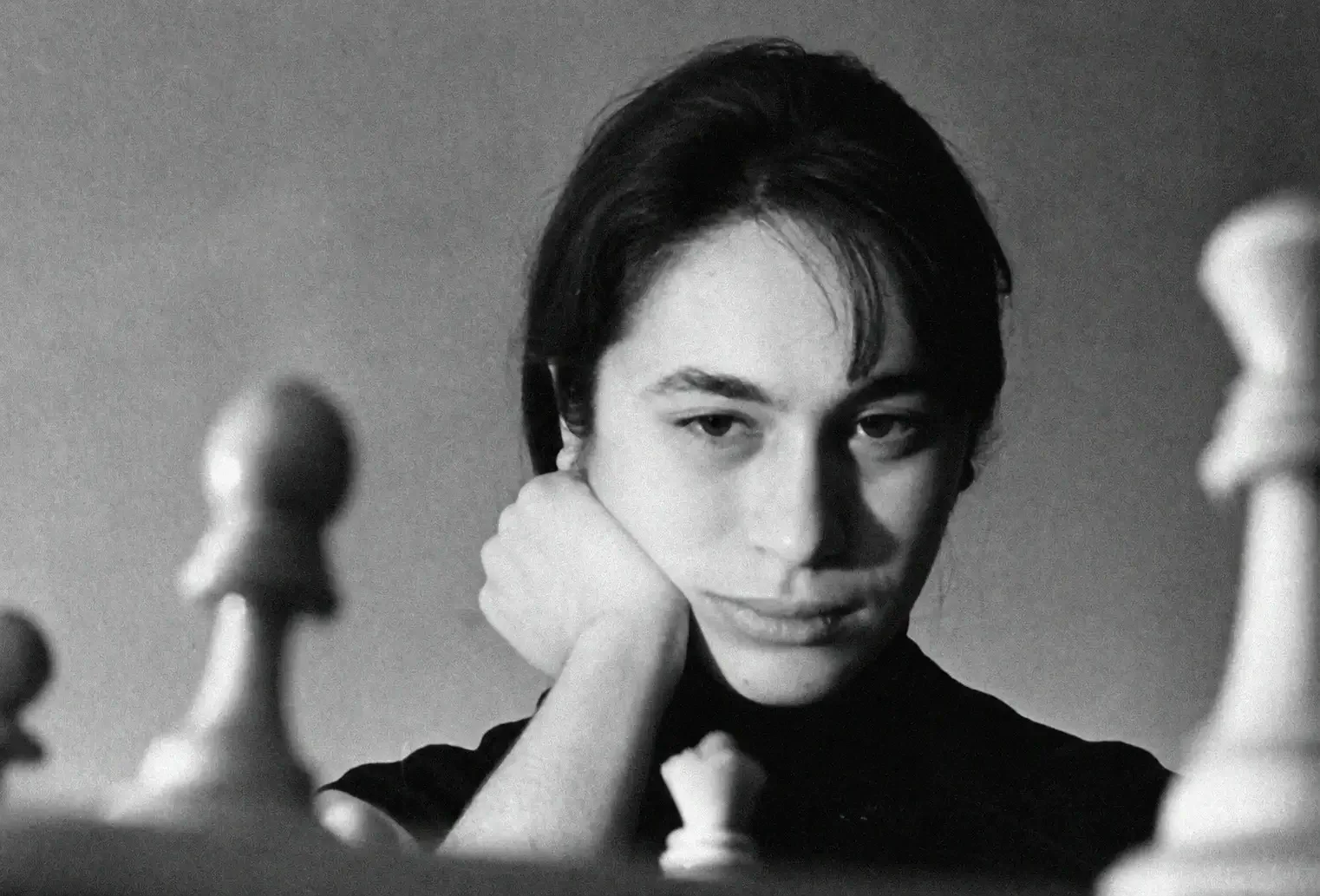
Nana Alexandria, born on October 13, 1949 in Poti in the Georgian SSR, belongs among the strongest women players produced by Soviet chess and among the most influential figures in the later institutional development of women’s chess. Official and specialist records credit her with the Woman International Master title in 1966, the Woman Grandmaster title in 1976, a peak historical rating of 2415 in January 1988, three Soviet women’s championship titles by the age of twenty, two matches for the women’s world crown, more than twenty international tournament victories, and an unusually long public career that continued into arbiting, administration, journalism, and advocacy. In 2024 FIDE marked her seventy-fifth birthday by announcing a centennial award for her contribution to the development and popularization of women’s chess in the twentieth century.
Alexandria deserves attention not simply as a player who came close to the world title, but as a historical hinge between phases of Georgian and Soviet women’s chess. She was younger than Nona Gaprindashvili, older than Maia Chiburdanidze, and strong enough to challenge both for the world championship. That rare position, combined with six team golds for the USSR in Olympiad play and later organizational work for women’s competitions, makes her one of the clearest examples of a great chess figure whose legacy exceeds a simple champion or non-champion divide.
Early Life and Chess Formation
The core facts of Alexandria’s early development are unusually consistent across specialist sources. She was born in Poti, learned chess as a small child, and by age ten had entered formal training in the Georgian school associated with Vakhtang Karseladze. ChessBase’s long profile of her states that she learned the game at four, began formal lessons at ten, and within six months became girls’ champion of Tbilisi; the same profile adds that her father was a mathematician and that she reached master strength by fifteen. The Russian Chess Federation’s biographical summary likewise identifies Karseladze as her formative trainer and notes that by fifteen she was already champion of Georgia.
Her education points to a wider intellectual formation than the stereotype of a narrowly specialized Soviet chess professional. Georgian biographical references state that she graduated in 1972 from Tbilisi State University’s faculty of Western European languages and literature. Russian reference summaries describe her by education as a journalist, while ChessBase characterizes her as a philologist who also pursued postgraduate work in literature. These details align with her later public roles in journalism, commentary, and writing. Publicly available family information is thinner than her tournament record, but later biographical notices identify her husband as the architect Levan Bokeria and their son as the Georgian politician Giga Bokeria.
One should be cautious not to romanticize the Georgian setting into a mythic explanation for every later success. The evidence supports something more concrete. Alexandria emerged from a training culture that had already begun to produce elite female players, and in a 2010 FIDE Grand Prix interview she herself emphasized both Georgia’s long chess traditions and the psychological example provided by Gaprindashvili to younger girls. In other words, she belonged to a genuine school and a living competitive lineage, not an accidental local surge.
Rise in Competitive Chess
Alexandria’s rise was rapid even by Soviet standards. In her own 2010 FIDE interview she recalled that her debut in the USSR women’s championship came at age fifteen, when after ten rounds she was sharing first place with the reigning world champion Nona Gaprindashvili. That memory fits the contemporary perception preserved in later Russian federation materials, which describe her debut in the Soviet championship as immediate evidence that Georgia had produced another player capable of contending at the very top.
Her first national summit came in Kiev in 1966. OlimpBase’s event record for the twenty-sixth Women’s Soviet Championship shows seventeen-year-old Nana Alexandria finishing first with 14 points from 19 games, ahead of Alexandra Kislova and Tatiana Zatulovskaya. Official FIDE records show that 1966 was also the year in which she received the Woman International Master title. Within a few years she added two more Soviet titles and by age twenty had become a three-time champion of the strongest women’s national championship in the world.
This was not only a domestic achievement. In the Soviet system, the women’s championship was one of the hardest proving grounds available, because it concentrated a deep field of established international players and future world title contenders. To win it at seventeen was already a sign of exceptional class. To win it three times before turning twenty established Alexandria not as a promising junior, but as a fully formed member of the top Soviet and world elite.
Major Career Achievements
Alexandria’s long middle career was defined by repeated entry into the women’s world championship cycle and by her ability to return after disappointment. The Russian Chess Federation summary notes that after defeating Milunka Lazarević she reached the final candidates stage in 1971, where she lost to Alla Kushnir. In the next cycle she broke through decisively, defeating Marta Litinskaya 5.5 to 2.5 and Irina Levitina 9 to 8 to earn the right to challenge Nona Gaprindashvili for the world title in 1975. FIDE’s birthday summary and later reference pages confirm the result of that match: Alexandria lost by 3 wins, 1 draw, and 8 losses, or 3.5 to 8.5 by points.
What distinguishes Alexandria from many one-cycle challengers is that she returned. In the 1980 to 1981 cycle, again according to the Russian federation summary, she defeated Elena Akhmylovskaya, Marta Litinskaya, and Nana Ioseliani to win another shot at the crown. OlimpBase’s record of the 1981 title match in Borjomi and Tbilisi shows an exact 8 to 8 tie against Maia Chiburdanidze. Under the rules, the reigning champion retained the title, so Alexandria again left the match without the crown. Yet historically that result is significant because it places her at a demonstrably equal score with a reigning world champion in a completed title match.
Her world-title relevance did not end there. The same Russian summary records that in 1983 she defeated Tatjana Lematschko in a candidates quarterfinal before losing narrowly to Levitina in the semifinal, while OlimpBase’s record of the 1986 candidates tournament in Malmö places Alexandria second with 9 points from 14 games, behind only Elena Akhmilovskaya. These results show that she remained a world-class contender well into the mid-1980s and was not merely a player whose reputation rested on one early burst of form.
Her Olympiad record strengthens that judgment. OlimpBase’s all-time Soviet women’s Olympiad record gives Alexandria six appearances for the USSR, in 1969, 1974, 1978, 1980, 1982, and 1986, with 41 points from 54 games, a 75.9 percent score, six team gold medals, and four individual gold medals. The 1969 event record shows her taking reserve-board gold with 8 out of 9, and the 1982 Lucerne Olympiad record shows her taking second-board gold with 7.5 out of 9. Later profiles add that from 1992 through 1996 she served as captain of the gold-medal-winning Georgian women’s Olympiad teams, which means her Olympiad significance extended into the post-Soviet era in a different role.
Style and Reputation
The best way to describe Alexandria’s style is not with a slogan but with a cluster of recurring technical judgments. The Russian Chess Federation’s profile states that Mikhail Tal called her an unusually multi-faceted player and credits her with confidence both in sharp positions and in endgames. This is broadly reinforced by other specialist summaries that describe her as universal rather than narrowly tactical or purely positional. In practical terms, that means contemporaries saw a player with balanced strengths across phases of the game, someone who could attack, maneuver, and convert.
The most illuminating evidence about her strengths and limitations comes from Mark Dvoretsky’s later recollections. In a memoir excerpt published from his book, Dvoretsky explained that during their collaboration Alexandria rebuilt her opening repertoire, abandoning eccentric side-lines for more principled systems better suited to her active style. He also wrote that her positional understanding, calculation technique, and decision-making improved substantially. That is a high-level trainer’s diagnosis, and it suggests that the mature Alexandria was not only talented but highly educable, able to revise large parts of her game when serious preparation demanded it.
Dvoretsky was equally clear about the defects that, in his view, kept her from becoming world champion. He described chronic time trouble, emotional vulnerability, and inconsistency under stress as enduring sporting problems. His pre-match assessment before the 1981 title contest is especially revealing: he wrote that in purely chess terms Alexandria did not уступать, or fall short of, Chiburdanidze overall, but that she was markedly weaker as a competitive match athlete because she remained vulnerable to nerves and late-game collapses. That is not a casual compliment, and it offers a historically serious explanation for the paradox of Alexandria’s career. She was strong enough to reach and even draw a world title match, yet could not reliably convert that strength into championship finality.
A later ChessBase account turns one game from the 1975 title match into a symbol of that pattern. According to that retrospective summary, Alexandria had a winning position in game nine against Gaprindashvili, blundered away a piece, and then failed to recover psychologically, losing several more games in succession. As a piece of historical interpretation rather than formal archival verdict, this should be treated carefully. Even so, it fits the broader documentary picture supplied by Dvoretsky and helps explain why so many assessments of Alexandria combine admiration for her chess with a sense of unrealized championship potential.
Contributions Beyond Tournament Play
Alexandria’s post-competitive importance is unusually concrete. Official FIDE materials state that she served as chairperson of the FIDE Women’s Commission from 1986 to 2001. In her own FIDE interview from Ulaanbaatar in 2010, she gave a detailed account of the initiatives she associated with that work: helping to realize the European Club Cup, persuading organizers of open events to include women’s prizes, pushing for girls’ age-group European and World Championships, and advancing the inclusion of the winning women’s Olympiad team in the World Team Championship. She also said that from 1992 onward she argued for increasing the number of women’s boards at the Olympiad from three to four. Because these claims come partly from Alexandria herself, the most careful wording is that she championed, promoted, or helped realize these reforms rather than single-handedly creating the whole modern structure. Even with that caution, the documentary record shows real institutional labor, not ceremonial office-holding.
Her later career also confirms that she was never only a former player living on reputation. FIDE’s official profile records her International Arbiter title in 1995, and FIDE’s 2024 tribute notes that she officiated many prestigious events, including the 2018 Carlsen versus Caruana world championship match as Deputy Chief Arbiter. ChessBase’s biographical profiles add that she worked as a journalist and commentator, wrote in Georgian, Russian, and English, and published books including 8:8 – Victory and Defeat and Georgian Women Chess Phenomenon. The same source credits her with making the documentary Georgian Gambit. Taken together, these activities show a figure who moved between elite play, public explanation, and administrative organization with unusual ease.
One further sign of her broader role is the durability of the institutions now attached to her name. Official festival pages from Poti and current FIDE tournament records show the continuing existence of the Nana Alexandria Cup as an international event. This is not just commemorative branding. It indicates that Alexandria became embedded in Georgian chess culture as a patronal figure whose name can still organize real competitive activity for younger players.
Historical Legacy
Alexandria’s place in chess history is clearest when one avoids two common distortions. The first is to reduce her to “the player who never became world champion.” The second is to dissolve her into a generalized story of Georgian women’s chess. The more precise historical view is that Alexandria was a principal actor within that Georgian ascent and one of the few players whose career directly connected the reigns of Gaprindashvili and Chiburdanidze. FIDE’s presentation of the documentary Glory to the Queen places her among the four Georgian women who dominated the top level from the 1960s to the early 1990s, while also noting that Alexandria and Nana Ioseliani were always close behind the champions. That is a good shorthand for her historical position: not peripheral, not merely symbolic, but continuously present at the summit.
Her historical weight also lies in duration. Many excellent players peak once. Alexandria remained relevant across decades, from her Soviet title at seventeen, to the 1975 title match, to the drawn 1981 title match, to the 1986 candidates tournament, to Olympiad captaincy for independent Georgia, and then to long service in FIDE and top-level arbiting. The arc is unusually broad. It spans player, near-champion, team pillar, organizer, spokesman, writer, arbiter, and public memory figure, all documented within the record rather than attached afterward by nostalgia.
Why does Nana Alexandria deserve attention today? Because chess history too often sorts its subjects into winners and everyone else. Alexandria does not fit that sorting. She was strong enough to stand level with a reigning world champion over a full title match, successful enough to anchor dominant Olympiad teams, and influential enough to shape later institutions for women’s chess. The continued existence of the Nana Alexandria Cup and FIDE’s 2024 centennial recognition both point to the same conclusion. Her legacy is not that of a forgotten runner-up. It is the legacy of a major historical figure whose playing career and institutional work together altered how women’s chess was contested, organized, and remembered.
Notes and Sources
This profile prioritizes official FIDE materials, event records from OlimpBase, Alexandria’s own 2010 FIDE interview, specialist Russian-language chess references, and Georgian biographical materials. For competitive facts, title dates, ratings, trophies, and match scores, official FIDE pages and OlimpBase event records were treated as the most reliable anchors. For style, training, and psychological assessment, Mark Dvoretsky’s retrospective account is especially valuable because it comes from a trainer who worked directly with Alexandria before her 1981 title match. For her later activity as journalist, organizer, arbiter, and advocate, FIDE tributes, ChessBase biographical essays, and official tournament pages provide the strongest usable public documentation.
Alternate spellings appear in the sources. Official FIDE pages use “Nana Alexandria,” while Georgian materials and tournament pages sometimes use a transliteration closer to “Nana Aleksandria.” Russian-language sources give Нана Александрия, and the Georgian form is ნანა ალექსანდრია. Researchers working across Soviet, Georgian, and post-Soviet materials should therefore check more than one transliteration when searching archives and databases.
