Alexander Konstantinopolsky
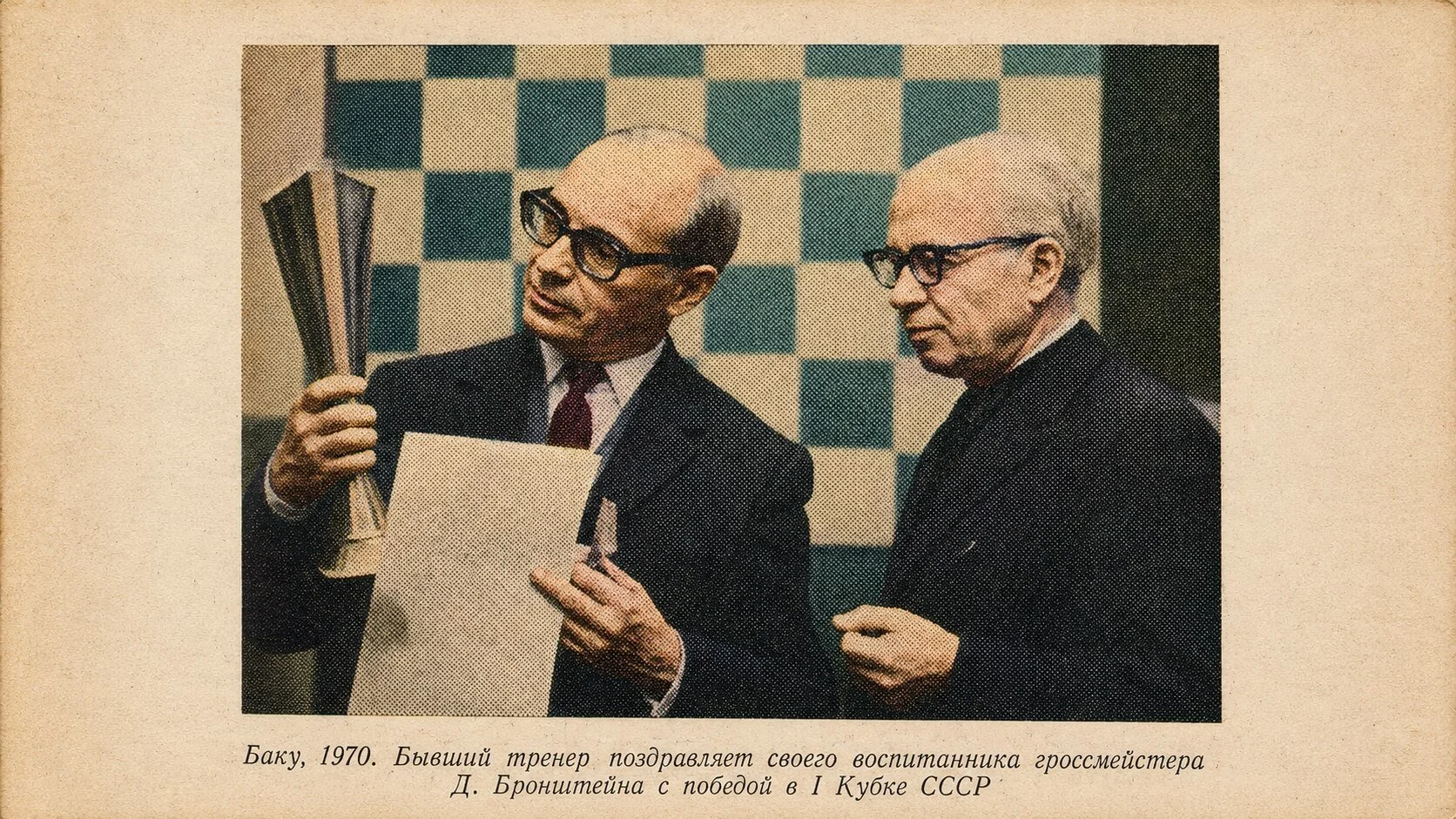
David Bronstein and Alexander Konstantinopolsky in Baku
Alexander Markovich Konstantinopolsky was one of those chess figures whom history too easily shelves a rank too low. Born on 19 February 1910 in Zhytomyr and dying in Moscow on 21 September 1990, he was simultaneously a strong Soviet master, a five-time Kyiv champion, a correspondence champion, a trainer of national teams, a chess theoretician, and eventually an honorary grandmaster. His importance lies not only in the tournaments he played but in the institutions, students, books, and habits of analysis he helped build.
That is the first thing short biographies usually miss. Konstantinopolsky was not merely “a strong player who coached Bronstein.” He sat at the intersection of several major streams of Soviet chess life: interwar Ukrainian competition, postwar Soviet master play, youth instruction in Kyiv, women’s national-team coaching, correspondence chess, and the literature of opening and middlegame theory. He is best understood not as a single glittering peak, but as a load-bearing beam in the architecture of twentieth-century chess.
Competitive career: stronger than his fame suggests
As an over-the-board player, Konstantinopolsky established himself in Kyiv during the early 1930s. He won the Kyiv championship five consecutive times from 1932 through 1936, earned the Soviet Master of Sport title in 1933, and recorded a string of strong results in Ukrainian championships: shared 3rd-5th in 1931, 3rd in 1933, 4th in 1936, and shared 3rd-4th in 1937. Those results made him one of the central figures of the Kyiv chess scene before the war.
His peak Soviet championship result came in the 10th USSR Championship at Tbilisi in 1937. There, he finished tied for 2nd-3rd with Viacheslav Ragozin on 12/19, just half a point behind Grigory Levenfish. That was not a decorative placement. In the Soviet context, it meant finishing near the summit of what was effectively one of the world's strongest national fields.
He was no one-result wonder. The Encyclopedia of Modern Ukraine records further best USSR championship finishes of 4th-6th in 1945 and 5th-6th in 1950, while OlimpBase credits him with six appearances in Soviet Championship finals between 1937 and 1952, for a cumulative 56.5 points from 109 games, with 28 wins, 57 draws, and 24 losses. That is a quietly formidable record, especially for a player who never enjoyed the international visibility given to later Soviet stars.
After relocating to Moscow in 1944, he remained a significant force in local competition. ChessBase’s historical retrospective notes that his best Moscow city championship result was shared 2nd-5th in 1954, and the Encyclopedia of Modern Ukraine adds strong Moscow showings in 1944-45, 1958, and 1966. ChessBase also states that FIDE awarded him the International Master title in 1950 and argues that he had grandmaster-level playing strength, but little real opportunity to prove it internationally outside the USSR. ESU’s entry notes Amsterdam 1966, where he shared 3rd-5th, as one of the few clear foreign markers in his late competitive record.
In other words, Konstantinopolsky’s playing career deserves to be read against the grain of fame. He did not become a household name because he lacked skill. He became relatively obscure because his best years unfolded inside the deep, crowded reservoir of Soviet chess, where many world-class players were forced to live on the same historical page.
Kyiv, the Young Pioneers Palace, and the making of a chess school
If one had to choose the single most important non-tournament fact about Konstantinopolsky, it would be his role in building the Kyiv Young Pioneers Palace chess culture. A New In Chess historical study of Kyiv chess records that the chess and checkers circle at the Palace opened in 1935, and that in April 1936 the Soviet Union’s first children’s chess and checkers club was established there. The transformation of a struggling circle into a powerful club, the study says, was spearheaded by Semyon Natov and Alexander Konstantinopolsky. Isaak Romanov later described the club founded by Konstantinopolsky as a template for talent-development centers across the country.
This is not merely institutional trivia. It is a window into how Soviet chess actually reproduced itself. The same source says Konstantinopolsky turned the club, with Natov, into one of the biggest and strongest chess-checkers collectives in the country, and describes him as having an “innate pedagogic talent.” The recollection is striking because it emphasizes not only chess instruction but pastoral care: he looked after pupils in school, in family life, and beyond the board.
The alumni list from that Kyiv club is astonishing. The New In Chess study names David Bronstein, Isaak Lipnitsky, Abram Khasin, Anatoly Bannik, and Khanan Muchnik among the pupils who passed through or were shaped by that orbit, while the Encyclopedia of Modern Ukraine specifically credits Konstantinopolsky with preparing Bannik and Bronstein. This is one of the clearest reasons his historical weight exceeds his tournament résumé. He helped create not just results, but generations.
A vivid anecdote survives from Bronstein. The club did not admit boys by merely waving them through the door; Bronstein later recalled that beginners were examined, and that Konstantinopolsky tested practical endgame understanding before accepting them. That small memory tells you a great deal about the man: exacting, practical, pedagogically serious, and interested in foundations rather than glitter.
Bronstein, national teams, and the wider Soviet system
Bronstein is the most famous branch of Konstantinopolsky’s teaching legacy. FIDE’s centenary article on David Bronstein explicitly identifies Bronstein as a pupil of Alexander Konstantinopolsky, and the Russian Chess Federation adds the fuller arc: Konstantinopolsky was Bronstein’s first mentor at the Kyiv Pioneers Palace and later served as his second in the 1951 world championship match against Botvinnik. That double role matters because it places him at both ends of elite formation, from childhood instruction to world-championship preparation.
Yet Bronstein was only one chapter. The Encyclopedia of Modern Ukraine states that Konstantinopolsky coached the Soviet women’s national team from 1954 to 1976, and the Russian Chess Federation gives the same span. When that tenure is set beside OlimpBase’s year-by-year Soviet women’s Olympiad record, the scale of his institutional success becomes clearer: during the years his team actually participated, the USSR women finished first in every Olympiad from 1957 through 1974. One should not reduce that dominance to a single coach, but it is impossible to write the history of Soviet women’s chess supremacy without him.
His standing in women’s chess is also reflected in later testimony. The Russian Chess Federation quotes Nona Gaprindashvili, remembering him as a major theoretician and mentor who did a great deal for Soviet chess. That is not just ceremonial praise. It reflects the fact that his influence ran through national-team culture, not only through individual lessons.
Nor was his coaching limited to over-the-board play. ESU says he later worked with the Soviet correspondence team from 1976 to 1982, which means that his coaching footprint extended across youth training, elite men’s preparation, women’s national-team work, and correspondence chess. Few chess figures leave marks in all four terrains.
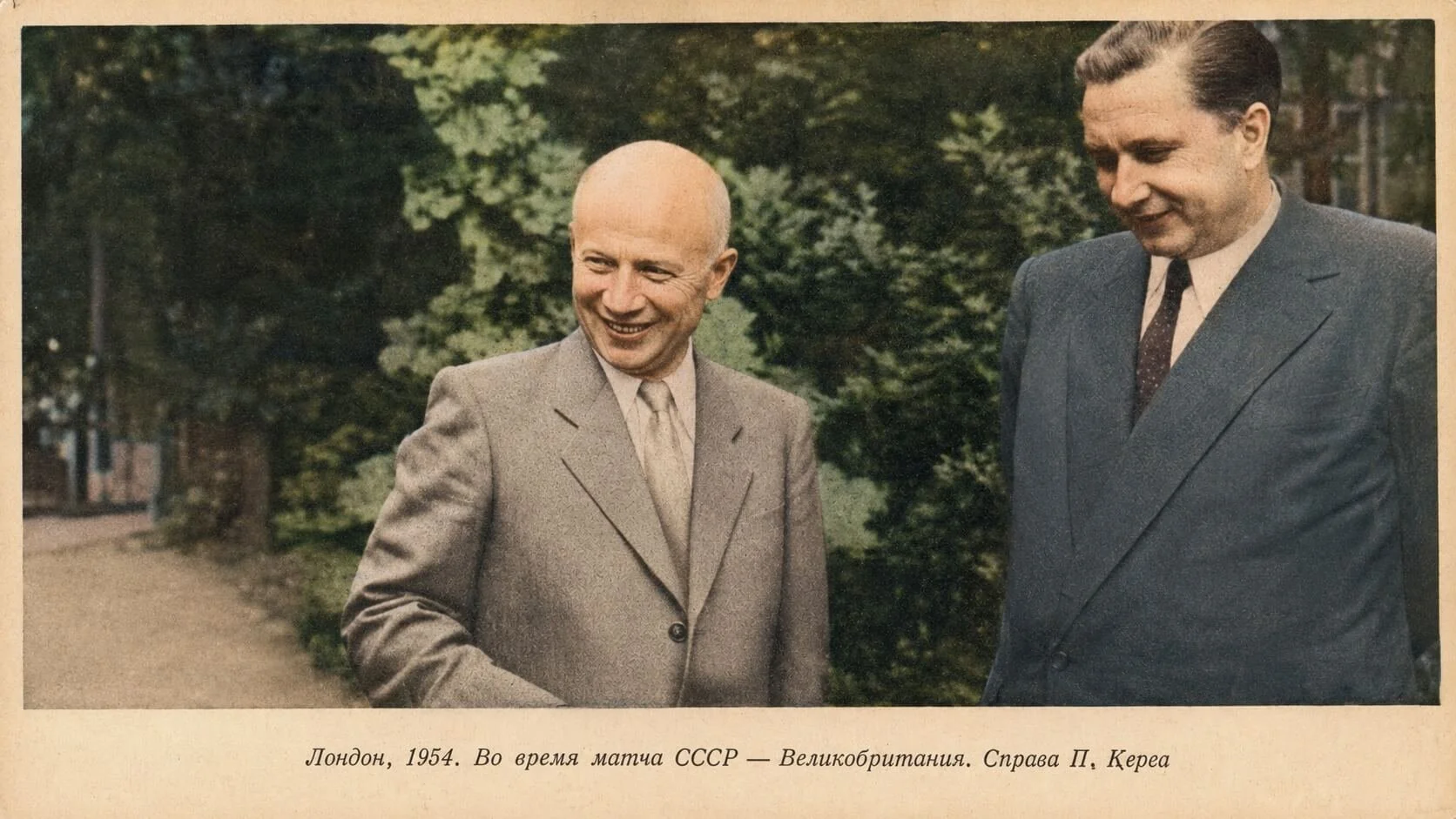
Alexander Konstantinopolsky and Paul Keres, 1954
Correspondence chess: not a side note, but a second career
Konstantinopolsky’s correspondence record is substantial enough to stand on its own. The Russian Chess Federation states that he became USSR correspondence champion in 1951, and ESU identifies him as the winner of the Soviet correspondence championship held from 1948 to 1951. ChessBase likewise places him among the best Soviet correspondence players of the 1940s.
The ICCF title lists him as an International Master of correspondence chess in 1966. A detailed historical table of the 3rd Correspondence Olympiad final lists the Soviet Union in first place on 35.5 points and names Konstantinopolsky on board three, where he contributed 4 points to the Soviet gold-medal finish. This matters because it shows that his correspondence success was not merely domestic. He belonged to the Soviet world-team machine at a moment when correspondence chess was intellectually prestigious and theoretically important.
Writer, theoretician, editor, and curator of chess knowledge
His published and editorial work is another major dimension often neglected in short profiles. ESU says directly that his writings were devoted to opening and middlegame theory. A sports encyclopedia entry goes further, crediting his research with contributing to both the theory of openings and the aesthetics of chess. That phrase is worth pausing over. It suggests a thinker interested not only in efficiency, but in form, clarity, and the beauty of chess ideas as such.
The bibliography attached to his name is broad and revealing. ESU and the sports encyclopedia list his work on the 18th and 21st Soviet Championships, his coauthored book on the Caro-Kann, his 1985 book Alexander Konstantinopolsky, and his coauthored book on the Vienna Game. The same sports source adds that he edited Soviet editions of Aron Nimzowitsch’s My System in 1974 and My System in Practice in 1979, and that he served as consulting editor of the encyclopedic dictionary Chess in 1990. Those are not the labors of a casual annotator. They are the labors of someone helping define how Soviet readers studied the canon.
Another overlooked point is that he also worked in chess journalism. The sports encyclopedia credits him with leading the chess sections of the newspaper Kommunist in 1937 and of the magazine Sport from 1939 to 1940. Taken together with his books and editorial work, this shows a man active across nearly every printed medium available to Soviet chess culture: newspapers, magazines, tournament books, opening monographs, and reference works.
Even his name survives in opening nomenclature. ChessBase notes that the line 1.e4 e5 2.Nf3 Nc6 3.g3 bears his name as the Konstantinopolsky Opening. But his theoretical legacy is larger than any single line. The important point is not that he attached himself to one corner of the ECO code-space. It is that contemporaries consistently remembered him as a serious analyst whose thinking linked opening choice to middlegame understanding.
How contemporaries saw him
Botvinnik’s judgment is especially revealing. In the Russian Chess Federation profile, Botvinnik calls Konstantinopolsky “thoughtful and objective.” That is a small phrase, but it is a sharp one. It implies sobriety of analysis, resistance to theatrical overstatement, and a kind of disciplined clarity. In an era of enormous chess egos, being remembered for intellectual balance is no small distinction.
Gaprindashvili’s remark complements that image. She remembered him as a major theoretician and mentor who did much for Soviet chess. Between Botvinnik’s stress on analytical seriousness and Gaprindashvili’s stress on mentorship, a coherent portrait emerges: Konstantinopolsky was valued not only for what he knew but for how reliably he could turn knowledge into instruction. That combination is rarer than it sounds. Many great players are poor teachers; many good teachers lack elite competitive credibility. He had both.
Recognition, late legacy, and historical place
The official distinctions he received trace the breadth of his career. ESU lists Soviet Master of Sport in 1933, Honored Trainer of the USSR in 1957, and correspondence International Master in 1966; the Russian Chess Federation adds that he received the honorary grandmaster title in 1983. These markers tell a story of layered recognition: first as player, then as trainer, then as correspondence master, and finally as a senior historical figure whose lifetime of work demanded formal acknowledgment.
His literary afterlife is revealing, too. The publisher’s note to Obsession: A Chess Biography of Vsevolod Rauzer states that Konstantinopolsky died before he could publish the manuscript, and that thanks to the efforts of his son Mark, it finally appeared in Russian in 2022 and in English in 2023. New In Chess describes Rauzer as Konstantinopolsky’s close friend and collaborator over many years. So even decades after his death, Konstantinopolsky remained an active presence in chess history through the delayed publication of his research and recollections.
That posthumous Rauzer book is symbolically perfect. Rauzer was one of the great opening minds of prewar Soviet chess, and Konstantinopolsky spent part of his own late life preserving, interpreting, and extending that memory. It captures something essential about his place in chess culture: he was not only a producer of results, but a custodian of lineage.
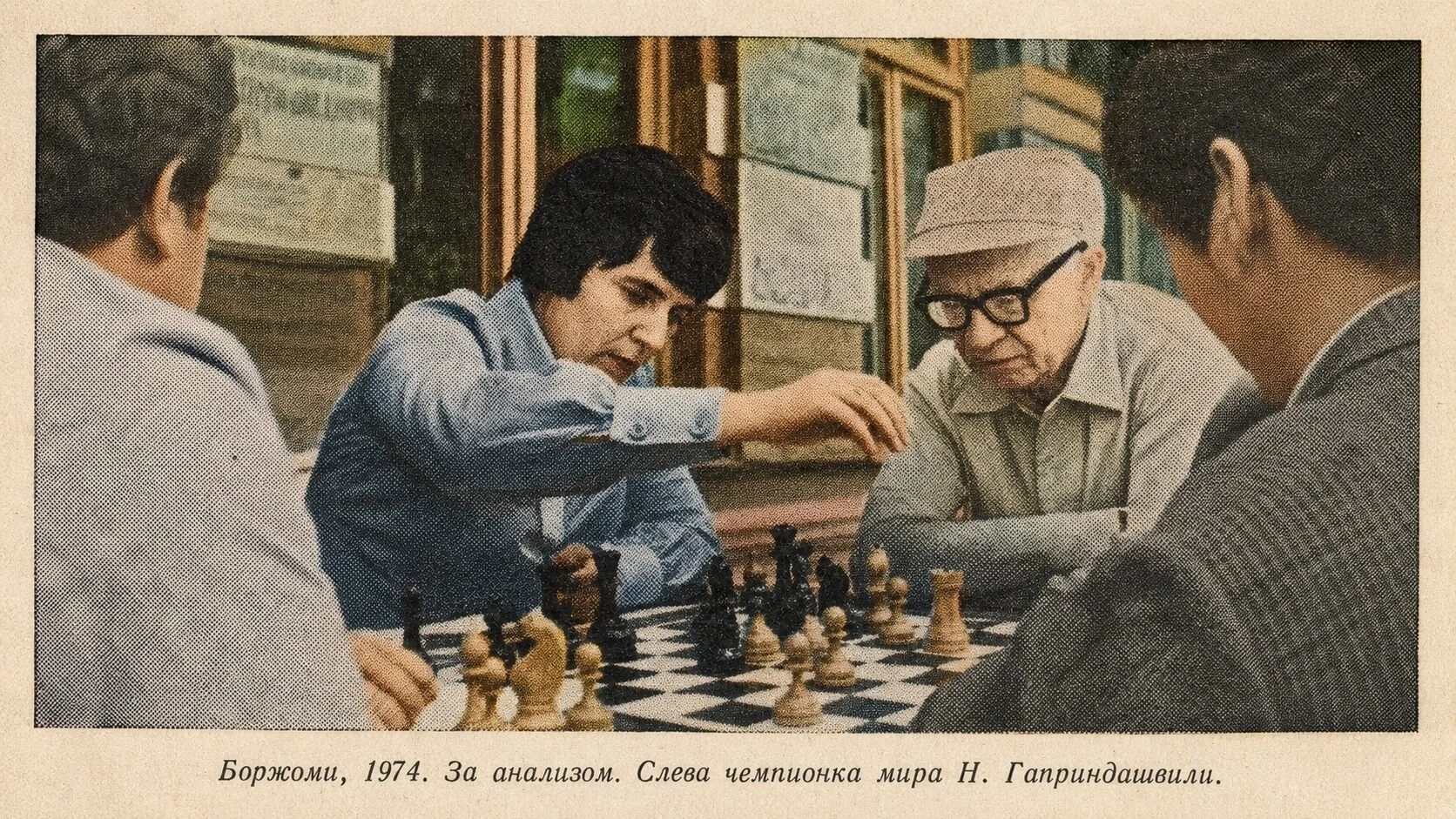
Nona Gaprindashvilli and Alexander Konstantinopolsky, 1974
Final assessment
The most accurate way to rank Alexander Konstantinopolsky is not to ask whether he belongs beside Botvinnik, Smyslov, or Bronstein in pure fame. He does not. The better question is whether Soviet chess would look the same without him. On that question, the answer leans strongly toward no. Remove him, and you lose a five-time Kyiv champion, a 1937 Soviet silver-level finisher, an IM-level master with limited foreign opportunities, the early mentor and later second of Bronstein, a builder of the Kyiv Pioneers Palace school, a long-serving coach of the Soviet women’s team, a correspondence champion and Olympiad gold medalist, and a substantial editor-theoretician whose fingerprints remain on opening literature and chess reference culture.
So the academically honest verdict is this: Alexander Konstantinopolsky was one of the significant hidden organizers of Soviet chess knowledge. He was strong enough to matter on the board, and wise enough to matter off it for even longer. His career was not built around one crown. It was built around transmission: from Kyiv to Moscow, from youth club to world-championship match, from opening notes to books, from one generation’s analysis to the next generation’s strength. That is a different kind of greatness, quieter in headline terms, but immense in historical consequence.
