Valdai “Noble” Soviet Chess Set
The Valdai chessmen (often called the “Nobles” or “Boyars” in English‑language auctions) are a distinctive Soviet pattern produced from the late 1940s through the 1970s and revived in modern reproductions. These medium‑sized sets have wide bell‑bottom bases, funnel‑shaped stems, and striking knights that differ markedly from the Staunton pieces familiar in Western tournaments. Because of the scarcity of information in Soviet archival sources, the set’s origin and the meaning of the nickname Nobles have been the subject of speculation. The research below consolidates information from collectors’ articles, archival investigations, and general historical references to provide a thorough picture of the Valdai Noble chess set.
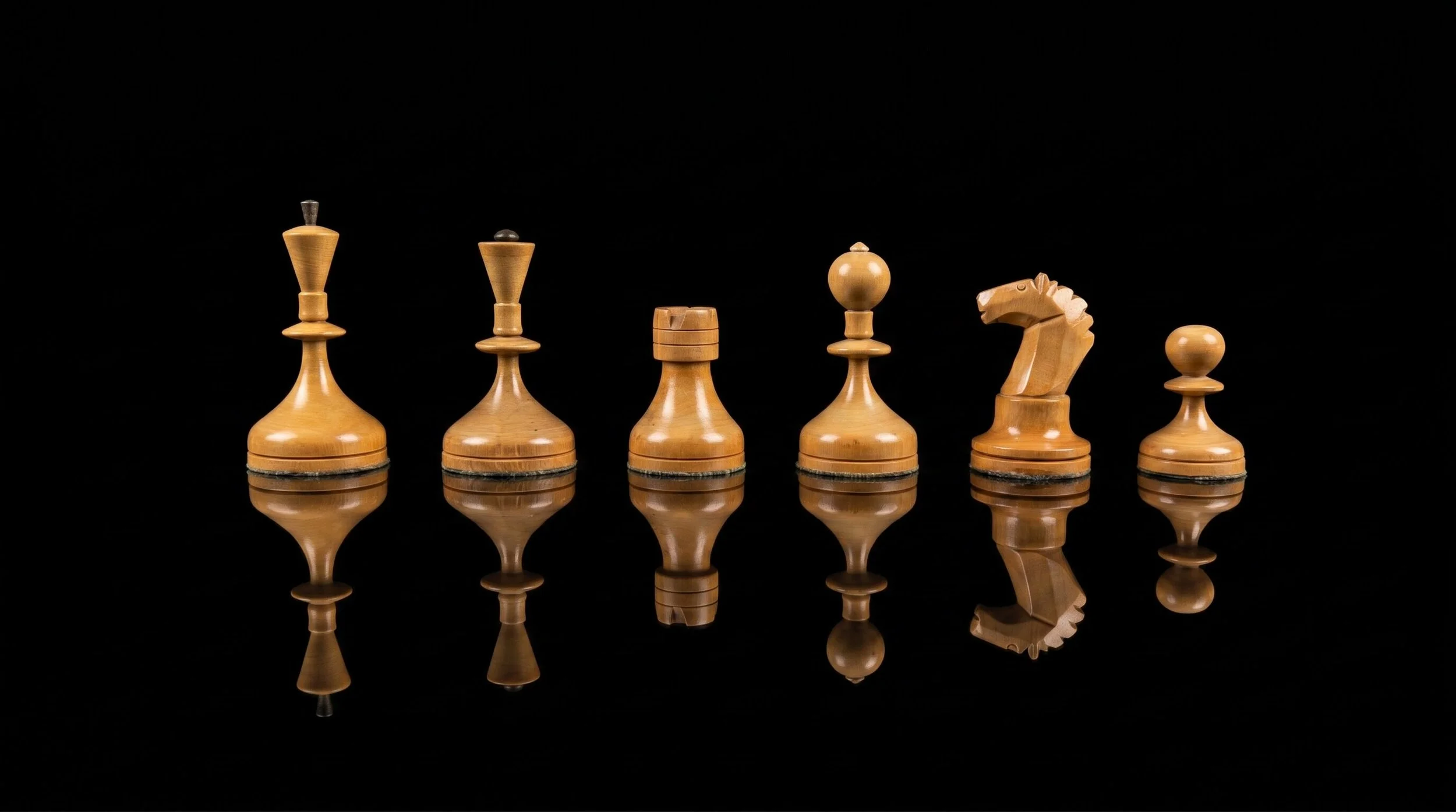
Valdai “Noble” Chessmen
Historical context and manufacturing
Where did the sets come from?
Production site and the “Gulag” debate. The Valdai pieces bear stamps on their boards and boxes that read Валдайский Райпромкомбинат — the Valdai District Industrial Plant. This plant was located in Valdai (also spelled Valday), a wooded region between Moscow and St. Petersburg. In 2024, research compiled on the Visual History of Chessmen website noted that these stamps indicate the sets were made at the Valdai Regional Industrial Manufactory rather than a Gulag prison. Collectors Charles Grau and Sergey Kovalenko cross‑checked Soviet Gulag databases and found no Gulag camp in Valdai, although a nearby labor camp (ITL “EM”) built missile silos about 22 km away. After 1957, the plant’s woodworking equipment and production were transferred to ITK‑4, a corrective‑labor colony; the Visual History article emphasizes that ITK‑4 was part of the post‑Gulag prison system, not a Gulag.
Corrective-labor colonies. Under Soviet law, corrective-labor colonies combined penal detention with compulsory work. The system of labor colonies originated in 1929 and, after 1953, they became the post‑Stalin replacement of the Gulag labor camps. Production of Valdai sets by the ITK‑4 colony, therefore, took place in a penal facility, but outside of the Gulag system.
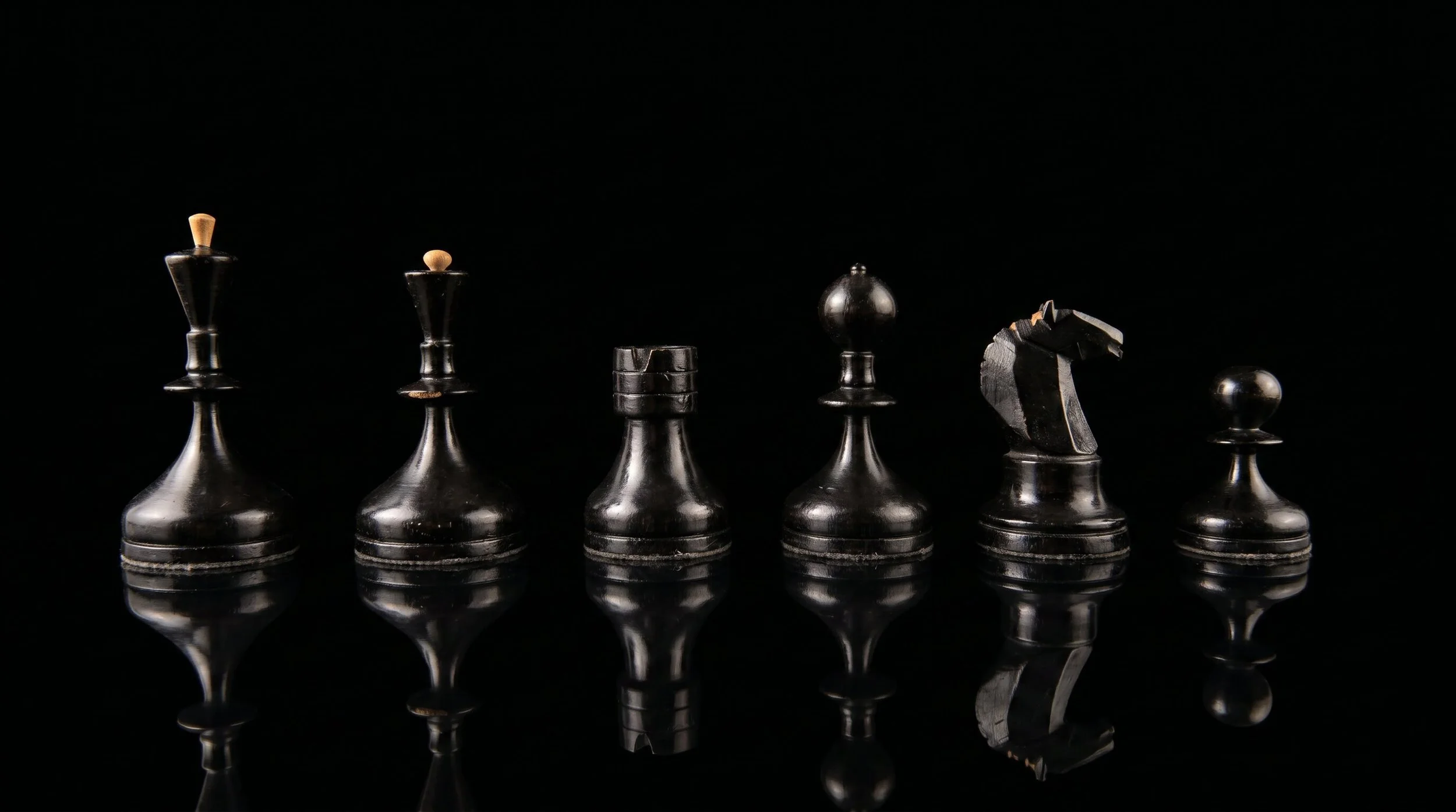
Valdai “Noble” Chessmen
Origins of the “Nobles” nickname
Russian‑language sources usually refer to these pieces simply as “Valdai chessmen”. The Visual History author could not find evidence that they were called boyar (боярин, “nobleman”) in Russian. Some recent Russian auction listings have used the adjective dvoryanskiye (“noble”) but only in quotes. British collector Alan Power restored several Valdai sets and christened each with a fanciful Latin name (e.g., Torquem Nobilis). Through his blog posts these names filtered into English‑language auctions, so “Valdai Nobles” became the accepted English moniker. Charles Grau notes that it is one of the rare Soviet chess patterns with a widely recognized endonym.
Design characteristics of the Valdai chessmen
Overall style
The Valdai pattern departs radically from the Staunton style. Pieces share several design motifs:
Broad bell‑bottom bases and funnel‑shaped stems. The bases are wide and taper gently into rounded “funnels,” evoking Russian Orthodox domes. These broad bases were partly functional: during the Stalin era, lead weights were scarce, so craftsmen enlarged the bases to provide stability.
Kings and queens. They have tall, slender bodies topped by cone‑shaped heads with opposite‑colored finials. Early sets often used painted finials, while later ones used simple turned wood.
Bishops (clerics). Instead of a Staunton‑style miter cut, Valdai bishops have a smooth spherical dome; in later versions, the “bishop signifiers” grew larger.
Rooks. These are small turret‑like pieces lacking crenellations; the stem flares into a much wider base.
Knights. The most distinctive pieces are slender and angular, with faceted heads. Alan Power described them as “elbow‑shaped” with minimalist facial features and likened their muzzles to the Clangers puppet characters. Some early 1940s sets had simple slab knights, while later versions adopted faceted knights with fluted manes and, in some examples, a slightly open “drop‑jaw” muzzle.
Pawns. Pawns echo the funnel shape: a bulbous base, narrow waist, and rounded head.
Materials and finishes
Collectors’ notes and surviving sets show that Valdai pieces were generally turned from birch or maple. Early sets used deep red lacquer for one army and black or dark brown lacquer for the other. Lacquered finishes gave the pieces a glossy appearance. In the 1950s and 1960s, craftsmen also produced natural‑wood versions finished with amber shellac; restorer Alan Power notes that the light pieces often darkened over time, prompting restorers to clean and polish them. The sets were usually lightly weighted or unweighted because of material shortages, hence the wide bases.
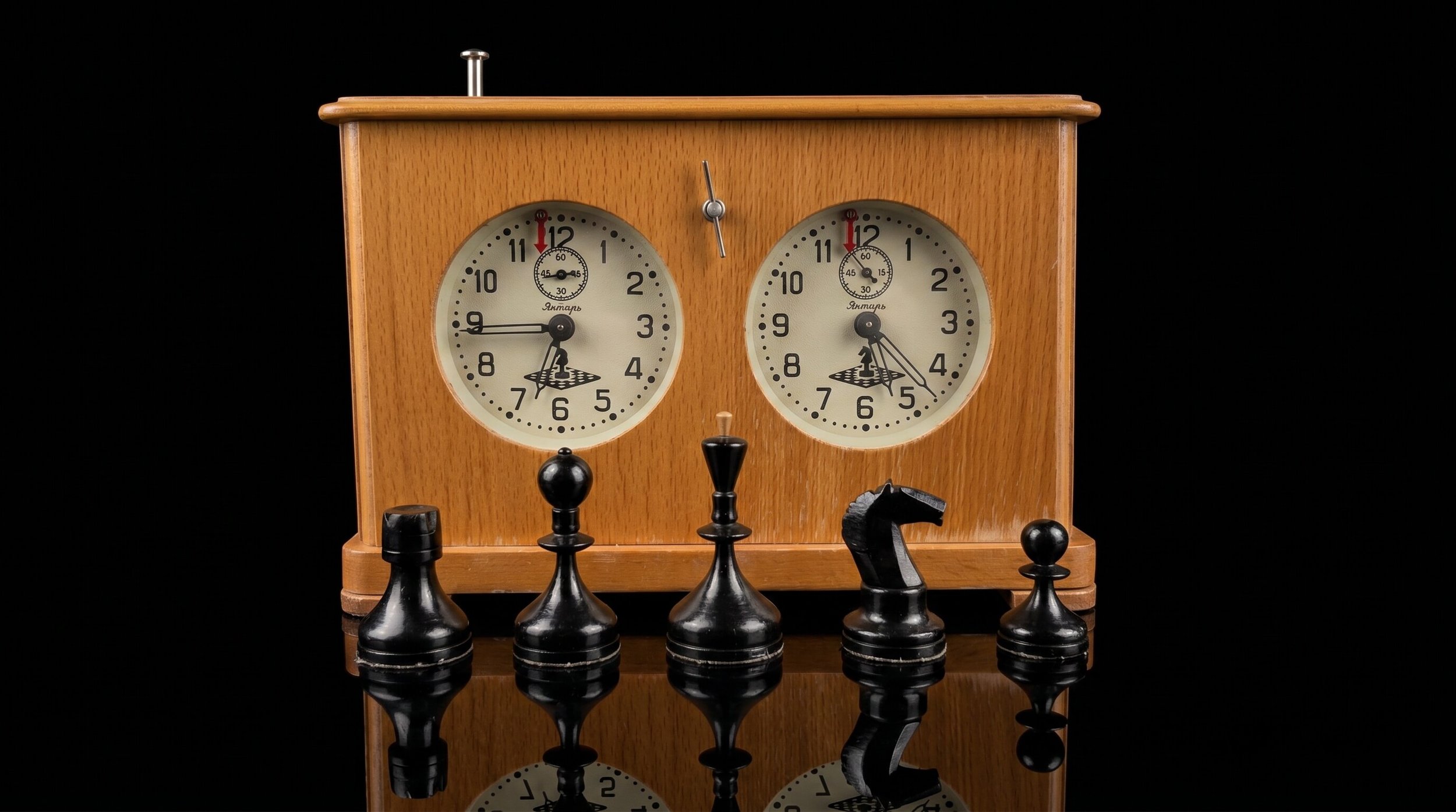
Variants and evolution
Early Valdai (late 1940s – early 1950s)
The earliest sets (sometimes labeled “Stalin‑era” Valdai or Nobilis Valdicum) were produced at the Valdai Regional Industrial Plant and feature:
Height: King about 8 cm with a base around 3.3 cm.
Color: red vs. deep brown/black lacquer.
Knights: simple slab‑like horses; fluted facets had not yet become prominent.
Other pieces: bishops have modest domes, and the overall silhouette is compact.
Transitional sets (mid‑1950s)
Sets sold by Alan Power as “The Noblemen (Boyarin)” illustrate a transitional stage combining early and later features. In this example, the king is 8.7 cm tall with a base 3.5 cm wide; the queen is 7 cm tall; the knights are 5.5 cm tall. The set retains the broad bases but shows larger bishop domes and faceted knights with fluted manes and a delicate “drop‑jaw” muzzle. Power suggests that the broad bases compensated for shortages of lead weight in post‑war Russia.
Mature Valdai (1960s)
By the 1960s, the pattern reached its mature form:
Faceted knights. Knights became angular with clear facets and pointed muzzles.
Height: kings around 8.5 cm, with base diameters of 3.7 cm and weights of 20 g for the king and 16 g for most other pieces (example from Alan Power’s “High‑Collared Nobles” set).
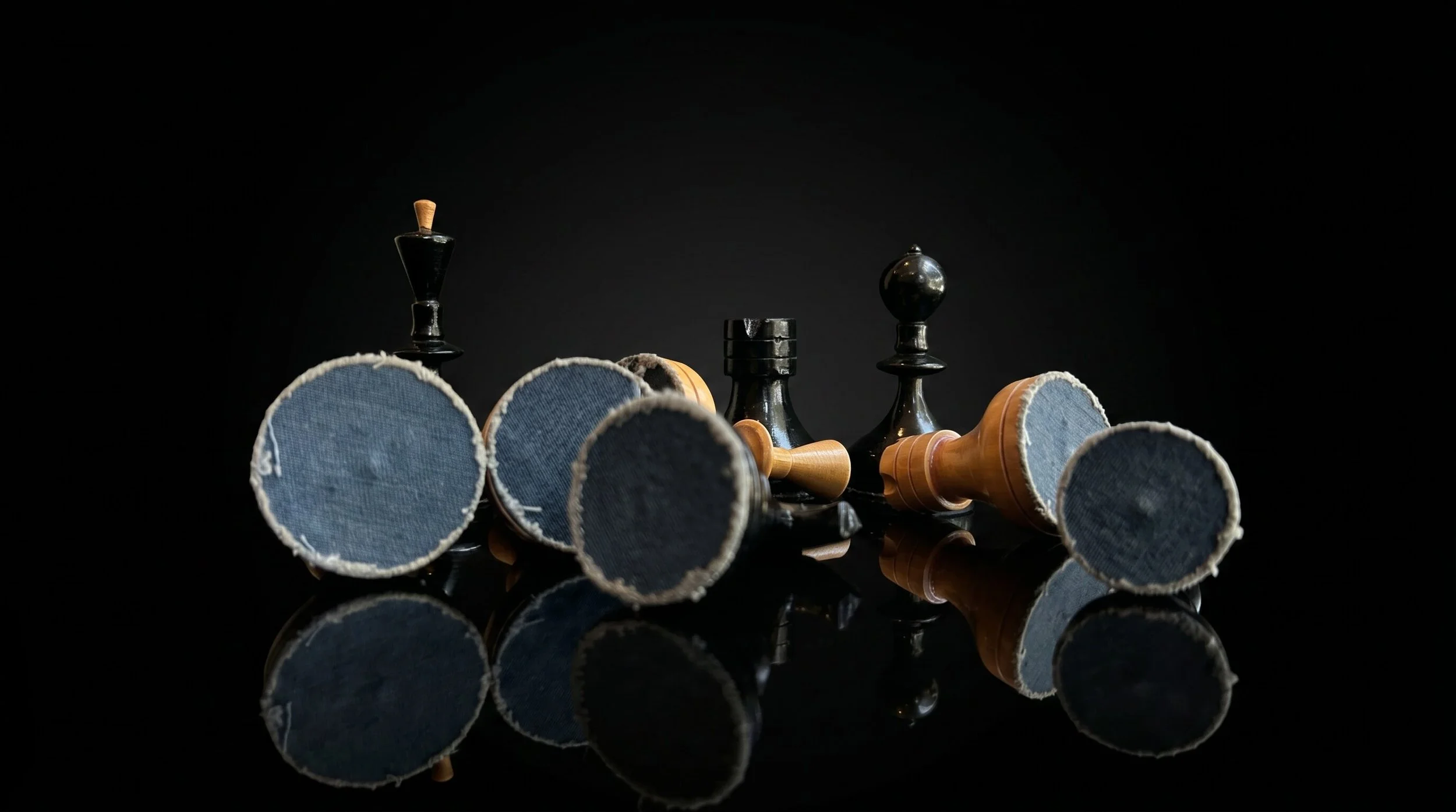
Colors: natural amber vs. black shellac or white vs. red lacquer; rooks sometimes carried felt pads.
Bishop signifiers: the domes increased in size, making bishops easily distinguishable.
Late and modern reproductions
By the 1970s, the Soviet Ministry of Arts produced a simplified version with concave stems; Russian luxury set maker Kadun reproduces this pattern as Retro 70s, marketing it with concave stems reminiscent of Soviet Grandmaster pieces. Contemporary reproduction houses, such as Chess Bazaar and various Etsy artisans, offer modern “Valdai Nobles” sets, often enlarging the pieces to 3.5–4 inches (9–10 cm) and adding weight. These reproductions have helped the name “Valdai Nobles” stick in English‑language markets.
Collectibility and significance
Valdai sets are prized by collectors for their distinctive Soviet aesthetic and their connection to mid‑20th‑century Soviet culture. The wide bases and funnel‑shaped stems evoke Russian onion domes, while the angular knights display a modernist flair uncommon among chessmen of the era. Photograph evidence shows players using Valdai pieces in post‑war tournaments—for example, a photo of Vlasov V.P. playing with Valdai pieces at a tournament in Chita after 1943. Though originally mass‑produced, surviving sets are relatively scarce because of limited manufacturing, penal‑colony production and the fragile lacquer finishes. Restorers such as Alan Power often repair damaged collars, refinish shellac and replace missing finials.
Conclusion
The Valdai “Nobles” chessmen represent a fascinating chapter in Soviet material culture. Made in the Valdai region rather than a Gulag, they bridge the period from post‑World War II shortages to the late Soviet era. Their design integrates functional stability—wide bases replacing scarce lead weights—with aesthetic references to Russian architecture and modernist sculpture. While the nickname Nobles was likely coined by Western collectors, the set’s enduring popularity has secured its place in chess history. Collectors and historians alike appreciate Valdai sets for their craftsmanship, distinctive knights and the insight they provide into mid‑century Soviet industry and design.
Notes
Eva Silvertant, A Visual History of Chessmen, version 3.8.web, 2025, “Valdai,” accessed June 9, 2026, https://chesshistory.github.io/.
Chuck Grau, “Gulag Knights? A Tale of Two Valdais,” Soviet and Late Tsarist Chess Sets, February 14, 2025, accessed June 9, 2026, https://sovietchesssets.com/2025/02/14/gulag-knights-a-tale-of-two-valdais/.
Grau, “Gulag Knights?”
“Gulag,” Encyclopaedia Britannica, last modified May 11, 2026, accessed June 9, 2026, https://www.britannica.com/place/Gulag.
Grau, “Gulag Knights?”
Silvertant, A Visual History of Chessmen, “Valdai.”
Silvertant, A Visual History of Chessmen, “Valdai.”
Alan Power, “SOLD Nobilis Valdicum (Valdai Nobles); Classic Soviet Wooden Chess Set, Weighted, Stalin Era, circa 1945-1955,” The Chess Schach, accessed June 9, 2026, https://www.thechessschach.com/product/nobilis-valdicum-valdai-nobles-classic-soviet-wooden-chess-set-weighted-stalin-era-circa-1945-1955/.
Power, “SOLD Nobilis Valdicum.”
Alan Power, “SOLD The Noblemen (‘Boyarin’) Soviet Valdai ‘Nobles’ Chessmen, c.1955,” The Chess Schach, accessed June 9, 2026, https://www.thechessschach.com/product/the-noblemen/.
Power, “SOLD The Noblemen.”
Alan Power, “SOLD Torquem Nobilis (High-Collared Nobles); Classic Soviet ‘Valdai’ Weighted Chess Set, Early Brezhnev Era, c.1964-1968,” The Chess Schach, accessed June 9, 2026, https://www.thechessschach.com/product-category/sold/page/5/.
Silvertant, A Visual History of Chessmen, “Valdai.”
Grau, “Gulag Knights?”
“Corrective Labor Colony,” Wikipedia, last modified October 2025, accessed June 9, 2026, https://en.wikipedia.org/wiki/Corrective_labor_colony.
