Vladas Mikenas
Vladas Mikėnas was born on 17 April 1910 in Reval (now Tallinn). He came from an Estonian‑Lithuanian family – his father, Jonas, was a builder who was later executed for political reasons, and his mother, Bronislava Veržbickaitė‑Mikėnienė, raised him in Tallinn. Mikėnas learned chess in a Russian private gymnasium and quickly proved precocious: he won local youth tournaments and even played a blindfold simultaneous display against Richard Réti. By his late teens, he was already a national contender – Mikėnas won the Tallinn city championship and then captured the Estonian championship in 1930 after defeating reigning champion Aleksander Tiurn. In the same year, he beat world‑championship contender Efim Bogoljubov in an international tournament and began writing a chess column for Estonian newspapers.
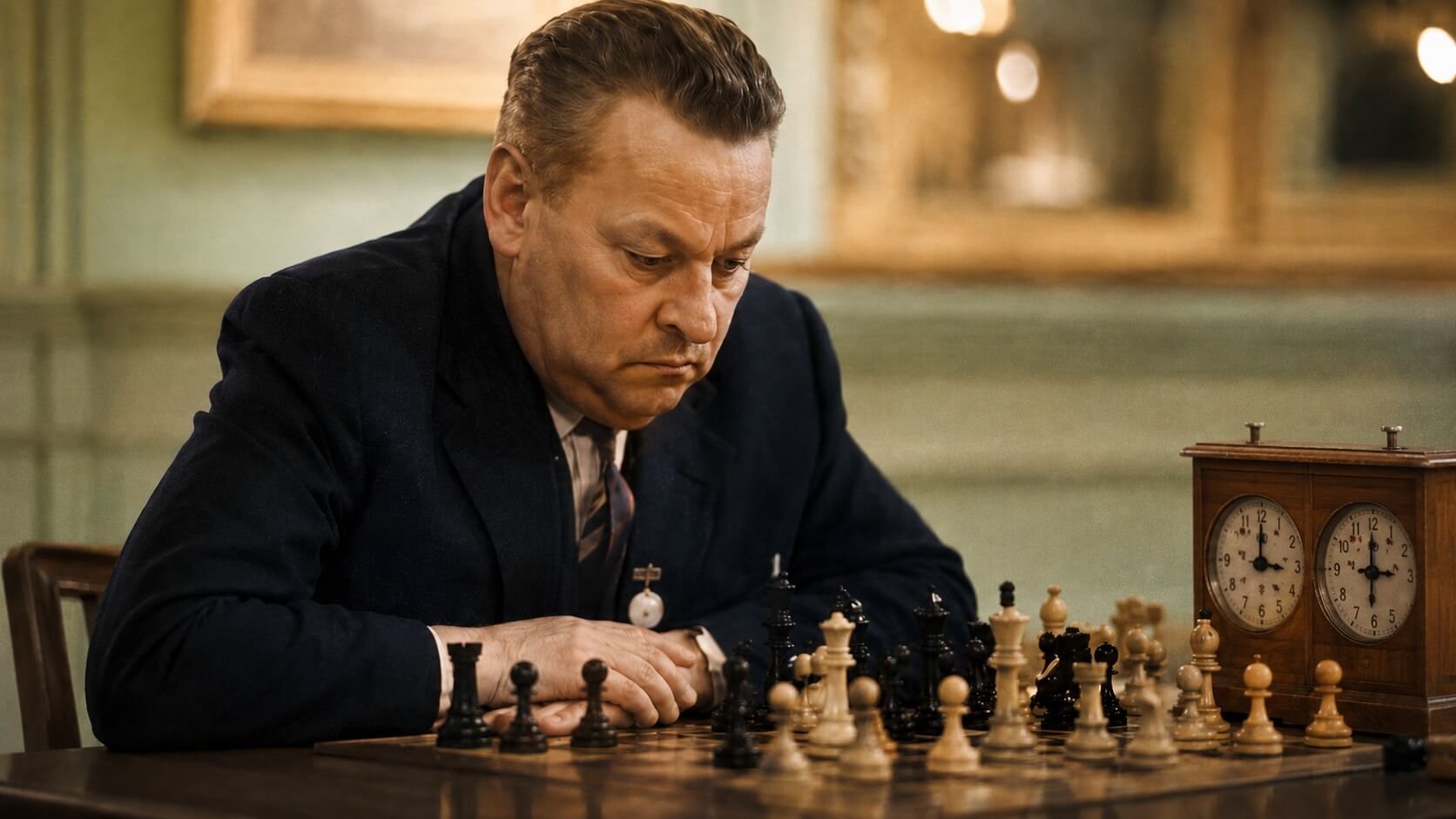
Early career and Lithuanian Olympiad star
In 1931, Mikėnas emigrated to Lithuania. That summer, he represented his new country on the first board at the 4th Chess Olympiad in Prague; he scored 10/18 for Lithuania, drawing with reigning world champion Alexander Alekhine and defeating the strong Slovene player Vidmar. He played first board in five official Olympiads – Prague 1931, Folkestone 1933, Warsaw 1935, Stockholm 1937, and Buenos Aires 1939 – plus the unofficial Munich 1936 Olympiad. These performances made him the leading Baltic player of the 1930s and a national hero. Mikėnas also became the Lithuanian champion in 1933 after beating Ž. Macht in a match and repeated the feat several times in the 1930s. At the 1937 Kemeri international tournament, he upset world champion Alexander Alekhine, and later that year, he shared sixth place at the prestigious Hastings tournament.
Beyond the board, Mikėnas enriched Lithuanian chess culture. In 1933, he published Šachmatų vadovėlis (Chess Manual) – the first chess book in Lithuanian. A year later, he launched the journal Šachmatai ir bridžas (Chess and Bridge), which fostered a vibrant chess community. His combination of playing strength and literary activity helped lay the foundation for Lithuania’s chess infrastructure before the Second World War.
Transition to Soviet chess and tournament successes
After the Soviet annexation of Lithuania in 1940, Mikėnas became a Soviet citizen. He reached the final of the USSR Championship ten times and faced the best Soviet players. The Lithuanian encyclopedia notes that he was the Lithuanian champion in 1933–34, 1937–38, 1945, 1947–48, 1965, and even again in 1977, demonstrating remarkable longevity. He also represented Lithuania in the USSR team championship finals and in numerous Baltic regional tournaments. During the 1940 USSR championship, he famously defeated future world champion Mikhail Botvinnik, and at a Riga tournament in 1959, he beat Mikhail Tal, the reigning world champion. His victories over multiple world champions – Alekhine, Botvinnik, Vasil Smyslov, and Tal – are cited in the Lithuanian encyclopedia and underline his class.
Mikėnas continued to win tournaments long after the war. He captured the Baltic Championship in Riga in 1945 and shared first place in Vilnius in 1954 ahead of Ratmir Kholmov and Viacheslav Ragozin. In 1965, he won the regional championship in Palanga, and in 1971, he claimed victory at the international festival in Lublin, Poland. His career stretched into his late sixties; the timeline records that he became Lithuanian champion again in 1977 at age 67.
Titles, training, and journalism
Mikėnas collected many official titles. The timeline notes that he became a FIDE International Master in 1950, the very year the title was introduced, and he was the first Lithuanian to receive this distinction. That same year, he was awarded the title of Soviet honorary sports master, also a first for a Lithuanian athlete. FIDE later recognized his lifelong contributions by bestowing the International Arbiter title on him in 1968 and the title of International Grandmaster (Honorary) in 1987, as confirmed by the Lithuanian encyclopedia. These honors – ranging from playing to officiating – reflect his versatile service to the game.
Aside from his competitive achievements, Mikėnas was a prolific journalist, coach, and organizer. In 1950, he founded the Lithuanian Chess and Draughts Club and served as its director until 1970; from 1970 to 1982, he worked there as a coach. He headed the chess sections of the magazine Švyturys for four decades (1950–1990) and of the newspaper Komjaunimo tiesa from 1952 to 1972. As a trainer, he coached Estonian grandmaster Paul Keres between 1955 and 1962 and guided many Lithuanian juniors. The timeline also records that he served as the chief arbiter for major events, including the World Championship matches between Garry Kasparov and Anatoly Karpov in the mid‑1980s, underscoring his authority within the international chess community.
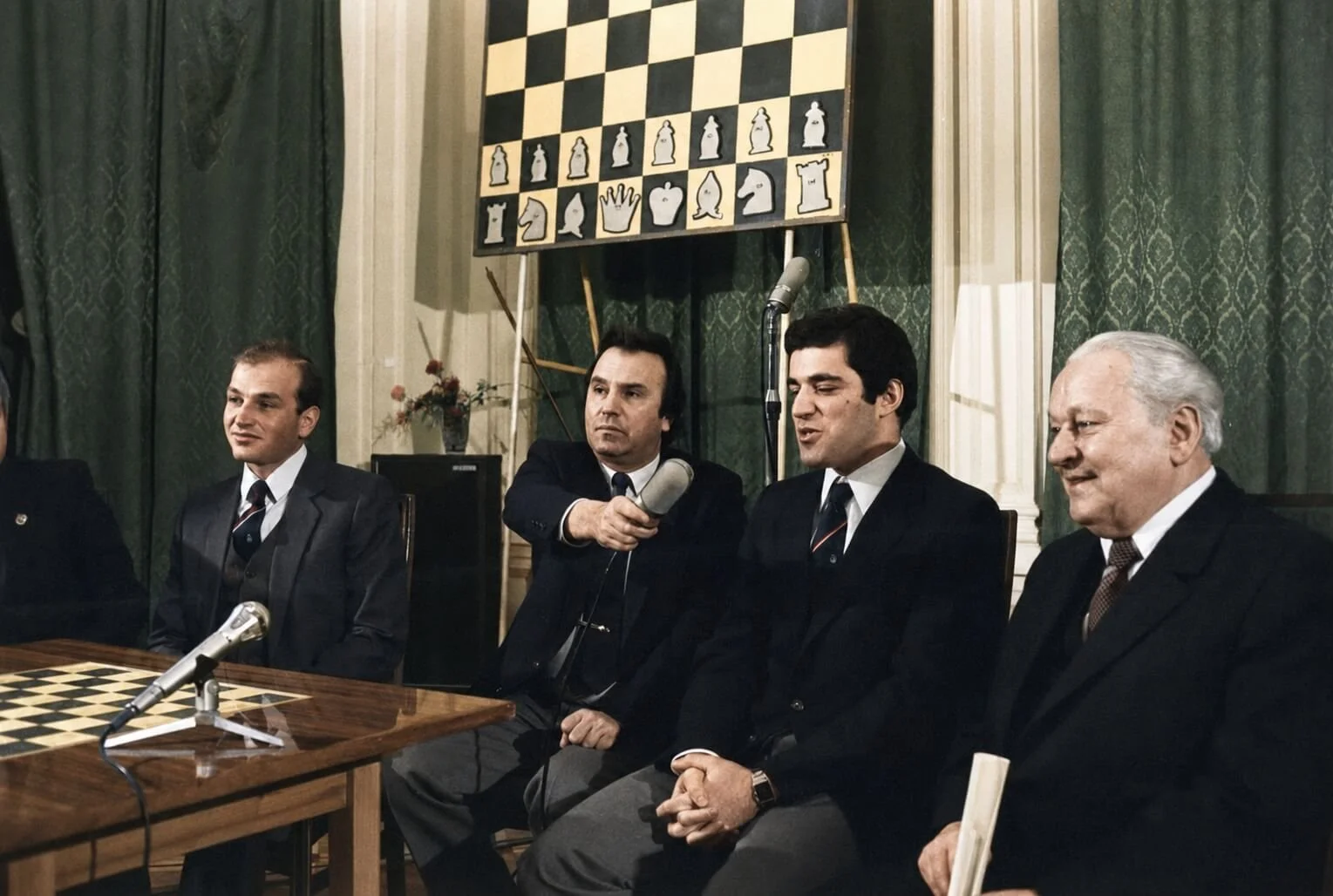
Alexander Beliavsky, Garry Kasparov, and Vladas Mikenas
Notable games and theoretical contributions
Mikėnas favored a combinational style and left a mark on opening theory. The Lithuanian encyclopedia notes that the attacking Mikėnas System, also known as the Flohr–Mikėnas System, is named after him. This system arises from the English Opening with 1.c4 Nf6 2.Nc3 e6 3.e4, where White quickly plays e4 and aims for active play. Another line bearing his name is the Mikėnas Variation of the Modern Benoni, a sharp pawn‑storming line beginning 1.d4 Nf6 2.c4 c5 3.d5 e6 4.Nc3 exd5 5.cxd5 d6 6.e4 g6 7.f4 Bg7 8.e5, which emphasizes rapid kingside expansion. These contributions ensure that Mikėnas’s name appears in opening manuals decades after his peak.
Mikėnas’s games against the world champions are often used as teaching examples. At Kemeri in 1937, he defeated Alexander Alekhine after declining a mating combination yet still grinding out the endgame; the position and Alekhine’s famous remark (“Young man, you could have mated in three!”) are preserved in chess lore. In the USSR Championship of 1940, he toppled Botvinnik, and at Riga 1959, he outplayed the tactical genius, Mikhail Tal. These victories highlight his ability to match the world’s best.
Legacy and remembrance
Mikėnas’s influence extends beyond the chessboard. He authored several books, including Šachmatų vadovėlis (1932), Šachmatų žaidimo pagrindai (1950), Šachmatų pirmenybės (1958), 35 metai prie šachmatų lentos (1961) and Šachmatai: teorija ir praktika (1968). These works served as textbooks for generations of players in Lithuania and the wider Soviet Union. After his death in Vilnius on 3 November 1992, an annual open tournament in his memory has been held in Vilnius, and his name lives on in the openings he pioneered. The Lithuanian encyclopedia succinctly states that he defeated world champions Alekhine, Botvinnik, Smyslov, and Tal and that a Flohr‑Mikėnas System bears his name. In 2010, Lithuania’s postal service issued a commemorative stamp marking his centenary, and his games even appeared in the Netflix series The Queen’s Gambit (2020), ensuring his legacy reaches new audiences.
