Lyudmila Rudenko
Lyudmila Rudenko was one of the hinge figures of twentieth-century chess: the second Women’s World Champion, the champion who restored the title after World War II, and a crucial bridge between Vera Menchik’s prewar dominance and the long Soviet ascendancy that followed. Born in 1904 in Lubny, in what is now Ukraine, she held the world title from 1950 to 1953. Her importance, though, is larger than the dates on the trophy. Her biography brings together elite sport, Soviet professional life, wartime humanitarian action, and late-blooming chess mastery in a single arc.
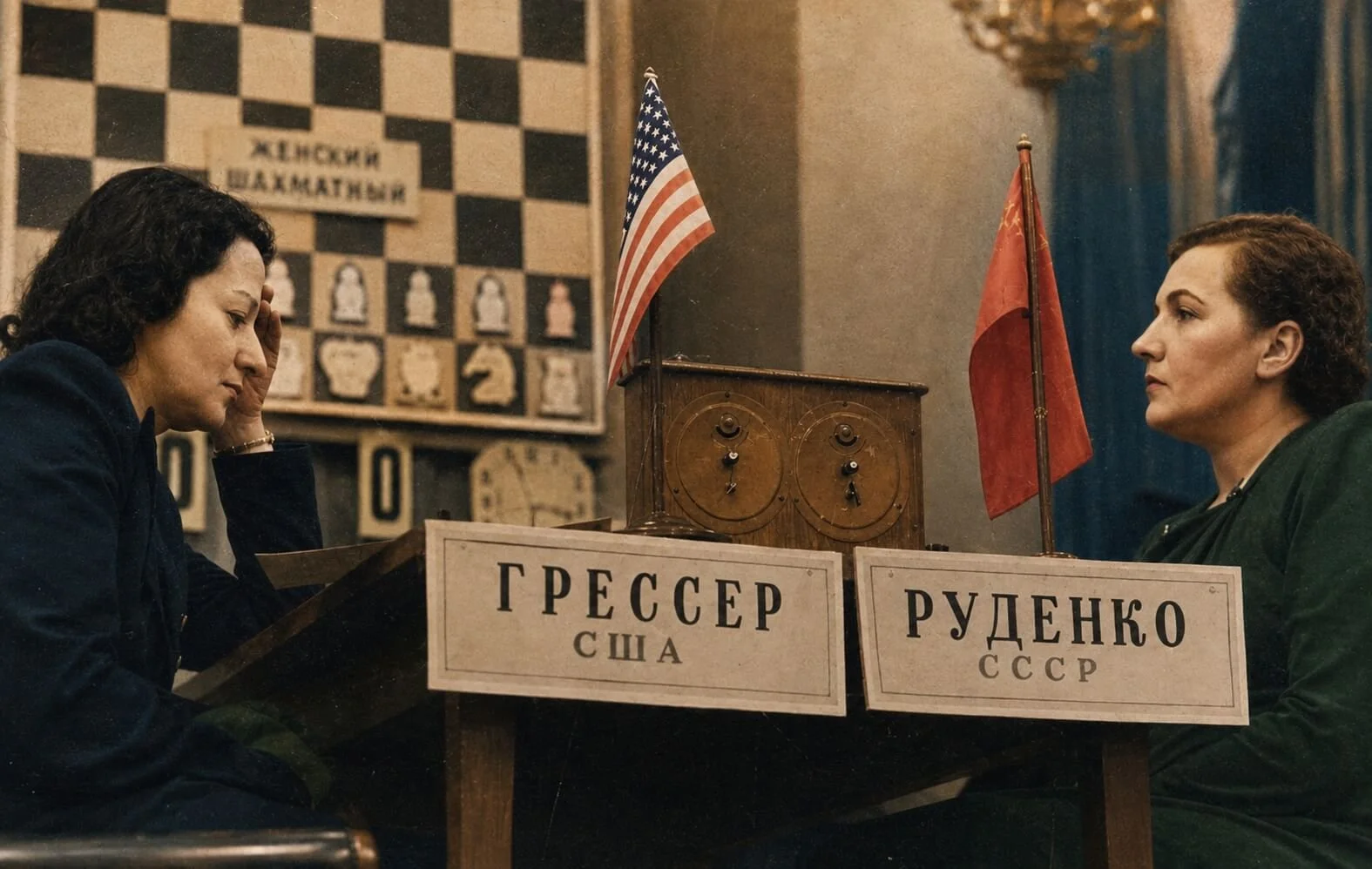
There is also a small but meaningful historical nuance in how she is remembered. Britannica identifies her as a Ukrainian chess player because of her birthplace, while FIDE situates her within the line of Soviet women’s world champions, and the World Chess Hall of Fame presents her under a Russian institutional banner while still noting that she was born in Lubny, Ukraine. That variation is not really a contradiction. It reflects the layered realities of empire, Soviet state representation, and later national memory that shape so many twentieth-century biographies.
Formation: swimmer, economist, chess player
Rudenko learned chess from her father at age ten, but chess was not initially her main calling. FIDE’s official champion profile describes her as a gifted swimmer and vice-champion of Ukraine, and Google’s 2018 Doodle notes that she first distinguished herself in Odessa in the 400-meter breaststroke. After school she studied economics in Odessa, then moved to Moscow in 1925 for work in Soviet economic planning, and later moved to Leningrad, where her chess development accelerated. Britannica adds that she married Lev Davidovich Goldstein, described there as a cybernetic pioneer, and had a son, Vladimir, in 1931.
That professional background matters. Rudenko did not emerge from a modern chess academy or a fully professional sports system. Like many strong Soviet players of her era, she balanced chess with serious non-chess work. A historical Chess.com profile stresses that before the war, there were very few chess professionals in the USSR, and that Rudenko herself worked as a planner and economist at factories while building her playing career. Her later success, therefore, came not from protected specialization but from persistence in an ordinary and demanding Soviet adult life.
Her rise in competition was gradual, then suddenly emphatic. The World Chess Hall of Fame notes that her first major event, the 1927 U.S.S.R. Women’s Chess Championship, ended in fifth place. One year later, however, she won the Moscow Women’s Championship ahead of reigning Soviet champion Olga Rubtsova. Chess.com’s historical profile goes further, reporting that she won all twelve games in that tournament. Whether one emphasizes the official summary or the richer tournament narrative, the point is the same: by the late 1920s, she had ceased to be a promising amateur and become a major Soviet contender.
Rise in Soviet chess
Leningrad was decisive. FIDE credits Peter Romanovsky with Rudenko’s breakthrough there, while the Russian Chess Federation adds Alexander Tolush and, later, Grigory Levenfish to the list of masters who trained her. On her city-title record, the sources are intriguingly uneven. FIDE’s museum says she won the Leningrad Women’s Championship three times, while the Russian federation says that in 1968 she became champion of Leningrad for the eighth time, which likely reflects a broader or differently counted city record. For a historian, that discrepancy is not a nuisance but a clue: Soviet domestic chess records were often preserved through overlapping local and federation traditions.
As a chess player, Rudenko was remembered less as a spotless technician than as an energetic attacker. Chess.com describes her early style as improvisational, sacrificial, and complication-seeking; the Russian Chess Federation emphasizes her sharp combinative play and love of the initiative. FIDE’s museum preserves a more tempered retrospective from Nona Gaprindashvili, who said Rudenko was “gifted by nature” but had not received the same systematic positional schooling as later generations. Taken together, these judgments sketch a player of real tactical force, formidable in active positions, dangerous when allowed to seize momentum, and not always interested in the tidiest route through a game.
War, evacuation, and moral stature
What many shorter biographies flatten or omit is the wartime chapter, which is indispensable to understanding her stature. During the Siege of Leningrad, Rudenko organized the evacuation of children, and later sources consistently report that she regarded this, not her world title, as the greatest achievement of her life. Google’s official Doodle emphasizes that point directly. Chess.com’s historical account adds vivid operational detail: she was sent back to gather children left behind, escorted them on a long wartime journey, and remembered, above all, that none of them perished. It is one of those episodes that changes the scale of a life. After it, “champion” becomes only one of her titles.
The war also intensifies the drama of her later success in chess. Britannica says her first substantial appearance on the international stage came in the 1946 USSR versus Great Britain radio match, where she defeated Rowena Bruce in both games. FIDE’s museum highlights one of those 1946 games as a signature example of her play. The same museum also preserves Kira Zvorykina’s recollection that after the war, Rudenko lived with her young son in a damp basement room in Leningrad while preparing for the world title. The image is almost novelistic: a future champion studying in scarcity, with smoke, instability, and postwar exhaustion all around her.
The road to the world title
The context of her world championship matters enormously. Vera Menchik, the first great queen of women’s chess, died in 1944, leaving the title vacant. FIDE’s official history notes that because of World War II, the Women’s World Championship went dormant for a decade, until the eighth championship was held in Moscow from 1949 to 1950. FIDE’s museum poster page records a 16-player field from 12 countries. Britannica adds an especially important detail: the event was organized alongside the process of determining Alexander Alekhine’s successor in the open world championship. In other words, this was part of chess’s postwar constitutional rebuilding, not a side event floating in isolation.
Rudenko won that tournament at age 45. FIDE’s champion page says she finished a full point ahead of the field; Chess.com and the Russian Chess Federation give her final score as 11.5 out of 15. The field was no paper crown. It included Olga Rubtsova and Elisaveta Bykova, both of whom would themselves later become world champions. That matters because it turns her victory from a historical placeholder into what it really was: a strong, earned triumph in a deep Soviet-led field at the precise moment when postwar women’s chess was re-centering itself. The Russian Federation is not overstating the case when it describes her as the first Soviet women’s world champion.
This is also where her career becomes especially interesting from an academic standpoint. Rudenko’s peak came very late by chess standards. Chess.com remarks that her postwar improvement in her forties was unusual, even rare, and attributes part of it to renewed work with Tolush and Levenfish after 1947. So her world title was not the flowering of a prodigy groomed from adolescence for international dominance. It was the culmination of a long apprenticeship, interrupted by work, war, motherhood, evacuation, and the sheer brutality of the 1940s. That gives her championship a particular texture of earnedness.
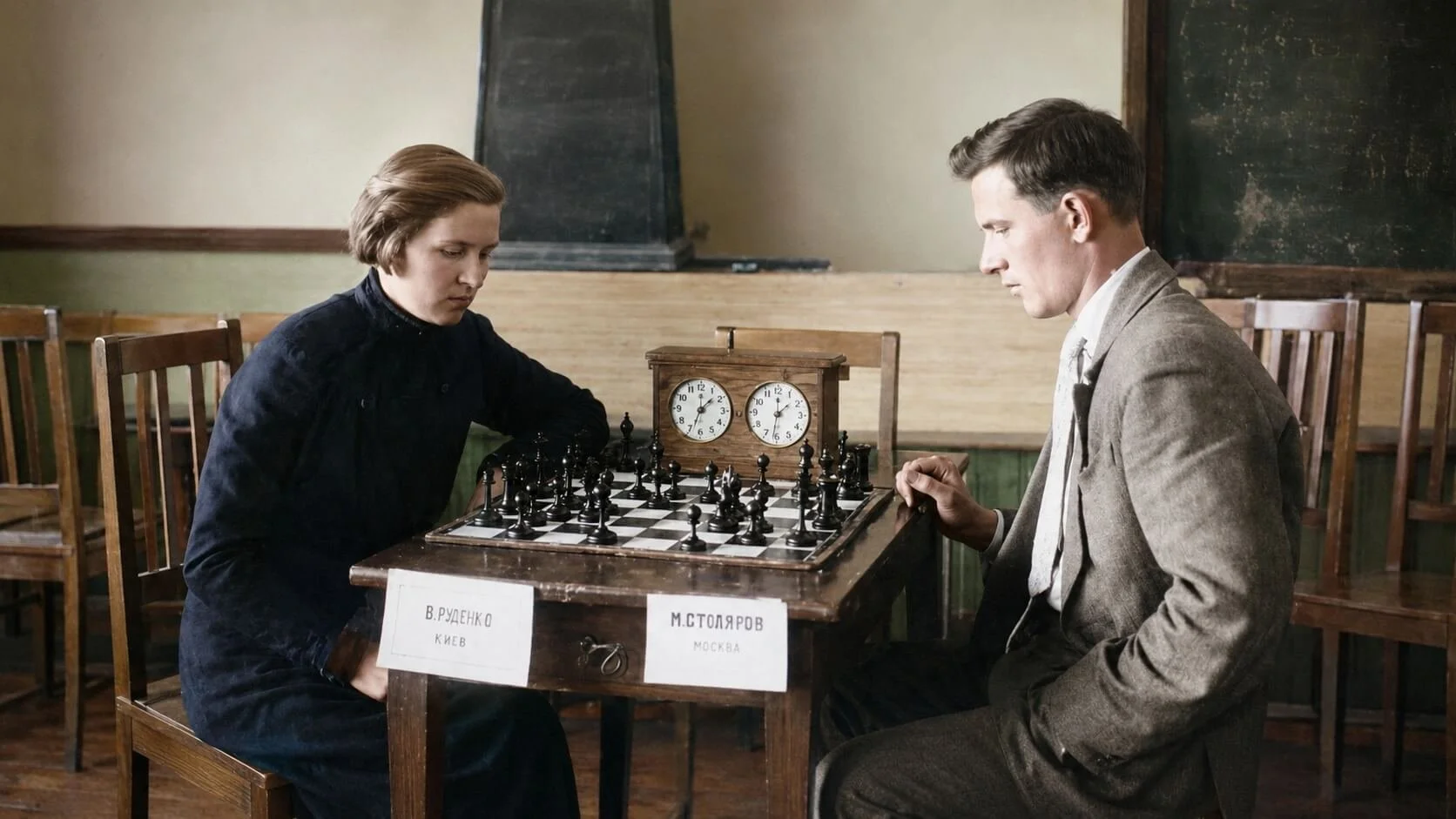
Image source unkown via Charles Grau, Soviet Chess Sets
Reign, title loss, and structural importance
Her reign was not long, but it was institutionally pivotal. The World Chess Hall of Fame notes that in 1952, she won the U.S.S.R. Women’s Championship, confirming that her 1950 title had not been a single bright flash. Yet FIDE’s history also shows that the women’s championship structure was changing during her reign: in 1952, the Candidates Tournament was introduced to produce a challenger for a title match. Bykova won that route and, according to FIDE’s profile of her career, defeated Rudenko in Leningrad in 1953 by seven wins to five, with two draws. Rudenko, therefore, occupies a precise hinge point in women’s chess history, the last champion produced by the old tournament logic and the first to lose under the newer Candidates-and-match system.
That structural position is one of her chief contributions. If Menchik established the title before the war, Rudenko re-legitimized it after the war under Soviet auspices. FIDE’s own historical writing is explicit that the 1949 to 1950 championship marked the beginning of the era of Soviet dominance in women’s chess. Rudenko was the first face of that era. She was not its longest ruler, but she was its founding postwar sovereign, the player who ensured that the women’s crown survived wartime rupture with prestige intact.
What kind of contribution did she make?
Rudenko’s contributions to chess were therefore multiple rather than singular. First, she contributed competitively: she won the first postwar world title and the Soviet women’s title. Second, she contributed symbolically: her victory helped normalize the idea that the Soviet Union would become the center of elite women’s chess. Third, she contributed culturally: as a player who combined work, family, and high-level competition, she offered a model very different from the myth of the isolated male genius. Fourth, she contributed morally, because her life in chess memory is inseparable from the evacuation of children during the siege. Put plainly, she expanded what it could mean to be a chess champion.
There is one more subtle contribution worth emphasizing. Later champions, such as Gaprindashvili, transformed women’s chess by challenging men more directly and stretching the ceiling of what women were imagined to be able to do in open competition. Rudenko’s role was different. She made continuity possible. She ensured that women’s world championship chess did not remain a prewar relic attached only to Menchik’s memory, but became a living postwar institution with real competitive legitimacy. In historical sequences, that kind of bridge figure is easy to underrate because bridges are judged by what comes before and after them. But without them, the sequence breaks.
Legacy and remembrance
Her later honors confirm that chess institutions themselves have not treated her as a marginal figure. The World Chess Hall of Fame notes that she received the International Master title in 1950 and the Woman Grandmaster title in 1976, and was inducted in 2015. Google honored her with a Doodle in 2018, explicitly presenting her as a player who paved the way for women to come. FIDE also records that in 2004, its Presidential Board approved “the Lyudmila Rudenko year.” Those commemorations are revealing. They do not remember her only as a former champion; they remember her as a figure of endurance, women’s achievement, and historical seriousness.
My own concise judgment would be this: Lyudmila Rudenko was not the most dominant women’s champion, nor the most theoretically polished. But she was one of the most historically consequential. Menchik established the title's prestige, Gaprindashvili later expanded its ambitions, and Rudenko was the resilient bridge between them. FIDE’s museum preserves a line of hers that serves as an apt epilogue: she said she could not imagine life without chess. In her case, that sentence carries the weight of a whole century’s weather.
