Alexander Onischuk
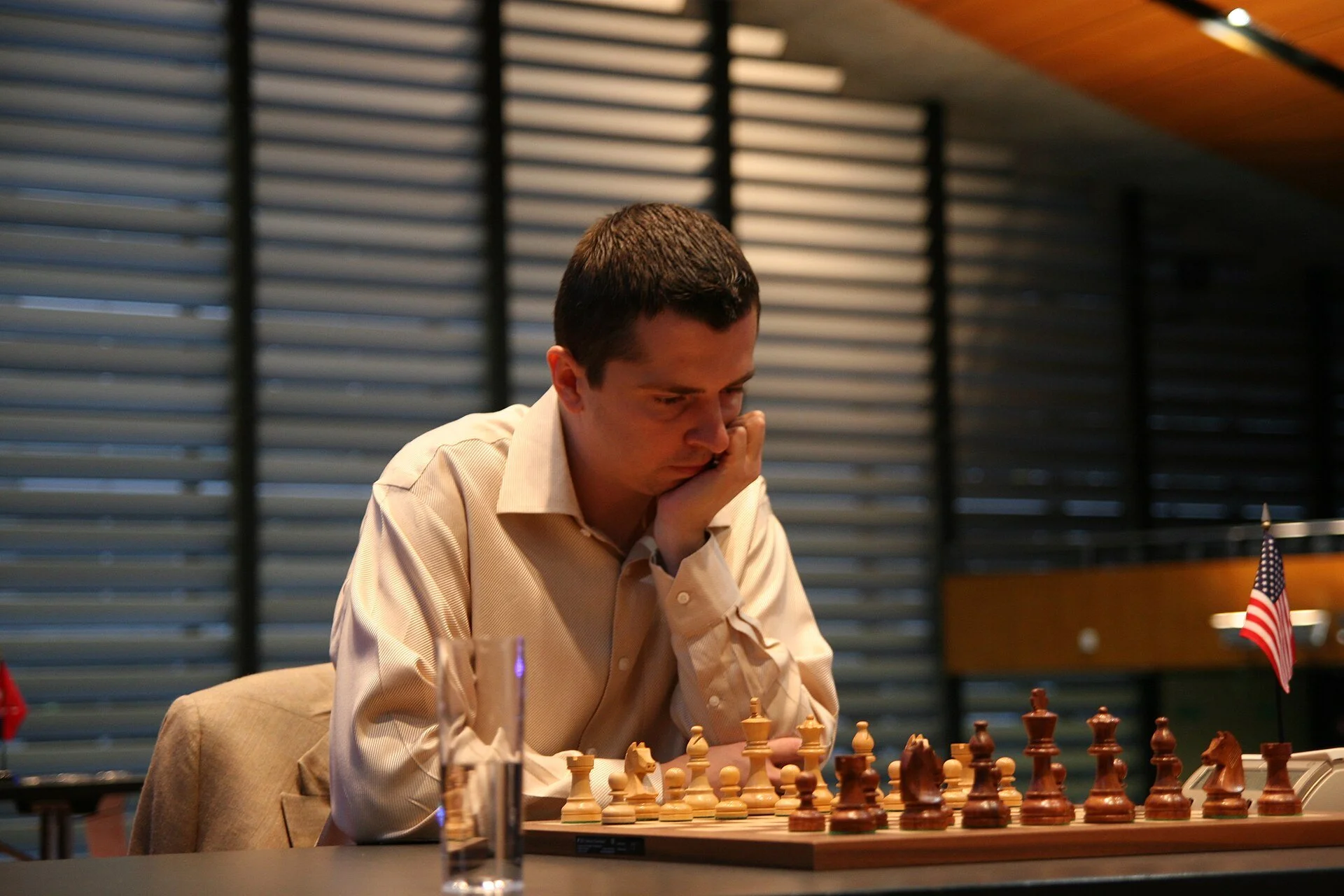
Cei Phillian, CC BY-SA 4.0
Introduction
Alexander Vasylovych Onischuk is one of the most significant bridge figures between the late Soviet chess school, independent Ukrainian chess, and the modern American professional and collegiate game. Born in 1975, he earned the International Master title in 1993 and the Grandmaster title in 1994, transferred from the Ukrainian federation to the United States on March 6, 2002, reached a peak FIDE rating of 2701 in July 2010, and was inducted into the U.S. Chess Hall of Fame in 2018. Since 2012, he has also been a central institutional figure in American college chess as head coach and program director at Texas Tech University.
Onischuk’s historical interest does not rest on world championship contention or a single immortal game. It rests on durability, technical strength, a long presence near the world elite, serious team value for two national squads, and an unusually consequential second career in building chess infrastructure. He belongs to that smaller group of grandmasters whose importance becomes clearer when one studies institutions, migration, and continuity of chess culture, not only first prizes.
Early Life and Chess Formation
The basic outline of Onischuk’s early life is clear, although the exact city of birth is less so. FIDE gives only the year 1975, while a U.S. Chess biography lists his birthplace as “Crimea, Ukraine.” A recent Russian Chess Federation profile says he was born and raised in Simferopol, whereas a 2004 Ukrainian interview described him as a product of the Sevastopol chess school. For a careful historical profile, the safest formulation is that he was born in Crimea on September 3, 1975, and formed in the Crimean chess environment associated with both Simferopol and Sevastopol.
Public sources are much fuller on his chess formation than on family biography. The most important documented formative influence is Grandmaster Vladimir Malaniuk. In a 2004 interview, Onischuk said that when he began playing youth events, Malaniuk’s advice was “invaluable,” and he later cited a Ruy Lopez line named for “Malaniuk-Onischuk” as evidence that their creative partnership had not ended even after they represented different federations. That same interview shows a young grandmaster still closely tied, emotionally and professionally, to his Crimean roots.
He began playing chess at about six years old, and his later educational record is unusually substantial for an elite player. Texas Tech identifies him as holding a B.A. in modern languages and linguistics from the University of Maryland, Baltimore County, and an M.A. in sociology from Moscow State University. Those degrees are not incidental biographical ornament. They fit the broader impression of Onischuk as a disciplined, analytical professional whose career was built on method rather than theatricality.
Rise in Competitive Chess
By the last Soviet years, Onischuk had already entered the strongest junior circuits. The Russian Chess Federation’s profile places him among the leading young players in the final USSR versus Yugoslavia youth match and records his rapid rise through the early post Soviet tournament grind. That profile also links his grandmaster breakthrough to successes at Dresden and Münster in 1994. Whether one uses Soviet, Ukrainian, or later American frames, the same pattern appears: he was a serious talent early, then converted that promise into hard professional standing with impressive speed.
His junior record deserves notice because it shows how close he was to the absolute top of his generation before he became a fully mature professional. Onischuk was fourth at the 1993 World Junior and, in 1995 at Halle, shared first on points but finished second on tie-break behind Roman Slobodjan. OlimpBase lists Slobodjan as the official winner, while the Russian Chess Federation explicitly notes Onischuk’s shared lead and second place on tie-break, a distinction worth preserving because it captures both the achievement and the documentary nuance.
His growth into a national team player for Ukraine was equally swift. He debuted for Ukraine at the 1994 Moscow Olympiad, then served on the 1996 silver-medal team in Yerevan and the 1998 bronze-medal team in Elista. OlimpBase shows him first as a 19-year-old board player in 1994, then as reserve on the silver-winning 1996 side, and by 1998 as a main board scorer producing 8 points from 12 games with a 2710 performance. This progression from promising junior to dependable Olympiad player is one of the clearest markers of his early adulthood as a chess professional.
The culminating achievement of his Ukrainian phase was the 2000 national championship, still one of the most important single titles of his career. U.S. Chess biographies continued to highlight that victory years later, and it deserves that place. To win the Ukrainian championship at the turn of the century meant prevailing in a federation shaped by the deep afterlife of Soviet training culture and populated by very strong grandmasters. It was a title of genuine historical weight, not a peripheral line on a résumé.
Major Career Achievements
Onischuk’s move to the United States transformed his career without breaking its underlying continuity. U.S. Chess recorded that he arrived in Baltimore in 2001 on a diversity visa and, for five years, played for the championship team at UMBC while studying linguistics. UMBC’s own record calls him captain during the program’s run of four consecutive national championships from 2002 through 2006. This period is historically important because it locates him at the intersection of immigrant grandmaster professionalism and the rise of scholarship based American college chess.
His definitive American breakthrough came at the 2006 U.S. Championship in San Diego. ChessBase’s event report shows him winning Group A with 7 points from 9 rounds, then defeating Yury Shulman 1.5 to 0.5 in the championship match. U.S. Chess later reported that Onischuk described winning the title as the happiest day of his life, a remark that is revealing. He had already won strong tournaments abroad, but becoming U.S. champion placed his name in a national line that included Morphy, Marshall, Reshevsky, Fischer, and other central figures in American chess memory.
That championship was not an isolated peak. Saint Louis and the World Chess Hall of Fame record repeated second and third place finishes in the U.S. Championship across 2004, 2007, 2008, 2009, 2012, 2013, and 2017. U.S. Chess also notes clear first at Poikovsky in 2002 and a tie for first at Biel in 2007, where he ultimately lost the tiebreak to Magnus Carlsen. These results define his standing accurately: not a fleeting champion, but a long running fixture at the top of American chess and a player entirely capable of sharing first in strong international fields.
His national team record after naturalization was equally strong. Saint Louis Chess Club states that he represented the United States in six Olympiads from 2004 through 2014 and eight World Team Championships from 2005 through 2022, helping the U.S. to Olympiad bronze in 2006 and 2008, team silver and individual board two gold at the 2009 World Team Championship, and board one on the U.S. gold medal team at the 2013 Pan American Team Championship. This body of work helps explain why later official biographies describe him as holding the record for most appearances on the U.S. national team.
By rating, too, he reached elite territory. As of 2026, the Saint Louis Chess Club notes that he is one of only 13 American players to have reached 2700 since the modern FIDE rating system began, and 2700chess records his peak precisely at 2701 in July 2010. Crossing that threshold is not merely symbolic. It places him in a very narrow band of American players with sustained world-class status.
Style and Reputation
Among contemporaries and national biographers, Onischuk’s reputation was built on technical professionalism rather than overt flamboyance. A U.S. Chess profile describes his style as “professional” and “solid,” with a very well-analyzed repertoire. The same source also makes a subtle but important criticism: because his openings, especially with Black in 1 e4 e5 structures, were so stable and well known, highly prepared weaker opponents could sometimes force drawish positions. That assessment is unusually specific and therefore especially valuable. It shows how he was seen inside the American chess community, as a player whose strength lay in accumulated understanding and reliability, even if that same reliability sometimes reduced practical volatility in Swiss events.
The rest of the evidence fits that picture. U.S. Chess says Onischuk himself believed that what separated him from slightly weaker grandmasters was superior understanding gained through work with elite players. His team records for both Ukraine and the United States reinforce the point. He was repeatedly trusted in national team lineups, often in roles that required steadiness under pressure, and his best American achievements came not only in individual play but in formats that reward consistency, preparation, and emotional control. That is an interpretation, but it is a close one, grounded in the way the primary biographical material describes him.
If one game must be singled out as historically essential, it is the 2006 U.S. Championship match win over Yury Shulman. Not because of the moves themselves, but because the result confirmed that Onischuk could do more than accumulate points through solidity. He could also convert in a short, high-pressure match setting, exactly when a national title required a more direct assertion of class. In that sense, the Shulman match clarifies his reputation better than any isolated tactical brilliancy would.
Contributions Beyond Tournament Play
Onischuk’s work away from the board is too substantial to be treated as an appendix. U.S. Chess states that he worked with Anatoly Karpov in the 1997 match against Anand and in preparation for Karpov’s 2002 match against Kasparov, and that he later drew on collaboration with elite figures including Veselin Topalov. A contemporary ChessBase report from the 2006 Topalov-Kramnik unification match lists " Aleksander Onischuk explicitly” among Topalov’s grandmaster aides in Elista. Even if the backstage roles in those teams are not always fully documented, the broad fact is clear: Onischuk was trusted as analytical labor at the highest level of match chess.
His most consequential institutional work has come in college chess. Texas Tech states that he became head coach and program director in late 2012 and credits him with Pan American Collegiate titles in 2015 and 2019, as well as repeated President’s Cup appearances. Texas Tech also describes him as a sought-after teacher who has worked with players from beginner level to world champions. In the broader history of American chess, that role is significant because it places a world-class émigré professional at the center of one of the country’s most important talent pipelines.
His public chess work has expanded further in recent years. FIDE now lists him as a Senior Trainer, although his licensing status is inactive. He has written first-person tournament reportage for U.S. Chess, such as his detailed 2006 account from Manila, and in 2025 and 2026 the Grand Chess Tour appointed him Deputy Executive Director, explicitly citing his leadership, player perspective, and role in maintaining competitive integrity. That sequence shows a natural evolution from player to trainer and institutional builder to senior administrator within elite chess.
Historical Legacy
Onischuk deserves attention today because he represents a type of chess career that shaped the game profoundly after the Soviet collapse but is often underwritten in popular narratives. He came through the Soviet and Crimean training system, established himself on the Ukrainian national team, remade himself in the United States on the professional and university circuits, won a national championship, strengthened American team chess for more than a decade, and then helped institutionalize high-level collegiate chess as a coach and organizer. Few players have been so consequential across three linked settings: Soviet-inherited training culture, post-Soviet national representation, and modern American chess infrastructure.
A concise historical assessment, then, would be this: Alexander Onischuk was not the emblematic star of an era, but he was one of its most instructive professionals. He shows how late Soviet technical formation could be carried into new national systems without losing its character, and how a grandmaster of genuine world-class strength could later become a builder of institutions rather than merely a veteran competitor. That is why he deserves attention on a serious chess history site. His career illuminates not only what he won, but how chess cultures persisted and were remade through one exceptionally durable player.
Notes and Sources
The name appears in several forms across the documentary record. English-language sources usually cite Alexander Onischuk. Russian language sources use Александр Онищук. OlimpBase often renders the surname as Onyschuk, reflecting another transliteration convention. For a site aimed at English-language readers, “Alexander Onischuk” is the most practical main form, with the alternatives worth acknowledging in notes or metadata.
Two source issues deserve explicit caution. First, the exact city of birth is not stated consistently across the available record, which is why the profile above uses the broader and safer formulation “born in Crimea.” Second, junior results in some later biographical sketches vary in detail, so where possible this article has preferred federation records, OlimpBase, or contemporary institutional biographies over unsourced summaries. The most useful core sources for this profile were FIDE’s player page, OlimpBase team and tournament records, the World Chess Hall of Fame and Saint Louis Chess Club biographies, U.S. Chess biographical and first-person materials, Texas Tech’s staff profile, UMBC’s archival news, and the Russian and Ukrainian interviews cited above.
