Ruslan Ponomariov
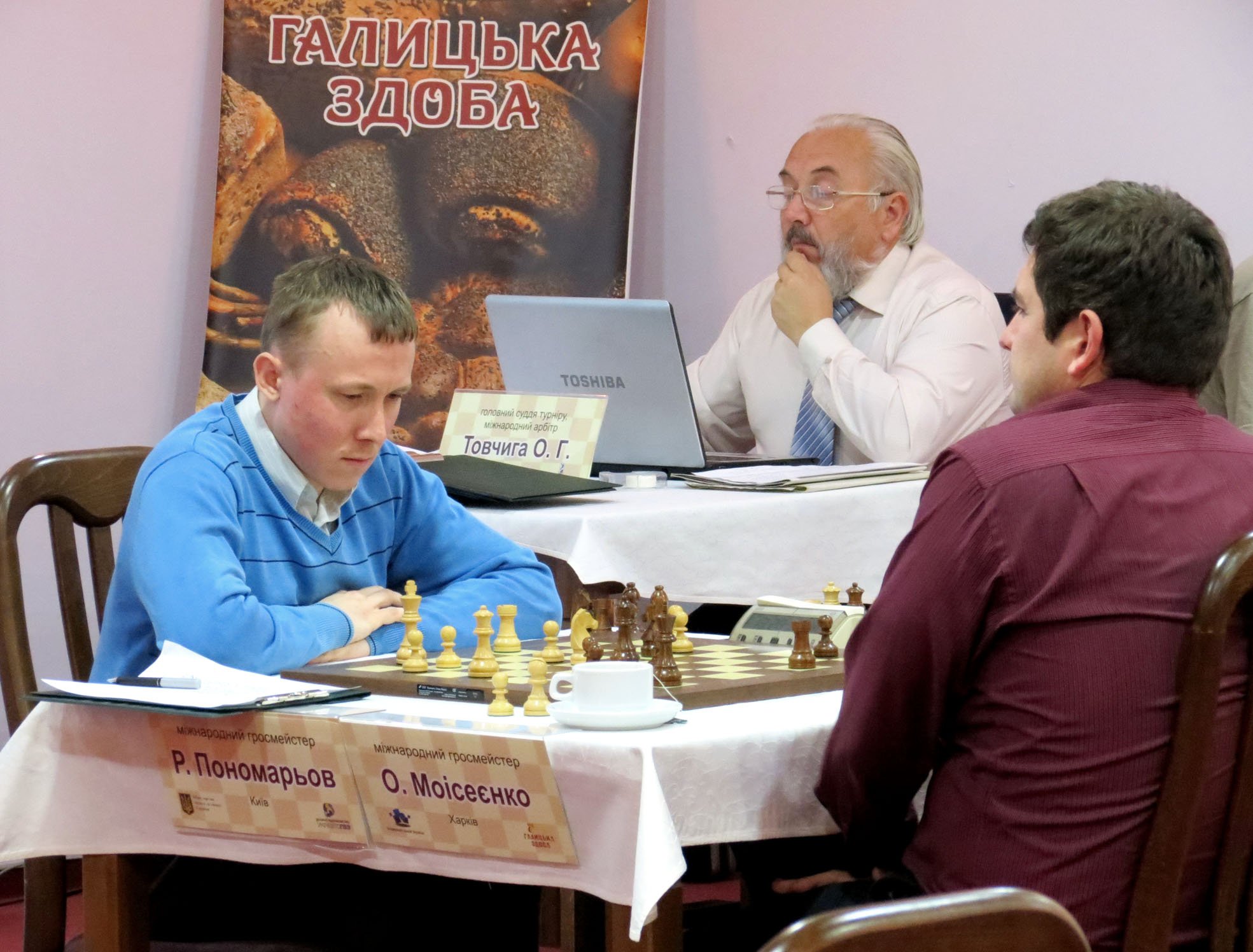
Петрокрс, CC BY-SA 3.0
Introduction
Ruslan Ponomariov occupies an unusual place in modern chess history. He was born in the late Soviet period, formed inside a still recognizably Soviet training culture in Donbas, reached grandmaster strength as a child, and then became FIDE World Champion in January 2002 at age eighteen by defeating Vasyl Ivanchuk in the final in Moscow. FIDE’s own historical summary still presents him as the youngest winner of the FIDE world title, and its ratings archive records that he later rose as high as world number six in April 2002.
He deserves attention today for more than the headline achievement. A close look shows a player who connected several historical layers at once: the last generation trained in the Soviet Union, the first strong generation of independent Ukrainian grandmasters, and the early computer age in which elite preparation changed beyond recognition. His career also includes recurring deep runs in knockout events, major team successes for Ukraine, a second peak around 2010 to 2011, and a later public role as an editor and organizer within the Ukrainian chess community.
Early Life and Chess Formation
Ponomariov was born on October 11, 1983, in Horlivka, Donetsk region, then in the Ukrainian SSR. Contemporary Russian-language biographical material and his own later interviews agree on the basic outline of the family background: his father taught him chess when he was about five or six, his mother worked as an elementary-school teacher, and his father was an engineer at an automobile repair plant. A small but telling detail from an early profile says that his father also brought him the local newspaper Kochegarka, where chess studies were published.
His early progress was rapid. According to a detailed biographical essay in Nauka i Zhizn, he reached first-category strength at nine, and in 1993 his talent was recognized in Kramatorsk. The city’s chess organizers persuaded his parents to move him into the orbit of the local chess school. For nearly eight years he lived with the family of Mikhail Ponomaryov, who was not a relative, and worked chiefly with Boris Ponomaryov, also unrelated, whom Ponomariov later described as a very good pedagogue. That combination of family sacrifice, institutional coaching, and relocation to Kramatorsk was decisive in his making.
The Kramatorsk setting is historically significant in a precise sense. FIDE’s later profile of Kateryna Lagno recalled that the Kramatorsk school produced a cluster of future grandmasters, including Ponomariov, Sergey Karjakin, and Zahar Efimenko. In Ponomariov’s case, the system worked with startling speed. By 1994 he was already a bronze medalist at the world under-12 level. By 1996, still only twelve, he won the European under-18 championship. In 1997 he won the world under-18 title, and the same autumn he completed the results that made him the youngest grandmaster in the world at that time. A contemporary profile in Nauka i Zhizn placed the age precisely at fourteen years and seventeen days.
That same early profile is useful for another reason. It already describes his chess in terms that would remain apt for decades: universality, strong calculation, positional competence, dependable endgame technique, and an ability to choose between strategic pressure and tactical play according to the demands of the position. The comparison that appeared most often was with the young Karpov. That is an interpretation from contemporaries, not a measurable fact, but it shows how experts tried to classify him before he had fully entered the adult elite.
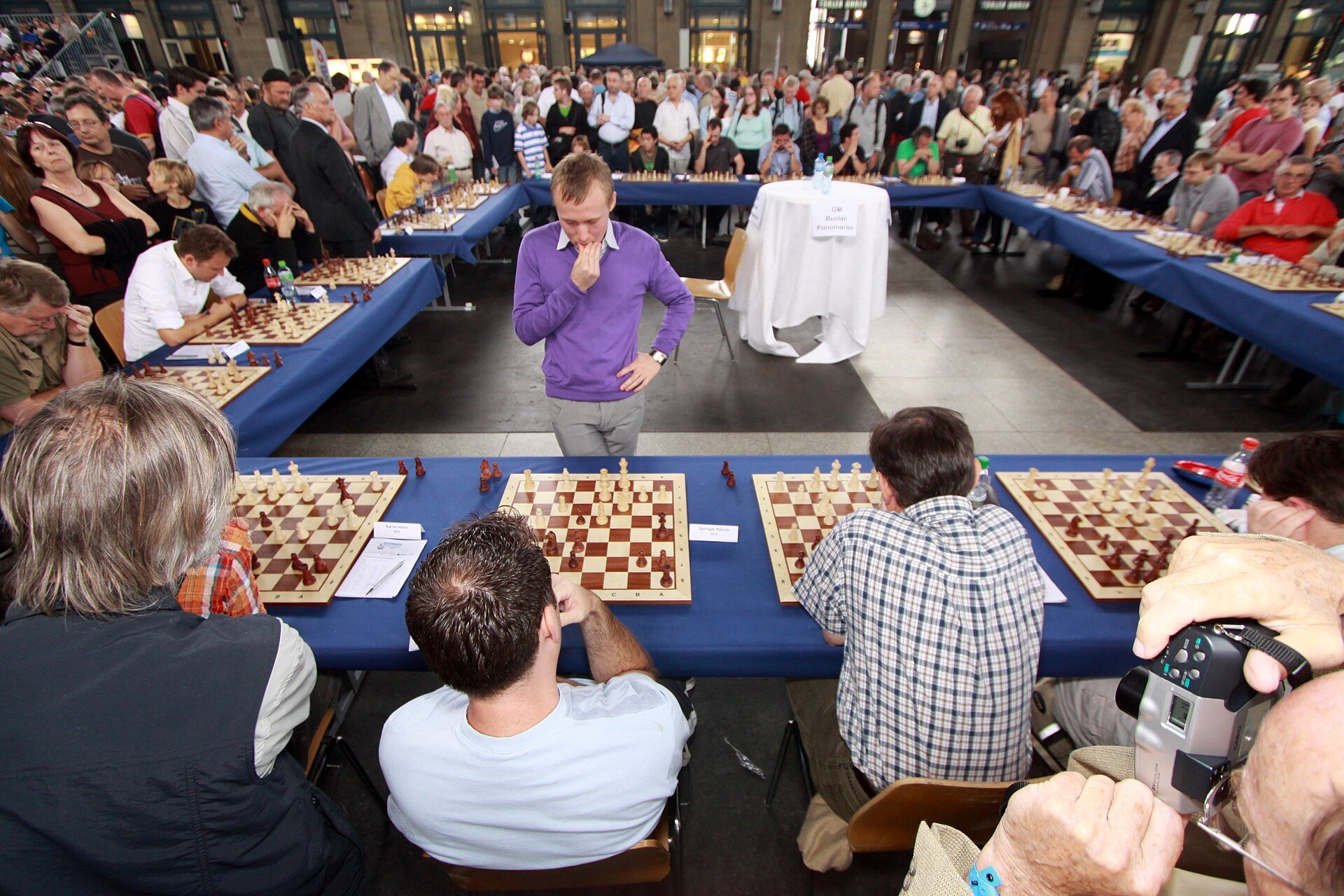
Jürg Vollmer from Chur, Schweiz, CC BY-SA 2.0
Rise in Competitive Chess
Ponomariov’s transition from prodigy to adult grandmaster was not a slow acclimatization. In 1998, still fifteen, he played for Ukraine at the Olympiad in Elista and contributed to a bronze-medal finish. That same year he won the Ukrainian zonal, which qualified him for the FIDE world championship cycle. The sequence illustrates how quickly Ukraine began to trust him in adult team and qualifying events.
Team competitions provide one of the clearest measurements of his early maturity. At the 2000 Olympiad in Istanbul he scored 8.5 out of 11 on board two and won the individual gold medal for that board. At the 2001 World Team Championship in Yerevan he scored 5.5 out of 7 on board two with the best individual result in the event, helping Ukraine take the team title. Contemporary newspaper coverage in the Los Angeles Times emphasized that he supplied the decisive point in match victories over Armenia and Russia during the final stretch. That evidence shows that before he became world champion, he was already one of the key competitive engines of the Ukrainian national team.
The 2001 to 2002 FIDE World Championship in Moscow remains the turning point of his life. The official FIDE cross-table shows his route through the knockout field: Li Wenliang, Sergei Tiviakov, Kiril Georgiev, Alexander Morozevich, Evgeny Bareev, Peter Svidler, and then Ivanchuk in the final. The route is important because it rebuts any idea that he won through a soft bracket. He passed through seasoned elite players from several chess cultures and then beat the strongest Ukrainian of the previous generation. FIDE’s historical champions page records the final score, 4.5 to 2.5 over Ivanchuk.
A reasonable historical reading is that this was the greatest early-career conversion achieved by any Ukrainian prodigy of his generation. The hard facts are clear enough: by early 2002 he had youth titles, a grandmaster title earned at record age, major team performances, and then the FIDE world title itself. FIDE’s ratings archive places him at number six in the world in April 2002, which confirms that the championship was followed by a genuine rise into the top tier of the rating list, not merely a symbolic title.
Major Career Achievements
Ponomariov’s world title belongs to the split-title era, so it needs careful description. He was FIDE World Champion from 2002 until the next FIDE championship cycle replaced him, and his projected unification match with Garry Kasparov became one of the unfinished episodes of early twenty-first-century chess politics. FIDE’s Presidential Board communiqué from August 2003 stated that the match in Yalta should be held under FIDE regulations and said that Ponomariov had been asked to sign the player’s agreement without conditions. Later that year, FIDE’s Executive Board formally endorsed the decision to cancel the match.
Ponomariov’s own later account is different in emphasis. In interviews from 2011 and 2016 he said that he wanted equal conditions as the reigning champion, especially over arbiters and general match terms, and that he believed FIDE supported Kasparov during the negotiations. For a factually careful profile, both layers belong in the record: FIDE documented the cancellation in institutional language, while Ponomariov later described the affair as a failure of parity and respect.
His post-championship career is stronger than his reputation sometimes suggests. In knockout play he was a runner-up at the 2005 World Cup, where FIDE’s event coverage recorded him reaching the final against Levon Aronian, and again in 2009, where FIDE recorded Boris Gelfand as defeating him 7 to 5 in tiebreaks. In 2011 he advanced deep once more and finished fourth after losing the third-place match to Ivanchuk. These repeated performances are a central feature of his historical profile. Ponomariov was one of the outstanding specialists of the knockout era, long after the 2002 title had passed into memory.
His second major peak came around 2010 and 2011. ChessBase’s coverage records that he won Dortmund in 2010, finishing ahead of Lê Quang Liêm, and the same event included his win over Vladimir Kramnik, a result that helped reintroduce him as a player capable of defeating the world’s most accomplished match specialist in a traditional elite tournament. In 2011 he won the 80th Ukrainian Championship, which contemporary coverage described as the strongest championship in the history of independent Ukraine. ChessBase and ChessBase’s author pages also note that his peak rating of 2764 was reached in July 2011.
His standing in team chess remained extremely high across a long span. He won the board-two gold medal at the 2000 Olympiad, team gold with Ukraine at the 2004 Olympiad in Calvià, and team gold again at the 2010 Olympiad in Khanty-Mansiysk. FIDE’s 2010 report praised Ukraine for fielding a remarkably stable and effective lineup, with Ponomariov on board two alongside Ivanchuk, Eljanov, Efimenko, and Moiseenko. These results show that his contribution to Ukrainian chess was never confined to his personal title run.
Style and Reputation
The best short description of Ponomariov’s chess is that he was universal, stubborn, and highly practical. Crestbook’s biographical preface to its 2011 conference with him called him a player of “universal,” even “Karpov-like,” style, known for his uncompromising fighting spirit and principled character. In the same feature, Sergey Shipov described him as tenacious, cool-headed, inventive, flexible, technically strong, and hard to predict. These are not neutral statistical descriptions. They are evaluations by informed contemporaries. Still, they align closely with the broader record of his games and results.
FIDE’s Paris Grand Prix coverage in 2013 captured another side of his reputation, saying that he could get “water out of stone” from positions others would consider barren. That phrase is unusually vivid, and it gets at a recurring quality in Ponomariov’s play: he often kept probing in positions that looked equal or dry and found resources that more overtly dynamic players might never have searched for. A separate 2013 round report notes that he once answered the description of his style as “solid” with a self-ironic suggestion that some might call it “boring.” His own comment is worth remembering because it shows that he understood the outer shell of his style and the hidden venom inside it.
Three games are especially useful as historical markers. The first is his win over Ivanchuk in the opening game of the 2002 final, because it established the practical and psychological tone of the match he would win. The second is his defeat of Kramnik at Dortmund in 2010, because it symbolized the full return of a player many observers had begun to place in the background. The third is his 2005 win over Fritz in Bilbao. The human team lost the overall match badly, yet ChessBase singled out Ponomariov’s victory as memorable. That game is important because it shows a former world champion who had adapted to the engine age well enough to strike back in a contest designed to dramatize human vulnerability.
His reputation among contemporaries was shaped by his work ethic as much as by his style. In 2016 he said that his 2002 title run against Ivanchuk had been supported by a strong team including Veselin Topalov, Gennady Kuzmin, and the twelve-year-old Sergey Karjakin, who offered tactical ideas. That detail is instructive. Ponomariov was never just a gifted improviser. Even as a teenager he was already functioning inside a serious professional support structure.
Contributions Beyond Tournament Play
Ponomariov’s work beyond competitive play has been selective, though it is more substantial than is often noticed. A 2008 interview is especially revealing here. He said that after becoming world champion he completed two university degrees. One was in law, with a thesis on legal problems and prospects for improving legislation in international sporting competitions; he specifically connected that thesis to the contract for the aborted Kasparov match. The second was in sports education at Kyiv’s State University of Physical Education, where he wrote on the analysis of chess software. Even in formal education, chess remained his subject.
The same interview shows him as an unusually articulate professional on institutional issues. He discussed paying for training camps himself, hiring Topalov as a coach for Kasparov preparation, refusing the modest state salary then attached to membership on the Ukrainian national team, and publicly arguing that Olympiad winners should be rewarded on a scale closer to Olympic medalists. Those comments help explain both his temporary distance from the national side and his later return after changes in federation leadership, as summarized by Crestbook.
His later public contributions have centered on teaching and cultural organization. In 2022, after Russia’s full-scale invasion of Ukraine, New In Chess asked him to act as general editor for From Ukraine with Love for Chess, a collective book whose proceeds were directed to Ukrainian charities. Official publisher pages describe him as the coordinating editor for a volume built from games and annotations provided by Ukrainian players themselves. In 2023 he also recorded his first ChessBase FritzTrainer, Typical Opening Mistakes, a training work aimed at players from beginners through professionals.
His personal life also settled into a quieter international rhythm. In a 2016 interview he said that he lived in Bilbao, that he had met his wife Ines, a Spanish interpreter, at a tournament in Vitoria in 2008, and that their son Yaroslav had been born that year. By July 2026, FIDE still listed him as an active grandmaster with a standard rating of 2632, and the Ukrainian national ranking page placed him third among active Ukrainian male players. That continuity is part of his story. He never became an ex-player in the ceremonial sense.
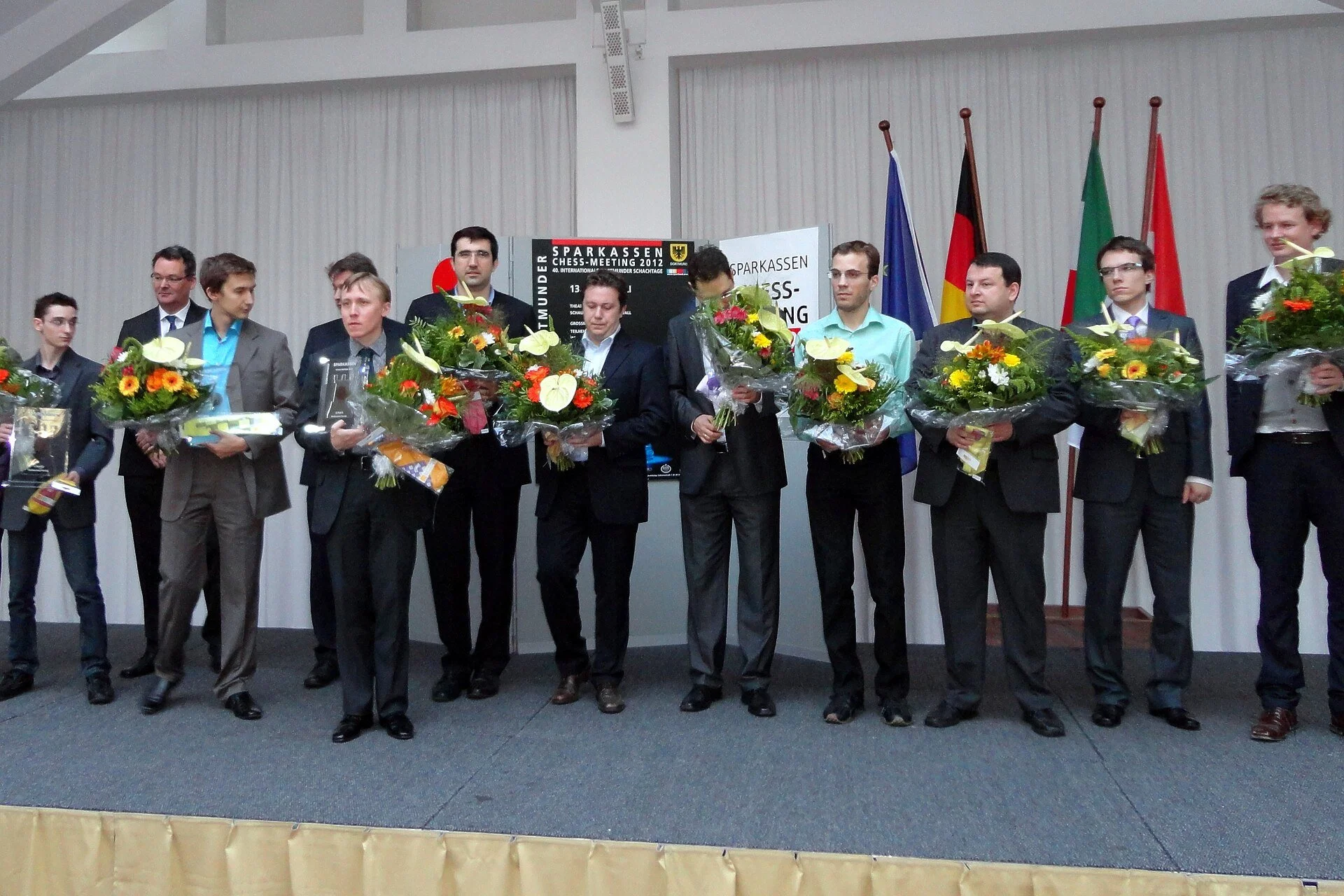
GFHund, CC BY 3.0
Historical Legacy
Ponomariov’s legacy rests on a combination that few players can match. He was a child prodigy whose adult career validated the early promise. He was a world champion in a fractured era, which means that his title carries historical complexity, yet the complexity should not obscure the scale of the feat. He emerged from a brutal knockout field, beat elite opposition, and did so while still a teenager. That remains one of the most impressive accelerations from junior success to world title in modern chess.
Within Ukrainian chess history, his place is especially secure. He was a product of the Kramatorsk school, a leading board on major Ukrainian teams, a world champion recognized by the Ukrainian state with high honors, and later an editor helping mobilize chess culture for Ukrainian charitable work. His career charts the survival of a Soviet training inheritance inside independent Ukraine, then its adaptation to the international, computer-driven, and politically unsettled chess world of the twenty-first century. That last sentence is an interpretive judgment, but it follows directly from the record of his upbringing, team results, public statements, and later organizational work.
He deserves attention today because he is easy to misremember. The split-title era tempts later writers to reduce him to an asterisk. The fuller record points somewhere else. Ponomariov was one of the strongest practical players of his generation, one of the great knockout specialists, a central figure in Ukrainian team chess, and a champion whose career still speaks to the passage from Soviet chess culture into the post-Soviet world.
Notes and Sources
For early life and formation, the most useful sources were Ponomariov’s own later interviews, especially the 2008 ChessBase interview and the 2016 German-language ChessBase interview, read alongside the biographical essay “Samyi Molodoi Korol” in Nauka i Zhizn. Those sources agree on the core early facts: Horlivka origins, the father’s role in teaching him chess, the move into the Kramatorsk system, the importance of Boris Ponomaryov, and the speed of his rise.
For results and institutional chronology, this profile relied chiefly on official FIDE materials and OlimpBase. FIDE’s Moscow 2001 to 2002 championship page provides the knockout route and match scores. FIDE’s documents on the Kasparov match establish the official record of the proposed unification match and its cancellation. OlimpBase confirms Olympiad and World Team results. Ukrainian state honorifics were checked against the Verkhovna Rada legal database. Later contributions beyond play were checked against New In Chess, Simon & Schuster, and ChessBase publisher pages. English-language sources usually use “Ponomariov,” while Russian-language materials print “Пономарёв” and Ukrainian state documents print “Пономарьов.”
