Garry Kasparov
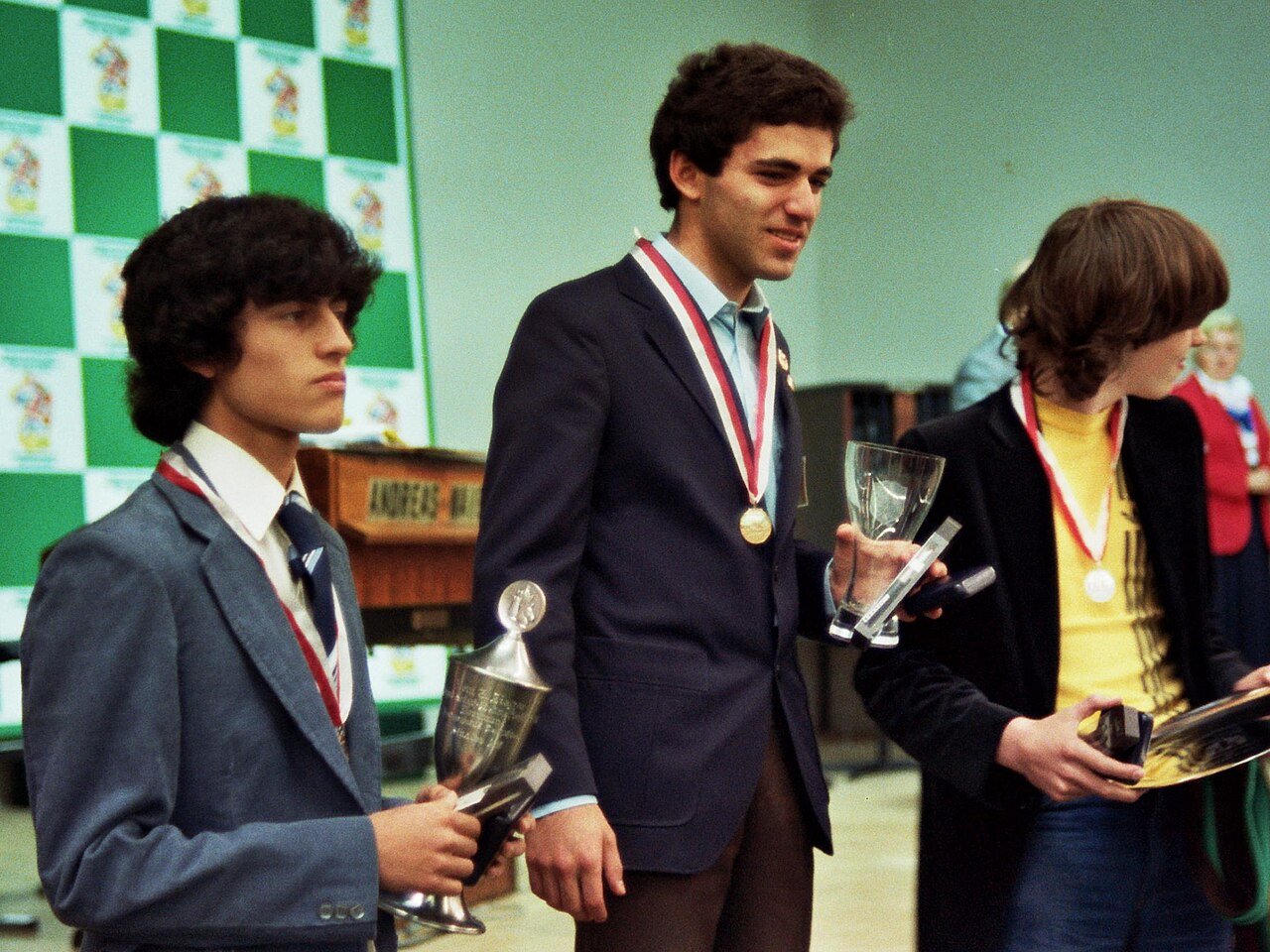
Ivan Morovic, Garry Kasparov and Nigel Short, Junior Chess World Championship 1980 at Dortmund, Photographer Gerhard Hund.
Introduction
Garry Kasparov belongs in any serious account of modern chess because his career joined unusual competitive dominance to unusual historical visibility. Born in Baku in 1963, world champion from 1985 to 2000, and for roughly two decades the top rated player in the world, he was at once a late Soviet prodigy, an architect of post Soviet chess professionalism, and an early emblem of the computer age in elite competition. A careful profile of Kasparov therefore has to treat him as more than a champion with brilliant games. He was also a public figure whose career altered how top chess was prepared, marketed, written about, and remembered.
A reasonable historical interpretation, grounded in the evidence, is that Kasparov was both the culmination of the Soviet training system and one of the men who helped loosen its old institutional framework. He came out of the Botvinnik school, the Baku youth system, and Soviet high performance coaching, yet later helped build the Grandmasters Association, broke with FIDE in 1993, embraced database driven preparation, and turned himself into an authorial and media presence on a scale earlier champions had not matched. That combination is central to his significance.
Early Life and Chess Formation
Russian language reference works identify him as Гарри Кимович Каспаров, while earlier records also preserve his birth name, Garik Kimovich Weinstein, from the Russian Вайнштейн. He was born on April 13, 1963, in Baku, then in the Azerbaijan SSR, to the radio engineers Kim Moiseyevich Weinstein and Klara Shagenovna Kasparova. His father was Jewish, his mother Armenian. The authoritative Russian encyclopedia entry notes that he originally bore his father’s surname and took his mother’s surname in 1975. Kasparov himself later wrote that his father died of leukemia when he was seven, and that his mother then devoted herself to his upbringing and career.
Several early details, often omitted in shorter sketches, help explain the shape of his later personality. The Great Russian Encyclopedia records that he was already reading geography and history books at four. It also states that he learned chess at six and that his first formal trainer at the Baku Palace of Pioneers was Oleg Privorotsky. Kasparov’s official site preserves the family anecdote that he first impressed his parents by solving a newspaper chess problem as a small child. Taken together, these details suggest not only precocity in chess, but a wider appetite for structured intellectual material, something that later showed in his historical writing and opening preparation.
His formative chess education was unusually strong even by Soviet standards. From 1973 he studied at Mikhail Botvinnik’s chess school, and the Russian encyclopedia notes that from 1976 to 1990 his main trainer was Alexander Nikitin. Kasparov’s own timeline adds Vladimir Makogonov and Alexander Shakarov to the circle of important early influences. In a later interview, Nikitin recalled first seeing the young Kasparov in 1976 and being struck by calculation that was already, in his words, at grandmaster level for his age. The same interview is useful for another reason: it shows that Kasparov’s team treated physical conditioning as part of chess excellence, a theme that becomes important in the Karpov matches.
Kasparov’s formal education did not disappear behind the usual myth of total specialization. Russian biographical sources record that he finished school with distinction and graduated in 1986 from the Azerbaijan Pedagogical Institute of Foreign Languages, specializing in English. That point is minor in strict chess terms, but historically relevant. He was not merely a prodigy trained to move pieces. He was a cultivated Soviet intellectual athlete whose later fluency as a commentator, polemicist, and author rested on more than celebrity.
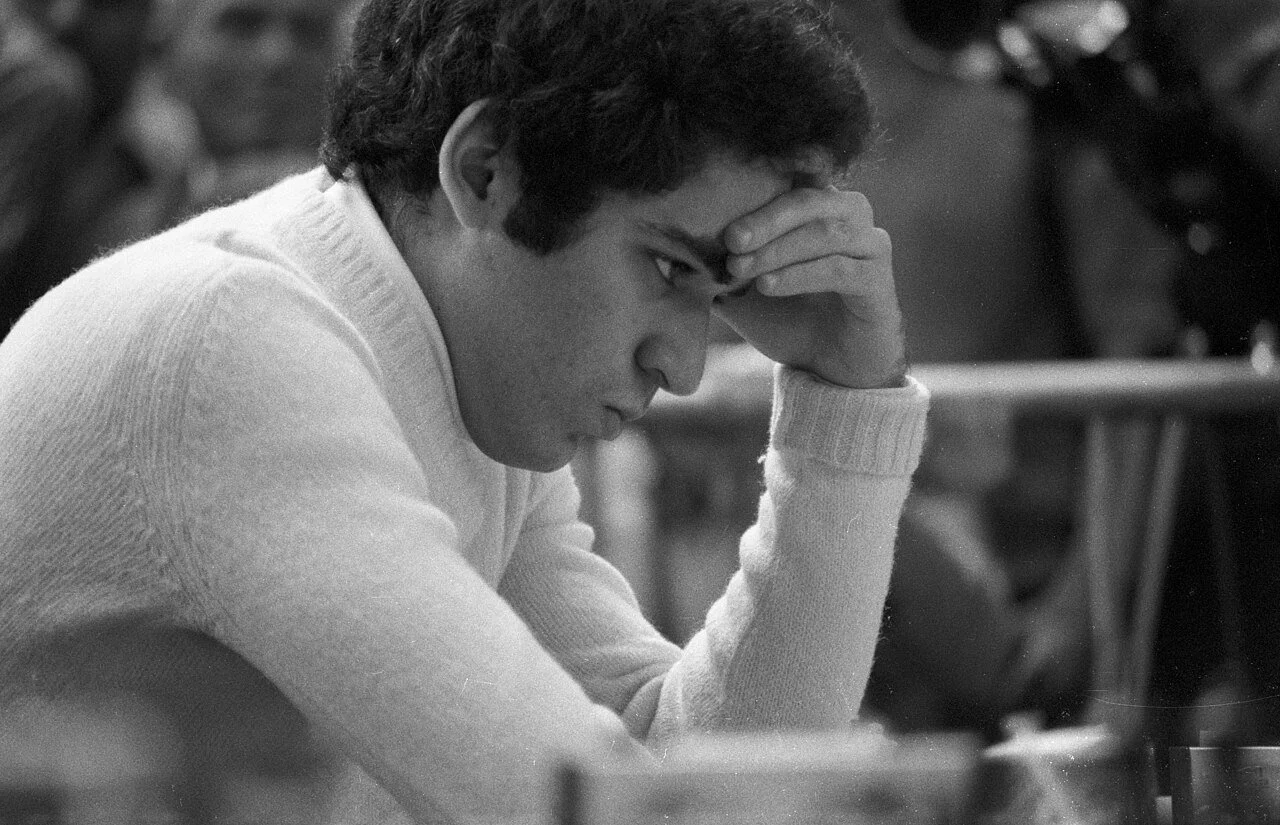
Krtschil, CC BY-SA 4.0
Rise in Competitive Chess
Kasparov’s rise through competition was astonishingly fast, yet it did not bypass demanding adult chess. His official timeline notes that he won the Soviet junior championship at twelve, repeated the feat the next year, won the World Junior Championship in 1980, and achieved the grandmaster title on his seventeenth birthday. The Russian encyclopedia adds a lesser known milestone, his victory in the Baku Cup among adults at twelve, then the rapid sequence through the Sokolsky Memorial in Minsk, the triumph at Banja Luka in 1979, and the shared USSR championship title in 1981, which made him the youngest champion in the history of that event. These were not ornamental junior results. They marked the arrival of a player already proving himself in serious adult company.
His path to the world title was equally demanding. After winning the 1982 Interzonal in Moscow, he defeated Alexander Beliavsky, Viktor Korchnoi, and Vasily Smyslov in the Candidates cycle to earn the right to challenge Anatoly Karpov. The first match, in Moscow in 1984 to 1985, became one of the defining ordeals in chess history. Kasparov fell behind 0 to 5, then fought back by winning games 32, 47, and 48 before FIDE President Florencio Campomanes terminated the match after 48 games. The documentary baseline is clear: both players said they preferred the match to continue, and the official reason given was concern for health. The more dramatic claim, that Kasparov was plainly on the verge of victory, belongs more to retrospective interpretation than settled fact. Edward Winter has explicitly warned against turning that later narrative into certainty.
The rematch in 1985 made Kasparov world champion at twenty two, still one of the most symbolically loaded moments in chess history. His own site calls game 16 of that match a positional masterpiece, and that description is helpful because it corrects a common simplification. Kasparov was never only a combinational attacker. He won the second match 13 to 11, and then held the crown against Karpov again in 1986, drew the 1987 Seville match to retain the title, and defeated him once more in the New York and Lyon match of 1990. The long sequence fixed their rivalry at the center of late Soviet chess culture and made Kasparov’s championship appear earned through repeated proof, not a single upset.
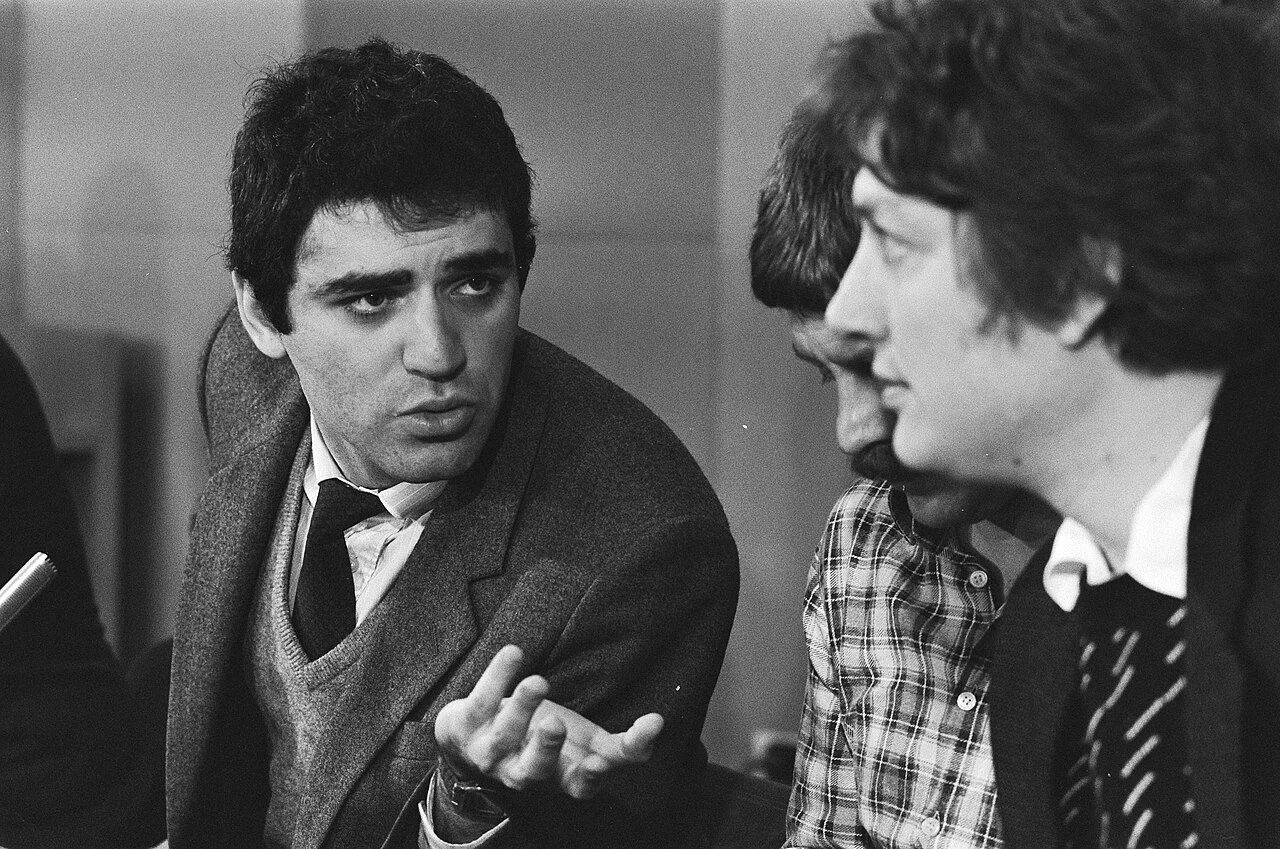
Rob Bogaerts / Anefo
Major Career Achievements
Kasparov’s achievements after winning the title are best understood in terms of sustained primacy rather than a mere list of trophies. The World Chess Hall of Fame states that he remained the top rated player for twenty years, became the first player to cross 2800, reached the then record rating of 2851, and set a record with fifteen consecutive tournament victories between 1981 and 1990. Reputable rating records also place his peak official rating at 2851 in July 1999. These achievements show a competitor who was not simply a match specialist. He dominated both long cycle championship chess and elite tournament practice.
His championship years also extended across the institutional fracture of the chess world. In 1993, dissatisfied with FIDE’s handling of the title match arrangements, Kasparov and Nigel Short created the Professional Chess Association and played their match outside FIDE jurisdiction. Britannica records the essentials: FIDE stripped Kasparov of its title, Kasparov defeated Short to become PCA champion, and he successfully defended that title against Viswanathan Anand in 1995. Kasparov’s own timeline confirms the scores, 12.5 to 7.5 against Short and 10.5 to 7.5 against Anand. This was one of the major turning points in modern chess governance, even if Kasparov later described the break as harmful in the long run.
His achievements in team chess are sometimes overshadowed by the world championship story. They should not be. The Russian encyclopedia records that he played in eight Olympiads, four for the Soviet Union and four for Russia, and won team gold every time, scoring 64.5 out of 82. That is a remarkably stable record across two states and two eras of chess organization. It also helps explain why Kasparov’s place in Soviet and post Soviet chess culture remained central even when his conflicts with institutions grew sharper.
The closing phase of his competitive career was historically significant even where it involved defeat. In 1996 he beat IBM’s Deep Blue 4 to 2 after losing the first game, which IBM identifies as the first win by a computer against a reigning world champion under regular time controls. In 1997 Deep Blue won the rematch 3.5 to 2.5, and both IBM and the Computer History Museum emphasize the symbolic force of that event. In 2000 Kasparov then lost his classical title to Vladimir Kramnik in London. Even so, he retired in 2005 after winning Linares, still ranked number one. For a profile of Kasparov, these final episodes belong in the story because they mark the end of one chess epoch and the arrival of another.

Rob Bogaerts / Anefo
Style and Reputation
The best concise description of Kasparov’s chess comes from the Great Russian Encyclopedia, which attributes to him a dynamic style, rich imagination, far sighted calculation, original opening ideas, and strategic depth. His official 1980 timeline uses similar terms, calling his young style aggressive and dynamic. Nikitin’s recollection of the boy’s calculating power fits these characterizations. Kasparov’s strength lay in the union of tactical violence and structured preparation. He was never merely improvisatory. His attacks usually came from positions he understood more deeply than his opponents, often because he and his team had mapped the terrain in advance.
Two games are enough to illustrate his range without turning this profile into game annotation. Game 16 against Karpov in the 1985 world championship remains essential because even Kasparov’s own retrospective presentation emphasizes its positional character, which is exactly what many casual summaries miss. Kasparov against Topalov at Wijk aan Zee in 1999 remains the other necessary exhibit. ChessBase describes it as what is now known as his “immortal game,” and its reputation is justified because it concentrates the traits most associated with him: initiative, calculation, willingness to accept risk for activity, and sustained attacking vision. One game shows the strategist, the other the attacker. Together they are sufficient.
Contemporaries respected him for more than over the board force. He acquired a reputation for psychological pressure, staging, and relentlessness. A computer history essay on Kasparov and Deep Blue notes that by the 1990s he was already widely seen as a master of psychology at the board. Nikitin’s later reminiscence on physical training before the Karpov matches also underlines a plainer truth, that Kasparov and his camp treated stamina, will, and stress resistance as competitive weapons. The principal weakness historians usually identify is the reverse side of these strengths. His need for initiative and command could become costly when an opponent refused the kind of fight he preferred. Kramnik later argued that Kasparov had become readable in patterns of play, a judgment that fits the sterile frustration of the 2000 match. That is less a verdict on a defective player than on the rare conditions required to neutralize him.
Contributions Beyond Tournament Play
Kasparov’s contributions beyond tournament play were substantial and are sometimes underdescribed because the championship story is so large. The Russian encyclopedia credits him with helping found the Grandmasters Association in 1987 and places him at the center of the six event World Cup series of 1988 and 1989, which he also won. These were not side projects. They were part of an effort to give elite players more professional control over their own circuit and to create a more coherent international calendar. In that sense, Kasparov was an institutional actor inside chess long before his political career outside chess became more famous.
As an author and theoretician, his record is impressive and also requires some caution. The Russian encyclopedia lists his early co authored opening book on the Scheveningen Sicilian with Nikitin in 1984 and later major works that include My Great Predecessors and the Modern Chess series. His own books page confirms the breadth of this project, from autobiographical volumes to multi volume historical works. These books enlarged the reading culture of chess and shaped how many players encountered earlier champions. At the same time, Edward Winter has repeatedly criticized their sourcing and factual reliability in places, especially in the historical series. The fairest conclusion is that Kasparov’s chess books are indispensable, but they have to be used critically, as major works of interpretation by a partisan genius rather than neutral archival finalities.
Kasparov also helped redefine opening preparation in the computer era. In his own retrospective on twenty five years of ChessBase, he wrote that his career could be divided into a pre ChessBase era and the period in which he pioneered the use of databases and engines for opening work. He specifically identified game 10 of the 1995 Anand match as the first time he used an opening novelty checked by an engine. Anand, looking back on the late 1980s, likewise recalled being told that Kasparov was already using databases while others still doubted their future. This is one of Kasparov’s most enduring practical legacies. He did not invent computer preparation, but he accelerated its adoption at the highest level and gave it prestige.
His later teaching and organizational work follows the same pattern of influence. FIDE lists him as a Senior Trainer from 2009. Around the same period he coached Magnus Carlsen, whose own recollection was that Kasparov helped him understand a whole class of positions better and gave him significant practical help. The Kasparov Chess Foundation describes its mission as bringing the educational benefits of chess to children through curricular and after school programs, and Kasparov’s own timeline records regional initiatives in Europe and Africa. Even after retirement, then, he remained a builder inside chess culture, not only a commentator standing outside it.
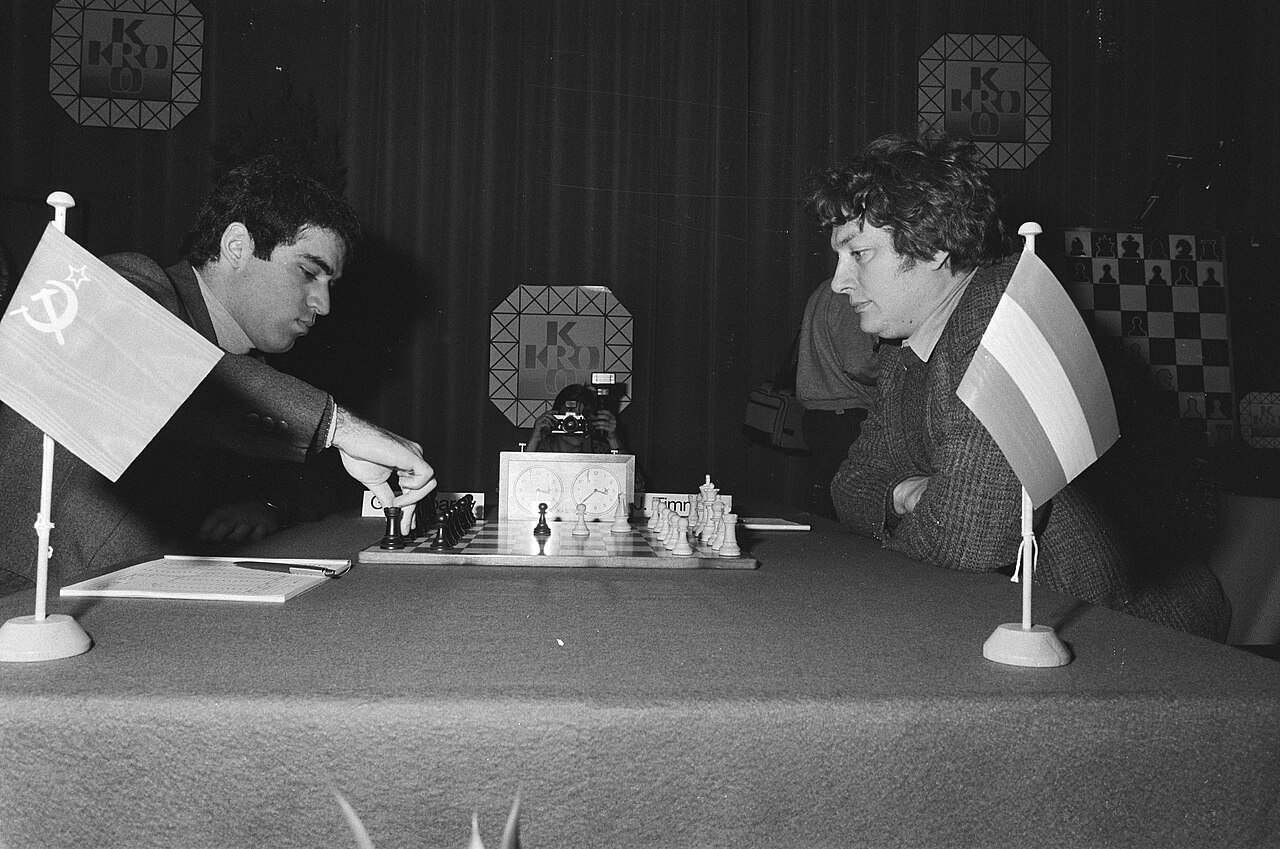
Rob Bogaerts / Anefo
Historical Legacy
Kasparov’s legacy is strongest when seen in historical layers. He was formed by Soviet institutions, yet repeatedly pushed beyond their inherited limits. He won for the USSR, then for Russia. He lived the transition from Soviet sports administration to globalized professional chess. In 1990, as his official biography and a Johns Hopkins profile note, he and his family escaped ethnic violence in Baku as the USSR collapsed. That biographical rupture belongs to the historical picture because it helps explain why Kasparov’s later public identity cannot be reduced to a simple national label. His career is entangled with the end of the Soviet world that trained him.
For chess history readers today, Kasparov deserves attention because he sits at the junction of several transformations that still define the game. He represents the high point of Soviet school professionalism, the modernization of elite preparation through databases and engines, the expansion of the champion into author, organizer, and public intellectual, and the moment when world championship chess entered a prolonged struggle over governance and legitimacy. His games remain studied because they are powerful. His career remains studied because it explains how modern chess became modern. That is his lasting historical claim.
Notes and Sources
This profile prioritizes primary and near primary material where available, especially Kasparov’s official site and timelines, Kasparov’s own retrospective writing, the Great Russian Encyclopedia entry by V. I. Linder, the Nikitin interview preserving coaching recollection, FIDE records, and institutional sources on Deep Blue from IBM and the Computer History Museum. Russian language biographical details were checked against Radio Svoboda and Novaya Gazeta. For historiographical caution, Edward Winter’s Chess Notes was used as a control against over familiar Kasparov narratives, especially on the 1984 to 1985 match termination and on Kasparov’s later historical writing. Douglas Griffin’s work on Kasparov in the Soviet chess press is also valuable for recovering contemporary Soviet commentary, even when it is used more as context than as a direct factual authority here. Where a claim remains disputed, such as the exact historical meaning of the 1984 termination, this article keeps to documented facts and identifies broader conclusions as interpretation rather than certainty.
