Anatoly Karpov
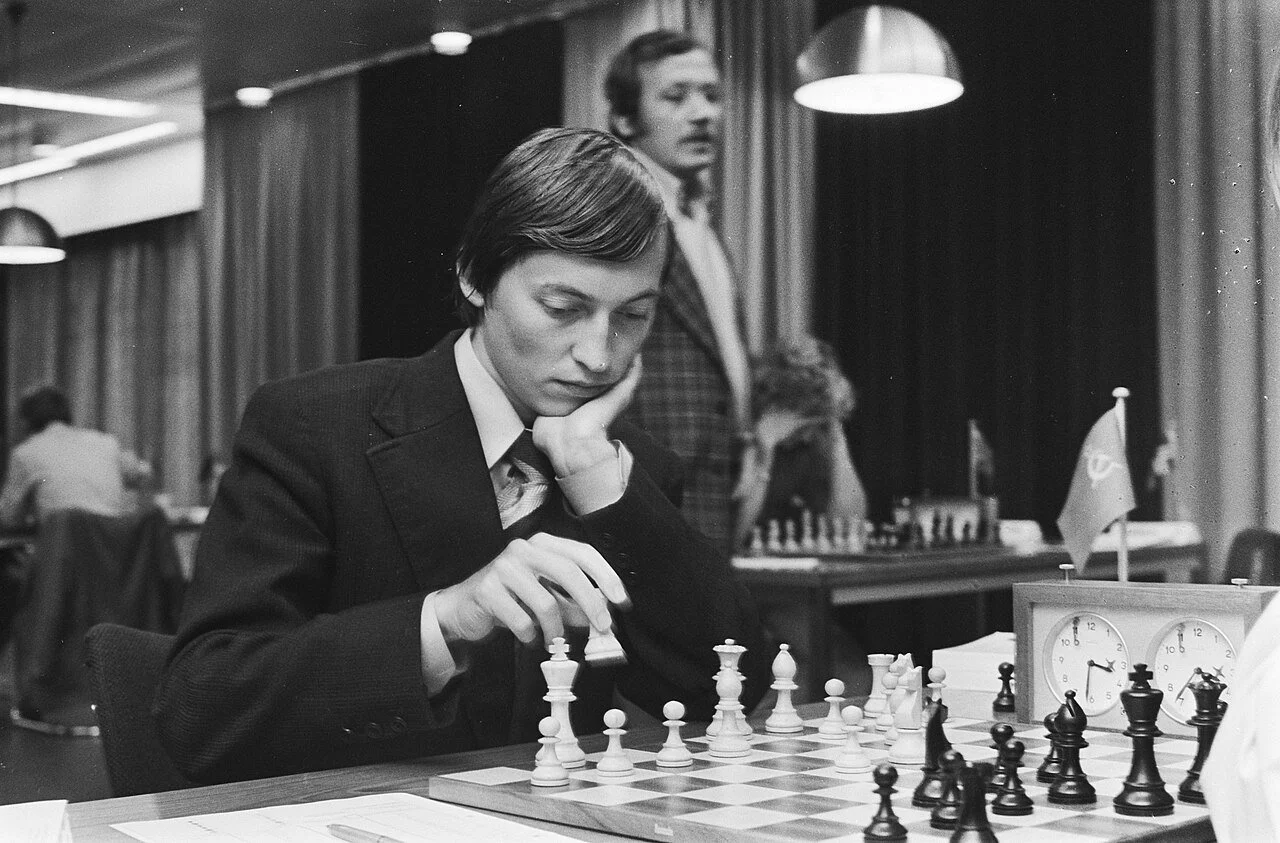
Verhoeff, Bert / Anefo
Introduction
Anatoly Yevgenyevich Karpov belongs among the small number of players whose historical profile cannot be captured by a single title or rivalry. Formally, he became the twelfth world champion in 1975 after Bobby Fischer declined to defend the crown. Yet that fact alone can distort his place in chess history. By the time Fischer withdrew, Karpov had already won one of the strongest qualification paths in modern chess, defeating Lev Polugaevsky, Boris Spassky, and Viktor Korchnoi in the 1974 Candidates cycle. He then spent a decade as champion, defended the title twice against Korchnoi, played the defining championship rivalry of the late Soviet era against Garry Kasparov, and in the 1990s added three FIDE world titles to his record. Contemporary institutional and historical sources also credit him with more than 150, and in some summaries more than 160, first-place finishes, which helps explain why his reputation rests as much on sustained tournament domination as on championship formalities.
A careful profile of Karpov should therefore begin from two linked propositions. The first is documentary: he was one of the most successful competitive players the Soviet system ever produced. The second is interpretive: he turned a specifically Soviet formation, factory club, junior training network, elite coaching, team culture, and state-backed tournament discipline, into a personal style of chess that looked quiet on the surface but was often devastating in effect. His career is not simply a preface to Kasparov, nor merely the aftermath of Fischer. It is a large and self-sufficient chapter in twentieth-century chess history.
Early Life and Chess Formation
Karpov was born on May 23, 1951, in Zlatoust, in the Chelyabinsk region of the Urals. Russian biographical sources agree on the place and date, and they place his earliest chess development in the chess section of the Zlatoust Metallurgical Plant. A small discrepancy appears in the sources about the exact age at which he learned the moves. The TASS encyclopedia says five, while Karpov in a later interview recalled that his father taught him at four. That discrepancy is minor, but it is worth noting because it is a reminder that even the biographies of major players contain accreted detail. What is clear is that chess entered his life very early, through family and the industrial civic culture around the plant. Karpov himself later described his background in language that stressed that origin, saying he was not a “son of the regiment” but a “son of the factory.” In the same interview he described his father as an engineer and prolific inventor, which is a useful clue to the household discipline in which he grew up.
His early progress was swift and unusually well documented. According to official Russian biographical records, he earned first-category status at nine, fulfilled the candidate master norm at eleven, entered Botvinnik’s correspondence chess school at twelve, and became a Master of Sport of the USSR at fourteen. In 1969 he won the World Junior Championship in Stockholm, gained the International Master title the same year, and became a grandmaster in 1970. These steps were not only markers of talent. They show how quickly Karpov moved through the Soviet hierarchy of chess accreditation. By the end of adolescence he was already no longer a provincial prodigy but an elite project.
His formal education followed a path that also illuminates the institutional world around him. The TASS encyclopedia states that after graduating, with a gold medal, from a mathematical class at school in Tula, he entered the mechanics and mathematics faculty of Moscow State University in 1968, transferred in 1969 to the economics faculty of Leningrad State University, and completed his degree only in 1978 because of competitive travel. Karpov himself later gave a more personal explanation for the move, recalling friction within the Burevestnik sports society and saying that Leningrad offered a route out of bureaucratic pressure while keeping him close to the chess people he needed. The underlying historical point is plain enough: in Soviet chess, talent developed through institutions, but institutions also constrained and directed personal careers.
The central formative relationship of Karpov’s chess life was not Botvinnik but Semyon Furman. Douglas Griffin’s work on Soviet primary sources shows that Furman and Karpov began working together in 1968, when both were connected with the Central Sports Club of the Army. Karpov later wrote that Furman helped him understand “the multifaceted science of chess mastery” on the road “from the title of master to that of World Champion.” That is not ceremonial praise. Furman was the coach who helped shape the mature Karpov: positionally exact, deeply practical, and emotionally self-controlled. After Furman’s death in 1978, Igor Zaitsev became the most important long-term analytical figure in Karpov’s world championship preparation, especially during the Korchnoi and Kasparov years.
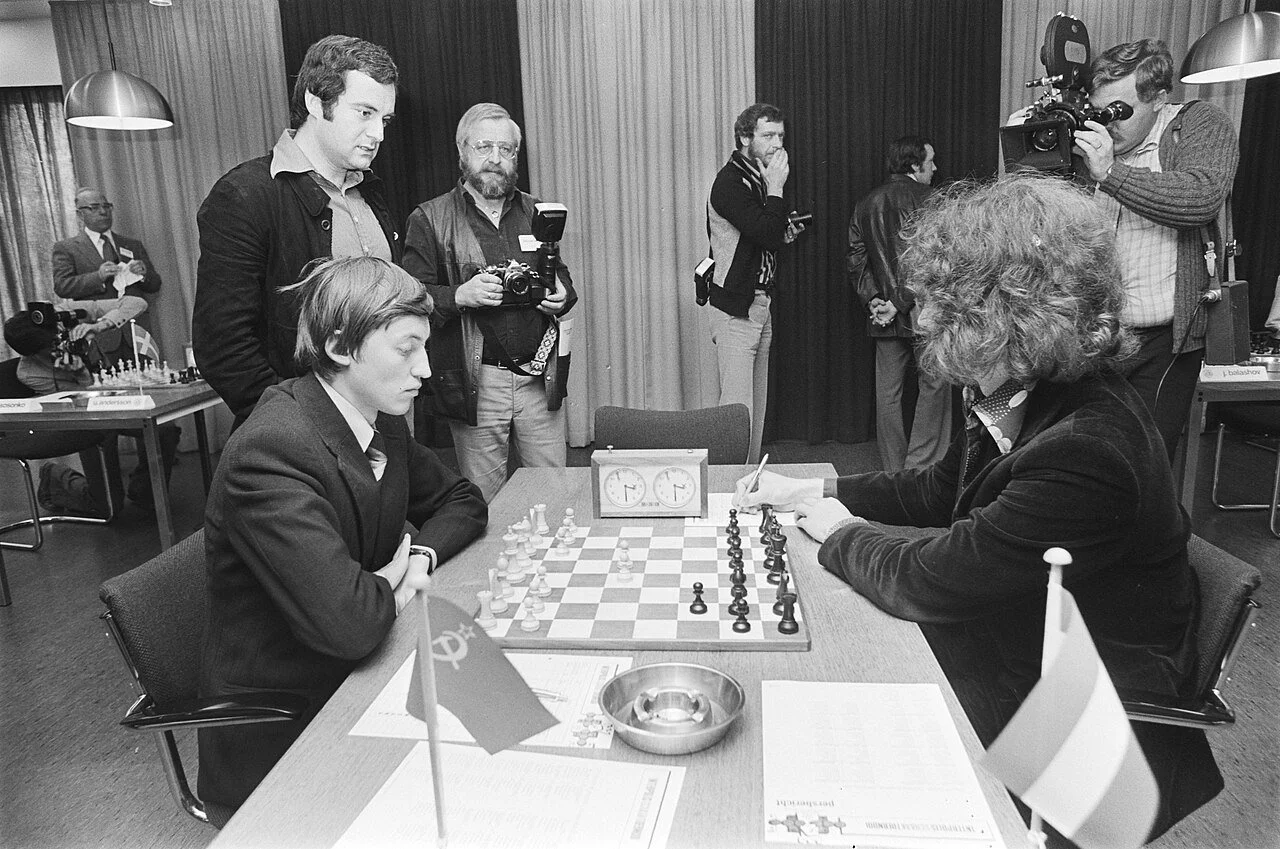
Suyk, Koen / Anefo
Rise in Competitive Chess
Karpov’s rise from junior champion to challenger was remarkably compressed. The World Chess Hall of Fame summary highlights a sequence that still looks extraordinary: European junior champion in 1967, world junior champion in 1969, grandmaster in 1970, winner of the Alekhine Memorial in 1971, and then a leading figure in the 1973 USSR Championship and Leningrad Interzonal. By the early 1970s he was no longer a talented newcomer. He was already being measured against former world champions and established candidates. Douglas Griffin’s work on the 1974 Candidates cycle notes that even Botvinnik regarded Karpov as the clear favorite against Spassky, which suggests how widely his upward trajectory had already been recognized inside the Soviet chess elite.
The decisive breakthrough came in 1974. Official FIDE history and Karpov’s own biographical materials agree on the essentials: he beat Polugaevsky in the quarterfinal, Spassky in the semifinal, and Korchnoi in the final. The Korchnoi match was especially consequential. FIDE’s museum notes that because Fischer later refused to defend his title, the Karpov-Korchnoi Candidates final can be seen in retrospect as a de facto world championship contest. This is an important corrective to the lazy formula that Karpov became champion “without playing for it.” Formally, yes, he received the title after a forfeit. Historically, he had already beaten the best available succession field over the board.
This rise also shaped Karpov’s reputation inside Soviet chess culture. He was young enough to symbolize renewal, but unlike Fischer he emerged through discipline, coaching, and federation structures rather than against them. He looked, from a Soviet institutional point of view, like proof that the system still produced world champions. That image later hardened during the Korchnoi matches and then again during the Kasparov rivalry, but its roots lay in the speed and regularity with which he climbed the Soviet and international ladder from 1969 to 1974.
Major Career Achievements
Karpov was proclaimed world champion in 1975 after Fischer’s withdrawal. That formal beginning is inseparable from the ensuing decade in which he validated the title by performance. He defended the crown against Viktor Korchnoi in Baguio in 1978 and again in Merano in 1981. FIDE’s museum records the Baguio match as one of the most politically charged in chess history and the Merano rematch as a much more one-sided affair, which ended 6 to 2 with 10 draws and entered chess memory as “the Massacre in Merano.” By then, the central sporting question was no longer whether Karpov was a legitimate champion. It was whether anyone could dislodge him.
His record outside championship matches is one of the strongest cases for his historical stature. The World Chess Hall of Fame credits him with more than 160 first-place finishes and a peak Elo of 2780, while the TASS encyclopedia gives a slightly more conservative figure of more than 150 tournament victories and records his six Chess Olympiad gold medals with the Soviet team, two World Team Championship titles with the USSR, three USSR Championships, and nine Chess Oscars. The important point is not the exact count in every category, but the consistency. Karpov was not a champion who withdrew into title defense alone. He played heavily and kept winning at elite level for years.
The great complication in his career, and one reason he remains so historically interesting, was Garry Kasparov. FIDE’s official histories describe the five Karpov-Kasparov world championship matches from 1984 to 1990 as a series that defined an era. Their first match in Moscow, played to six wins with no limit on draws, was stopped by FIDE President Florencio Campomanes in February 1985 with Karpov leading 5 to 3 after 48 games. A 24-game rematch later that year was won by Kasparov, and Karpov then returned for championship matches in 1986, 1987, and 1990, missing by the narrowest of margins in 1987, when Kasparov saved the title in the last game of the match.
Karpov’s post-Soviet achievements are sometimes treated as an appendix, but they deserve more weight than that. After the 1993 split in the world championship, he defeated Jan Timman for the FIDE title, then successfully defended it against Gata Kamsky in 1996 and Viswanathan Anand in 1998. FIDE’s museum also notes that he won the first FIDE-recognized rapid world championship in 1988. His late-career titles did not take place in the simpler world of a unified championship, but they nonetheless show that his elite relevance extended far beyond the decade usually used to define him. He was not merely a displaced former champion. He remained a player of world-title strength well into the 1990s.

Roland Gerrits / Anefo, CC0
Style and Reputation
Karpov’s style has often been summarized with phrases such as “positional squeeze” or “prophylaxis,” but those labels only partly capture why strong players and historians keep returning to him. FIDE’s museum preserves a particularly revealing cluster of contemporary judgments. Max Euwe described Karpov’s games as seemingly illogical at first, then “extremely logical” once understood. Mikhail Tal compared him to a tank that could not be diverted from its goal. Kasparov, despite being his great rival, praised his “deep, infiltrating style,” subtle positional feeling, practicality, flexibility, and persistence. Kramnik went even further, saying that Karpov could hold an advantage almost without visible movement, yet somehow keep increasing it. Taken together, these are not descriptions of a merely cautious player. They describe a player who could make pressure cumulative and invisible until resistance broke.
Karpov’s own practical credo fits those descriptions. A remark preserved by Edward Winter from Chess is My Life says: “In general one has to learn not to lose, and wins will then come of their own accord.” That sentence is often quoted because it sounds modest, but historically it points to something harder and more ambitious. Karpov treated prevention, limitation, and technical accuracy not as defensive concessions but as a route to domination. His games often begin by narrowing the opponent’s options, continue by improving every piece and pawn structure relation a little at a time, and end with an advantage that looks retrospectively inevitable.
It would be a mistake, though, to reduce him to a bloodless strategist. His own game collections, as catalogued by Douglas Griffin, show that Karpov repeatedly chose as representative wins games that were tactical, attacking, or sharply dynamic when the position required it. He was not incapable of tactical play. Rather, he preferred to arrive at tactics from a position of strategic control. That distinction helps explain why his games are still so instructive for strong players. They show not only how to exploit a weakness, but how to create the conditions in which a weakness becomes decisive.
A reasonable historical interpretation is that the long rivalry with Kasparov exposed the very edge of Karpov’s method. Against most opponents, his accumulation of small advantages gave him strategic ownership of the game. Against Kasparov, who combined dynamic preparation, heavy opening work, and sustained tactical aggression, Karpov could still compete at the highest level, but he less often dictated the terms for long stretches. That does not diminish him. If anything, the closeness of their world championship sequence shows how formidable Karpov remained even when confronted by the strongest possible stylistic counterweight.
Contributions Beyond Tournament Play
Karpov’s off-board contribution was broad, if less conceptually unified than Botvinnik’s or Kasparov’s. The TASS encyclopedia records that he served as editor-in-chief of the Encyclopedic Chess Dictionary in 1990 and of 64 - Shakhmatnoe Obozrenie from 1980 to 1991. It also credits him with dozens of books, collections, manuals, and autobiographical works. Douglas Griffin’s bibliographical work on Soviet editions of Karpov’s games confirms how central he was as an annotator of his own career, especially through Selected Games 1969-1977 and 100 Victorious Games. In other words, Karpov did not only generate model games. He also helped curate and explain them for Soviet and later international readers.
As a trainer in the formal institutional sense, Karpov’s role was more limited than his role as a patron, lecturer, organizer, and symbolic authority. FIDE’s profile lists him as a Senior Trainer from 2009, and Russian sources record a long-running network of Karpov schools in Russia and abroad. His own official site places him in leadership roles connected with youth events, Belaya Ladya, school-chess projects, and international school networks. RCF reporting from 2009 and 2011 confirms that schools bearing his name or founded with his participation existed beyond Russia as well. These projects do not add up to a single pedagogical school of thought in the way Botvinnik’s academy did, but they do show a sustained commitment to institutional chess life after his main competitive years.
His philanthropic and civic work also deserves notice because it is often omitted from purely chess-centered sketches. TASS records that in 1998 he became a UNICEF ambassador for Russia, the CIS, and Eastern Europe, and that he was active in humanitarian work connected with Chernobyl. FIDE later highlighted him as a driving force behind long-term efforts to bring chess into prisons, and Russian interviews confirm that this was not a nominal role. He spoke about it, supported it publicly, and tied it to his wider view that chess should reach people outside elite competition. Even readers who judge these activities separately from his politics should recognize them as part of the practical afterlife of his fame.
Historical Legacy
Karpov’s place in chess history rests on an unusual combination of legitimacy, longevity, and method. He was a champion by formal forfeiture in 1975, but he had already earned the right to challenge by defeating a first-rank succession field. He then spent ten years validating that title through match victories and tournament supremacy. After losing the unified crown, he remained close enough to the summit to return as FIDE champion in the 1990s. Few players have managed to be central in so many distinct historical settings: late Soviet ascendancy, the charged Korchnoi years, the Kasparov rivalry, and the fractured post-Soviet championship era.
His role within Soviet and post-Soviet chess culture was equally large. He was a product of the Soviet system, from factory club to Botvinnik school to CSKA and elite coaching circles, but he also became one of the chief international faces of that system. Later he moved into journalism, publishing, public initiatives, parliamentary office, and honorary federation roles. In December 2022 the Chess Federation of Russia elected him Honorary President, while FIDE’s official record shows that his standing in international chess administration became more complicated after February 2022, when the FIDE Council suspended his title of Ambassador for Life. Those facts do not settle how he should be judged outside chess, but they do show that his later public identity cannot be separated from civic and political institutions.
Why does Karpov deserve close attention today? Because few players have shown so clearly that chess greatness need not look theatrical to be profound. Karpov made control into an active force. He treated logic, patience, and restriction as winning weapons. He stood at the center of some of the most charged contests of the twentieth century, yet his games still speak most strongly through craft rather than mythology. For serious readers of chess history, he remains indispensable not as a supporting figure in other people’s stories, but as one of the clearest examples of championship chess as accumulated pressure, disciplined judgment, and sustained competitive intelligence.

Bart Molendijk / Anefo, CC0
Notes and Sources
This profile relies first on Russian and institutional sources for biographical facts and offices, especially the TASS encyclopedia entry on Karpov, Karpov’s own interview with TASS, his official biographical page, FIDE’s official museum and historical summaries, the FIDE ratings profile, and Russian Chess Federation reports. For historical interpretation and bibliographic control, Douglas Griffin’s work on Soviet primary materials and Edward Winter’s Chess Notes were especially useful. The World Chess Hall of Fame summary and FIDE museum pages help confirm the large outline of Karpov’s competitive record, while specialist event references such as official FIDE histories and archive-style federation pages help anchor specific results and later institutional roles.
A few documentary cautions are worth stating openly. Sources differ slightly on whether Karpov first learned chess at four or five, so the article treats that as early childhood rather than forcing a false precision. The 1975 championship accession is a documented fact, but the claim that Karpov’s legitimacy rested on more than Fischer’s withdrawal is an interpretation grounded in his 1974 victories over Polugaevsky, Spassky, and Korchnoi. Likewise, later public-life references are limited here to roles and decisions that are directly documented by official bodies or established news-reference sources.
Read together, the strongest sources produce a stable historical picture. Karpov appears as a champion whose authority came from far more than circumstance, a player whose style was admired even by rivals, and a public chess figure whose influence extended into publishing, youth development, and institutional life. That is why he still deserves sustained attention. He is one of the clearest examples of how a world champion can shape chess through method as much as through spectacle.
