Tigran Petrosian
Introduction
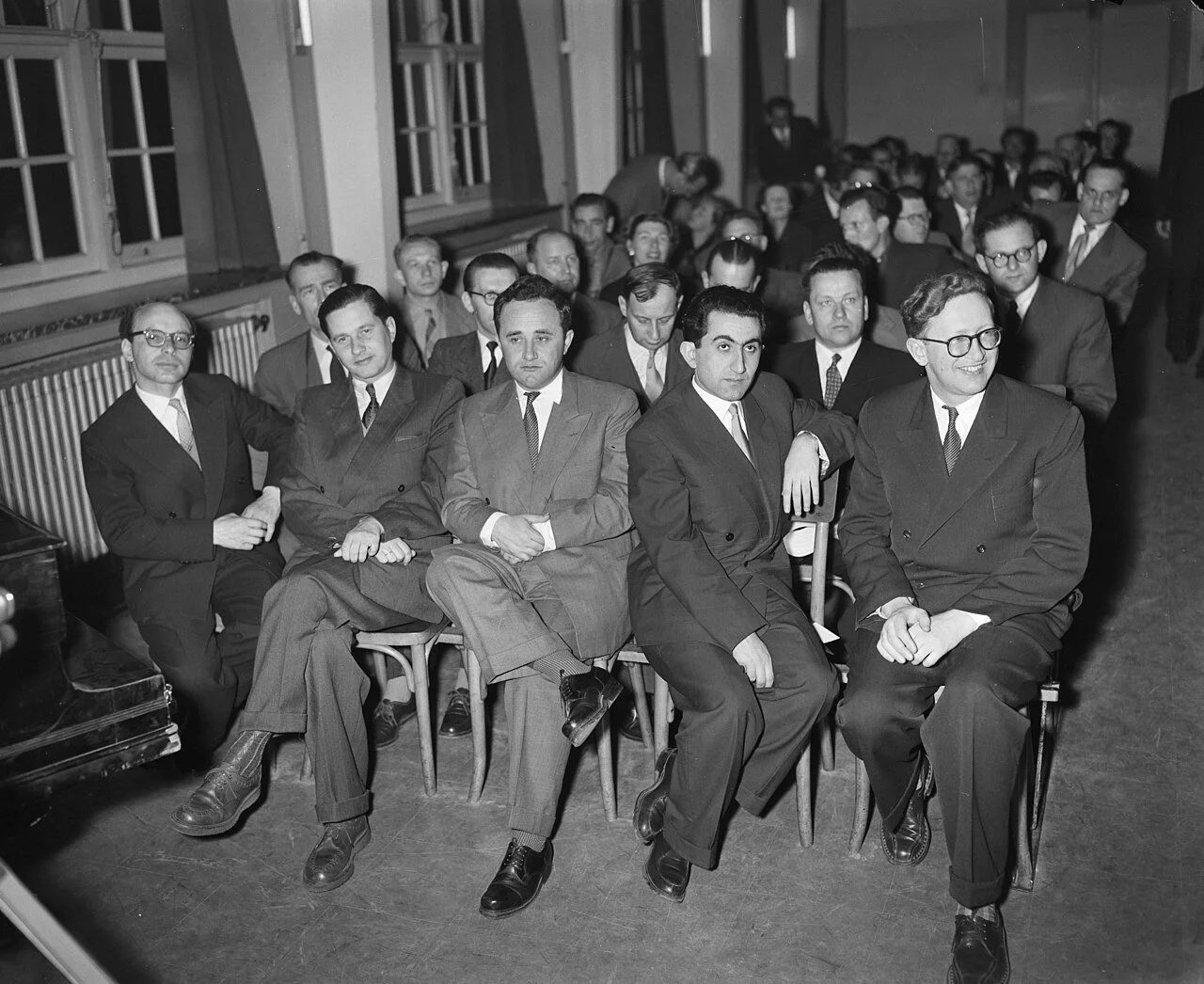
Tigran Vartanovich Petrosian, often rendered in English as Tigran Petrosyan and Petrosian, was born in Tbilisi on June 17, 1929, and died in Moscow on August 13, 1984. He was the ninth World Chess Champion, holding the title from 1963 to 1969 after defeating Mikhail Botvinnik, defending successfully against Boris Spassky in 1966, and then losing the return match to Spassky in 1969. Britannica’s capsule judgment remains apt: Petrosian’s play was subtle, patient, and directed toward the gradual weakening of an opponent rather than immediate destruction. That description, though concise, captures why his historical standing has remained unusually secure even when his public image has been less vivid than that of Tal, Fischer, or Kasparov.
Petrosian deserves close attention because he occupies a distinctive place in chess history. He was not merely a champion who happened to win the title in a strong era. He helped redefine elite defensive technique, prophylactic thinking, and match strategy. He was also a Soviet Armenian intellectual figure who consciously described himself, in a contemporaneous American interview, as “a Soviet Armenian,” a formulation that helps explain both his place inside Soviet institutions and his later symbolic role in Armenian chess culture.
Early Life and Chess Formation
Petrosian was born into an Armenian family in Tiflis, now Tbilisi. Official Russian and Georgian reference sources agree on the essentials of his early background: his father, Vartan, worked as a janitor, and Petrosian’s childhood was marked by poverty, loss, and wartime disruption. The Russian Chess Federation’s commemorative profile states that he lost his mother early and then his father, and that he began serious chess study at the Tbilisi Palace of Pioneers under Archil Ebralidze. The World Chess Hall of Fame likewise describes him as impoverished and orphaned during World War II.
The hardship was not decorative biography but formative experience. A later profile, indexed through Google’s archive of the 1969 illustrated magazine piece “Close-up: Tigran Petrosian,” records Petrosian’s own recollection of sweeping streets as a weak, embarrassed boy during the war years. Modern ChessBase coverage of the same interview reproduces the memory in brief and situates it within the wartime period, when he was struggling to survive. This evidence does not by itself explain his future chess style, but it does make a restrained inference reasonable: the stoicism, economy, and dislike of unnecessary risk for which he later became famous were not developed in comfort.
His chess education was also unusually coherent. Petrosian learned the game young, and FIDE’s museum biography places the start at age eight. More important than the exact age was the shape of his instruction. The Georgian Encyclopedia preserves Petrosian’s own retrospective hierarchy of influences: “My first instructor was Life itself,” then Archil Ebralidze, and then Capablanca and Nimzowitsch. The Russian Chess Federation similarly emphasizes Ebralidze’s admiration for Capablanca and Petrosian’s lifelong attachment to the Cuban champion. That combination helps explain the core of Petrosian’s chess formation: positional cleanliness from Capablanca, prophylactic structure from Nimzowitsch, and a distrust of ornament for its own sake.
His route to the center of Soviet chess passed through both Yerevan and Moscow. The World Chess Hall of Fame notes that after a strong showing in the 1946 Georgian Championship he moved to Yerevan, where he won the Armenian Championship in 1946 and 1947, and then went to Moscow for stronger competition. Britannica adds that he became a chess master in 1947. These details are enough to establish the pattern: Petrosian was shaped in Tbilisi, consolidated in Armenian chess, and completed by the much harsher competitive ecology of Moscow.
Rise in Competitive Chess
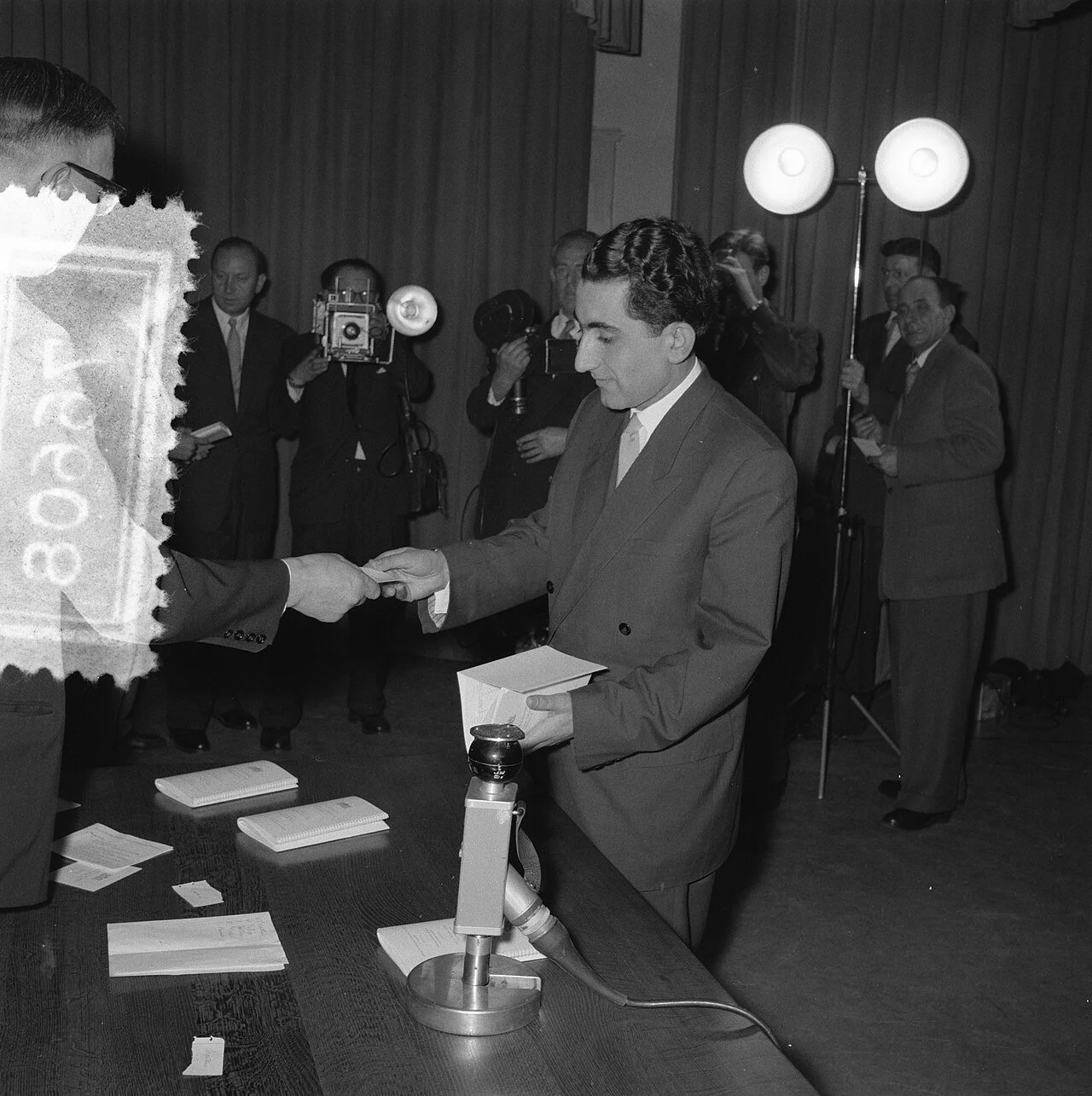
Petrosian’s rise was not meteoric in the Tal sense, nor explosive in the Fischer sense. It was incremental, but by the early 1950s it had clearly reached world level. The World Chess Hall of Fame notes that he eventually qualified for eight Candidates cycles over his career, while FIDE’s museum summary records that, before his victory at Curaçao in 1962, he had already appeared in three Candidates tournaments. This repeated qualification is significant. It shows that Petrosian was not a one-cycle champion but a permanent presence at the summit across decades.
The turning point in public reputation came when his solid style ceased to look merely cautious and began to look strategically superior. The Russian Chess Federation’s profile stresses his two Soviet Championship victories in 1959 and 1961, noting his positional understanding, endgame technique, and defensive mastery. By the time of the 1962 Candidates in Curaçao, he had become the kind of player for whom a lack of losses was not a statistical curiosity but an organizing principle. Official Russian and FIDE summaries both emphasize that he won Curaçao without losing a game.
That matters for historical interpretation because Curaçao clarified what Petrosian’s style was for. In tournaments, his reserve could attract criticism. In a long qualification event and then in World Championship match conditions, the same reserve became an instrument of control. Petrosian’s ascent therefore did not involve abandoning his natural style. It involved proving that the style could rule the highest level.
Major Career Achievements
Petrosian’s greatest competitive achievement was the 1963 World Championship match in Moscow, where he defeated Botvinnik by 12½ to 9½. OlimpBase’s championship record gives the score, and FIDE’s museum summary notes the match score in terms of decisive games, with Petrosian dethroning Botvinnik by five wins to two with fifteen draws. The result ended what the World Chess Hall of Fame calls the Botvinnik era, which had lasted fifteen years.
He then defended the title successfully against Boris Spassky in 1966, again in Moscow. OlimpBase records the final score as 12½ to 11½, and the World Chess Hall of Fame notes the larger historical point: Petrosian became the first reigning champion since 1934 to beat his challenger in a title defense. That is one reason his championship tenure should not be reduced to a brief interruption between Botvinnik and Spassky. His reign was earned in one match and confirmed in another.
The 1969 return match with Spassky ended his reign, but not his stature. OlimpBase records Spassky’s 12½ to 10½ victory. FIDE and Russian federation sources both stress that Petrosian remained active and dangerous long after the title was gone. He won the Soviet Championship four times in total, in 1959, 1961, 1969, and 1975, and he was still strong enough to share first in the Rio de Janeiro Interzonal of 1979, at age fifty, according to the Russian Chess Federation profile.
His team record is among the most impressive on record for any world champion. The World Chess Hall of Fame states that while representing the Soviet Union on ten Olympiad teams he lost only once, compiling 79 wins, 50 draws, and 1 loss. The Russian Chess Federation repeats the same total and presents it as one of his signature records. This was not only accumulation. It indicates extraordinary repeatability under team pressure and against elite opposition over two decades.
A lesser-known but telling late achievement was his victory over the young Garry Kasparov at Tilburg in 1981. Both FIDE’s museum biography and the World Chess Hall of Fame single out that result as a memorable late-career success. It is easy to romanticize such episodes, but this one earns mention because it shows that Petrosian’s style remained competitive even against the generation that would soon replace the postwar Soviet elite.
Style and Reputation
Petrosian’s own statements are the best place to start. FIDE’s museum preserves two of his compact formulations. In one, he calls chess “a game by its form, an art by its content, and a science by the difficulty of mastering it.” In another, he says he is “absolutely convinced” that in chess “there is nothing accidental,” and that he believes only in “logical and correct play.” These are not decorative aphorisms. They correspond very closely to the structure of his games, which often look like practical demonstrations of risk control, strategic overprotection, and slow constriction.
Contemporaries understood that his reputation as a defender was only part of the story. Max Euwe gave the famous image of Petrosian as a “python” or a “crocodile,” waiting and then constricting. Smyslov described him as especially dangerous in counterattack. Tal called him a “defensive virtuoso” and a deep psychologist. Fischer said Petrosian saw and eliminated danger twenty moves in advance. Karpov said he could create combinations as well as Tal, though he concealed that gift beneath positional play. Spassky went even further, saying that Petrosian was essentially a strategist but “inherently a tactician.” Taken together, these comments show a remarkable consensus: Petrosian was not a passive player hiding behind caution, but an active master of latent force.
This is why the well-known 1966 queen sacrifice against Spassky in Game Ten deserves brief mention even in a non-analytic profile. FIDE’s archive highlights it not because it was his everyday method, but because it dramatized something his contemporaries already knew: Petrosian’s tactical power was real, sudden, and often underestimated because he preferred to keep it hidden until the position justified it. The historical point is reputational, not combinational.
Later champions recognized the depth of his defensive contribution. Vladimir Kramnik called him “the first defender with a capital D,” arguing that Petrosian showed how almost any position contains hidden defensive resources if approached with enough precision and psychological calm. That judgment is especially valuable because it comes from a modern elite player whose own chess owed much to technical defense and positional elasticity. The line from Petrosian to later prophylactic and resource-conscious chess is not literal imitation, but it is historically real.
There was, however, a limit to the style. Britannica notes that against comparable opposition he played many draws. Douglas Griffin’s summary of Petrosian’s loss to Fischer in the 1971 Candidates final points to a recurring late-career problem: under certain conditions, his instinct for safety could become too willing to simplify and too reluctant to seize transient attacking chances. That criticism should not be exaggerated, but it is fair. Petrosian’s great strength, especially in matches, could, in some tournament- and momentum-driven contexts, become a real competitive constraint.
Contributions Beyond Tournament Play
Petrosian’s importance was not confined to over-the-board results. Britannica notes that after becoming world champion, he continued postgraduate philosophical study in Yerevan and in 1968 published Chess and Philosophy. A separate academic reference work that cites Soviet dissertations identifies his 1968 candidate dissertation as Some Problems of the Logic of Chess Thought. Those titles fit the public image he presented of himself: a player for whom chess was not only competitive labor but also an object of disciplined reflection.
He also played a visible institutional role in Soviet chess journalism. The Russian Chess Federation says that he wrote many articles, opened his own chess school, and was an excellent teacher. Another official Russian Federation page, in a profile of Alexander Roshal, states that the weekly 64 was reestablished in 1968 on the initiative of the then-world champion Tigran Petrosian, with Roshal serving as executive secretary. Petrosian later became identified with the publication as editor-in-chief. That editorial role is historically important because 64 was one of the central public organs of Soviet chess culture.
His literary afterlife also reflects the esteem in which his instructional voice was held. Google Books metadata for Petrosian’s Legacy explains that, before his death, he had been preparing lectures, notes, and broadcasts for publication as a book, and that his widow, Rona Petrosian, worked to recover tapes and transcripts after his death. FIDE’s museum lists Petrosian’s Legacy alongside the Vasiliev biography and the later Karolyi and Gyozalyan volumes as standard references for studying him. In other words, Petrosian was remembered not only for games chosen by later admirers. He remained present through his own analytical and didactic voice.
Historical Legacy
Petrosian’s historical legacy operates on at least three levels, all centered on him rather than on general Soviet mythology. First, he remains one of the strongest match players in chess history, a champion who turned risk prevention into a positive weapon. Second, he became a symbol of Armenian excellence within a Soviet framework without surrendering that identity. His 1973 interview remark, “I am a Soviet Armenian,” was not a slogan created by later nationalism. It was his own way of naming the dual setting in which he lived and worked.
Third, his title had a concrete cultural afterlife in Armenia. The Wall Street Journal wrote that the country “caught the chess bug” on May 20, 1963, when Petrosian dethroned Botvinnik. This should not be read as meaning that Armenian chess began with him, since it plainly did not. It is better read as a concise description of scale. Petrosian’s championship transformed Armenian chess from a respected practice into a mass cultural reference point. That interpretation is reinforced by the later memorial economy built around his name, including official FIDE documentation stating that, in 2018, Armenia placed him on its 2,000-dram banknote.
He is sometimes less celebrated in popular memory than more visibly dramatic champions. That relative neglect has historical causes. Petrosian’s greatest skill was often preventing events that spectators prefer to see. Yet the testimony of Euwe, Tal, Spassky, Fischer, Karpov, and Kramnik shows an elite consensus that his chess was not bloodless at all. It was simply organized at a deeper strategic level, where the highest art lies in making the opponent’s intended game impossible.
Notes and Sources
This profile uses Petrosian, the most common English spelling, while noting that major English reference works also use Petrosyan and Russian sources use Петросян. The factual core here rests on a mixture of primary or near-primary material and authoritative reference work: the 1969 magazine profile indexed by Google Books, the 1973 Chess Life & Review interview, official institutional summaries from FIDE, the Russian Chess Federation, the World Chess Hall of Fame, and the Georgian Encyclopedia, together with result verification from OlimpBase and Britannica’s biographical entry.
For further reading, the most useful modern book-length studies identified by FIDE’s museum are Viktor Vasiliev’s Tigran Petrosian: His Life and Games, Tibor Karolyi and Tigran Gyozalyan’s two-volume Tigran Petrosian Year by Year, and Petrosian’s own posthumous Petrosian’s Legacy. Edward Winter remains especially useful for checking quotations and reputational myths, while Douglas Griffin is valuable for translated Soviet commentary and match context.
A concise historical assessment follows naturally from the evidence. Petrosian deserves attention today not because he was merely “hard to beat,” but because he expanded the intellectual vocabulary of top-level chess. He showed that defense could be creative, that prophylaxis could be aggressive in effect, and that a champion’s authority could rest on logic, restraint, and hidden tactical force rather than spectacle alone. For readers interested in serious chess history, he stands as one of the clearest demonstrations that control can be as original as attack.
