Boris Spassky
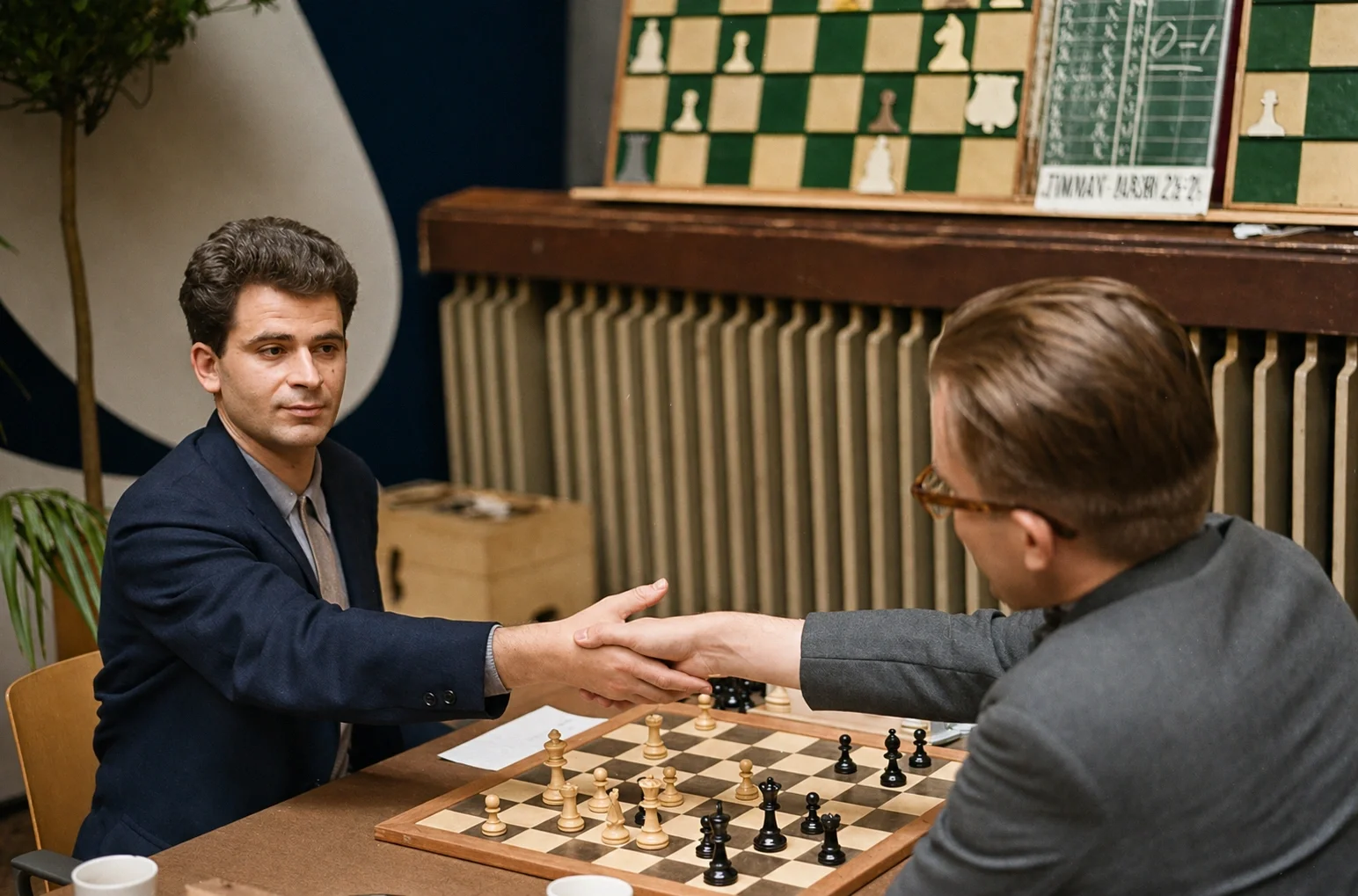
Spassky and Bent Larsen
Boris Vasilievich Spassky, born in Leningrad on January 30, 1937 and dead in Moscow on February 27, 2025, was the tenth World Chess Champion and one of the strongest bridge figures between the classical Soviet school and the later, more fully universal style of elite chess. His record includes the 1955 World Junior title, the grandmaster title at age eighteen, a Candidates debut at nineteen, the world championship in 1969 after two title matches against Tigran Petrosian, and continued top-level relevance into the late 1970s and beyond. Official FIDE and World Chess Hall of Fame materials, together with major obituaries and specialist commentary, place him securely among the great champions, even though public memory has often reduced him to the man Fischer dethroned in Reykjavík.
The consensus of authoritative chess commentary is that Spassky’s defining trait was universality. FIDE described him as the “first genuinely universal player,” Vladimir Kramnik called him “the first truly modern universal player,” and Svetozar Gligorić, as quoted by AP, emphasized his extraordinary capacity to adapt to different opponents’ styles. That reputation was not static. He began as an aggressive prodigy, then, under changing coaching influences and repeated failures in qualification cycles, developed into a more rounded player whose openings, middlegames, and endings formed an unusually integrated whole.
His historical importance extends beyond championship results. Spassky helped preserve or popularize several opening systems at the highest level, gave model demonstrations of how positional pressure could flow into tactical resolution, and embodied the cultural and political tensions of Soviet chess during the Cold War. He was also a figure of unusual poise in public, remembered for sportsmanship, wit, cosmopolitan instincts, and a later life shaped by emigration, illness, archival loss, and contested narratives about his final decades. The main gaps in scholarship still concern his French years, the fate of his personal archive, and the extent to which Soviet institutions shaped both his career and the post-1972 memory of it.
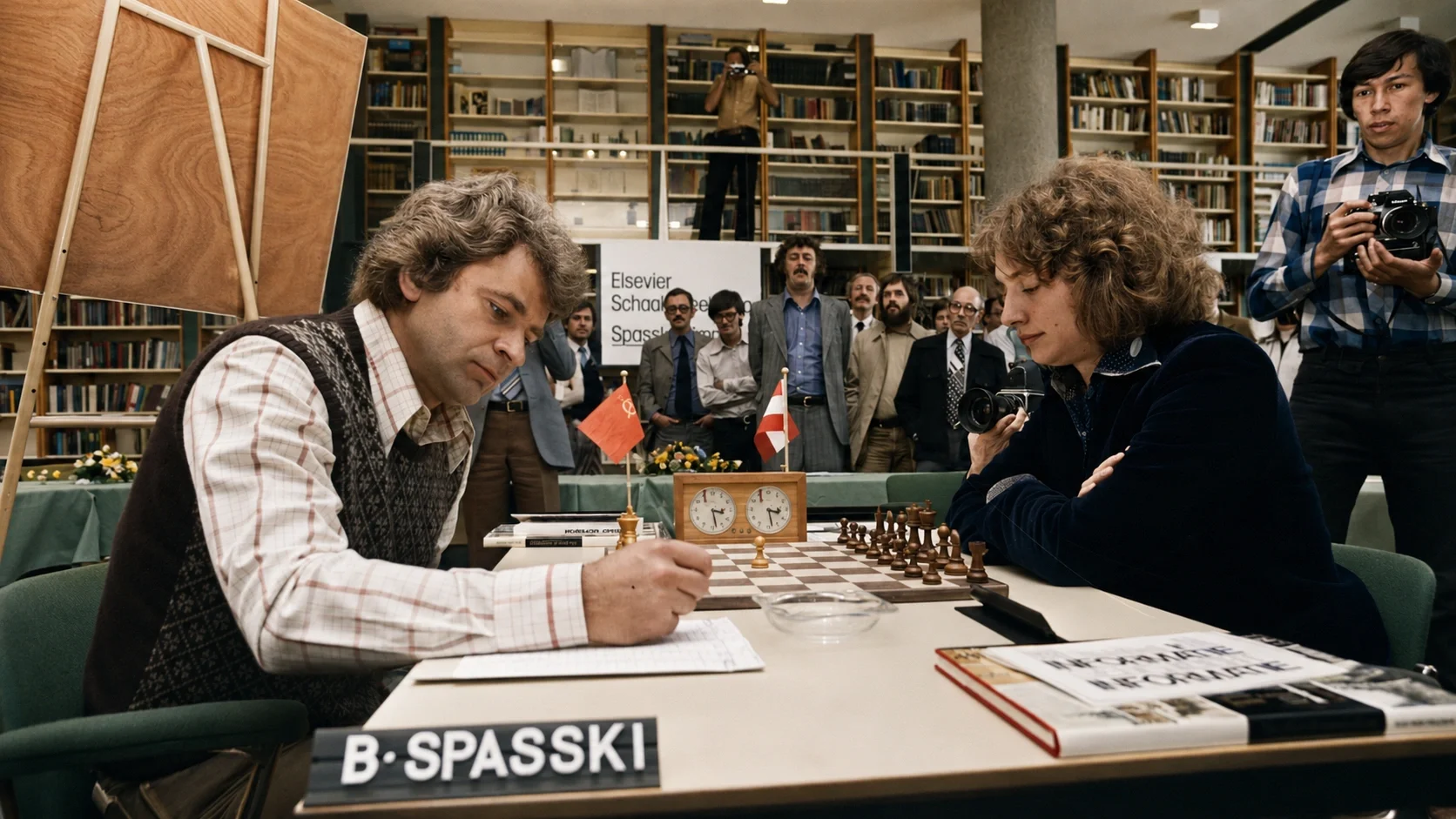
Koen Suyk / Anefo, CC0, via Wikimedia Commons
Biography and Career Trajectory
Spassky’s childhood was marked by war and displacement. Born during the Stalin era in Leningrad, he first encountered chess at about age five while being evacuated from the city during the Siege of Leningrad. After the war, he became absorbed in the game through the chess pavilion in the city’s Central Park and then the Leningrad Palace of Pioneers, where the coach Vladimir Zak recognized his talent. Leonard Barden’s obituary records that Spassky defeated Mikhail Botvinnik in a simultaneous exhibition at age ten, became the youngest Soviet master at fifteen, won the World Junior Championship at eighteen, and, in 1955, became the youngest grandmaster to that date. FIDE’s obituary likewise presents him as a prodigy who reached grandmaster level at eighteen and the Candidates at nineteen.
His ascent was not linear. FIDE notes that after his 1956 Candidates debut he missed the next two world championship cycles, while Barden describes key qualification failures in 1958 and 1961, together with a period of overstrain, personal disruption, and official discipline after the 1960 World Student Team Championship. Those reverses seem central to understanding Spassky’s maturation. Barden’s account also stresses the importance of two very different trainers: Alexander Tolush, who encouraged a more tactical attacking style, and later Igor Bondarevsky, whose calmer strategic influence helped turn Spassky into the broad, all-round player associated with his peak years.
His later life moved through several national and institutional settings. After Moscow’s harsh reaction to the 1972 loss, his second marriage collapsed, and in 1976 he left the Soviet Union with his third wife, Marina Shcherbachova, later becoming a French citizen in 1978. He represented France in Olympiads during the 1980s. In the 2016 Sport-Express interview, translated on Chess.com, Spassky retrospectively said that he emigrated because he wanted the freedom to choose tournaments and because Soviet authorities had repeatedly blocked invitations; he also linked that decision to a burglary he believed was politically tinged. Because that explanation comes from late personal recollection rather than archival proof, it is best treated as evidence of how Spassky himself interpreted his break with the Soviet system. He returned to Russia in 2012 under disputed circumstances after serious health problems, and died in Moscow in 2025.
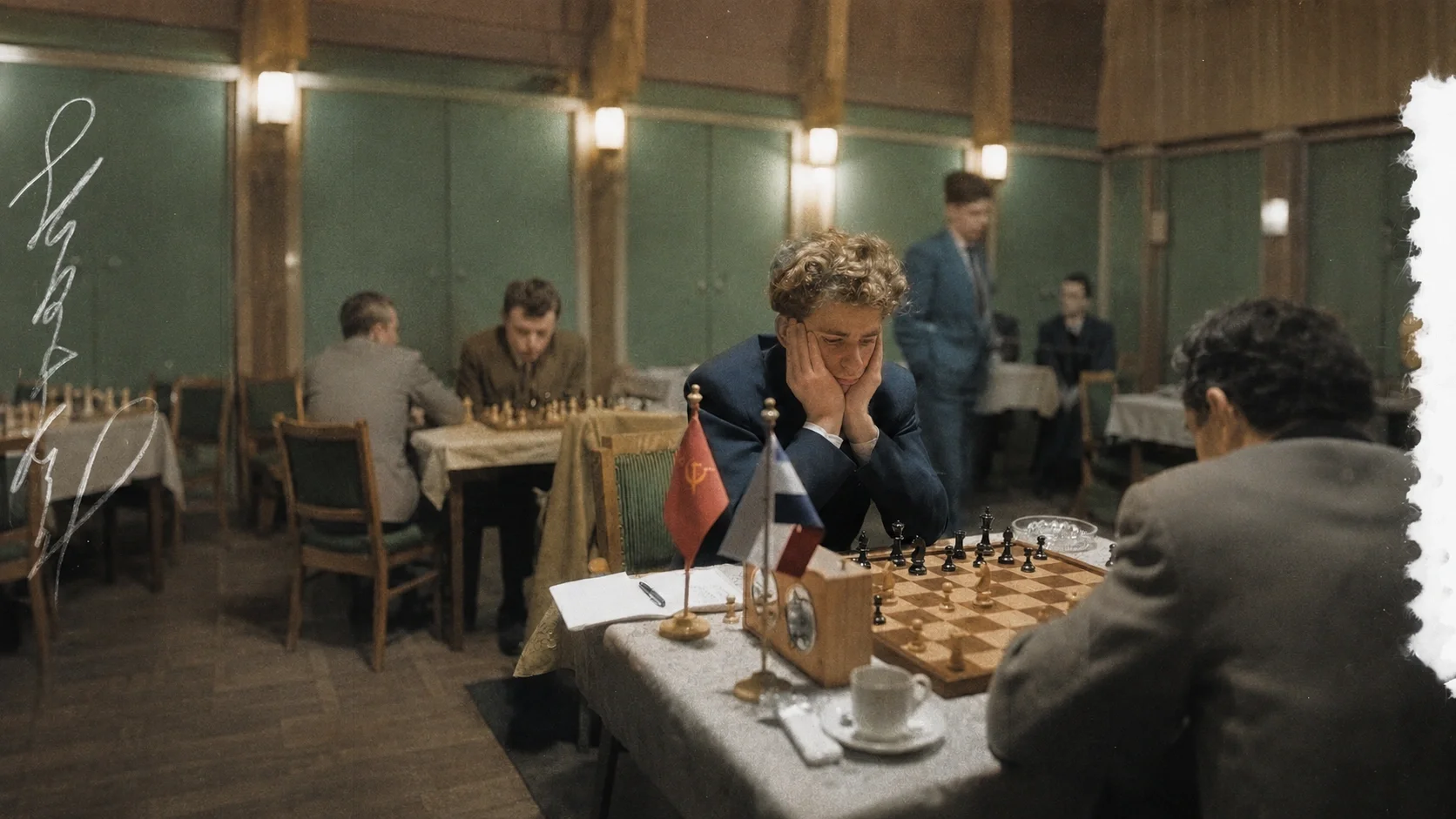
Spassky in 1956, the Netherlands
Competitive Achievements and High-Level Matches
Spassky’s formal achievements were elite by any standard. He was World Junior Champion in 1955, tied for third in the 1956 Candidates, won the Soviet Championship outright in 1961 and 1973, tied for first in the Soviet Championship in 1956 and 1963 before losing play-offs, and appeared in seven Candidates competitions between 1956 and 1985, winning the 1965 and 1968 cycles. World Chess Hall of Fame materials and FIDE history place him among the most persistent contenders of the postwar era, not a champion who emerged suddenly from one isolated cycle.
His world-title path is especially significant. FIDE records that he defeated Paul Keres, Efim Geller, and Mikhail Tal in the 1965 Candidates matches, lost the 1966 world championship match to Petrosian by one point, then returned to win the next Candidates cycle and dethrone Petrosian in Moscow in 1969 by 12½ to 10½. In 1972 he lost the title to Bobby Fischer in Reykjavík by 12½ to 8½ in the match that became the most famous world championship contest in chess history. FIDE’s obituary describes that match as one of the most iconic in chess, while the World Chess Hall of Fame identifies the 1969 title as the culmination of roughly fifteen years at world-class level.
Outside the title matches, he remained a premier competitor. Barden identifies 1965 to 1970 as his peak period, noting his victory at Santa Monica in 1966 and his strong results against Fischer before Reykjavík. FIDE’s obituary says he later reached the Candidates semifinal in 1974 and final in 1977. The World Chess Hall of Fame highlights his first notable classical win over Fischer at Mar del Plata in 1960, and Barden notes that he stayed in the world top ten into the late 1980s. He also played seven Olympiads for the USSR, winning thirteen team and individual medals and scoring 69 points from 94 games, then played three Olympiads for France on first board after naturalization.
His rating record is slightly less straightforward than his match record because early FIDE rating archives are sparse. The FIDE museum history page states that on the first official FIDE rating list, published in 1971, Spassky was second in the world on 2690, behind Fischer’s 2760; the specific month is unspecified in that cited page. This is important for perspective: Spassky was a sitting world champion whose standing among contemporaries was fully elite, even though he did not lead the first official list.
Style, Evolution, and Theoretical Contribution
The most reliable descriptions of Spassky’s style converge strongly. The World Chess Hall of Fame describes an early “hyper-aggressive brilliance” that matured into “seamless universality.” FIDE, as quoted by AP, called him the “first genuinely universal player,” and Kramnik’s judgment on the FIDE museum site is even sharper, calling him the first truly modern universal player whose games reward close study. In practical terms, that universality meant real competence in all phases, flexible adaptation to opponents, and a manner of play in which strategic development and tactical resolution were tightly connected.
The evolution behind that style can be traced through coaching and match strategy. Barden writes that Tolush pushed Spassky toward a more combative attacking approach, while Bondarevsky helped him become a calmer, all-round strategist. The same obituary quotes Spassky’s own retrospective distinction between the 1966 and 1969 Petrosian matches: in the first he attacked too directly, in the second he shifted to a slower, more cumulative method. That self-description aligns closely with later assessments that his greatest strength lay in harmonizing initiative, positional logic, and timing rather than in forcing every game into one preferred mode.
On opening theory, the strongest recent expert summaries say that Spassky was influential more as a practical theoretician than as a systematic analyst in the Botvinnik mold. ChessBase’s Dorian Rogozenco, as quoted in its Spassky course materials and review, explicitly says the opening was not Spassky’s strongest area and that he was “not a theoretician or opening innovator” in the narrow sense. Yet those same sources credit him with a wide and sometimes aggressive repertoire, major expertise in the Ruy Lopez with both colors, and the popularization or high-level rehabilitation of systems such as the King’s Gambit, the Closed Sicilian, and the Nimzo-Indian Leningrad Variation. Chess.com’s study of the latter directly links the variation’s name to Spassky and his Leningrad coach Vladimir Zak.
That combination is central to Spassky’s theoretical legacy. His contribution was not primarily a single canonical novelty or school of analysis. It was a body of model practice showing that classical structures, gambit play, and flexible transpositions could be handled at the highest level through understanding rather than encyclopedic memorization. ChessBase’s King’s Gambit survey notes his long, unusually successful attachment to that opening, while its Spassky review argues that he habitually chose openings he understood deeply and that led to middlegames suited to his temperament. In middlegame theory, his games became exemplars of coordinated development, timing of initiative, and the fusion of strategic pressure with tactical finish. In endgame study, later evaluators such as Karsten Müller and ChessBase’s reviewers stress that he was a genuinely strong endgame player, which helped justify the label “universal.”
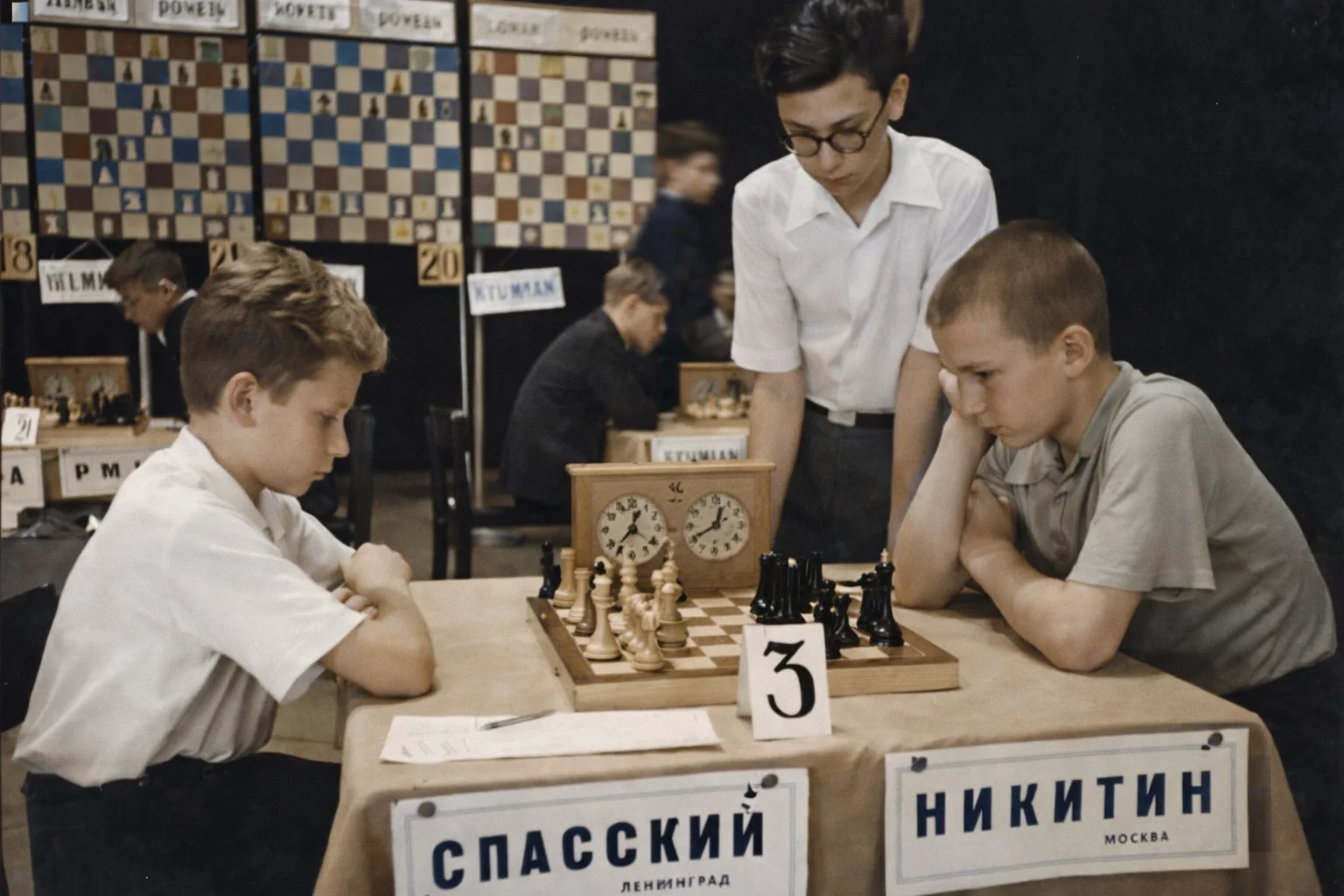
Boris Spassky and Alexander Nikitin
Public Image, Personal Life, and Soviet Political Context
Spassky’s public image combined elegance, polish, and unusual sportsmanship. Barden describes him as cultured, handsome, calm, athletic, ironic, and articulate. Reuters highlighted the episode in Reykjavík where he applauded Fischer after losing the famous sixth game, and AP quoted a recollection in which Spassky said, “Our chess kingdom does not have borders.” These features gave him a public identity distinct from the caricature of a rigid Soviet functionary. Even during the Cold War’s symbolic peak, his own language often suggested a more cosmopolitan and less doctrinaire outlook than the media scripts surrounding him.
At the same time, his career cannot be understood outside Soviet political culture. World Chess Hall of Fame material on the 1972 match says the contest “embodied” Cold War tension between the United States and the Soviet Union. FIDE’s obituary says the match drew unparalleled media coverage, major global outlets, a record prize fund of $250,000, and, according to FIDE, some 50 million viewers. Broader scholarship on Soviet sport reinforces why that burden was so heavy. Michael A. Hudson’s dissertation frames Soviet chess as a tool of Party and state, while James Riordan’s work, as summarized by JSTOR, notes that in the USSR a world chess champion was effectively a political office. Spassky’s own 2016 recollection that the championship years were his unhappiest and came with “colossal responsibility” fits that interpretive context closely.
His personal life intersected repeatedly with those structural pressures. Barden reports three marriages and three children, with the breakdown of his second marriage following the 1972 defeat and his third marriage leading into emigration. AP and later obituaries note that he returned to the USSR from Reykjavík to a cold reception and became, in official eyes, a disappointment. The World Chess Hall of Fame and FIDE museum records then mark a real second career in France, including French citizenship and Olympiad representation, followed by declining activity and health. His later identity was therefore layered: Soviet prodigy, world champion, French-based grandmaster, Russian returnee, and elder statesman of the game.
Historiography, Controversies, and Lasting Significance
The main historiographical problem in Spassky’s case is disproportional memory. The World Chess Hall of Fame biography opens by observing that he is still most famous for losing to Fischer, then immediately argues against that reduction. Barden’s obituary reaches a similar conclusion, saying that despite Reykjavík’s career-defining weight, history is likely to regard him as a great champion whose harmonious style joined grace and power. Edward Winter’s commentary, as reflected in search summaries from Chess Notes, captures another persistent scholarly intuition: Spassky produced many “immortal” games, yet his brilliance could feel so natural and unforced that it became oddly harder to monumentalize than the more singular styles of some rivals.
Several controversies also require clear framing. The first is the 1972 title match itself. AP’s contemporary archive shows the pre-match disputes over prize money, apologies, cameras, delays, and forfeits; Spassky later told Sport-Express that Soviet officials had instructed him to protest and leave, while he chose to continue, a decision he later called mistaken. The second is the 1992 Fischer rematch in Montenegro and Belgrade. Barden records the score, 5 losses, 10 defeats, and 15 draws from Spassky’s perspective, while later academic work has treated the event as an attempted breach of sports sanctions in Yugoslavia. The third is his 2012 return from France to Russia, which remains clouded by conflicting accounts involving illness, family dispute, and alleged mistreatment. In each case, the available record is substantial, though not fully settled.
His influence on later generations is unusually well attested. Kasparov called him his first chess idol and later praised his willingness to mentor younger players. Reuters reports Karpov calling Spassky one of his idols as well. Kramnik’s recommendation that Spassky’s games deserve study for both improvement and aesthetic pleasure shows that his influence was technical as well as commemorative. The World Chess Hall of Fame also notes the spillover of his games into popular culture, including the famous borrowing of one of his combinations for From Russia with Love. The public and scholarly images therefore converge on a figure whose authority extended beyond isolated results into pedagogy, style, and cultural memory.
There are, however, real gaps for future research. English-language writing still overweights Reykjavík and underweights his 1950s formation, his French competitive years, his Olympiad career, and his relations with Soviet institutions after 1972. A second gap concerns the personal archive. In 2016 Spassky said he feared losing his chess archive in France and mentioned unfinished manuscripts, including one on a major match, which suggests that unpublished material once existed outside the standard public source base. A fuller scholarly biography would ideally combine Soviet sports archives, French federation records, period journalism in Russian and French, and whatever survives of Spassky’s private papers.
Spassky’s lasting significance lies in the quality and breadth of his chess, and in the way his life reveals the opportunities and costs of Soviet chess greatness. He was a champion of very high practical strength, a stylist of uncommon balance, and a public figure whose grace often outlasted the ideological scripts imposed on him. For primary or near-primary sources, the best starting points are FIDE’s obituary and historical pages, the World Chess Hall of Fame’s Spassky entry and 1972 exhibition materials, AP’s historical 1972 excerpts, and the translated 2016 Sport-Express interview. For modern book-length studies, useful starting points include Alexey Bezgodov and Dmitry Aleynikov’s Spassky’s Best Games from New In Chess, Tibor Karolyi’s two-volume Quality Chess biography on Spassky, Zenón Franco’s Spassky from Everyman Chess, and Raetsky and Chetverik’s Boris Spassky Master of Initiative.
