Isaac Boleslavsky
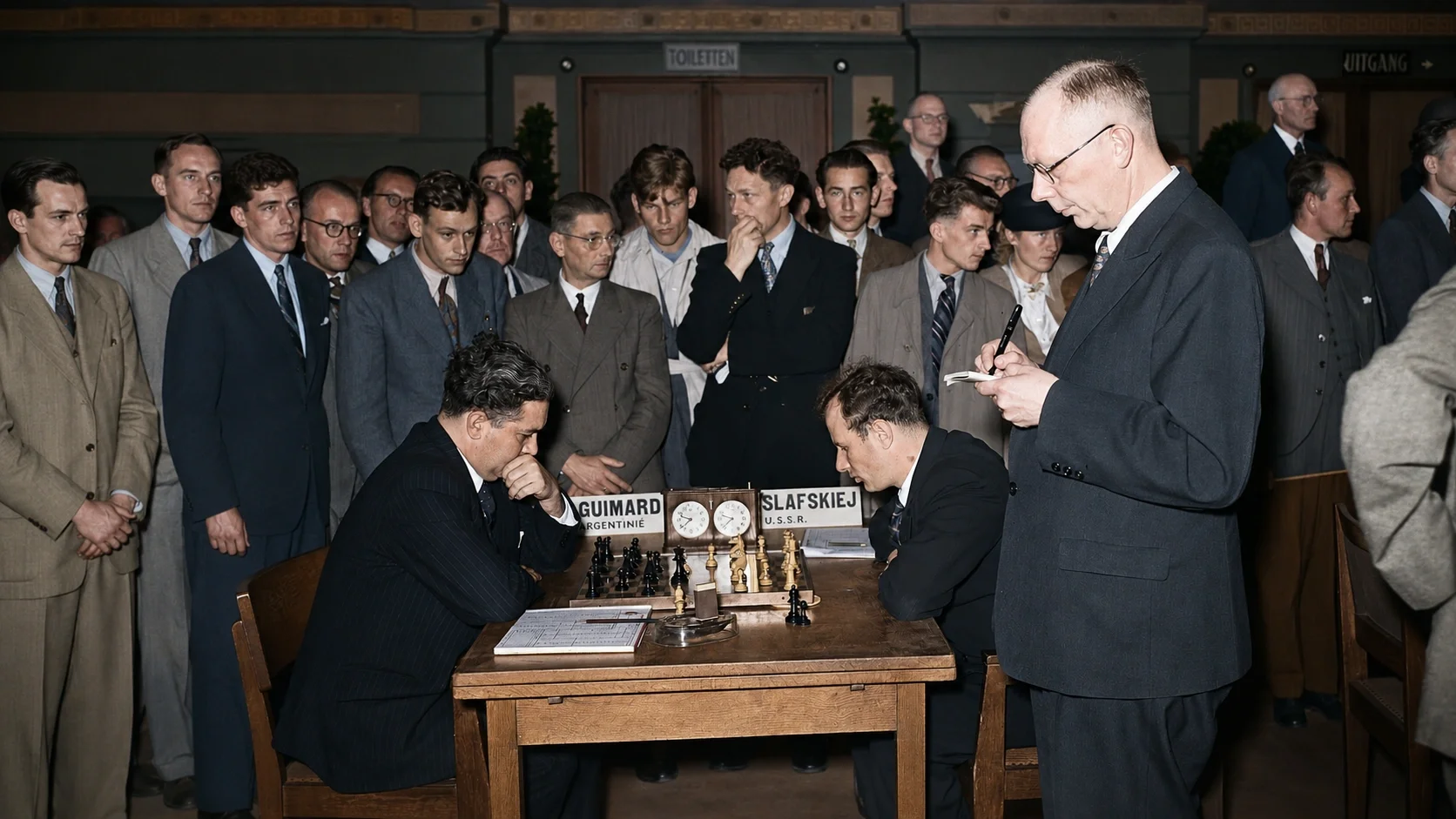
Isaac Boleslavsky (Isaak/Yefremovich in common transliterations) was one of the key Soviet grandmasters whose peak years (late 1930s through the mid‑1950s) coincided with the USSR’s consolidation of global chess dominance. Born 9 June 1919 in Zolotonosha and later based in Minsk, he came closest to a World Championship match by sharing first place in the inaugural Candidates Tournament 1950, then losing the playoff to David Bronstein.
Boleslavsky’s historical importance rests on a highly unusual combination: (1) elite competitive results in the hardest Soviet and FIDE events of his generation; (2) lasting theoretical influence—especially the Sicilian structures associated with …e5 (the “Boleslavsky hole”) and a named Sicilian line (“Boleslavsky Variation”); and (3) long-term service as a high-level trainer/second inside the Soviet system, notably in support roles connected to Tigran Petrosian and the Soviet team program.
A critical caveat for corpus-level claims is that major public databases do not agree on the size of his surviving game record: for example, one large public index reports 885 games (1938–1971), while another reports 748 games (1940–1971). These discrepancies are typical for pre-digital-era players (duplicates, exhibition/rapid inclusions, incomplete archival coverage).
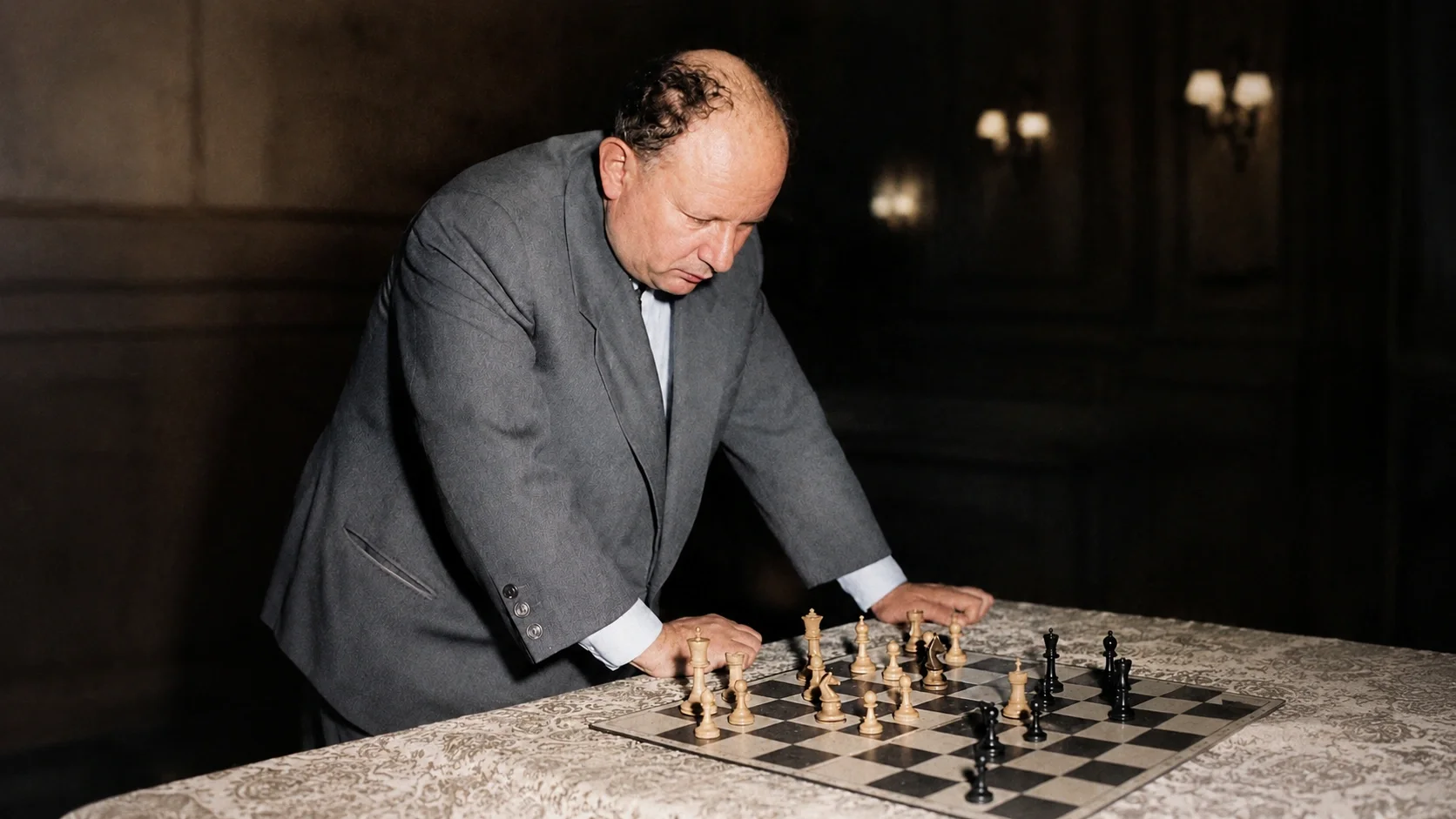
Biography and movements
Boleslavsky was born in Zolotonosha (then within the Soviet Union) and grew up in Soviet Ukraine; multiple standard references describe him as Jewish and trace his early chess formation to the Ukrainian Soviet chess environment.
His education is unusually well documented for a Soviet grandmaster: a mid-century Soviet instructional text reports that he graduated from the philological faculty of Sverdlovsk university (wartime evacuation patterns help explain why sources sometimes associate him with different institutions/cities).
After the war and his emergence into the top Soviet tier, Boleslavsky’s life becomes strongly associated with Minsk and the Belarusian chess scene; multiple biographical references place his later life and death there. He died in Minsk on 15 February 1977 (age 57) according to a widely used synthesis reference; however, at least one official chess federation biography gives a conflicting late‑1977 date, and a major commercial player database lists a different February day—so the exact day should be treated with archival caution unless verified via an obituary or state record.
Family details are partly recoverable from secondary compilations: one commonly repeated point is that his daughter Tatiana (born 1946) later married David Bronstein, linking two leaders of the post-war Soviet generation as family as well as colleagues.
Competitive chess career and results
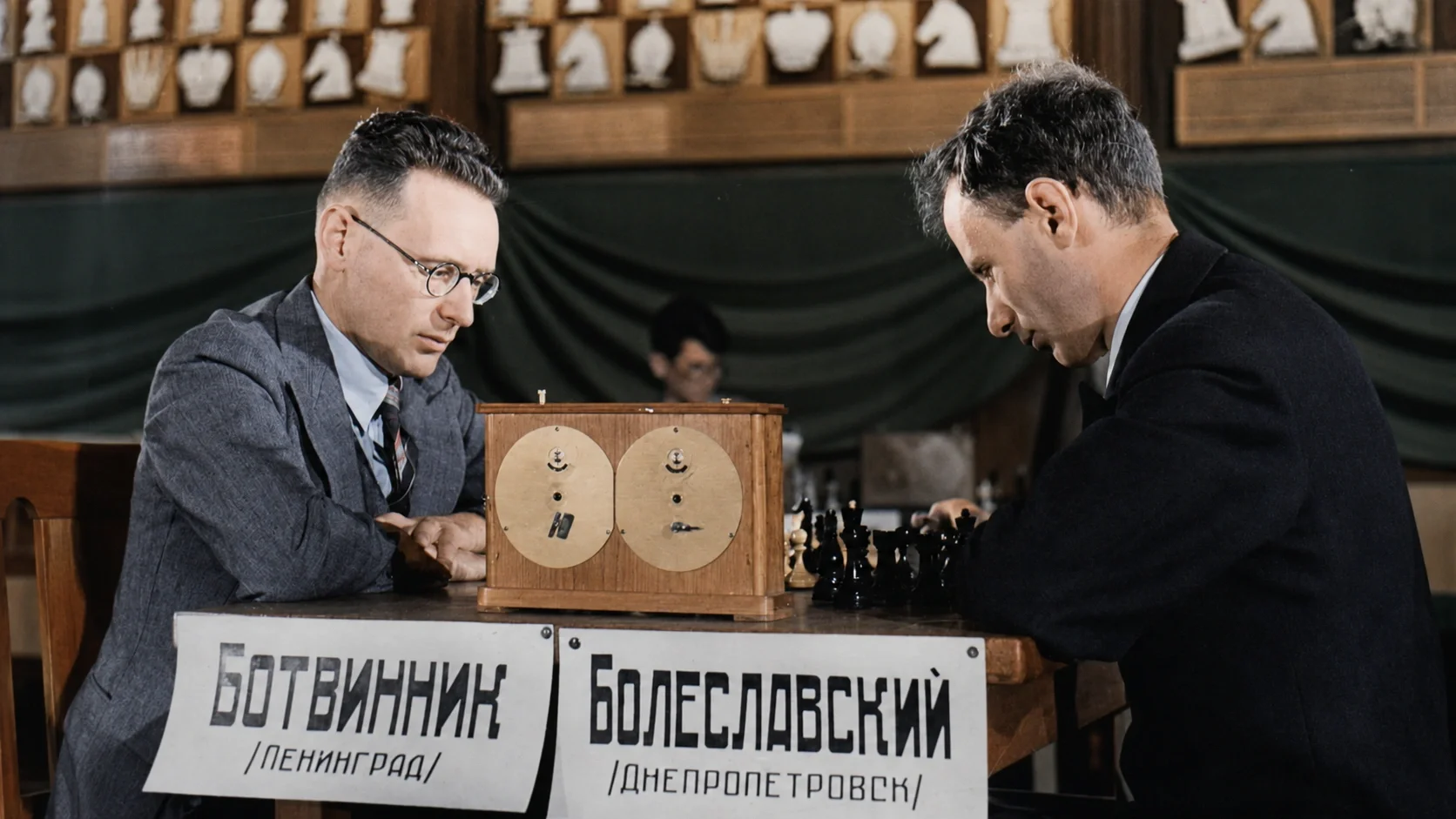
Boleslavsky’s competitive record is best understood as a sequence of “Soviet proving grounds” → “World Championship cycle contender” → “selective later appearances + coaching focus.”
In the USSR’s internal hierarchy, he achieved high placements in the most competitive national events. For example, a major tournament record shows him scoring 11.5 points in the 1940 USSR Championship final in Moscow (placing among the leaders alongside top Soviet names).
Internationally, he became a leading contender in the early FIDE cycle structure. He qualified through the 1948 interzonal stage (Saltsjöbaden) into the Candidates and, at Budapest 1950, shared first with Bronstein—an event later surrounded by persistent controversy about Soviet-player coordination and “managed” outcomes (a claim echoed in later historical commentary, including a ChessBase historical article, and contested in tone by other accounts).
Team competition provides one of the clearest statistical snapshots of his practical strength. At the 10th Chess Olympiad, he scored 7/8 from a reserve role; OlimpBase’s individual statistics list this as an 87.5% result.
Boleslavsky received the International Grandmaster title in 1950 among the inaugural awardees under FIDE’s then-new title system.
On the post-1970 FIDE rating scale, his documented peak in standard lists is 2560 in July 1971 (his highest FIDE-published figure in the sources consulted here).
Opening theory contributions
Boleslavsky Variation in the Sicilian
The opening label “Boleslavsky Variation” is commonly attached to a Classical Sicilian structure featuring an early …e5 push, typically expressed (one canonical move order) as:
e4 c5
Nf3 d6
d4 cxd4
Nxd4 Nf6
Nc3 Nc6
Be2 e5
This line is explicitly named for him in standard references on openings named after people.
The strategic heart of the variation is structural: Black gains space and tempo by driving the d4-knight, at the cost of weakening d5 and potentially accepting a backward d6 pawn. Modern structure taxonomies explicitly treat “the Boleslavsky hole” (d5 outpost and associated plans) as a recurring major pawn formation across several Sicilians and related openings.
The “Boleslavsky Hole” as a structural concept
The “hole” is less an opening trick than a strategic bargain: accept a potentially exploitable outpost (d5) in exchange for (1) space, (2) time, and (3) dynamic freeing breaks—especially …d5 at the right moment. Modern pawn‑structure summaries describe this formation and its thematic plans and explicitly attach Boleslavsky’s name to the concept.
The “Boleslavsky Wall” and the King’s Indian approach
In King’s Indian structures, Boleslavsky’s name is also attached to a pawn “wall” configuration arising after …exd4 and …c6, producing a characteristic central zone in which Black seeks dynamic counterplay while living with a potentially weak d6 pawn. A reference taxonomy notes its formation and attributes its naming to Hans Kmoch, whose classic pawn-strategy book is available in a 1959 English edition and earlier German editions.
Boleslavsky is frequently grouped with a cohort of Ukrainian-born Soviet masters—Bronstein, Efim Geller, and Alexander Konstantinopolsky—credited with transforming the King’s Indian Defense from a suspicious sideline into a mainstream elite defense beginning in the late 1930s.
Training roles and seconding
An official federation biography in English states that he trained the Soviet Olympiad team from 1958 to 1970 and acted as coach/second to Petrosian from 1959 to 1969, specifically linking him to Petrosian’s world-title successes (1963 and 1966 cycles). These claims, while plausible within Soviet coaching practice, should ideally be cross-checked against match-day rosters or memoir literature to ensure full academic rigor.
Publications and archival footprint
Boleslavsky’s publication footprint exists in three layers: (1) his own Soviet-era selected-games and instructional contributions; (2) later Soviet biographical compilation work (notably by a disciple); and (3) English-language translation/curation work.
A Soviet-era Selected Games volume is cataloged in Russian bibliographic records, and later English-language editions are described as translations/editions of this Soviet selected-games material.
A major biography is attributed to Alexei Suetin; Russian library exhibition materials list the book’s bibliographic details (publisher and year), and the descriptions emphasize that it compiles Boleslavsky’s theoretical investigations, annotations, and even some unpublished archival materials.
A separate bibliographic record shows Boleslavsky as a co-author (with Igor Bondarevsky and others) on a published treatment of a Petrosian–Spassky match cycle (a common Soviet practice: seconds and analysts producing official match books).
Legacy, assessment, and controversies
Boleslavsky’s legacy is unusually “structural” for a player: his name persists not only in an opening-variation label but in two widely discussed pawn formations (“hole” and “wall”) that anchor modern strategic teaching.
From a purely results-based standpoint, his 1950 Candidates performance and 1952 Olympiad score place him among the most impactful Soviet players of the transition into the FIDE-era world-cycle chess.
The largest enduring controversy concerns the integrity of the 1950 Candidates’ finish and the extent to which Soviet player coordination influenced the final standings. A ChessBase historical piece summarizes the allegation through later admissions attributed to Bronstein; this claim coexists with more charitable portrayals emphasizing sporting honor, and it remains a topic in which a rigorous historian would consult memoirs, contemporaneous press, and archival documents rather than relying on a single retrospective narrative.
Finally, the archival record shows a nontrivial uncertainty even for basic biographical metadata (death date), with major chess references disagreeing. This is not unusual for Soviet-era sports figures and underscores the value of obituary retrieval or civil record verification in any publication that aims for “primary-source grade” biography.
